

By July 2026, the volume of attempted cyberattacks in the UAE surged to 800,000 daily incidents. This reality proves that basic security is no longer a choice; it's a matter of corporate resilience. Implementing robust dlp for google workspace is the frontline defense for any enterprise handling sensitive data within the cloud ecosystem. You've likely felt the frustration of paying for high-tier Enterprise Plus licenses only to be buried under false positives that disrupt your team's workflow. It's exhausting to try and map technical detectors to the strict requirements of the UAE Personal Data Protection Law (PDPL) without a clear roadmap.
This guide provides the strategic framework to transform your security from a restrictive bottleneck into a managed defense that automates compliance and eliminates insider threats. We'll explore the architecture of a leak-proof environment, from advanced data discovery and classification to the technical measures required by UAE regulators to ensure your long-term digital relevance. By moving beyond native detectors toward a risk-based architecture, you can secure your corporate ecosystem while maintaining the momentum of your business operations.
Key Takeaways
- Understand the critical shift from perimeter-based security to a data-centric model designed for the 2026 cloud-first enterprise landscape.
- Discover how to leverage unified policy engines and Optical Character Recognition (OCR) to secure sensitive data across Gmail, Drive, and Chat.
- Learn to map your dlp for google workspace configuration to UAE PDPL requirements using custom detectors for Emirates IDs and local financial formats.
- Identify the strategic differences between native Google licenses and managed solutions to overcome alert fatigue and high operational costs.
- Explore how integrating human expertise with technical infrastructure transforms raw security alerts into actionable, compliant business intelligence.
The Strategic Importance of DLP for Google Workspace in 2026
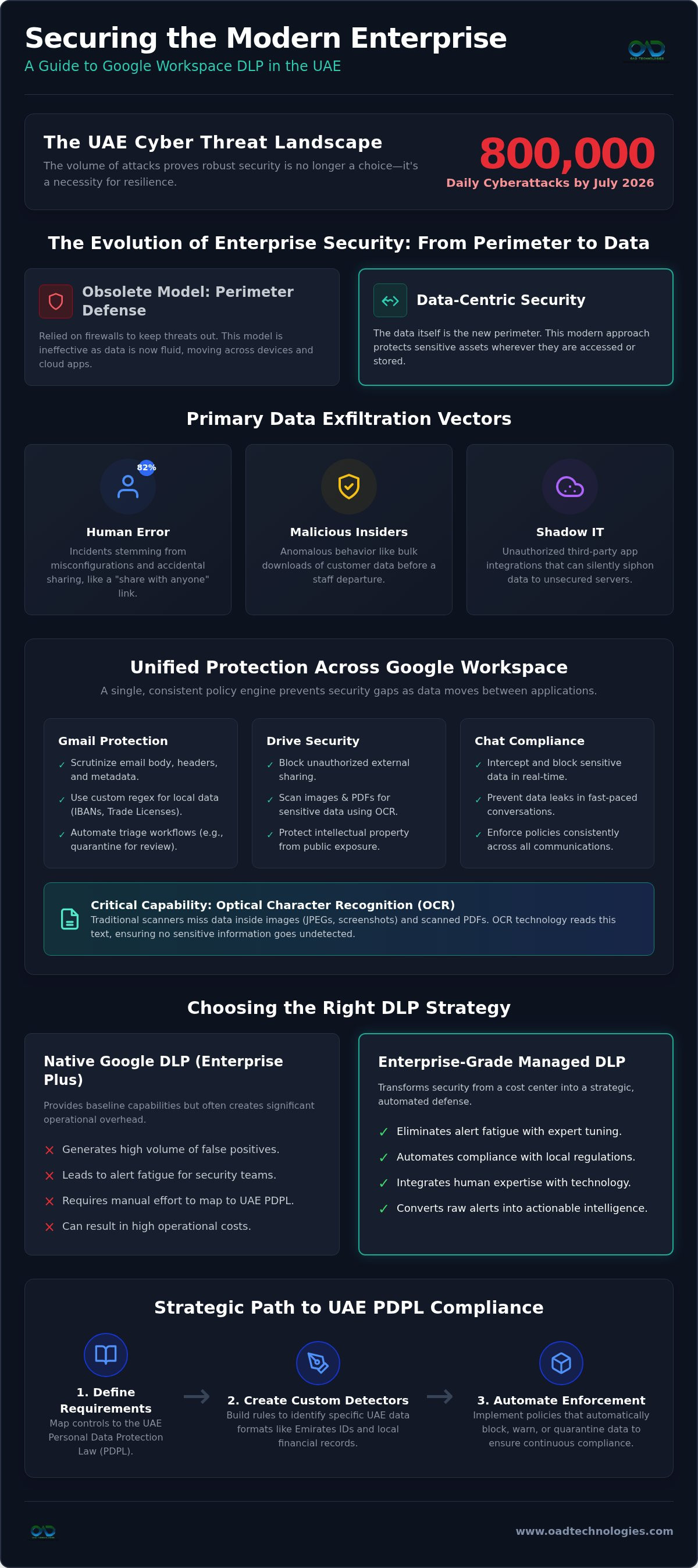
In a cloud-first ecosystem, Data Loss Prevention (DLP) has evolved from a secondary compliance checkbox into the core of the security stack. The old model of perimeter defense, which relied on firewalls to keep threats out, is obsolete in 2026. Data is now fluid, moving between Gmail, Drive, and mobile devices at light speed. For modern enterprises, dlp for google workspace provides the granular visibility needed to track this movement. It ensures that sensitive assets remain protected regardless of where they're accessed or who is accessing them. This shift toward data-centric security acknowledges that the data itself is the new perimeter.
The stakes for UAE organizations are higher than ever. By July 2026, the volume of cyberattacks against regional targets reached 800,000 daily incidents. This surge, combined with the rising financial burden of data recovery, means that native security features aren't just a luxury. They're a baseline requirement for survival. Businesses that fail to prioritize data-centric security risk more than just technical downtime; they risk their very viability in a market that increasingly demands absolute data sovereignty.
Understanding Data Exfiltration Vectors
Human error remains the most persistent vulnerability. Research indicates that 82% of cloud security incidents stem from misconfigurations and accidental sharing. A single "share with anyone with the link" click in Google Drive can expose intellectual property to the public web. Beyond accidents, malicious insiders pose a significant threat. DLP monitors for anomalous behavior, such as unauthorized bulk downloads of customer databases before a staff departure. Additionally, the proliferation of third-party apps within the Workspace ecosystem creates "Shadow IT" risks. Without oversight, these integrations can silently siphon data to unsecured external servers.
The Role of DLP in Business Continuity
Core Capabilities: Securing Gmail, Drive, and Chat
A fragmented security posture is a vulnerable one. The strength of dlp for google workspace comes from its unified policy engine, which provides a consistent layer of protection across the entire suite. This architecture prevents the security gaps that occur when data moves between applications. For instance, a policy designed to protect financial records remains active whether that data is stored in a Sheet, discussed in a Chat room, or attached to a Gmail thread. This holistic approach ensures that your security standards don't degrade as users collaborate across different tools.
Advanced features like Optical Character Recognition (OCR) are critical in this environment. Traditional text-based scanning can't see the data inside a JPEG or a flattened PDF. OCR bridges this gap, allowing the system to scrutinize images and scanned documents for sensitive patterns. In Google Chat, where communication is instantaneous, the DLP engine works in real-time to intercept and block snippets of sensitive data before they're transmitted. For organizations looking to refine these technical controls, partnering with a specialized integrator can help bridge the gap between software features and actual business results.
Gmail DLP: Beyond Content Compliance
Securing email requires looking beyond the body text when configuring dlp for google workspace. Since the expansion of DLP capabilities in Gmail, administrators can scrutinize envelope headers and metadata. You can choose between predefined detectors for global standards or use custom regular expressions (regex) to identify specific local data formats like IBANs or trade license numbers. When a policy is triggered, you don't just block the message. You can trigger triage workflows that send the email to a secure vault for review or educate the user with a custom warning message at the point of sending. This real-time feedback turns a security event into a training opportunity for your workforce.
Securing the Drive and Docs Ecosystem
The Drive ecosystem is often where the most significant data leaks occur due to overly permissive sharing settings. Managing "anyone with the link" risks is a priority for UAE enterprises aiming for PDPL compliance. By using automated classification, you can apply persistent labels to sensitive files that dictate their sharing permissions. This works most effectively when synced with Identity and Access Management (IAM). By combining DLP rules with strict IAM roles, you ensure that even if a file is accidentally shared, only authorized identities have the necessary permissions to interact with the content. This multi-layered defense is essential for maintaining a truly leak-proof cloud environment.
Native Google DLP vs. Enterprise-Grade Managed Solutions
Choosing the right tier for dlp for google workspace is a decision that balances technical capability with operational reality. While Enterprise Standard provides a foundational policy engine, Enterprise Plus is necessary to unlock advanced features like automated classification and the OCR capabilities discussed previously. However, simply owning the highest license tier doesn't guarantee security. Native tools are designed as broad-spectrum instruments. They often lack the surgical precision required to distinguish between a legitimate business process and a data leak in a complex, high-stakes environment. Noise hides danger.
The most pervasive issue with native implementations is alert fatigue. When a system generates hundreds of low-risk warnings daily, security teams naturally become desensitized. This operational friction often leads to policies being weakened or ignored entirely. There's also a significant visibility gap to consider. Google's native DLP is primarily ecosystem-locked. It can't effectively track data as it migrates across multi-cloud environments or into unmanaged third-party SaaS applications. Managed DLP bridges these gaps by providing a unified, risk-based architecture that looks beyond the Google border.
The Limitations of a 'Set-and-Forget' Approach
Static rules fail against evolving social engineering tactics. Attackers don't just steal data; they manipulate users into bypassing technical controls. A "set-and-forget" configuration quickly becomes obsolete as business workflows change and threat actors adapt. Maintaining an effective defense requires constant policy tuning to reduce false positives and ensure that legitimate communication isn't blocked. This is where Managed Detection and Response (MDR) becomes indispensable. It complements your DLP alerts with human intelligence, ensuring that every flag is investigated with context rather than just being a line item in a log file.
Evaluating Third-Party DLP Integrations
For organizations operating in the UAE, the cost-benefit analysis of security goes beyond license fees. You must weigh the price of a subscription against the value of a managed service that ensures compliance with national laws. Multi-cloud organizations often benefit from integrating a Cloud Access Security Broker (CASB) alongside their Google Workspace environment. This provides a centralized management layer, allowing you to enforce consistent data sovereignty rules across your entire infrastructure. Investing in a managed solution isn't just about adding more software. It's about securing a partnership that protects your long-term digital relevance through expert-led integration and proactive defense.
Implementation Strategy: Mapping Rules to UAE Compliance
Aligning dlp for google workspace with the UAE Personal Data Protection Law (PDPL) requires more than just enabling standard PII detectors. While Google provides global templates, UAE enterprises must configure custom regular expressions to identify local identifiers accurately. This includes the 15-digit Emirates ID number and UAE-specific IBAN formats used by local financial institutions. By implementing these specific detectors, you ensure that automated data processing complies with Federal Decree-Law No. 45 of 2021, which mandates strict technical measures to prevent unauthorized data transfers. It's not just about stopping leaks; it's about meeting the specific legal definitions of protected data within the Emirates.
Data residency remains a critical pillar for sensitive government and financial sectors within the region. While Workspace is a global cloud, you can use DLP policies to restrict data movement based on regional storage requirements. This ensures that high-value assets don't exit mandated jurisdictions, preserving national data sovereignty. For organizations navigating these complexities, OAD Technologies provides specialized system integration to bridge the gap between technical rules and legal mandates.
Compliance with UAE PDPL and ISR
The PDPL emphasizes data minimization, requiring that only necessary personal data is processed and stored. You can use dlp for google workspace rules to automatically identify and purge stale sensitive data, reducing your overall risk surface. In the event of a security incident, your DLP logs provide the forensic evidence required for regulatory breach notification. This technical alignment is a core component of a broader Governance Risk and Compliance (GRC) strategy, ensuring your organization meets both national and international standards simultaneously.
The 5-Step Deployment Roadmap
Deploying DLP without disrupting business continuity requires a deliberate, phased approach. A sudden shift to restrictive modes can paralyze communication. Follow this structured roadmap for a smooth transition:
- Phase 1: Data Discovery. Identify where sensitive UAE PII lives across your Drive and Gmail accounts to understand your baseline risk.
- Phase 2: Policy Auditing. Run your rules in 'audit-only' mode. This allows you to measure the impact and identify false positives without affecting users.
- Phase 3: Stakeholder Alignment. Communicate the upcoming changes to your workforce. Educate them on why certain data sharing is being restricted to reduce friction; for organizations that prioritize continuous professional development, you can discover Peradus Store to find relevant digital learning resources.
- Phase 4: Enforcement. Activate 'Block' and 'Quarantine' actions for high-risk data types once your rules are properly tuned.
- Phase 5: Continuous Optimization. Security isn't static. Use incident data to refine your rules and adapt to new business workflows as they emerge.
Managed DLP: Elevating Workspace Security with OAD Technologies
Effective security in the cloud operates under a shared responsibility model. While Google secures the underlying infrastructure, the burden of protecting the actual data resides with the enterprise. OAD Technologies bridges this gap by transforming dlp for google workspace from a static feature into a proactive managed defense. We recognize that raw alerts are meaningless without context. Our approach focuses on turning technical triggers into actionable intelligence, ensuring that your security team isn't chasing shadows but responding to genuine risks. As a Dubai-based partner, we possess an intimate understanding of the local regulatory climate, allowing us to align your technical controls with the specific nuances of the UAE market.
Our methodology emphasizes the critical synergy between data protection and active threat identification. By integrating DLP with Vulnerability Assessment (VAPT), we uncover the specific pathways an attacker might use to exfiltrate sensitive assets. This combination allows us to harden your environment from the inside out. We don't just set rules; we simulate breaches to ensure those rules actually hold under pressure. This rigorous engineering standard provides a level of assurance that native tools alone cannot replicate.
Customized Integration vs. Standardized Security
Standardized security often fails because it ignores the unique workflows of different industry verticals. A legal firm in the DIFC has vastly different data movement patterns than a logistics provider in JAFZA. OAD builds bespoke DLP policies tailored to your specific operational DNA. We act as a master designer of systems, working collaboratively as an extension of your internal IT staff. Our goal is to empower your team with sophisticated tools and expert oversight, enhancing their capacity to manage a complex dlp for google workspace environment without the need for constant, manual intervention.
Securing Your Digital Future
Data resilience is a journey, not a destination. Positioning DLP as a fundamental pillar of a Zero Trust Architecture ensures your organization remains viable as the threat landscape evolves toward 2027 and beyond. We provide a roadmap for long-term success, acting as the guardian of your digital relevance in an increasingly volatile market. By moving beyond quick fixes, we help you build a legacy of security that supports strategic expansion and innovation. To begin your transition from reactive monitoring to managed resilience, consult with OAD Technologies for a Strategic DLP Audit and secure your corporate ecosystem today.
Securing Your Corporate Ecosystem for 2027
The 2026 threat landscape demands more than just basic cloud filters. You've seen how a data-centric approach transforms dlp for google workspace from a restrictive toggle into a strategic asset. By mapping technical detectors to the specific requirements of the UAE PDPL and utilizing a phased deployment roadmap, you secure your organization against both accidental leaks and malicious insiders. This transition ensures that your security posture evolves alongside your business growth rather than acting as a bottleneck to innovation.
True resilience comes from a partnership that bridges the gap between infrastructure and compliance. OAD Technologies provides the Dubai-based expertise necessary to navigate the national regulatory landscape while integrating comprehensive MDR and GRC capabilities into your security stack. We act as a guardian of your ongoing digital relevance, ensuring your systems are built to endure. Secure Your Google Workspace with OAD's Strategic DLP Solutions today to ensure your corporate ecosystem remains resilient and compliant. Your data is your most valuable asset; it's time to protect it with the precision it deserves.
Frequently Asked Questions
Does Google Workspace have built-in DLP?
Google Workspace includes built-in Data Loss Prevention, but its availability depends on your specific license tier. It functions as a native policy engine that scans for sensitive data patterns across Gmail, Drive, and Chat. While these tools are integrated directly into the admin console, they require manual configuration to effectively identify and protect your organization's unique data assets.
Which Google Workspace editions include DLP features?
Native DLP is exclusively available in the Enterprise editions of Google Workspace. This includes Enterprise Standard and Enterprise Plus. If your organization currently utilizes Business Starter, Standard, or Plus plans, you don't have access to these built-in security features. Upgrading to an Enterprise tier is the first step toward implementing a native dlp for google workspace strategy.
Can DLP prevent users from downloading files to personal devices?
DLP can prevent unauthorized downloads when integrated with Context-Aware Access and endpoint management policies. While the DLP engine identifies the sensitive content within a file, the access levels determine if a user can download it based on their device's security status. This multi-layered approach ensures that sensitive data doesn't migrate to unmanaged personal devices or unsecured environments.
How does Google Workspace DLP handle encrypted files or password-protected zips?
The native DLP engine cannot inspect the contents of password-protected ZIP files or encrypted documents. When the system encounters these files, it marks them as "unscannable." You should configure your policies to treat unscannable content with caution, often by quarantining the files or blocking their transmission to external recipients until a security professional can verify the contents.
What is the difference between Google Workspace DLP and Content Compliance rules?
Content Compliance rules are legacy tools primarily focused on Gmail filtering through simple keyword matches or sender attributes. In contrast, DLP is a sophisticated, suite-wide engine that uses predefined detectors and machine learning to identify sensitive data like credit card numbers. It offers much deeper inspection capabilities, including OCR for images, making it the superior choice for modern data protection.
How do I reduce false positives in my DLP policies?
Reducing false positives requires a phased implementation approach. Start by running your rules in "audit-only" mode to observe how they flag legitimate business communication without blocking it. You can then refine your policies by adjusting detector confidence levels or creating custom regular expressions that exclude common, non-sensitive strings that frequently trigger incorrect warnings.
Is Google Workspace DLP compliant with the UAE Personal Data Protection Law (PDPL)?
Google Workspace DLP provides the technical framework necessary for UAE PDPL compliance, but it requires specific regional configuration. You must build custom detectors to identify UAE-specific PII, such as Emirates ID numbers and local bank formats. Simply enabling the default settings isn't enough to meet the rigorous standards of Federal Decree-Law No. 45 of 2021.
Can I use DLP to monitor sensitive data sharing in Google Chat?
You can use dlp for google workspace to monitor and secure communications within Google Chat. The engine scans both messages and shared files in real-time. If a user attempts to send sensitive information, the system can block the message instantly or warn the user, preventing data leaks in fast-paced, collaborative environments where accidental sharing is common.
Disclaimer
Content by OAD Technologies is for general informational purposes only and does not constitute professional or cybersecurity advice. No warranties are made regarding accuracy or completeness; reliance is at your own risk. OAD Technologies shall not be liable for any direct or indirect losses arising from use of this content.