

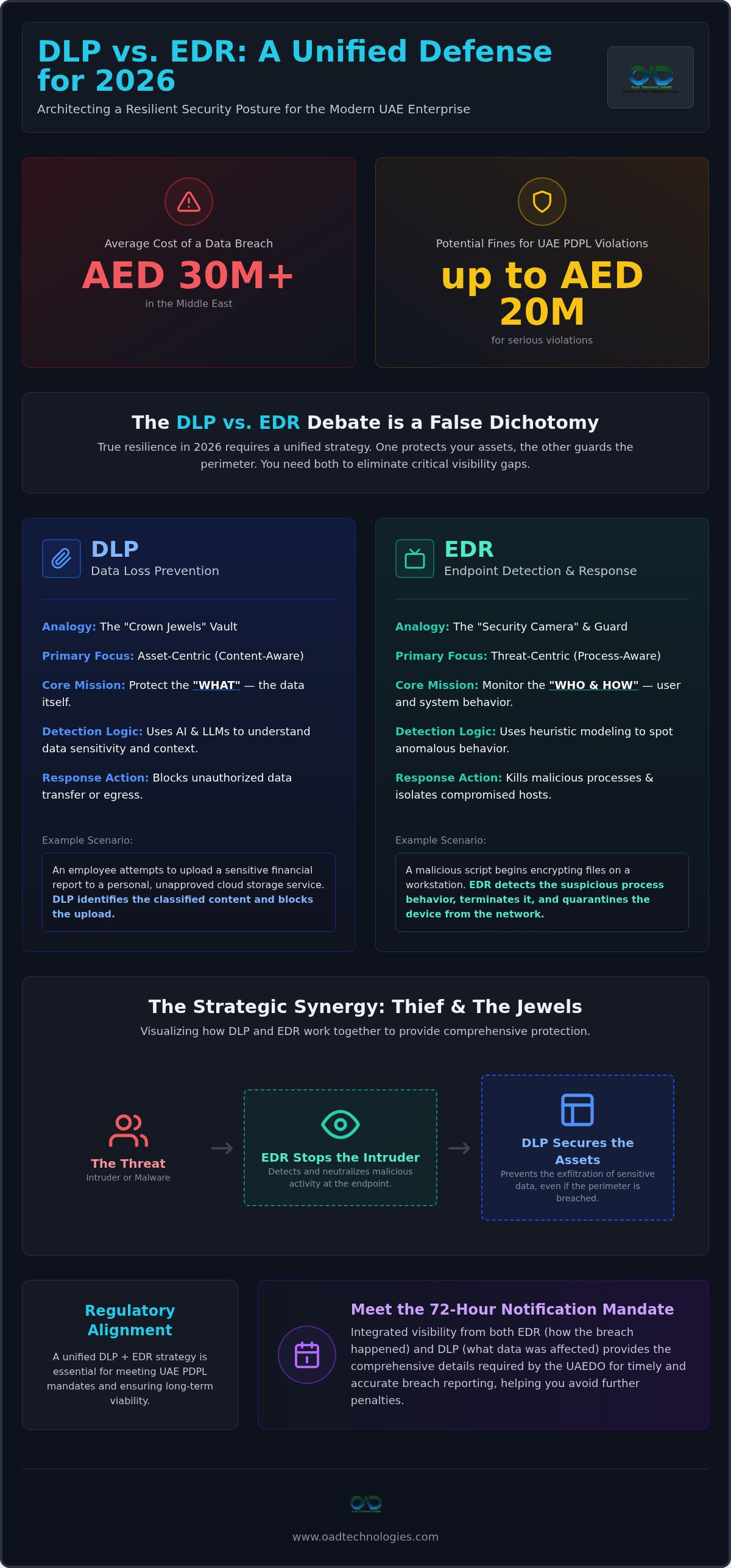
With the average cost of a data breach in the Middle East now exceeding AED 30 million, can your enterprise afford to treat data protection as a secondary thought? You've likely invested in various tools, yet the constant noise of false positives and visibility gaps in remote endpoints probably leave you feeling exposed. The debate of dlp vs edr often frames these technologies as competing choices, but in the high-stakes regulatory environment of 2026, choosing one over the other is a strategic gamble. Under the UAE PDPL, serious violations can lead to fines of up to AED 20 million, making a fragmented security stack a liability you can't ignore.
This article clarifies the critical distinctions between Data Loss Prevention and Endpoint Detection and Response to help you architect a truly resilient posture. We'll show you how to move beyond off-the-shelf software and toward a bespoke integration that protects the "what" and monitors the "who" simultaneously. You'll understand the essential synergies required to eliminate visibility gaps, satisfy the UAEDO's 72-hour notification mandate, and ensure your organization's long-term digital relevance.
Key Takeaways
- Understand the fundamental distinction between content-awareness in DLP and process-awareness in EDR to eliminate visibility gaps across your hybrid workforce.
- Recognize why the dlp vs edr debate is a false dichotomy; true resilience in 2026 requires a unified strategy where EDR stops the intruder and DLP secures the assets.
- Learn how to align your technical controls with the UAE PDPL to ensure your organization meets the 72-hour breach notification mandate and avoids heavy penalties.
- Discover the "Thief and the Jewels" analogy to better communicate complex security requirements to executive leadership and technical stakeholders alike.
- Evaluate why bespoke, integrated security architectures outperform standardized software by providing the long-term viability needed for the evolving UAE regulatory landscape.
Understanding the 2026 Security Landscape: DLP and EDR Defined
The 2026 security environment demands a departure from isolated tools. As enterprises transition to complex, hybrid infrastructures, the distinction between dlp vs edr becomes the foundation of a modern defense. We view these not as competing products but as two distinct lenses through which a "Master Designer" views risk. One protects the substance of your business; the other protects the environment where that substance exists.
DLP acts as the safeguard for your "Crown Jewels." It's an asset-centric discipline that prioritizes the sensitivity of the information itself. Conversely, EDR serves as the "Security Camera" for device and user behavior. It's a threat-centric discipline focused on identifying malicious activity before it can execute. Legacy definitions that treat these as standalone silos are now obsolete. Modern attackers don't just steal data; they subvert the very processes used to manage it, making a unified visibility strategy essential for survival.
The Asset-Centric Pillar: Data Loss Prevention
In a 2026 multi-cloud context, data isn't confined to a single server. It exists at rest in distributed databases, in motion across encrypted tunnels, and in use within volatile memory. Modern DLP has evolved beyond simple regex patterns. It now relies on automated AI classification to identify sensitive intellectual property or personal identifiers without human intervention. For UAE enterprises, this evolution is critical for maintaining "Data Sovereignty." Complying with the UAE PDPL requires knowing exactly where personal data resides across a fragmented cloud footprint, ensuring that your most valuable assets never cross unauthorized borders or fall into the wrong hands.
The Behavior-Centric Pillar: Endpoint Detection and Response
While DLP watches the data, EDR watches the system. It has become a behavioral analysis powerhouse capable of identifying "Living off the Land" (LotL) attacks. These sophisticated threats bypass traditional signatures by using legitimate administrative tools to conduct malicious activities. A comprehensive Endpoint Security Overview reveals that modern protection must monitor every process thread and system call. EDR is the primary tool for maintaining endpoint integrity against advanced ransomware. It detects the subtle behavioral shifts that signal an encryption event is imminent, allowing for automated isolation before damage spreads. This process-awareness ensures that even if an attacker gains entry, their ability to move or act is immediately neutered.
DLP vs EDR: 10 Critical Differences in 2026
The 2026 comparison of dlp vs edr reveals a fundamental divergence in operational philosophy. While both tools reside on the endpoint, their architectures serve different masters. DLP is built on a content-aware framework designed to inspect the payload and prevent unauthorized egress. EDR utilizes a process-aware architecture that monitors system calls and execution flows to isolate compromised hosts. Understanding these distinctions is the first step in moving from a reactive "patchwork" defense to a designed security posture.
Their response mechanisms provide a clear contrast in outcomes. If an employee attempts to upload a sensitive file to an unapproved personal cloud, DLP blocks the transfer based on data classification. If that same file is being encrypted by a suspicious background process, EDR kills the thread and isolates the workstation from the network. One stops the leak; the other stops the infection. This difference in scope is why a "DLP vs. EDR Explained" analysis, such as the one found at Xcitium, is vital for UAE enterprises navigating complex compliance mandates.
Detection Logic and Metadata Analysis
Legacy systems relied on rigid pattern matching, which often resulted in a high volume of false positives that exhausted security teams. In 2026, we've transitioned to Large Language Models (LLMs) to understand data intent. These models determine if a document contains sensitive UAE financial records or merely generic text, drastically reducing noise. EDR differs by using heuristic modeling to spot anomalies in behavior rather than content. While DLP struggles with the "context" of the data, EDR focuses on the "intent" of the process. Balancing these two requires a master's touch to ensure that security doesn't impede operational performance.
Operational Scope: Cloud, Network, and Endpoint
EDR’s scope is naturally limited to the device. It provides deep, granular visibility into the endpoint's activity but remains blind to data once it leaves that environment. Modern DLP must be broader, spanning SaaS applications and IaaS buckets. Integrating Cloud Security Posture Management (CSPM) with DLP allows for a unified view of data risks across your entire hybrid infrastructure. This synergy ensures your visibility doesn't stop at the office door. EDR complements this by securing the network layer during an active exfiltration attempt, acting as a final fail-safe. Architecting these interlocking systems is a complex engineering task. You can explore how we build bespoke security architectures to see how these tools work in harmony.
The Strategic Synergy: Why UAE Enterprises Need Both
Viewing the dlp vs edr debate as a choice between two standalone tools is a false dichotomy that leaves enterprises vulnerable. In 2026, resilience isn't found in a single product but in the synergy between behavioral monitoring and data protection. Think of it through the "Thief and the Jewels" analogy: EDR is the security team that catches the thief breaking into the building, while DLP is the vault and tracking system that ensures the jewels never leave the premises. Without EDR, the thief roams undetected; without DLP, the thief walks out with the assets. Integrating these layers reduces the Mean Time to Respond (MTTR) by providing high-fidelity alerts that combine process intent with data value. Orchestrating this complex relationship is where Managed Detection and Response (MDR) becomes the critical command center for your security operations.
Closing the Visibility Gap
EDR offers the "context" that legacy data protection tools often lack. It tells you who accessed a file, when they did it, and from where. As Yale University explains EDR, its primary function is collecting granular telemetry on system-level events to identify malicious patterns. However, EDR is often blind to the actual value of the files being touched. This is where DLP steps in to provide the "value" lens, identifying exactly what sensitive information is at risk. This visibility is further sharpened when integrated with Identity and Access Management (IAM), ensuring that behavioral anomalies are immediately linked to specific user permissions and roles within the UAE's strict regulatory framework.
Unified Incident Response
A modern security posture relies on a "Unified Response Playbook" where actions are coordinated across the stack. For instance, a high-severity DLP alert indicating unauthorized data movement should trigger an automated EDR host isolation. This prevents further lateral movement while analysts investigate the breach. Achieving this level of coordination requires robust SIEM integration to correlate disparate alerts into a single, actionable narrative. OAD Technologies designs these synergistic architectures to empower human analysts, providing them with the filtered, high-context data they need to make rapid, informed decisions in the face of sophisticated threats.
Regulatory Alignment: Mapping DLP and EDR to UAE Standards
The regulatory landscape in the UAE makes the comparison of dlp vs edr a matter of legal survival. Compliance with Federal Decree-Law No. 45 of 2021 (PDPL) requires technical controls that go beyond simple firewalls. DLP serves as the primary evidence for Governance Risk and Compliance (GRC) auditing by documenting every data movement. EDR fills the gap by providing the forensic telemetry required to meet the 72-hour breach notification mandate to the UAE Data Office (UAEDO). Without this behavioral trail, your GRC officer can't accurately report the scope of an incident.
For organizations operating within critical national infrastructure, these tools are essential for meeting NESA and ISR requirements. These standards demand rigorous technical protection for the nation's digital sovereignty. Implementing these layers ensures that your organization doesn't just meet the minimum bar but architects a posture capable of withstanding the scrutiny of national auditors.
Navigating PDPL and Data Localization
UAE data localization requirements demand that personal data stays within national borders unless specific legal conditions are met. DLP is your primary tool for monitoring cross-border transfers, while EDR ensures the integrity of the local environments where this data resides. In 2026, the penalties for failing to implement these required security measures are severe. Serious violations of the PDPL can result in fines of up to AED 20 million. This financial risk makes the synergy between detection and prevention a non-negotiable part of your digital strategy.
Continuous Compliance through VAPT
Static security policies don't account for evolving threats. Utilizing VAPT services is critical to validate that your integrated policies actually work. Penetration testing allows us to simulate exfiltration scenarios and test the response synergy between your detection layers. This verification is essential for UAE-based GRC officers who must provide empirical proof of control efficacy. To ensure your systems meet these national standards, book a technical security assessment with our engineering team today.
Architecting for 2026: The OAD Technologies Approach
Standardized, off-the-shelf software often creates a false sense of security while burying your team in alerts. In the UAE's high-stakes regulatory environment, a "plug-and-play" approach to dlp vs edr is a recipe for operational friction and visibility gaps. OAD Technologies acts as the Master Designer of your digital resilience, moving beyond simple tool deployment to create integrated systems that reflect your specific business risks. We don't just sell software; we engineer architectures that ensure your security posture is an asset rather than a bottleneck.
Our approach begins with a deep understanding of your data flow and threat surface. We reject one-size-fits-all solutions in favor of customized frameworks that align with your long-term strategic goals. This commitment to engineering standards ensures that your investment provides a measurable return through reduced risk and improved operational performance.
Customized Integration vs. Standardized Tools
Standardized tools often lead to "DLP fatigue," where security teams become desensitized to a constant stream of false positives. This noise can cause genuine threats to go unnoticed while simultaneously hindering employee productivity. We solve this through bespoke policy tuning that understands the context of your data. As a system integrator deeply rooted in the UAE national security landscape, we ensure your controls are precise. Our focus remains on long-term viability, utilizing rigorous VAPT services to validate every configuration. This engineering-first mindset ensures that your security stack evolves alongside your business, providing a stable foundation for growth.
Securing Your Digital Relevance
The transition to AI-driven autonomous security operations requires more than just new algorithms. It demands a partner who can bridge the gap between high-level innovation and practical business results. We position ourselves as that partner, guarding your digital relevance in an ever-changing market. While technology provides the capacity for defense, human insight remains the essential guide for strategic decision-making. Our architectures empower your people, providing them with clear, actionable intelligence rather than raw data. This synergy between human expertise and technological power is what defines a truly resilient UAE enterprise. To begin your transformation, we recommend a tailored security stack assessment to identify your current maturity level and map a path toward a unified, compliant future.
Securing Your Enterprise Future through Strategic Integration
The landscape of 2026 doesn't permit visibility gaps or fragmented toolsets. You've seen that the strategic choice of dlp vs edr isn't a competition but a foundational partnership. By aligning content-aware protection with behavioral monitoring, your organization meets the rigorous demands of the UAE PDPL while maintaining operational momentum. Relying on standardized software often results in analyst fatigue and missed threats; true resilience requires a master designer's touch to bridge the gap between innovation and practical results.
As UAE-based GRC and technical security specialists, OAD Technologies provides the engineering standards needed for bespoke integration and national compliance. We help you move beyond quick fixes by architecting comprehensive MDR and SIEM synergy into your core security posture. This approach ensures your systems empower your people rather than just replacing processes.
Take the next step in your security evolution. Consult with OAD Technologies for a Strategic DLP vs EDR Assessment and ensure your digital relevance remains protected in an ever-changing market.
Frequently Asked Questions
What is the primary difference between DLP and EDR?
The fundamental distinction in the dlp vs edr comparison lies in their focus: DLP is asset-centric, while EDR is threat-centric. DLP inspects the content of files to prevent unauthorized data movement based on classification. EDR monitors system processes and user behaviors to detect and isolate malicious activities like malware or ransomware. One guards the "Crown Jewels" themselves, while the other acts as a security camera and intervention force for the endpoint.
Do I need DLP if I already have a robust EDR solution?
Yes, because EDR is generally blind to the sensitivity or value of the data being moved. While EDR can stop a process from encrypting files, it won't necessarily stop a legitimate user from uploading confidential UAE financial records to an unapproved personal cloud. DLP provides the content-awareness required to enforce data sovereignty and compliance policies that EDR isn't designed to handle. Relying solely on EDR leaves a gap in data protection.
How does the UAE Personal Data Protection Law (PDPL) influence the DLP vs EDR choice?
The UAE PDPL mandates strict technical measures for protecting personal data, making the dlp vs edr integration a regulatory necessity. DLP provides the evidence required for auditing data transfers and localization compliance. EDR supports the law's 72-hour breach notification requirement by providing the forensic telemetry needed to identify the scope of an incident. Failing to implement these can result in fines up to AED 20 million for serious violations in 2026.
Can EDR prevent data exfiltration by an insider threat?
EDR can detect insider threats only if the user's behavior deviates significantly from established baselines or involves known malicious tools. If a trusted employee uses legitimate administrative commands to slowly exfiltrate data, EDR may not trigger an alert. This is why a bespoke DLP layer is essential. DLP monitors the specific sensitivity of the egressed content, acting as a fail-safe when the user's system behavior appears normal but their data handling is unauthorized.
How do DLP and EDR integrate with a Zero Trust architecture?
In a Zero Trust framework, DLP and EDR serve as the critical enforcement points for the "Never Trust, Always Verify" principle. EDR validates the integrity of the device and the legitimacy of the process requesting access. Simultaneously, DLP ensures that once access is granted, the data is only used according to its classification and policy. Together, they provide the granular visibility needed to adjust access dynamically based on real-time risk scores from the endpoint.
What are the most common implementation failures for enterprise DLP?
The most frequent failure is "DLP fatigue" caused by high volumes of false positives from standardized, off-the-shelf policies. Many enterprises fail to perform the bespoke tuning required to understand their specific data context. Another common pitfall is treating DLP as a standalone project rather than integrating it with EDR and IAM. Without this synergy, the system lacks the context to distinguish between a legitimate business process and a genuine data leak.
How does AI improve DLP and EDR performance in 2026?
By 2026, Large Language Models (LLMs) have revolutionized DLP by enabling automated data classification based on intent rather than simple keywords. This drastically reduces false positives. In EDR, AI-driven behavioral analysis identifies "Living off the Land" attacks by spotting subtle anomalies in legitimate system tools. These advancements allow for autonomous security operations that can isolate threats and block unauthorized data movement in milliseconds, far faster than any human-led response could ever achieve.
Is it better to buy a unified platform or "best-of-breed" for DLP and EDR?
While unified platforms offer convenience, they often provide shallow features in one area. For complex UAE enterprises, a bespoke integration of "best-of-breed" tools usually delivers superior resilience. This approach allows a Master Designer to select the most advanced EDR for threat hunting while utilizing a specialized DLP for strict PDPL compliance. Integration through a central MDR or SIEM ensures these tools communicate effectively without sacrificing technical depth for mere simplicity.
Disclaimer
Content by OAD Technologies is for general informational purposes only and does not constitute professional or cybersecurity advice. No warranties are made regarding accuracy or completeness; reliance is at your own risk. OAD Technologies shall not be liable for any direct or indirect losses arising from use of this content.