

What if your next DESC audit wasn't a source of operational dread, but the definitive proof of your organization's superior digital resilience? Most IT leaders in the UAE struggle with the friction of aligning NESA and ISR v3.0 requirements while managing manual evidence collection. It's easy to view these mandates as a drain on resources rather than a strategic asset. This dubai isr compliance guide provides a structured 2026 roadmap to help you master the 13 security domains of ISR v3.0. You'll learn how to navigate strict data residency laws and the mandate for UAE National CISO leadership while driving measurable business value from your security investments.
We'll explore how to automate your GRC workflows and integrate technical tools like SIEM, IAM, and VAPT into your regulatory framework. By the end of this guide, you'll have a clear strategy to reduce the risk of audit failure and ensure your security architecture supports long-term growth. We're moving beyond simple checkboxes to build a proactive defense that protects your organization's digital relevance in an increasingly complex regulatory environment. This approach ensures your compliance efforts translate into a robust competitive advantage within the UAE market.
Key Takeaways
- Understand why ISR v3.0 is the definitive benchmark for Dubai's digital ecosystem and how it addresses the unique security challenges of 2026.
- Leverage this dubai isr compliance guide to master the 13 security domains while ensuring strict adherence to UAE data residency and CISO leadership mandates.
- Discover the synergies between ISR, NESA, and ISO 27001 to streamline your evidence collection and reduce operational friction.
- Follow a structured 5-step implementation roadmap that prioritizes gap analysis and the strategic deployment of technical controls like DLP and EDR.
- Transition from reactive compliance to a proactive risk management model that transforms regulatory mandates into a measurable competitive advantage.
Understanding the Dubai ISR: A National Standard for Cyber Resilience
The Information Security Regulation (ISR) serves as the primary benchmark for protecting Dubai's digital assets. It isn't merely a set of technical suggestions; it's a mandatory framework designed by the Dubai Electronic Security Center (DESC) to ensure the city's government and critical infrastructure remain resilient against sophisticated threats. While many organizations look to global information security standards for general guidance, the ISR provides a localized, rigorous mandate that aligns specifically with the Dubai Cyber Security Strategy. For any enterprise operating within this ecosystem, this dubai isr compliance guide is the starting point for turning regulatory necessity into a strategic advantage.
By 2026, the digital landscape has shifted significantly. The rise of AI-driven phishing, complex multi-cloud environments, and the expansion of IoT devices in urban infrastructure have made the transition to ISR v3.0 essential. This version moves beyond static security controls. It demands a dynamic, risk-based approach that forces organizations to think about security as an ongoing lifecycle rather than a one-time achievement. DESC authority now extends across a broader range of entities, ensuring that every link in the national supply chain meets a high standard of craftsmanship in its digital defenses.
The Core Objectives of DESC and ISR
DESC's primary mission through the ISR is to guarantee the continuity of critical business processes. If a government service or utility provider goes offline due to a breach, the impact is felt across the entire emirate. The regulation minimizes these risks by providing a technology-neutral framework. It doesn't tell you which specific brand of firewall to buy, but it dictates the security outcomes you must achieve. Crucially, the ISR seeks to embed a culture of accountability. It mandates that executive leadership takes direct responsibility for information security, ensuring that protection isn't just an IT department concern but a top-level business priority.
Who Must Comply with ISR Standards?
The scope of the ISR is broad and continues to expand. It applies to all Dubai government entities and their semi-governmental subsidiaries. However, the private sector isn't exempt. Any private partner, consultant, or supplier that handles sensitive data for a government entity must adhere to these standards. In 2026, we're seeing a more aggressive shift toward mandatory compliance for operators of Critical Information Infrastructure (CII). This means if your business manages systems related to energy, transport, or finance, you're likely within the DESC audit scope. Compliance is now a prerequisite for participating in Dubai's high-value digital economy.
The Anatomy of ISR v3.0: Navigating the 13 Security Domains
The ISR v3.0 framework organizes its 13 domains into three strategic pillars: Governance, Operation, and Assurance. This multi-layered architecture ensures that security isn't just a technical layer but a fundamental business process. This dubai isr compliance guide highlights that Domain 1 (Governance) is the most critical starting point. It establishes the strategic mandate, requiring a UAE National CISO to oversee the security function. This ensures that leadership is deeply rooted in local regulatory understanding and national interest, moving security from the server room to the boardroom.
Technical domains, including network security and asset management, require significant investment to meet DESC expectations. According to the Gartner cybersecurity spending forecast, security spending in the MENA region continues to see robust growth as organizations modernize their defenses. This financial commitment reflects the increasing complexity of cloud security and the need for precision in asset tracking. Without a clear inventory of what you're protecting, the other 12 domains lose their effectiveness. Domain 13 (Compliance) then acts as the ultimate validator, measuring how well these controls function in a live environment.
Governance and Risk Management Domains
Integrating Governance Risk and Compliance (GRC) into your ISR framework is essential for long-term viability. It's not about a single audit; it's about building a repeatable lifecycle. You need clear roles and a formal risk assessment process to prioritize control implementation based on actual business impact. This structured approach helps you avoid the trap of generic security measures that don't address your specific operational risks.
Operational and Technical Security Controls
The operational domains focus on the practical execution of security. Mapping Identity and Access Management (IAM) to ISR requirements ensures that only authorized personnel reach sensitive data. This rigor must extend to third-party security through vendor risk management protocols. Physical security and environmental controls also remain vital, protecting the hardware that powers your digital evolution. If you're unsure where your current architecture stands, conducting a thorough vulnerability assessment can provide the clarity needed to begin your alignment.
Selecting the Right Framework: Aligning ISR with Global Standards
Efficiency in compliance isn't about checking separate boxes for every regulator. For most UAE enterprises, the challenge lies in managing the overlap between international best practices and local mandates. This dubai isr compliance guide emphasizes that while ISO/IEC 27001 provides a robust global foundation, the ISR v3.0 introduces specific regional rigors that global standards often overlook. These include strict data residency requirements and the mandatory appointment of a UAE National CISO. Attempting to manage these as isolated silos leads to redundant documentation and wasted technical resources.
Building a unified compliance framework allows your organization to satisfy multiple regulators simultaneously. By mapping common controls across ISR, NESA, and ISO standards, you create a single point of truth for your security posture. This approach is particularly vital in 2026 as multi-cloud environments and AI-driven threats complicate the audit trail. A centralized strategy ensures that a single technical implementation, such as a properly configured SIEM or IAM solution, provides evidence for several different regulatory domains at once.
Global vs. Regional Standards
ISO 27001 is excellent for establishing an Information Security Management System (ISMS), but it doesn't account for Dubai's specific digital sovereignty needs. ISR v3.0 fills this gap by preventing the storage of critical information outside the UAE. For multi-national enterprises, a hybrid framework is often the best path forward. It allows you to maintain global consistency while applying localized controls where DESC requirements are more stringent. The main drawback is the increased complexity in documentation, which requires a sophisticated GRC toolset to manage effectively during simultaneous audits.
National Alignment: NESA and PDPL
The hierarchy of UAE cybersecurity regulations in 2026 requires a clear understanding of how federal and local laws intersect. NESA standards focus heavily on Critical Information Infrastructure Protection (CIIP) at a national level, while ISR provides the specific governance for Dubai entities. Furthermore, the UAE Personal Data Protection Law (PDPL) introduces privacy mandates that directly influence how you handle data residency. You can leverage existing ISR controls to satisfy PDPL requirements, such as using Data Loss Prevention (DLP) to automate data protection impact assessments and ensure sensitive information remains within national borders.
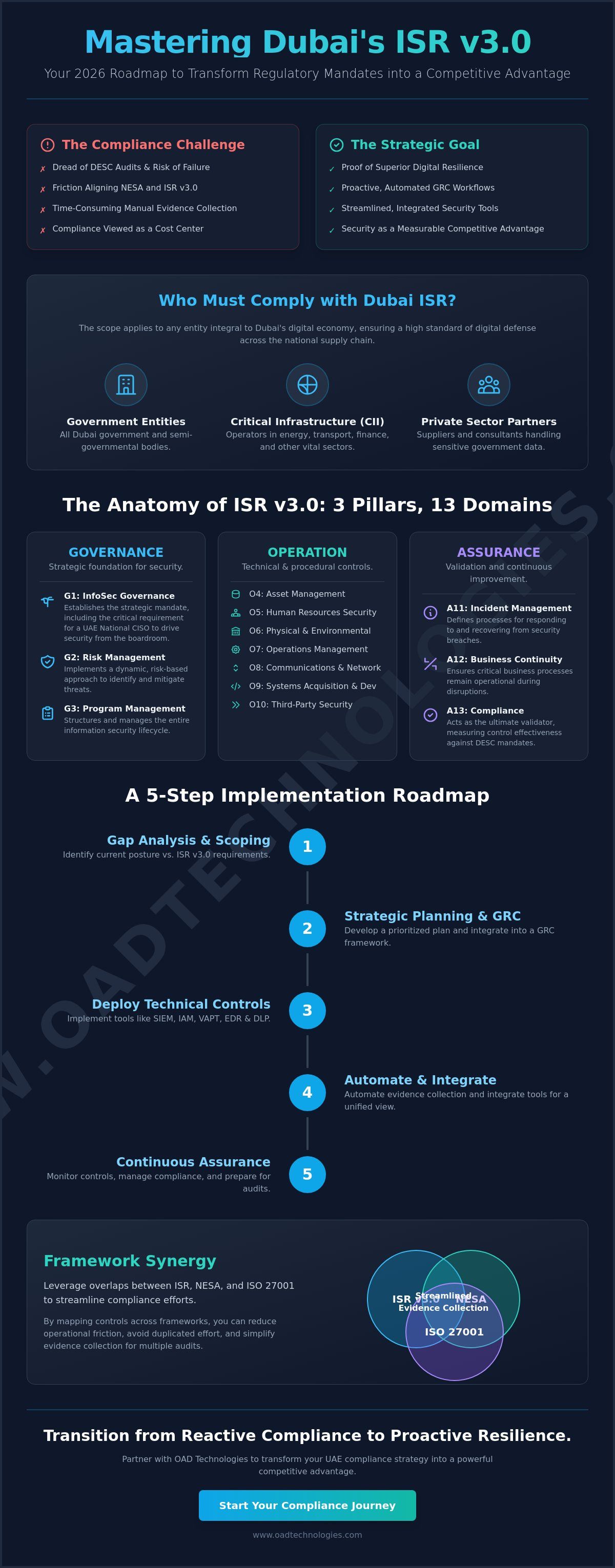
Implementation Roadmap: A 5-Step Guide to ISR Compliance
Achieving compliance requires a shift from reactive fixes to a structured engineering lifecycle. This dubai isr compliance guide begins with a comprehensive gap analysis to benchmark your current posture against the 13 domains of ISR v3.0. Identifying exactly where legacy systems fall short allows for targeted investment rather than broad, inefficient spending. Once you've mapped these gaps, technical integration follows. Deploying robust Data Loss Prevention (DLP) and endpoint security ensures that sensitive information remains within UAE borders, satisfying strict data residency requirements from the outset.
Policy development moves the needle from a simple IT project to a formal corporate governance structure. You must craft a framework that reflects DESC standards and assigns clear accountability to leadership. However, compliance isn't a static state achieved once a year. Utilizing Managed Detection and Response (MDR) provides the real-time visibility needed for continuous monitoring. This proactive stance simplifies the final step of audit and assurance. By maintaining a constant state of readiness, you significantly reduce the risk of failure during independent DESC assessments and certifications.
Mapping Technical Controls to ISR Requirements
Technical controls must map directly to specific regulatory expectations to be effective. For example, conducting regular Vulnerability Assessment and Penetration Testing (VAPT) satisfies the requirements of Domain 12 (Assurance) by proving your defenses can withstand real-world attack vectors. Similarly, SIEM solutions provide the logs and incident detection capabilities mandated for Domain 9. As enterprises shift workloads to the cloud, Cloud Security Posture Management (CSPM) becomes the primary tool to secure cloud-native assets while staying aligned with ISR mandates.
Overcoming Common Compliance Hurdles
Many Dubai organizations struggle with the cybersecurity talent gap and the burden of manual evidence collection. Moving from fragmented spreadsheets to automated GRC compliance platforms reduces the administrative weight of audits and prevents compliance decay between cycles. Specialized MSSP partnerships help bridge the expertise gap, ensuring your team isn't overwhelmed by the intricate technical nuances of DESC requirements. Maintaining compliance momentum requires a culture of security that persists long after the auditors leave the building.
Ready to transform your regulatory obligations into a resilient defense? Contact OAD Technologies today to design a customized ISR roadmap that secures your organization's digital future.
OAD Technologies: Your Strategic Partner for UAE Compliance
Compliance shouldn't be a friction point that slows your organization down. At OAD Technologies, we reject the superficial "box-ticking" approach that many firms adopt simply to pass a DESC audit. True resilience requires a master designer's perspective, where every security control is an integrated component of a larger, high-performance system. This dubai isr compliance guide has detailed the rigorous demands of ISR v3.0, but implementation is where strategy meets reality. We focus on building proactive engineering standards that ensure your security investments provide long-term viability rather than temporary fixes.
Our approach centers on the customized integration of technical toolsets. We don't believe in standardized, one-size-fits-all security. Whether it's aligning your Data Loss Prevention (DLP) protocols with UAE data residency laws or deploying Managed Detection and Response (MDR) to satisfy continuous monitoring mandates, our solutions are tailored to your specific architectural needs. By harmonizing your technical stack with a robust Governance, Risk, and Compliance (GRC) framework, we transform regulatory obligations into a measurable competitive advantage for your enterprise.
The OAD Advantage in GRC Consulting
We take direct accountability for the systems we design. In complex enterprise environments, the gap between executive strategy and technical execution is often where compliance failures happen. We bridge this divide by speaking the language of both the boardroom and the server room. Our consulting focus remains fixed on investment returns. We optimize your security operations to reduce manual overhead, allowing your team to focus on growth while we maintain the integrity of your ISR alignment. This synergy between human insight and technological capacity is what defines our partnership model.
Next Steps for Your Compliance Journey
The path to 2026 regulatory mastery begins with a clear understanding of your current position. We recommend a structured transition to automated resilience to stay ahead of evolving DESC requirements. You can start your journey by following these steps:
- Initiate a Gap Analysis: Work with our specialized GRC team to conduct a deep-dive assessment of your current posture against all 13 ISR domains.
- Deploy Managed Security: Move beyond fragmented tools by adopting an integrated stack of SIEM, EDR, and IAM solutions managed by our experts.
- Design Your Roadmap: Establish a multi-year strategy that accounts for system growth and digital evolution within the UAE market.
Don't leave your digital relevance to chance in an increasingly regulated environment. Contact OAD Technologies today to design a customized compliance roadmap that protects your assets and empowers your people. We act as an extension of your team, ensuring your organization remains a leader in Dubai's secure digital ecosystem.
Securing Your Position in Dubai’s Digital Future
Mastering the 13 domains of ISR v3.0 requires more than technical adjustments; it demands a fundamental shift in how your organization views digital risk. This dubai isr compliance guide has outlined the path from initial gap analysis to the deployment of sophisticated controls like MDR and DLP. By prioritizing data residency and local leadership mandates, you're not just satisfying DESC requirements. You're building a resilient architecture that supports sustainable growth in the UAE's evolving digital economy.
As a Dubai-based technical authority with a national reach, OAD Technologies provides the engineering-led expertise needed to navigate these complex regulatory landscapes. We act as specialized integrators for your GRC, MDR, and DLP needs, ensuring every solution is customized for long-term viability. Partner with OAD Technologies to master your ISR compliance strategy today. Your journey toward absolute digital resilience starts with a single, strategic step.
Frequently Asked Questions
What is the Information Security Regulation (ISR) in the UAE?
The Information Security Regulation is the definitive cybersecurity framework established by the Dubai Electronic Security Center (DESC). It defines mandatory security standards for government entities and critical infrastructure to protect the confidentiality, integrity, and availability of digital assets. It acts as a comprehensive dubai isr compliance guide for organizations operating within the emirate’s digital ecosystem, ensuring a unified defense against national cyber threats.
How does ISR v3.0 differ from previous versions of the regulation?
ISR v3.0 introduces stricter mandates regarding data residency, specifically preventing critical information from being stored or processed outside the UAE. It also requires that the Chief Information Security Officer (CISO) be a UAE National who reports directly to executive leadership. This version expands the scope to include enhanced controls for IoT devices, cloud computing, and cyber resilience to address the technological shifts of 2026.
Is ISR compliance mandatory for private companies in the UAE?
Compliance is mandatory for private sector companies that serve as suppliers, contractors, or consultants to Dubai government entities. It also applies to private organizations identified as Critical Information Infrastructure (CII) operators. Even for entities without a direct legal mandate, aligning with these standards is a strategic necessity to ensure eligibility for high-value government contracts and to maintain digital trust within the UAE market.
What is the role of the Dubai Electronic Security Center (DESC) in ISR audits?
DESC acts as the primary regulatory authority responsible for creating, enforcing, and auditing the ISR. They oversee the implementation of the 13 security domains and conduct periodic assessments to verify that entities meet the required standards. DESC also manages the certification framework that organizations must navigate to prove their adherence to national security mandates and maintain their operational status in Dubai.
How often should an organization perform an ISR compliance assessment?
Organizations should conduct internal compliance assessments at least annually or whenever significant changes occur in their technical architecture. While DESC sets specific audit schedules based on an entity's risk profile, a proactive approach involves continuous monitoring. Regular assessments ensure that security controls remain effective against evolving threats and prevent compliance decay between formal DESC audit cycles.
Can a company be ISO 27001 certified and still fail an ISR audit?
Yes, an organization can hold an ISO 27001 certification and still fail an ISR audit because the ISR includes localized requirements that international standards don't cover. Specifically, the ISR mandates UAE-centric controls like local data residency and the requirement for a UAE National CISO. You must bridge these specific gaps to satisfy DESC auditors, as international certifications alone aren't sufficient for Dubai regulatory alignment.
What are the penalties for non-compliance with DESC standards?
Non-compliance can result in formal warnings, administrative fines, and the suspension of an entity's ability to provide services to Dubai government bodies. Beyond legal penalties, organizations risk significant reputational damage and exclusion from the national digital supply chain. DESC uses a phased enforcement schedule, meaning persistent failures to remediate gaps identified during audits can lead to escalating administrative actions and restricted market access.
How do managed security services help with ISR implementation?
Managed security services provide the technical expertise and tools required to satisfy complex regulatory domains without the burden of manual evidence collection. Solutions like MDR, SIEM, and IAM automate the continuous monitoring and incident reporting requirements mandated by the dubai isr compliance guide. Partnering with an MSSP allows organizations to bridge the talent gap and ensures technical controls are managed by experts familiar with DESC expectations.
Disclaimer
Content by OAD Technologies is for general informational purposes only and does not constitute professional or cybersecurity advice. No warranties are made regarding accuracy or completeness; reliance is at your own risk. OAD Technologies shall not be liable for any direct or indirect losses arising from use of this content.


