

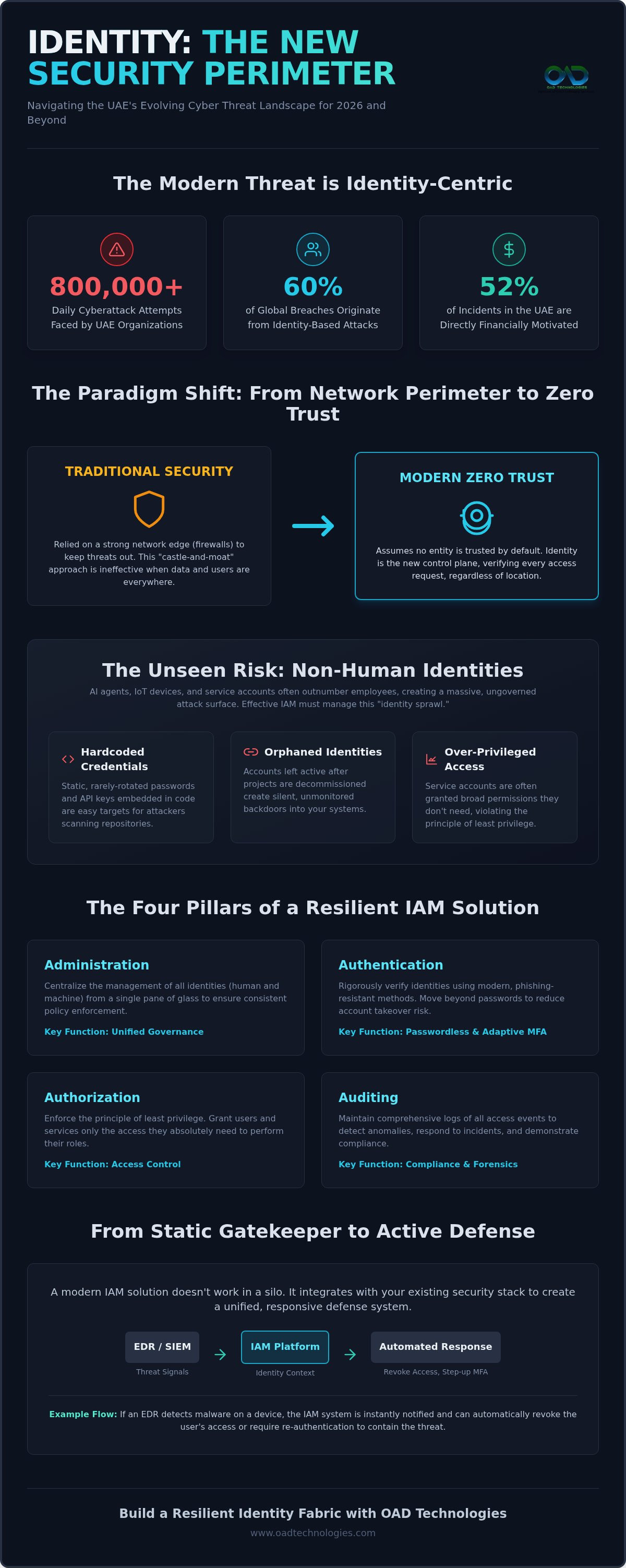
With the UAE facing up to 800,000 daily cyberattack attempts in 2026, the traditional security perimeter has effectively dissolved. Identity-based attacks now account for 60% of global breaches, making the selection of robust iam solutions the most critical decision in your security stack. You likely recognize the mounting difficulty of managing hybrid identities while striving to eliminate the risk of account takeover. This challenge becomes even more acute when you must demonstrate rigorous alignment with UAE PDPL requirements and the latest digital safety mandates.
We believe that security should never come at the cost of operational momentum. This guide provides a strategic framework for building a resilient identity fabric rather than just purchasing a product. You'll learn how to evaluate platforms that balance national regulatory compliance with a frictionless user experience. We will analyze the critical components of a scalable architecture, ensuring your organization remains secure and compliant as the UAE digital landscape continues to evolve through 2026 and beyond.
Key Takeaways
- Understand why identity has replaced the network perimeter as the primary security layer for protecting human and machine assets in 2026.
- Discover how to evaluate iam solutions based on their capacity to integrate with existing SIEM and EDR ecosystems for a unified defense strategy.
- Compare the operational speed of proprietary SaaS platforms against the architectural flexibility of open-source frameworks for bespoke enterprise needs.
- Learn the specific technical configurations required to align your identity workflows with UAE PDPL and national GRC compliance standards.
- Identify the strategic advantages of building a customized identity fabric that supports long-term scalability and measurable investment returns.
Beyond the Perimeter: Why IAM Solutions are the Foundation of Modern Cybersecurity
In 2026, the firewall is no longer your primary defense. With UAE organizations facing over 800,000 daily cyberattack attempts, the boundary has shifted from the network edge to the individual user. Modern Identity and Access Management (IAM) has evolved into a strategic orchestration layer. It isn't just about managing employee logins anymore; it's about governing every entity, human or machine, that interacts with your data. This shift is vital as businesses move toward hybrid models where data lives everywhere and nowhere simultaneously.
Stolen credentials remain the most frequent entry point for breaches. Since identity-based attacks account for 60% of all cyber incidents globally, iam solutions serve as the bedrock of a Zero Trust Architecture. By assuming no entity is trusted by default, these systems enable secure remote work without compromising the agility your business needs to scale. In the UAE's high-stakes digital economy, where 52% of incidents are financially motivated, verifying the "who" and "what" of every request is the only way to protect your balance sheet.
The Shift from Access Control to Identity Security
Standard authentication can't stop modern adversaries who specialize in credential harvesting. Today's security requires Identity Threat Detection and Response (ITDR) to monitor behavioral anomalies in real-time. If a credential is used from an unusual location or at an odd hour, the system must react instantly to revoke access. This proactive stance moves you beyond simple gatekeeping and into the territory of active defense. An Identity Fabric acts as the unified layer connecting disparate security tools into a single, resilient mesh.
Non-Human Identities: The New Frontier
The explosion of AI agents, IoT devices, and service accounts has created a massive blind spot for the modern enterprise. These non-human identities often outnumber employees but frequently lack the same level of governance. Without centralized management, you face "identity sprawl" across multi-cloud environments. This creates several specific risks:
- Hardcoded Credentials: Automated scripts often use static passwords that are rarely rotated.
- Over-Privileged Access: Service accounts are frequently granted broad permissions they don't actually need.
- Orphaned Identities: Decommissioned projects often leave active accounts behind, creating silent backdoors.
Treating machine identities with the same rigor as human ones is no longer optional. It's a prerequisite for operational performance and risk mitigation. Effective iam solutions must provide a single pane of glass to manage these automated entities, ensuring their permissions are as restricted and audited as any executive's login.
Essential Evaluation Criteria for Enterprise Identity Platforms
Selecting the right iam solutions requires moving beyond simple feature checklists. You need a framework that evaluates how a platform aligns with both operational performance and strategic growth. According to NIST's perspective on IAM, these systems are fundamental to a mature cybersecurity posture. The core evaluation should rest on four pillars: Administration, Authentication, Authorization, and Auditing. These pillars ensure that identities are managed centrally, verified rigorously, restricted appropriately, and logged for compliance.
Your choice shouldn't exist in a vacuum. A resilient identity platform needs to communicate natively with your existing Security Information and Event Management (SIEM) and Endpoint Detection and Response (EDR) tools. This telemetry sharing allows for real-time risk scoring. For instance, if an EDR detects malware on a device, the IAM system should automatically step up authentication requirements or revoke access entirely. This level of integration transforms identity from a static gatekeeper into an active participant in your threat response ecosystem.
Advanced Authentication and Authorization
Passwordless authentication is no longer a luxury. It's a necessity to combat the 32% increase in phishing incidents seen in early 2026. Evaluate solutions based on their support for FIDO2 standards and adaptive MFA that adjusts based on context, such as geo-location or network velocity. Additionally, look for a shift toward Attribute-Based Access Control (ABAC) for complex environments. Unlike traditional Role-Based Access Control (RBAC), ABAC allows for granular decisions based on time, location, and resource sensitivity. This ensures the Principle of Least Privilege is enforced at every layer of your digital architecture.
Privileged Access Management (PAM) Integration
Privileged accounts are the "keys to the kingdom." Any enterprise-grade evaluation must include how the solution handles session monitoring and credential vaulting for administrative users. Integrating PAM with your broader IAM framework provides a unified view of risk, preventing attackers from moving laterally through your network. If you're struggling to map these technical requirements to your specific business goals, exploring specialized identity integration services can help bridge the gap between high-level policy and technical execution.
Finally, consider the joiner-mover-leaver lifecycle. Identity Governance and Administration (IGA) should automate provisioning and de-provisioning to eliminate "orphaned" accounts. This automation, paired with a frictionless user experience, ensures that security doesn't become a bottleneck for your workforce. By prioritizing these criteria, you build an identity fabric that is both secure and scalable.
Strategic Deployment Models: Managed Services vs. In-House Orchestration
Choosing how to deploy iam solutions is just as critical as the features themselves. UAE enterprises often struggle between the speed of proprietary SaaS and the deep customization of open-source frameworks. While proprietary platforms offer rapid deployment and vendor-managed updates, they come with recurring licensing fees and a risk of vendor lock-in. Conversely, open-source options provide architectural transparency and flexibility. Yet, they demand a high level of internal engineering expertise that many organizations find difficult to maintain in a competitive talent market.
Cost evaluation must go beyond the initial price tag. You've got to weigh licensing fees against the hidden costs of operational maintenance, patching, and the risk of downtime. A well-orchestrated deployment model balances these factors to create a sustainable identity fabric. Whether you choose a fully managed service or a hybrid in-house model, the goal remains the same: a secure, scalable architecture that supports your organization's digital evolution without becoming a technical burden.
Managed Identity Services (MSSP) for UAE Enterprises
The cybersecurity skills gap remains a significant hurdle for local firms in 2026. This has led to a noticeable shift toward Managed IAM models. A managed approach doesn't just provide 24 X 7 monitoring; it injects human insight into automated processes. Partnering with a local MSSP ensures your identity strategy is grounded in the specific realities of the UAE threat landscape, where financially motivated attacks are prevalent. You gain rapid incident response capabilities without the massive operational overhead of building an in-house Security Operations Center. This synergy between human expertise and technological capacity often yields a much higher ROI than self-managed stacks.
Proprietary vs. Open Source: A Strategic Choice
Reliability often dictates the choice for proprietary systems. Large vendors offer guaranteed uptimes and extensive support ecosystems that provide peace of mind for mission-critical applications. However, managing the long-term viability of these tools requires a clear strategy to avoid being trapped in a single ecosystem. UAE enterprises are increasingly adopting a hybrid approach, integrating diverse tools into a cohesive Identity and Access Management framework. This allows you to leverage the stability of a major vendor for core authentication while using customized integrations to handle unique business workflows or legacy systems. By prioritizing flexibility, you ensure your iam solutions can adapt to future regulatory changes or technological shifts.
Navigating Compliance: Aligning Identity Management with UAE GRC Standards
Compliance in the UAE has reached a new level of maturity in 2026. With the UAE Personal Data Protection Law (PDPL) in full enforcement, enterprises must prove exactly who has access to sensitive data and why. Modern iam solutions provide the technical controls needed to satisfy these legal requirements. They create a definitive record of access, ensuring that only authorized personnel can interact with protected datasets. Beyond simple access, these platforms address strict data residency requirements, keeping identity metadata within national borders to satisfy local sovereignty mandates.
Identity management doesn't exist in a vacuum. It's a core component of your broader Governance Risk and Compliance (GRC) framework. By centralizing control, you reduce the risk of regulatory non-compliance that often stems from fragmented systems. This alignment ensures that your security posture supports, rather than hinders, your strategic business objectives. It's about building a system where compliance is an inherent outcome of your security architecture, not a separate, manual task.
Automating Compliance Audits with IAM
Point-in-time audits are no longer sufficient to meet the expectations of UAE regulators. You need continuous compliance that monitors identity health in real-time. Advanced iam solutions use analytics to flag anomalies and provide instant audit trails for national reporting. This automation removes the manual burden from your IT team, allowing them to focus on growth instead of paperwork. By leveraging identity analytics, you can demonstrate a proactive approach to data protection during any regulatory assessment, satisfying both internal auditors and federal authorities.
Aligning with National Cybersecurity Standards
Your identity strategy must map directly to mandates like the NESA Information Assurance Standards and DESC regulations. These frameworks require rigorous access controls and session monitoring. To ensure your defenses are actually working, you should use Vulnerability Assessment and Penetration Testing (VAPT) to stress-test your IAM implementation. A VAPT exercise can identify misconfigured permissions or ghost accounts that an attacker might exploit.
Local expertise is your greatest asset when navigating this shifting landscape. Specific rules, such as the mandatory e-invoicing framework introduced in July 2026 or the Child Digital Safety Act, add layers of complexity to how you manage identities. If you're ready to build a compliant identity fabric, consult with our UAE-based security experts to design a solution tailored to your specific regulatory and enterprise goals.
Implementing a Resilient Identity Strategy with OAD Technologies
Purchasing a software license doesn't equate to securing an enterprise. In 2026, the most effective iam solutions are those woven into a customized identity fabric that accounts for your specific architectural nuances. At OAD Technologies, we reject the standardized, one-size-fits-all approach common in the market. We recognize that a financial institution in the UAE faces different identity hurdles than a logistics provider. Our role is to act as a master designer, building a system that bridges the gap between high-level innovation and the practical results your board expects.
True resilience comes from a holistic defense strategy. We focus on integrating your identity workflows with Data Loss Prevention (DLP) to ensure that security controls follow the data, even if a user's context changes. This unified approach prevents the silos that often lead to security gaps. By aligning identity with data protection, we help you build a defensive posture that is both proactive and deeply grounded in the reality of modern threats.
Our Collaborative Implementation Roadmap
We don't just deliver a solution; we join your team. Our implementation process begins with a rigorous technical assessment of your current identity sprawl. We move from this discovery phase into a strategic deployment that prioritizes your most critical assets first. This phased approach ensures minimal disruption to your operations while building momentum toward a Zero Trust state. We utilize proactive engineering standards to ensure your architecture remains viable for the long term, guarding your digital relevance as the UAE market continues to evolve.
Total Visibility and Control
Maximum security is achieved when iam solutions work in perfect harmony with your SIEM and MDR layers. This combination provides total visibility into every authentication event and access request across your environment. We focus on the synergy between human insight and technological capacity, empowering your staff with tools that enhance productivity rather than hindering it with excessive friction. A secure experience should be a seamless one.
If you're ready to move beyond standardized security and build an identity strategy that truly scales, our specialists are here to help. We can provide a tailored identity assessment that maps your current state against 2026 benchmarks. Reach out to OAD Technologies today to begin designing your resilient identity fabric.
Architecting Long-Term Identity Resilience
Identity is no longer a back-office utility; it's the primary defense against the 800,000 daily cyberattack attempts facing UAE organizations in 2026. Success requires a shift from simply purchasing tools to architecting a resilient identity fabric that scales with your strategic growth. Implementing effective iam solutions ensures your enterprise remains secure while satisfying the UAE's rigorous PDPL and national GRC mandates. This alignment turns security from a checkbox into a demonstrable business advantage.
As a UAE-based strategic security integrator, OAD Technologies specializes in customized identity fabric design that bridges the gap between high-level innovation and practical results. Our deep expertise in national regulatory alignment ensures your architecture is built for long-term viability. We're ready to act as an extension of your team to solve your most complex digital challenges. Secure your enterprise identities with OAD Technologies and ensure your organization stays ahead of the evolving threat landscape. Let's build a secure, frictionless future together.
Frequently Asked Questions
What is the difference between IAM and PAM?
Identity and Access Management (IAM) governs the lifecycle of every user across your organization, from employees to external partners. Privileged Access Management (PAM) is a specialized subset that focuses strictly on high-risk accounts with administrative rights. While IAM provides broad access controls, PAM adds rigorous vaulting, credential rotation, and session recording to protect your most sensitive systems from internal and external threats.
How does IAM help with UAE PDPL compliance?
The UAE Personal Data Protection Law (PDPL) mandates strict controls over who can process and access personal data. IAM systems provide the granular authorization and detailed audit logs necessary to demonstrate compliance during regulatory assessments. By automating user de-provisioning and enforcing the Principle of Least Privilege, you ensure that personal data is only accessible to authorized entities, satisfying federal data protection requirements.
Can IAM solutions protect against ransomware?
Modern iam solutions act as a critical barrier against ransomware by preventing lateral movement within your network. Since most ransomware attacks rely on stolen credentials, enforcing adaptive Multi-Factor Authentication (MFA) stops the initial breach. By restricting user permissions to only what is necessary for their role, you limit the potential blast radius if a single account becomes compromised by an attacker.
What is adaptive authentication and why is it important in 2026?
Adaptive authentication uses real-time risk scoring to change security requirements based on a user's current context. In 2026, this is essential because attackers use AI to bypass static security measures. The system evaluates factors like device posture, network location, and behavioral patterns. It only prompts for additional verification when it detects an anomaly, ensuring a frictionless experience for legitimate users while blocking suspicious activity.
How long does it take to implement an enterprise IAM solution?
A typical enterprise implementation ranges from three to nine months, depending on your architectural complexity. While cloud-native deployments are faster, integrating legacy on-premises systems requires a more deliberate pace. We recommend a phased roadmap that prioritizes high-impact areas like remote access and privileged accounts. This strategy allows your organization to realize security benefits and ROI while the broader identity fabric is being constructed.
Is open-source IAM secure enough for large corporations?
Open-source iam solutions provide significant architectural flexibility and transparency, which many technical teams value. They are secure enough for large corporations when backed by a rigorous engineering standard and proactive patching. However, the operational burden of maintaining these systems in-house is high. Many UAE enterprises prefer managed versions of these tools to ensure 24 X 7 availability and alignment with national security mandates.
What are the risks of using a single identity provider (IdP)?
Relying on a single Identity Provider (IdP) introduces a significant single point of failure for your entire digital ecosystem. If that provider experiences an outage, your workforce loses access to every integrated application simultaneously. Additionally, a compromise of the IdP's root keys could grant an adversary total control over your identities. Many organizations now utilize a secondary IdP to ensure business continuity and architectural resilience.
Disclaimer
Content by OAD Technologies is for general informational purposes only and does not constitute professional or cybersecurity advice. No warranties are made regarding accuracy or completeness; reliance is at your own risk. OAD Technologies shall not be liable for any direct or indirect losses arising from use of this content.