

If a single data breach now costs an average of $4.88 million globally, why is the conversation around security still treated as a technical line item rather than a core business continuity strategy? You're likely exhausted from managing over 2,000 weekly cyberattacks while facing the mounting pressure of UAE PDPL compliance and a talent market that makes 24 X 7 hiring nearly impossible. It's frustrating to watch your team struggle with alert fatigue while the boardroom views security as a cost center rather than a strategic asset. Successfully getting executive buy-in for mdr requires shifting the narrative from technical telemetry to operational resilience and financial risk mitigation.
This article provides a clear framework to translate complex security needs into boardroom value, helping you secure the necessary budget for Managed Detection and Response. We'll show you how to align your defense strategy with corporate growth goals and reduce personal liability. You'll learn to present a roadmap that moves beyond reactive fixes toward a proactive, architected solution that protects both your data and your brand equity.
Key Takeaways
- Shift the internal narrative from reactive defense to proactive resilience by framing security as a driver of digital continuity.
- Master the process of getting executive buy-in for mdr by aligning technical risks with the three pillars of boardroom concern: revenue, reputation, and regulation.
- Analyze the total cost of ownership for an in-house SOC versus the efficiency of a managed model to highlight long-term operational savings.
- Use the findings from a Vulnerability Assessment and Penetration Testing (VAPT) to provide the empirical data required for strategic investment approval.
- Explore how the synergy between MDR and Data Loss Prevention (DLP) creates a unified defense layer that protects both infrastructure and intellectual property.
The Strategic Necessity of MDR in the 2026 Threat Landscape
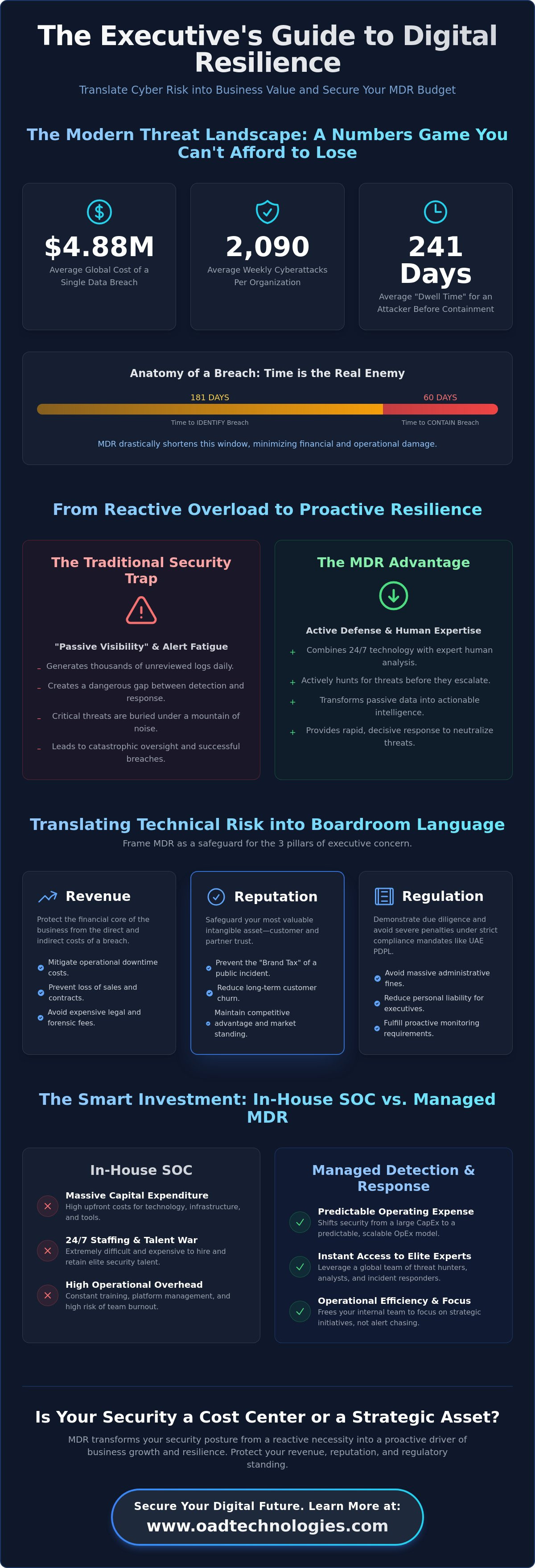
In 2026, the concept of a "perimeter" has become an architectural relic. With cyberattacks increasing by 17% this year to an average of 2,090 per week according to SentinelOne research, security is no longer about building higher walls. It's about maintaining "Digital Resilience." This shift is fundamental for security leaders getting executive buy-in for mdr, as it moves the conversation from technical overhead to a strategic insurance policy. Managed Detection and Response (MDR) provides the proactive framework necessary to sustain operations in a high-threat environment where breach attempts are a mathematical certainty rather than a possibility.
The financial impact of a security incident is often a direct function of time. Global data shows it takes an average of 181 days to identify a breach and another 60 days to contain it. This "dwell time" is where the real damage happens, driving the average cost of a breach to $4.88 million. MDR isn't just about stopping an attack; it's about drastically shortening this window to minimize business disruption. By the time a traditional system flags an anomaly, an adversary has often already established persistence. MDR changes this dynamic by hunting for threats before they escalate into headlines.
Why Traditional Security Fails the Modern Enterprise
Traditional tools often create a "passive visibility" trap. They generate thousands of logs that go unreviewed, creating a dangerous gap between detection and actual response. In unmanaged environments, alert fatigue isn't just a nuisance; it leads to catastrophic oversight where critical signals are buried under noise. Managed Detection and Response (MDR) is the continuous synergy between human expertise and 24 X 7 technology that transforms passive data into active defense.
MDR as a Catalyst for Strategic Growth
Security should never be a bottleneck for innovation. A robust MDR posture allows organizations to pursue digital transformation with confidence, knowing that new cloud workloads and SaaS integrations are under constant watch. During mergers or acquisitions, a proven MDR framework reduces the "risk discount" that investors apply to companies with opaque security postures. In the UAE market, where regulatory scrutiny under the PDPL is intensifying, positioning your security as a competitive advantage can be the deciding factor in securing high-value partnerships. Successfully getting executive buy-in for mdr means showing the board that security is a bridge to new opportunities, not a barrier to entry.
Translating Technical Risk into Boardroom Language
Executive leaders don't manage firewalls; they manage risk. When getting executive buy-in for mdr, the most common pitfall is presenting technical telemetry as the primary value proposition. Your board isn't interested in the nuances of a specific malware strain. They're interested in how that threat translates to business downtime. To bridge this gap, you must frame Managed Detection and Response as a safeguard for the company’s revenue, reputation, and regulatory standing. These are the three pillars of executive concern that drive every major budgetary decision in the 2026 threat landscape.
Quantifying the "Cost of Inaction" (COI) is often more persuasive than a traditional ROI calculation. If the global average cost of a data breach remains near record highs, the question isn't whether the business can afford MDR, but whether it can afford the financial shock of a successful intrusion. This conversation becomes even more critical when discussing the UAE Personal Data Protection Law (PDPL). Under this mandate, the lack of proactive monitoring isn't just a security gap; it's a legal liability that can result in massive administrative fines that directly impact the bottom line.
Quantifying the Financial Impact of a Breach
To make the risk tangible, calculate the hourly cost of operational downtime for your specific industry. This includes more than just lost sales. You must factor in legal fees, the expense of forensic investigations, and the mandatory notification costs that follow a breach. There's also a "Brand Tax" to consider. Security incidents erode customer lifetime value, often leading to long-term churn that far exceeds the immediate recovery costs. If you want to ensure your infrastructure is resilient against these costs, it's vital to evaluate your current exposure levels through rigorous testing.
Alignment with National Regulatory Standards
MDR provides the "continuous monitoring" required by national GRC frameworks, transforming compliance from a periodic checkbox into a real-time capability. By documenting rapid response protocols, you demonstrate a commitment to data sovereignty that resonates with stakeholders and partners alike. This proactive stance significantly reduces the risk of administrative penalties. For a deeper look at aligning your security with regional mandates, see our guide on Governance Risk and Compliance (GRC). Successfully getting executive buy-in for mdr happens when you prove that security isn't a cost center, but a guardian of the organization's legal and financial integrity.
In-House SOC vs. MDR: The Cost-Benefit Analysis
The "Build vs. Buy" dilemma is often the final hurdle when getting executive buy-in for mdr. Many boards instinctively prefer owning their infrastructure, assuming internal control equates to better security. However, the capital expenditure (CapEx) required to launch a modern Security Operations Center (SOC) often creates a massive financial drag before a single threat is ever detected. Between SIEM and EDR licensing, hardware procurement, and facility costs, the initial investment is significant. Managed Detection and Response (MDR) flips this model, converting heavy upfront costs into a predictable operational expenditure (OpEx) that scales with your business growth.
Beyond the hardware, the "hidden costs" of an internal SOC are usually found in the human element. The cybersecurity talent gap is widening, making the recruitment and retention of tier-two and tier-three analysts an expensive, ongoing battle. When you factor in specialized training and the high turnover rates common in high-stress SOC environments, the true cost of ownership skyrockets. Organizations often find that translating technical risk into business impact reveals that an in-house team is actually a liability if it isn't fully staffed and equipped with elite threat intelligence.
The Math of 24 X 7 Security Coverage
True 24 X 7/365 "eyes on glass" coverage isn't a three-person job. To account for three daily shifts, weekend rotations, public holidays, sick leave, and mandatory vacation time, a resilient SOC typically requires between 8 and 12 full-time security professionals. For most mid-market and even large enterprises, the payroll alone for this headcount makes an in-house SOC financially non-viable. You can compare these internal staffing requirements to our Managed Detection and Response (MDR) model, which provides instant access to a global pool of expertise without the individual overhead of benefits, training, and recruitment fees.
Speed of Deployment and Time-to-Value
Time is the one resource a CISO cannot manufacture. Building a functional in-house SOC from the ground up generally takes 6 to 12 months, a period during which your organization remains exposed to the evolving 2026 threat landscape. In contrast, an MDR solution can be onboarded and operational within 30 days, providing an immediate "maturity jump." This rapid deployment allows you to close security gaps before an adversary can exploit them. Choosing to build it yourself often means falling behind the threat curve as your team spends months on configuration instead of active hunting. For leaders focused on getting executive buy-in for mdr, the speed of deployment is a powerful argument for immediate risk reduction.
Building the Business Case: A 5-Step Action Plan
Moving from a technical proposal to a funded mandate requires a structured approach that mirrors how other business units request capital. Executives are more likely to approve a budget when they see a clear, phased roadmap that addresses specific organizational vulnerabilities. Successfully getting executive buy-in for mdr depends on your ability to present a logical sequence of events that leads to a measurable reduction in risk. Follow this five-step plan to build a compelling case for your leadership team:
- Step 1: Conduct a VAPT to identify current exposure. This provides the empirical evidence needed to move beyond theoretical risks.
- Step 2: Map security gaps to specific business risks and regulatory mandates. Show how a vulnerability in the cloud directly threatens your compliance with the UAE PDPL.
- Step 3: Present a tiered solution using a "Good-Better-Best" approach. Boards appreciate having options that allow them to balance cost with risk appetite.
- Step 4: Use case studies or social proof from similar national organizations. Validating that competitors or peers are adopting MDR provides external justification for the investment.
- Step 5: Define clear success metrics for the first 90 days. Focus on "Mean Time to Detect" (MTTD) and "Mean Time to Respond" (MTTR) to show immediate value.
If you're ready to begin Step 1 and uncover the specific gaps in your infrastructure, you can book a comprehensive vulnerability assessment today to start building your data-driven case.
Leveraging Evidence through Technical Assessments
A current-state assessment provides the "shock factor" often required to move a budget request from the "later" pile to the "now" pile. By using data from SIEM logs, you can demonstrate existing "near misses" that would have been catastrophic without a stroke of luck. Involving stakeholders from Legal and HR early in the process adds weight to your argument. They can speak to the non-technical consequences of a breach, such as employee data liability and contract breaches, making the need for MDR an organizational priority rather than just an IT concern.
The Executive Presentation: Focus on Outcomes
Your presentation should follow a tight structure: Problem, Impact, Solution, and ROI. Avoid "Alphabet Soup" at all costs. While terms like EDR, CSPM, and IAM are central to your daily life, they often cloud the strategic message for a CEO or CFO. Simplify these into concepts like "Endpoint Protection," "Cloud Visibility," and "Identity Control." The goal is to answer the most important objection: "Why now?" By highlighting the accelerating threat frequency and the cost of potential downtime, you make it clear that the current posture is a gamble the company can no longer afford to take. This level of clarity is the final key to getting executive buy-in for mdr.
Partnering for Resilience: The OAD Technologies Approach
OAD Technologies designs security systems that act as an organic extension of your internal operations. We recognize that getting executive buy-in for mdr is only the first step; the real value lies in the long-term viability of the partnership. By aligning our detection capabilities with your specific business objectives, we move beyond the role of a distant vendor to become a guardian of your digital relevance. This partnership ensures that your security posture evolves alongside the 2026 threat landscape, maintaining the resilience that stakeholders and investors expect. We don't just provide alerts; we provide the strategic clarity required to manage complex digital environments.
A critical component of our strategy is the synergy between MDR and Data Loss Prevention (DLP). While MDR focuses on identifying and responding to active intrusions, DLP ensures that your sensitive data remains within authorized boundaries. Together, these solutions provide a comprehensive shield that protects both your infrastructure and your intellectual property. This integrated approach simplifies the reporting process for the board. It demonstrates a unified defense strategy rather than a fragmented collection of tools, proving that your security investment covers multiple risk vectors simultaneously.
Our commitment to national compliance standards and local threat intelligence distinguishes our approach in the UAE market. We understand the nuances of the regional regulatory environment and the specific tactics used by adversaries targeting Middle Eastern enterprises. This localized expertise allows us to provide faster, more accurate responses that keep your organization ahead of the curve. We focus on long-term success over quick fixes, ensuring that every technological implementation serves a broader strategic purpose.
Customized Integration for UAE Enterprises
We reject the standardized, one-size-fits-all model favored by traditional MSSPs. Every enterprise has a unique architectural footprint, and our team specializes in customized integrations that respect your existing investments. Whether it's aligning with your Identity and Access Management (IAM) protocols or optimizing your cloud security posture, we ensure our MDR solution fits seamlessly into your stack. We prioritize human-led threat hunting over purely automated systems. This provides the nuanced insight required to distinguish between legitimate administrative activity and a sophisticated adversary attempting to hide in the noise.
Next Steps: Securing Your Digital Future
Securing the budget for a managed service is about more than just numbers. It's about providing peace of mind to the CISO and the board. Our framework simplifies the process of getting executive buy-in for mdr by demonstrating how our partnership solves the talent scarcity and compliance challenges discussed earlier. We invite you to book a strategic consultation to help refine your specific business case and define a roadmap for your organization's security evolution. Partner with OAD Technologies for Enterprise MDR and transition from reactive defense to proactive resilience.
Securing Your Seat at the Strategic Table
The transition from a technical cost center to a strategic business partner requires a fundamental shift in how you communicate risk. By focusing on operational resilience and financial predictability, getting executive buy-in for mdr becomes a conversation about protecting the organization's long-term growth. You've seen how translating technical telemetry into the language of revenue and reputation aligns security with corporate objectives. Now, it's time to execute the roadmap. This secures both your infrastructure and your professional standing.
OAD Technologies provides specialized UAE national expertise to help you navigate this transition. Our advanced SOC combines 24 X 7 human-led threat hunting with integrated GRC and PDPL alignment. This ensures your organization remains compliant and resilient. We act as a collaborative master designer of systems. This ensures your digital relevance isn't just maintained but actively protected. Don't settle for standardized approaches when your business requires a tailored defense.
Build Your MDR Business Case with OAD Technologies
You have the framework and the tools to lead this change. Your journey toward proactive resilience starts today.
Frequently Asked Questions
What is the difference between an MSSP and an MDR provider?
An MSSP typically focuses on perimeter management and log collection, whereas an MDR provider delivers active threat hunting and rapid incident remediation. While an MSSP might notify you of a potential issue, an MDR partner investigates the signal and takes decisive action to contain the threat. This distinction is vital when getting executive buy-in for mdr, as it highlights the move from passive observation to active defense.
How does MDR help with UAE PDPL compliance?
MDR helps fulfill the UAE PDPL requirement for "continuous monitoring" and "incident notification" by providing a documented audit trail of all security events. It ensures that personal data is protected by a 24 X 7 response layer, significantly reducing the risk of administrative fines. This alignment with national standards proves to the board that security is a legal safeguard for the organization's data assets.
Can MDR replace our existing internal security team?
MDR doesn't replace your internal security team; it acts as a force multiplier that removes the burden of 24 X 7 alert monitoring. This allows your senior architects to focus on high-value strategic initiatives rather than burning out on tier-one triage. It’s a collaborative model where external expertise empowers your people to work more effectively on business-specific challenges.
What are the most important KPIs to show the board after implementing MDR?
The most impactful KPIs for executive reporting are Mean Time to Detect (MTTD) and Mean Time to Respond (MTTR). You should also present data on the volume of critical threats contained before they impacted business operations. These metrics demonstrate a tangible reduction in risk and provide a clear justification for the ongoing investment in resilience.
How much does a typical MDR service cost for a national enterprise?
The cost of MDR for a national enterprise depends on several variables, including the total number of endpoints, the volume of data ingested, and the complexity of the cloud environment. Organizations typically find that the subscription-based model is more cost-effective than the payroll and overhead required for a 24 X 7 internal SOC. You should evaluate your specific infrastructure needs to determine the most efficient scale for your deployment.
What happens if we already have a SIEM—do we still need MDR?
A SIEM is a powerful tool for data aggregation, but it still requires a skilled team to interpret the logs and respond to alerts. MDR provides the human intelligence and response protocols that turn your SIEM data into actionable security outcomes. Without the response layer that MDR provides, a SIEM often becomes a graveyard for unreviewed alerts that could hide a breach.
How does MDR integrate with our existing Cloud Security Posture Management (CSPM)?
MDR complements your Cloud Security Posture Management (CSPM) by adding a real-time detection layer to your configuration monitoring. While CSPM identifies misaligned settings or compliance gaps in your cloud, MDR watches for adversaries attempting to exploit those specific weaknesses. This synergy creates a unified defense that protects your cloud workloads from both human error and active attacks.
What is the typical time-to-value after signing an MDR contract?
Most organizations experience significant time-to-value within the first 30 days of deployment as the MDR team establishes initial visibility and identifies existing dormant threats. The full maturity of the service, including deep behavioral baselining and advanced threat hunting, typically occurs within 90 days. This rapid onboarding is a key factor in getting executive buy-in for mdr compared to the months required to build an internal capability.
Disclaimer
Content by OAD Technologies is for general informational purposes only and does not constitute professional or cybersecurity advice. No warranties are made regarding accuracy or completeness; reliance is at your own risk. OAD Technologies shall not be liable for any direct or indirect losses arising from use of this content.


