

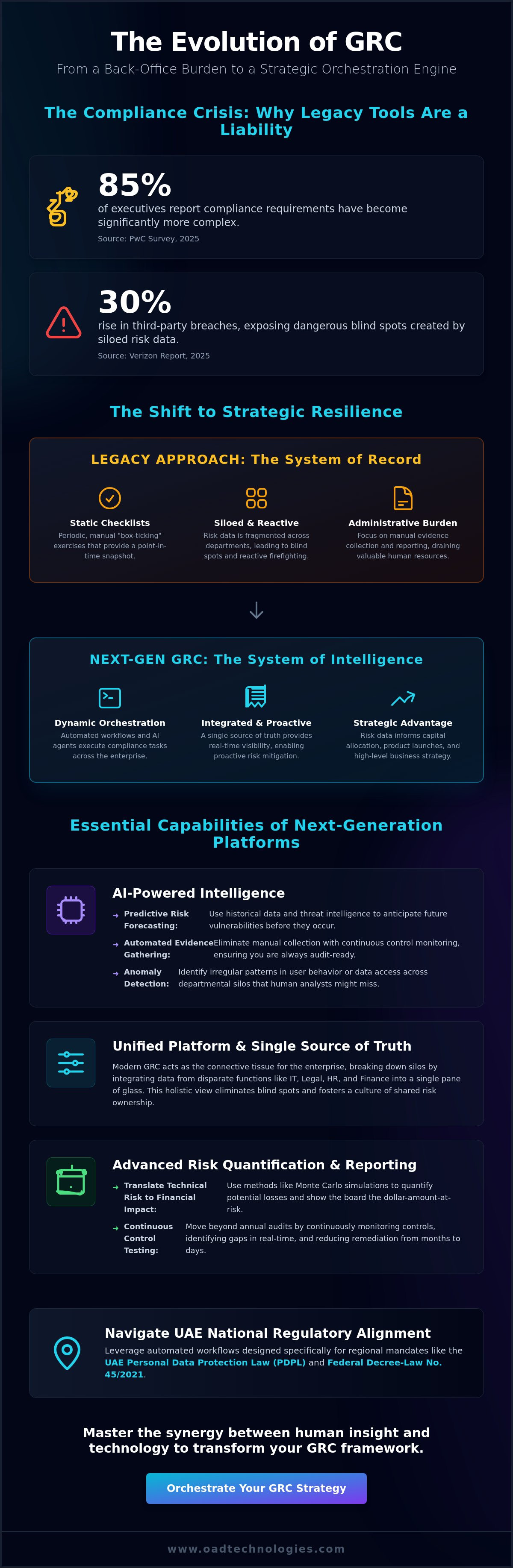
According to a 2025 PwC survey, 85% of executives report that compliance requirements have become significantly more complex over the last three years. If you're managing manual evidence collection or struggling to align with UAE Federal Decree-Law No. 45/2021, you aren't alone. Most leaders recognize that siloed risk data across departments creates dangerous blind spots. Selecting the right grc tools and software for enterprise is no longer a simple administrative task; it's a strategic necessity to bridge the gap between technical security and high-level governance.
You've likely realized that traditional, document-heavy methods can't keep pace with the 30% rise in third-party breaches reported by Verizon in 2025. We'll show you how to master these complexities using a strategic framework for selecting next-generation GRC software. This guide explores how to move toward a single source of truth through automated compliance workflows and agentic AI ecosystems. By the end, you'll have a clear roadmap for achieving real-time visibility that empowers your board-level reporting and ensures long-term digital relevance in an evolving regulatory market.
Key Takeaways
- Transition from static compliance to dynamic orchestration by understanding why legacy tools fail to meet 2026's rapid regulatory shifts.
- Evaluate high-impact grc tools and software for enterprise based on their ability to provide continuous control testing and real-time risk quantification.
- Navigate the trade-offs between consolidated GRC suites and modular point solutions to build a customized stack that scales with your organization.
- Ensure regional compliance by leveraging automated workflows designed specifically for UAE Personal Data Protection Law (PDPL) and national Information Assurance Standards.
- Master the synergy between human insight and technological capacity to transform your GRC framework from a recording system into a strategic orchestration engine.
The Evolution of GRC Tools and Software for Enterprise in 2026
By 2026, the concept of Governance, risk, and compliance (GRC) has transitioned from a back-office administrative burden into a high-performance orchestration engine. Organizations no longer view risk as a series of checkboxes to be cleared once a quarter. Instead, the most resilient firms utilize grc tools and software for enterprise as a central nervous system that provides real-time visibility into every layer of the business. Legacy tools fail in this new environment because they rely on static snapshots of data. In a market defined by rapid regulatory shifts and sophisticated cyber threats, a tool that was current yesterday is a liability today.
We've moved toward a model of Governance for Performance. This shift means that risk data isn't just used to avoid fines; it's used to inform capital allocation, product launches, and strategic expansion. When your GRC framework is integrated with your broader technology stack, it stops being a barrier and starts being a competitive advantage. It bridges the gap between technical security teams and the boardroom by translating raw vulnerabilities into clear business impact. This allows for a proactive stance rather than a reactive scramble.
From Checklists to Strategic Resilience
The era of fragmented point solutions is over. Managing risk in silos creates blind spots that modern enterprises can't afford. We're seeing a decisive move toward integrated platforms that ingest data from across the entire digital estate, including SIEM, IAM, and cloud environments. Real-time data ingestion is now a non-negotiable requirement. Without it, leaders are making decisions based on outdated information. These next-generation tools empower executives to move beyond box-ticking and toward a model of strategic resilience. This resilience allows the organization to pivot quickly in response to emerging threats without compromising its regulatory standing or operational integrity.
The Role of AI and Automation in 2026
AI's role in GRC has evolved far beyond simple chatbots or basic search functions. Today's platforms leverage predictive risk modeling to forecast potential breaches before they occur. By analyzing patterns across massive datasets, these systems identify anomalies that human analysts might miss. This technology also removes the evidence collection burden that historically paralyzed compliance teams. Automation now handles the repetitive tasks of gathering logs and verifying controls, allowing your specialists to focus on high-level strategy. Key AI-driven capabilities include:
- Predictive Risk Forecasting: Using historical data and threat intelligence to anticipate future vulnerabilities.
- Automated Evidence Gathering: Continuous monitoring of controls to ensure audit readiness at all times.
- Anomaly Detection: Identifying irregular patterns in user behavior or data access across departmental silos.
Agentic GRC represents the next frontier of automation where AI agents independently execute complex compliance workflows and risk assessments across the enterprise ecosystem.
Essential Capabilities of Next-Generation GRC Platforms
Next-generation grc tools and software for enterprise act as the connective tissue between disparate business functions. They don't just store data; they orchestrate it. By integrating HR, IT, Legal, and Finance into a single pane of glass, these platforms eliminate the silo effect that often leads to compliance failures. This holistic approach is a cornerstone of a Governance Risk and Compliance (GRC): The 2026 Enterprise Strategy Guide. Rather than waiting for an annual audit, modern systems utilize automated evidence monitoring to test controls continuously, ensuring that gaps are identified and remediated in days rather than months.
Advanced Risk Quantification and Reporting
One of the most significant leaps in modern GRC is the ability to translate technical vulnerabilities into concrete financial impact. Using Monte Carlo simulations, these platforms can forecast potential losses based on various threat scenarios. This quantitative data is essential for board-level reporting. While a CISO needs to see granular patch status, the Board needs to understand the dollar-at-risk. Insights from McKinsey on GRC best practices suggest that this shift toward data-driven risk management is what separates market leaders from laggards. Real-time dashboards replace stale quarterly reports, providing a live view of the organization's risk posture at any given moment.
Interoperability with the Cybersecurity Stack
To provide true value, grc tools and software for enterprise can't operate in a vacuum. They must pull telemetry directly from your technical security stack to validate that controls are actually functioning. This includes integrating with your SIEM for threat detection logs and your EDR for endpoint health. When you conduct a Vulnerability Assessment and Penetration Testing (VAPT), the findings should map directly to your compliance frameworks within the GRC tool. Mapping these technical vulnerabilities ensures that your risk register is always accurate.
There's also a vital synergy between GRC and Identity and Access Management (IAM). By linking these systems, you can automate the verification of user access controls. This ensures that only authorized personnel have access to sensitive data, which is a primary requirement for most global regulations. Effective integration ensures that your compliance status isn't just a best guess but a reflection of your actual security posture. If you're looking to strengthen your resilience, you might consider a comprehensive VAPT assessment to identify the specific gaps your GRC software needs to track and manage.
Evaluating GRC Software: Platform vs. Point Solutions
Selecting grc tools and software for enterprise requires a clear eyed assessment of your organization's maturity and architectural philosophy. The debate usually centers on two paths: the "all-in-one" consolidated platform or a modular, best-of-breed stack. Consolidated platforms offer a unified data model and a consistent user interface, which simplifies training and provides a single source of truth. However, these suites can sometimes lack the deep, specialized functionality found in point solutions. On the other hand, a modular approach allows you to select the most advanced tool for specific needs, such as third-party risk or environmental social governance, but it often demands significant integration effort to prevent data silos.
Total Cost of Ownership (TCO) extends far beyond the initial license fee. You must account for implementation timelines, internal resource allocation, and the long term costs of maintaining custom integrations. Scalability is equally paramount. As your enterprise pursues national expansion or enters new regulated markets, your software must accommodate increased data volumes and more complex organizational hierarchies without a degradation in performance. A tool that works for a single entity might buckle under the weight of a multi-national corporate structure.
Platform Selection Criteria for Large Enterprises
Finding the sweet spot between ease of use and depth of customization is the primary challenge for procurement teams. If a tool is too complex, your front-line staff won't use it; if it's too simple, it won't capture the nuance required for sophisticated risk modeling. We recommend prioritizing an API-first architecture over closed ecosystems. This ensures your GRC environment can ingest data from your broader security stack seamlessly. Additionally, never underestimate the value of a local implementation partner. Having experts who understand regional business culture and specific regulatory nuances can be the difference between a successful rollout and a multi-million dollar shelfware mistake.
Risk-Based vs. Compliance-Based Approaches
Modern enterprises are moving away from "box-ticking" compliance toward a risk-based strategy. This means choosing software that helps you prioritize high-impact risks that could actually disrupt your operations, rather than just tracking minor compliance gaps. Your tool's regulatory content library should be evaluated for its regional relevance, ensuring it includes specific mandates like the UAE PDPL. To ensure your GRC data reflects reality, you need technical validation. This is where a strategic Vulnerability Assessment and Penetration Testing (VAPT) becomes essential. By feeding VAPT results directly into your GRC platform, you move from theoretical risk to a validated, evidence-based security posture.
Navigating UAE National Regulatory Alignment with GRC Tools
Organizations operating within the Emirates face a unique and rapidly maturing regulatory environment. Managing compliance is no longer just about following global best practices; it requires precise alignment with local mandates like the UAE Personal Data Protection Law (PDPL) and the Information Assurance Standards (ISR). Modern grc tools and software for enterprise address these challenges by replacing manual tracking with automated workflows. These systems don't just record data; they ensure that cross-border data transfers and residency requirements are handled with the technical rigor demanded by UAE authorities. This localized approach ensures your organization remains viable and compliant as national standards continue to evolve.
National Standards and Framework Mapping
The most effective GRC platforms offer pre-built templates for regional frameworks such as NESA and the Dubai Information Security Regulation (ISR). These templates allow your team to hit the ground running without having to manually interpret complex regulatory language. One of the most powerful features of next-generation software is "One-to-Many" mapping. This capability allows you to map a single security control, such as an encryption standard, across multiple national and international regulations simultaneously. By maintaining a continuous, audit-ready state, grc tools and software for enterprise significantly reduce the billable hours and operational downtime typically associated with UAE regulatory audits. This efficiency allows your compliance team to shift from administrative work to strategic risk management.
Data Sovereignty and Local Compliance
Data sovereignty is a non-negotiable priority for many UAE-based enterprises, particularly those in critical infrastructure or government-linked sectors. Your GRC software must support specific data residency and localization mandates, ensuring that sensitive information stays within the required geographical boundaries. Choosing vendors that understand and support UAE-specific standards is vital for long-term success. Beyond your internal operations, these tools are essential for managing third-party risk in a nationally interconnected supply chain. As your partners and vendors access your systems, your GRC platform provides the visibility needed to ensure they also adhere to national data protection standards. To ensure your framework is built on a foundation of technical excellence, you can explore our specialized Governance, Risk, and Compliance solutions tailored for the regional market.
Managing these requirements manually is increasingly impossible as the volume of data grows. A centralized platform acts as a guardian of your digital relevance, providing the stability needed to navigate the complexities of the UAE's digital evolution. By integrating these tools into your core strategy, you transform compliance from a reactive burden into a proactive business driver that supports sustainable growth across the region.
Orchestrating Your GRC Strategy with OAD Technologies
Software alone cannot solve a governance crisis. While the right grc tools and software for enterprise provide the necessary infrastructure, they represent only 20% of the success equation. The remaining 80% depends on a well-defined strategy, refined processes, and the human expertise required to interpret complex data. At OAD Technologies, we don't just implement software; we act as a strategic partner to ensure your technology stack delivers measurable business results. By moving from a simple tool implementation to a managed resilience partnership, your organization gains the agility needed to thrive in a volatile risk environment.
A critical component of this orchestration is the integration of GRC with Data Loss Prevention (DLP). When your GRC platform communicates directly with your DLP protocols, you create a holistic protection layer that spans from high-level policy to granular data movement. This synergy ensures that your governance isn't just theoretical but is actively enforced across your digital estate. It bridges the gap between what you say you're doing and what your systems are actually doing.
Strategic Implementation and Integration
OAD Technologies serves as a master designer for your security and governance architecture. We recognize that every enterprise has a unique DNA, so we reject standardized, "out-of-the-box" approaches. Instead, we customize GRC workflows to match your specific operational requirements and risk appetite. This process involves bridging the traditional gap between the Security Operations Center (SOC) and the Compliance Office. By aligning these two functions, we transform technical telemetry into actionable governance insights. This ensures that your compliance posture is backed by real-world security data, not just static documentation.
The Future of Managed GRC
The future of risk management lies in continuous optimization. We leverage telemetry from Managed Detection and Response (MDR) to feed real-time risk scores back into your GRC system. This creates a feedback loop where every detected threat informs your broader risk posture. As new threats emerge, your grc tools and software for enterprise must evolve to stay relevant. Our team ensures your stack remains optimized for long-term viability, protecting your digital relevance in an ever-changing market. We help you move beyond point-in-time assessments to a state of constant readiness.
Don't leave your governance to chance. Design your strategic GRC framework with OAD Technologies today to build a resilient, future-proof enterprise that values precision and high-quality craftsmanship.
Building a Resilient Governance Architecture for 2026
The shift from manual checklists to AI-powered orchestration is no longer a future projection. It's a current requirement for any firm operating in a complex regulatory landscape. By unifying risk data and automating evidence collection, you transform compliance from a reactive cost center into a driver of strategic performance. You've seen how selecting the right grc tools and software for enterprise bridges the gap between technical security and the boardroom while ensuring strict alignment with UAE national security standards.
Success in this space requires more than just a software license. It demands a partner who understands the deep synergy between Governance, Risk, and Compliance (GRC), Data Loss Prevention (DLP), and Managed Detection and Response (MDR). OAD Technologies provides this integrated expertise. We act as a master designer for your digital resilience, moving beyond standardized setups to build a customized framework that evolves with your business. Our strategic partnership approach ensures your technology stack remains a guardian of your ongoing digital relevance.
Secure Your Enterprise Future with OAD Technologies. Your roadmap to sustainable growth and operational excellence starts here.
Frequently Asked Questions
What are the primary benefits of using GRC tools for large enterprises?
GRC platforms provide a single source of truth by unifying risk data from across the entire organization. This eliminates the silos that often hide vulnerabilities and allows for automated compliance workflows. For large enterprises, these tools replace manual evidence collection with continuous monitoring. This shift ensures you maintain audit readiness at all times while empowering leadership to make risk-informed strategic decisions that protect long-term digital relevance.
How does GRC software help with UAE PDPL compliance?
GRC software simplifies adherence to the UAE Personal Data Protection Law by providing pre-built templates that map specific data controls to the law's requirements. It helps manage complex data residency and localization mandates by tracking where sensitive information is stored and processed. By using grc tools and software for enterprise, you can automate the reporting needed to demonstrate compliance to national authorities, reducing the risk of administrative penalties.
Can GRC tools integrate with existing cybersecurity software like SIEM or EDR?
Integration is a core capability of next-generation GRC platforms. These tools utilize API-first architectures to ingest real-time telemetry from your SIEM and EDR solutions. This connectivity allows the GRC system to validate that technical controls are functioning as intended. By linking these systems, you ensure your risk register is based on actual endpoint health and threat detection data rather than static, manual entries or outdated spreadsheets.
Is it better to choose a cloud-based or on-premise GRC solution in 2026?
The choice depends largely on your industry’s data residency requirements and internal security policies. While cloud-based solutions offer superior agility and faster updates, some organizations in highly regulated UAE sectors prefer on-premise or hybrid models to maintain total control over data sovereignty. In 2026, most leading platforms provide flexible deployment options that satisfy national localization mandates while still offering the benefits of AI-driven orchestration and remote scalability.
How long does it typically take to implement an enterprise GRC platform?
Implementation timelines vary based on the complexity of your organizational structure and the number of integrated systems. A phased rollout typically takes between three and nine months. This period includes mapping your existing controls, configuring workflows, and establishing data integrations with your security stack. Success depends on having a clear roadmap and a dedicated implementation partner to ensure the software is customized to your specific organizational DNA.
What is the difference between a GRC tool and a simple compliance checklist?
A simple checklist is a point-in-time recording system that quickly becomes obsolete. In contrast, grc tools and software for enterprise act as dynamic orchestration engines that provide continuous monitoring and predictive analytics. While a checklist only tells you what you've done, a GRC platform shows you real-time risk posture and forecasts potential impacts. It moves your strategy from reactive box-ticking to proactive, data-driven governance and strategic resilience.
How does AI improve the accuracy of risk quantification in GRC software?
AI improves risk quantification by analyzing massive datasets to identify patterns and anomalies that human analysts might miss. It utilizes predictive modeling and Monte Carlo simulations to forecast the financial impact of various threat scenarios. This technology removes the guesswork from risk assessment, providing leaders with concrete data to prioritize high-impact vulnerabilities. It ensures your risk scores are a reflection of actual environmental telemetry rather than subjective manual estimates.
What should I look for in a GRC implementation partner in the UAE?
Look for a partner with deep expertise in UAE national security standards, such as NESA and ISR. They should possess the technical capacity to integrate GRC with your existing stack, including DLP and MDR solutions. A reliable partner acts as a master designer, offering customized strategies rather than standardized fixes. Ensure they prioritize a collaborative approach that bridges the gap between your technical teams and executive leadership for long-term success.
Disclaimer
Content by OAD Technologies is for general informational purposes only and does not constitute professional or cybersecurity advice. No warranties are made regarding accuracy or completeness; reliance is at your own risk. OAD Technologies shall not be liable for any direct or indirect losses arising from use of this content.


