

If your security strategy relies on a single calendar date to trigger a defense check, you're likely already exposed. The question of how often should you conduct a penetration test has evolved from a simple compliance checkbox into a high-stakes strategic decision. Most leaders feel the pressure of balancing fixed budget constraints against a threat landscape where the average US data breach cost hit a record $10.22 million in 2025. You're right to suspect that an annual assessment is no longer a sufficient shield against adversaries who iterate their tactics daily.
This guide provides a defensible, bespoke roadmap to align your testing cadence with the 2026 threat landscape and the mandatory requirements of the updated HIPAA Security Rule. You'll discover how to transition from reactive testing to a proactive, risk-based schedule that satisfies both the Board and national regulators. We'll examine the shift toward continuous testing models and provide the technical authority you need to improve your security posture without creating operational downtime.
Key Takeaways
- Move beyond the "point-in-time" fallacy by shifting from rigid calendar-based schedules to a dynamic, risk-driven security strategy.
- Determine how often should you conduct a penetration test by evaluating your specific infrastructure complexity and the sensitivity of the data assets you protect.
- Ensure full alignment with 2026 global and national mandates, including the mandatory requirements of PCI DSS 4.0 and the UAE Personal Data Protection Law.
- Identify critical operational triggers, such as major cloud migrations or application version releases, that necessitate immediate out-of-cycle testing.
- Discover how a bespoke VAPT partnership transforms security from a technical hurdle into a strategic asset that supports long-term business growth.
The Evolution of Pentest Frequency: Why Annual Testing is No Longer the Gold Standard
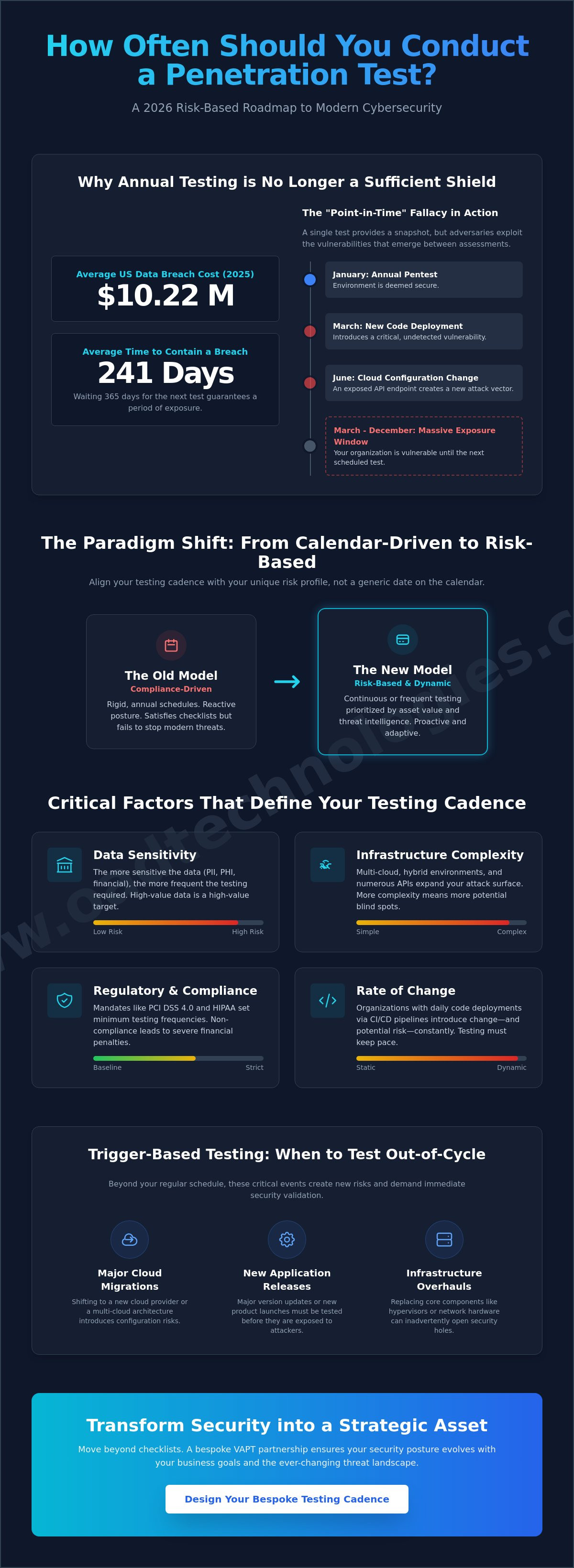
In the context of modern cybersecurity, penetration test frequency refers to the strategic interval between simulated, human-led attacks designed to identify and exploit vulnerabilities. While many organizations previously viewed this as an annual exercise, the 2026 threat landscape has rendered that approach obsolete. To understand what is a penetration test in a strategic sense, one must view it as a stress test for your digital architecture. Relying on a report from January to protect you in March is a dangerous gamble known as the "Point-in-Time" fallacy. In the 90 days following a test, your environment likely undergoes dozens of code deployments, configuration changes, and third-party updates. Each change is a potential entry point for adversaries who now use automated exploit weaponization to find and hit targets within hours of a vulnerability release.
Deciding exactly how often should you conduct a penetration test requires a shift from calendar watching to risk assessment. A sophisticated defense requires a dual-layered Vulnerability Assessment and Penetration Testing (VAPT) approach. While automated scans provide broad coverage, deep-dive penetration tests uncover the complex logic flaws that machines miss. In 2025, the average time to identify and contain a breach was 241 days; waiting 365 days for your next test effectively guarantees that an intruder could live in your network for most of the year before being discovered.
The Shift from Compliance-Driven to Risk-Based Testing
Checking a box for an auditor might satisfy a checklist, but it rarely stops a sophisticated breach. Compliance standards like PCI DSS 4.0 provide a baseline, yet they often lag behind the actual velocity of attackers. When the average cost of a US data breach reached $10.22 million in 2025, the financial argument for "just enough" security collapsed. A risk-based approach prioritizes testing based on the value of the assets and the likelihood of attack. A Security-First cadence acts as a proactive business enabler by ensuring that defense evolves at the same velocity as your digital transformation goals.
Continuous vs. Periodic Testing: Finding the Middle Ground
Annual testing is a relic; however, not every organization has the resources for a fully continuous model. Quarterly cycles often provide the best balance for high-growth enterprises. The maturity of your security stack dictates your needs. If your internal team is lean, leveraging Managed Detection and Response (MDR) can bridge the gaps between deep-dive pentests by providing 24 X 7 visibility. While periodic tests offer deep architectural insights, MDR ensures that the vulnerabilities identified in your last assessment aren't being exploited while you wait for the next one. This synergy ensures you aren't just finding holes, but actively closing them before they result in a $7.42 million healthcare-sector-sized disaster.
Critical Factors Influencing Your Penetration Testing Cadence
Determining how often should you conduct a penetration test requires a deep dive into your organization's unique risk profile. It isn't a static number. Instead, it's a dynamic response to your data sensitivity and the complexity of your digital footprint. For instance, an organization managing 50,000 PII records faces different pressures than one protecting a global supply chain with millions of data points. If you're operating in the healthcare sector, which saw average breach costs of $7.42 million in 2025, your margin for error is non-existent. High-value targets require more frequent, more aggressive probing to ensure that defensive layers remain intact.
Infrastructure complexity further complicates this cadence. As you scale across multi-cloud or hybrid environments, your attack surface expands exponentially. Every new API endpoint or cloud configuration change creates a potential blind spot. If your development team pushes code daily through a CI/CD pipeline, a quarterly test might leave you vulnerable for 89 days out of every 90. We also monitor threat intelligence trends; if your specific industry is seeing a surge in automated exploit weaponization, we recommend tightening your testing intervals to stay ahead of the curve. This is especially true for firms undergoing major infrastructure shifts, such as a VMware replacement, which can introduce temporary configuration gaps.
Assessing Your Digital Asset Value
Effective testing requires you to categorize assets based on their criticality. Your public-facing APIs, which serve as the gateway to your services, require a much higher testing cadence than air-gapped internal databases. By segmenting your environment, you can apply a bespoke testing schedule that allocates resources where they matter most. This approach aligns perfectly with a comprehensive Data Loss Prevention (DLP) framework, ensuring that your most sensitive intellectual property is never left unvalidated for too long.
Security Maturity and Internal Capabilities
The maturity of your internal security team significantly influences the question of how often should you conduct a penetration test. A robust internal vulnerability management program can handle routine hygiene, allowing external pentests to focus on complex, human-led deep dives. We view ourselves as the "Expert Architect" in this relationship, providing the external validation your internal controls need. While automated scans catch the "low-hanging fruit," they can't simulate the creative persistence of a human adversary. Balancing these tools with a tailored VAPT strategy ensures that your security posture remains resilient without overwhelming your operational budget. This collaborative model transforms security from a recurring cost into a strategic pillar of your digital growth.
Compliance vs. Security: Navigating Global and National Regulatory Mandates
Meeting regulatory requirements is often mistaken for achieving total security. However, the 2026 regulatory environment demands a more sophisticated approach than a simple annual check. For instance, PCI DSS 4.0, which became fully mandatory on March 31, 2025, explicitly requires penetration testing at least annually and after any significant infrastructure change. For service providers, this frequency increases, requiring segmentation validation every six months. While these global standards set the floor, national mandates like the UAE Personal Data Protection Law (PDPL) and the Information Assurance Regulation (ISR) introduce specific data residency and protection layers that require a more tailored strategy.
Determining how often should you conduct a penetration test requires balancing these overlapping mandates. In the UAE, ISR compliance often necessitates regular technical audits to maintain government-grade security standards. Relying solely on a "compliance minimum" leaves blind spots that attackers exploit between audit cycles. By utilizing Governance, Risk, and Compliance (GRC) services, you can align these disparate schedules into a unified roadmap. This ensures you're not just satisfying an auditor in Dubai or London, but actively hardening your perimeter against evolving threats.
Sector-Specific Requirements
In financial services, quarterly testing has become the de facto industry standard due to the high volume of transactions and the constant evolution of fintech APIs. Healthcare organizations face even tighter scrutiny; as of May 2026, updated HIPAA Security Rule proposals suggest annual penetration testing is moving from a recommendation to a mandatory standard for all covered entities. Navigating these mandates doesn't have to result in operational friction. We help clients consolidate multiple audit requirements into a single, strategic pentesting program that satisfies international standards like ISO 27001:2022 while addressing local PDPL obligations.
The Legal Implications of Testing Frequency
The question of how often should you conduct a penetration test is now a matter of legal due diligence. In the event of a breach, the Board's liability often hinges on whether they followed industry best practices or merely the bare legal minimum. 2026 legal precedents increasingly view "annual-only" testing as insufficient for large enterprises, especially those managing high volumes of PII. Regular third-party validation provides a defensible record of proactive defense. It proves that you treated security as a continuous business process rather than a once-a-year administrative task.
Trigger-Based Testing: When to Conduct Out-of-Cycle Pentests
Relying on a fixed schedule ignores the reality of digital transformation. If you've recently migrated from on-premise servers to a multi-cloud environment, your previous pentest is effectively void. The question of how often should you conduct a penetration test becomes secondary to the question of what has changed in your architecture. Major application releases or version updates also demand targeted testing. Since attackers weaponize exploits within hours, launching a new product without a fresh VAPT check invites disaster. You wouldn't launch a vessel without a hull inspection; your digital products deserve the same rigor.
Mergers and acquisitions present a unique peril. Integrating a target company's network without a pre-acquisition pentest often leads to inheriting dormant malware or unpatched backdoors. This can turn a strategic expansion into a $10.22 million liability overnight. Similarly, after a security incident, a follow-up test is non-negotiable. You must validate that your remediation efforts actually closed the entry point and that no secondary persistence mechanisms remain. This architectural verification ensures that your recovery is permanent rather than a temporary patch that an attacker can easily peel away.
The "Significant Change" Checklist
Most compliance frameworks use the term "significant change" without defining it. In our experience as Expert Architects, a change is significant if it alters the flow of sensitive data or modifies your trust boundaries. This includes adding a new regional office, implementing a new remote access protocol, or migrating to a software-defined perimeter. For modern DevOps teams, we recommend integrating automated security checks directly into the CI/CD pipeline. However, these automated tools can't replace the nuanced insight of human-led pentests after every major sprint or architectural pivot. This hybrid approach keeps your security posture in sync with your development velocity.
Cloud and Identity Triggers
Misconfigurations remain the leading cause of cloud-based data breaches. When you adjust your Identity and Access Management (IAM) policies, you're potentially opening new attack vectors that automated tools might miss. Frequent validation of these boundaries is the cornerstone of a Zero Trust model. High-priority alerts from your Cloud Security Posture Management (CSPM) system should also serve as a trigger for a deeper manual investigation. If your CSPM flags a persistent drift in configuration or unauthorized bucket access, it's time to verify the integrity of your entire cloud stack. If you're navigating a complex migration, reach out to OAD Technologies for a bespoke assessment that secures your long-term roadmap.
Designing a Bespoke Testing Cadence with OAD Technologies
At OAD Technologies, we reject the transactional, speed-over-substance model that defines many modern testing platforms. Determining how often should you conduct a penetration test isn't just about finding a slot in a calendar; it's about architecting a defense that mirrors your specific business goals and risk appetite. We move beyond simple vulnerability discovery by treating every engagement as a strategic milestone within your broader VAPT strategy. Our focus remains on high-quality craftsmanship, ensuring that our findings translate into measurable ROI and improved operational efficiency.
While automated tools have advanced, they still struggle to replicate the creative intuition of a human adversary in 2026. Our team leverages sophisticated human intelligence to uncover the intricate logic flaws that automated scans routinely overlook. This collaborative approach ensures that your security posture isn't just compliant, but truly resilient against the bespoke exploits targeting your unique infrastructure. By integrating these insights with your existing Managed Detection and Response (MDR) or Data Loss Prevention (DLP) frameworks, we create a seamless defensive web that protects your data from every angle.
Beyond the Report: Remediation and Resilience
Our role as your Expert Architect doesn't end with the delivery of a PDF. We provide comprehensive post-test support, including thorough re-testing to ensure that remediation efforts have successfully neutralized the identified risks. We understand that explaining technical debt to the Board is a common pain point. To solve this, we translate complex technical findings into strategic business narratives. This helps C-suite executives understand why the question of how often should you conduct a penetration test is a fundamental business decision that protects long-term growth and strategic stability. This process allows us to build a multi-year roadmap that matures your security posture as your company scales.
Future-Proofing Your Security Strategy
The 2026 threat landscape is increasingly defined by AI-driven automated attacks and the emerging need for quantum-resistant architectures. We help you stay ahead of these shifts by positioning our technology as an extension of your own team. A distant third-party vendor model can't provide the same level of future-proofing as a dedicated strategic partner. By choosing a collaborative path, you ensure that your security measures empower your people rather than just replacing your processes. We provide the stability and expertise required to navigate these complex digital challenges with confidence. To begin designing your defensible security schedule, schedule a consultation with OAD Technologies for a bespoke VAPT assessment.
Architecting a Resilient Future
The transition from static, annual checklists to a dynamic, risk-based defense is no longer optional. By evaluating your infrastructure velocity and data sensitivity, you've moved beyond the "Point-in-Time" fallacy toward a posture of continuous validation. Determining how often should you conduct a penetration test requires balancing these internal shifts with the rigorous demands of the UAE Personal Data Protection Law and global PCI DSS 4.0 standards. This integrated approach ensures that your security efforts drive strategic growth rather than merely satisfying an auditor's requirement.
OAD Technologies serves as your Expert Architect; we bridge the gap between complex technical assessments and high-level business objectives. Our model prioritizes a long-term strategic partnership over one-off vendor transactions, integrating specialized UAE-market expertise with comprehensive GRC frameworks. This collaborative method empowers your team to stay ahead of automated exploits while maintaining operational momentum. Secure your enterprise with a bespoke VAPT strategy from OAD Technologies and turn your security posture into a competitive advantage. You're now equipped to build a digital future that's both innovative and unshakeable.
Frequently Asked Questions
Is an annual penetration test enough for PCI DSS compliance?
No, an annual test is merely the baseline for compliance. PCI DSS v4.0 requires testing after any significant infrastructure change; additionally, service providers must perform segmentation validation every six months. Since all future-dated requirements became mandatory on March 31, 2025, staying compliant requires a more frequent, trigger-based approach to ensure your payment environment remains resilient against 2026 threats.
What is the difference between a vulnerability assessment and a penetration test?
A vulnerability assessment is a broad, automated scan that identifies known security gaps, while a penetration test is a deep, human-led simulation of a real-world attack. Scans offer high-frequency hygiene, but pentests attempt to exploit vulnerabilities to verify their actual business impact. Combining both creates a comprehensive VAPT strategy that protects your critical architecture from complex logic flaws that automated tools often miss.
How much does a penetration test typically cost in 2026?
Costs vary significantly based on the scope, complexity, and depth of the assessment rather than a flat fee. While we don't provide generic pricing, industry data shows that the global PTaaS market is projected to reach $0.72 billion in 2026. Investing in a bespoke assessment is a strategic hedge against the record-high $10.22 million average cost of a US data breach recorded in 2025.
What counts as a "significant change" requiring a new pentest?
A change is significant if it alters how data flows or modifies your security perimeter, such as migrating to a new cloud provider or implementing a new IAM protocol. Adding a regional office or launching a major software version also triggers this requirement. These events fundamentally shift your attack surface, making your previous report obsolete and requiring fresh validation to maintain your security posture.
Can we use automated tools instead of a manual penetration test?
Automated tools are excellent for continuous hygiene, but they can't replace the creative intuition of a human expert. In 2026, attackers use sophisticated AI to bypass standard automated defenses. A manual test uncovers the complex chains of vulnerabilities and logic errors that software misses, providing the deep architectural insight needed for long-term resilience and a defensible security roadmap.
How long does a standard enterprise-level penetration test take?
A thorough assessment typically spans two to four weeks depending on the environment's complexity. This timeframe includes the initial reconnaissance, active exploitation, and the development of a strategic remediation roadmap. We prioritize precision over speed to ensure every potential vector is analyzed, helping you understand how often should you conduct a penetration test to maintain this level of depth across your lifecycle.
Should we conduct internal or external penetration tests more frequently?
Both are critical, but external tests often require a higher cadence because your public-facing perimeter is exposed to 24 X 7 automated probing. Internal tests are essential for validating your Zero Trust boundaries and lateral movement defenses. We recommend a balanced schedule where external assets are tested quarterly and internal environments undergo deep-dive assessments at least twice a year to ensure total coverage.
How do we prepare our systems for an upcoming penetration test?
Start by defining a clear scope and ensuring all internal stakeholders are aligned on the testing objectives. You should back up all critical data and provide the testing team with necessary documentation, such as network maps or API specifications. This preparation allows our team to function as an extension of yours, focusing on identifying complex vulnerabilities rather than navigating administrative hurdles during the engagement.
Disclaimer
Content by OAD Technologies is for general informational purposes only and does not constitute professional or cybersecurity advice. No warranties are made regarding accuracy or completeness; reliance is at your own risk. OAD Technologies shall not be liable for any direct or indirect losses arising from use of this content.


