

Why are organizations paying up to $35 per endpoint for managed security while their Mean Time to Respond remains stagnant? In a market projected to reach a $6.28 billion valuation this year, the gap between basic alert monitoring and true cyber resilience is widening. Understanding how to choose an mdr provider requires moving beyond software checklists to find a strategic architect capable of navigating the sophisticated AI-driven threat landscape of 2026. You're likely feeling the strain of persistent alert fatigue and the rigorous pressure to satisfy UAE ISR and PDPL compliance standards without a massive internal SOC. We recognize that you don't just need another vendor; you need a partnership that functions as a high-performance extension of your own team.
This guide provides a definitive framework for evaluating MDR partners through the lenses of technical capability, human expertise, and strategic alignment. You'll learn how to identify providers that offer more than just technology-first automation, focusing instead on bespoke integration with your existing DLP and EDR stacks. We'll explore the shift toward proactive exposure management and how to verify if a $3,000,000 breach warranty actually protects your interests. We'll outline the exact criteria needed to reduce your MTTR and secure your organization's long-term digital relevance.
Key Takeaways
- Prioritize human-led SOC expertise over basic automation to effectively counter sophisticated 2026-era threats.
- Master a structured 5-step roadmap on how to choose an mdr provider that aligns with your specific risk profile and national compliance standards like UAE ISR.
- Evaluate the interoperability of potential partners with your existing SIEM and EDR stacks to ensure a seamless and unified security posture.
- Look for bespoke strategic alignment rather than generic models to achieve a significant reduction in your Mean Time to Respond (MTTR).
The Evolution of Managed Detection and Response in 2026
By 2026, the cybersecurity paradigm has shifted from passive defense to a state of continuous, active resilience. Managed detection and response (MDR) is no longer a luxury for the few; it's a bespoke fusion of high-velocity technology and human-led threat hunting. While industry analysts recently noted that 60% of organizations will utilize MDR services by the end of this year, simply buying a subscription isn't enough. The challenge lies in how to choose an mdr provider that acts as a strategic architect rather than a mere alert factory.
Traditional Security Operations Center (SOC) models are failing against 2026-era automated threats. These legacy systems rely on static playbooks that can't keep pace with AI-generated polymorphic malware. True MDR moves the needle from simple alerting to active remediation. This means your partner doesn't just send an email at 2 AM; they isolate the infected host and neutralize the threat before your team even logs in. For national enterprises, this requires a provider with localized expertise who understands the nuances of regional data residency and compliance.
MDR vs. Managed MSSP: Understanding the Gap
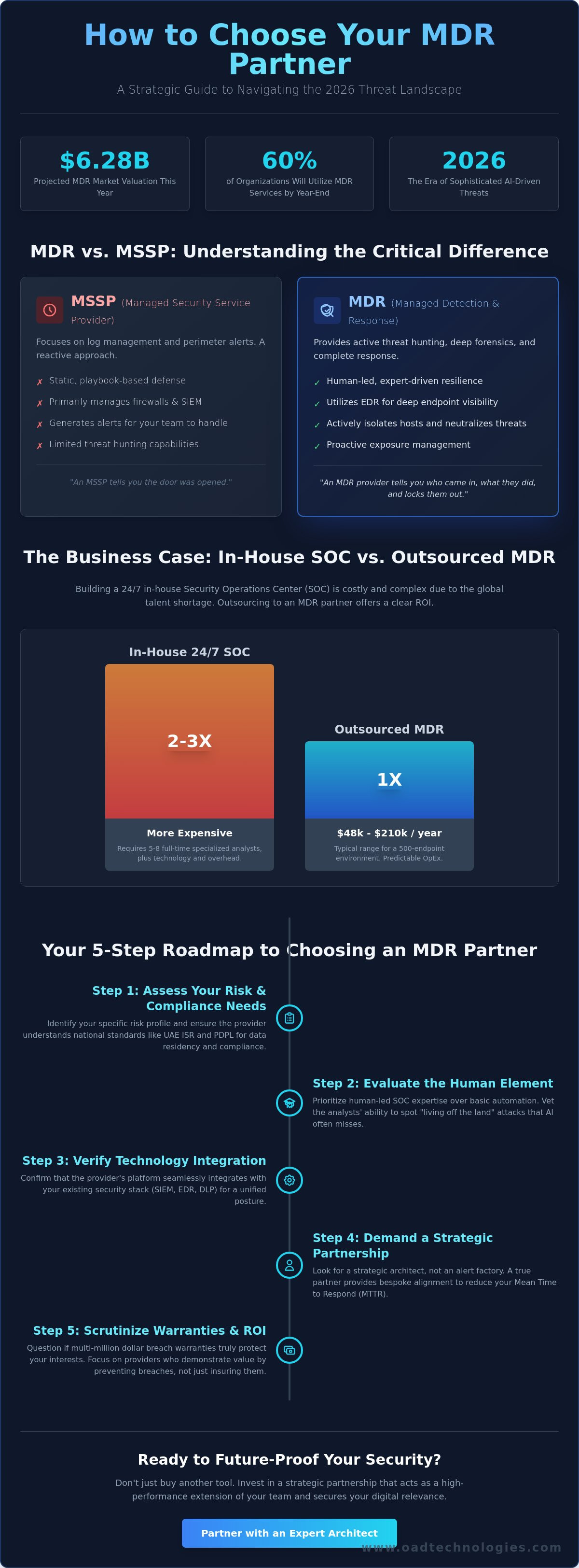
It's easy to confuse MDR with a Managed Security Service Provider (MSSP), but the difference is foundational. MSSPs focus on log management and perimeter alerts. In contrast, MDR utilizes Endpoint Detection and Response (EDR) as its primary engine to perform deep forensic detection. An MSSP tells you the door was opened; an MDR provider tells you who walked through it, what they touched, and then locks the door behind them. Without this active response capability, your organization remains exposed to modern risk profiles that exploit the lag time between detection and human intervention.
The Business Case for Outsourced Detection
The ROI of outsourcing is undeniable when you look at the numbers. For a 500-endpoint environment, endpoint-only MDR services in 2026 typically cost between $48,000 and $210,000 annually. Attempting to build an equivalent in-house 24 X 7 SOC requires a minimum of five to eight specialized analysts to cover shifts, which often costs double or triple that amount in salary alone. When evaluating how to choose an mdr provider, businesses must weigh the cost of a catastrophic breach against the predictable operational expense of a high-tier partnership.
The national cybersecurity talent shortage makes finding these experts nearly impossible for most firms. Investing in managed detection and response bridges this gap, providing immediate access to elite threat hunters and ensuring your long-term digital relevance. This partnership allows your internal team to focus on strategic growth while the Expert Architect handles the complexities of the modern threat landscape.
Evaluating the Human Element: SOC Analysts and Threat Intelligence
Technology is a force multiplier, but the efficacy of any security program is ultimately capped by the expertise of its human analysts. When determining how to choose an mdr provider, you must look past the flashy dashboards and interrogate the caliber of the team behind the screen. While AI can process millions of events per second, it lacks the contextual intuition required to identify "living off the land" attacks. These sophisticated maneuvers involve intruders using authorized administrative tools like PowerShell or Windows Management Instrumentation to move laterally. Automated systems often ignore these actions as legitimate activity, but a seasoned analyst recognizes the subtle deviations that signal a breach in progress.
True resilience requires 24 X 7/365 operations, yet the structure of this coverage is what separates a vendor from a partner. Many providers utilize a generic "follow-the-sun" model that can lead to fragmented handovers and lost context during critical shifts. A more robust approach involves dedicated national pods that possess a deep understanding of the UAE's specific regulatory environment and local threat actors. These analysts act as your Expert Architects. They don't just triage alerts; they lead the remediation effort, ensuring that every response is grounded in your specific business logic and operational requirements.
The Role of Advanced Threat Intelligence
Top-tier providers leverage global threat databases but refine that intelligence with national precision. This involves a sophisticated integration of machine learning and human validation to reduce the false positives that cause alert fatigue. By filtering the noise, analysts can focus their energy on high-fidelity signals. Proactive Threat Hunting is the search for undetected malicious activity within a network. This methodology ensures that dormant threats are identified and neutralized before they can execute their final payload. If you want to see how this level of human-led intelligence transforms your defense, you can explore our bespoke MDR capabilities.
Incident Response and Forensic Depth
When a high-pressure breach occurs, you need forensic depth rather than a simple system reboot. Your provider must be capable of performing a comprehensive root cause analysis to identify exactly how an attacker gained entry and what they touched. Clear communication protocols are essential during these events to ensure your stakeholders remain informed without being overwhelmed by technical jargon. Unlike a "standard response" that follows a rigid, one-size-fits-all script, bespoke remediation is tailored to your unique infrastructure. This ensures that security measures protect your assets without accidentally disrupting critical business processes or causing unnecessary downtime.
Technology Integration: SIEM, EDR, and the Unified Stack
Successful MDR deployment requires more than a simple API connection. It demands a unified architecture where telemetry flows seamlessly between disparate tools. When researching how to choose an mdr provider, you must evaluate their ability to ingest data from your existing SIEM and EDR investments. This prevents the "rip and replace" cycle that drains budgets and disrupts operations. A provider's ability to operate within your current ecosystem determines whether they're a technical burden or a strategic asset.
The choice between a "Bring Your Own License" (BYOL) model and a "Vendor-Provided Stack" is a critical strategic decision. BYOL offers you greater flexibility and long-term data ownership, while a vendor-provided stack often guarantees tighter integration and faster deployment. Regardless of the model, protecting your digital assets requires the intersection of MDR and data loss prevention. This ensures that while you're detecting external threats, you're also preventing the unauthorized exfiltration of sensitive information. In hybrid environments, Cloud Security Posture Management (CSPM) integration is mandatory to eliminate the blind spots inherent in multi-cloud architectures.
Visibility Across the Entire Attack Surface
Monitoring endpoints is just the baseline in 2026. A comprehensive MDR strategy must encompass networks, cloud workloads, and identities. Data from identity and access management (IAM) enriches alerts by providing the "who" behind the "what." This allows analysts to distinguish between a compromised credential and a legitimate administrative task. Furthermore, results from regular VAPT exercises identify specific vulnerabilities that your MDR provider should prioritize for monitoring. This evaluation of technical interoperability is a core pillar in how to choose an mdr provider that actually adds value to your existing stack.
Automation vs. Human Intervention
Efficiency relies on automated Security Orchestration, Automation, and Response (SOAR) playbooks, but blind automation is dangerous. If a playbook automatically shuts down a critical production server during a false positive, the business impact outweighs the security benefit. You need a partner who balances automated speed with manual analyst intervention. This human-led decision-making ensures that response actions are surgical rather than blunt. Future-proofing your security means choosing cloud-native architectures that scale as your data volumes grow, ensuring performance doesn't degrade during a high-pressure crisis.
A Strategic Roadmap for Selecting Your MDR Partner
Selecting a security partner is a high-stakes architectural decision that dictates your organization's resilience for years to come. It isn't merely a procurement task; it's a search for a collaborator that understands your specific threat surface. When determining how to choose an mdr provider, you need a structured methodology that moves from internal discovery to a rigorous Proof of Concept (PoC). This roadmap ensures that your chosen partner doesn't just provide software, but delivers a bespoke service aligned with your operational goals.
The selection process should follow five distinct phases to guarantee success. First, conduct an internal needs audit. Second, perform a technical and operational evaluation. Third, shortlist vendors based on national regulatory alignment. Fourth, execute a deep-dive PoC using real telemetry. Finally, assess the onboarding plan to ensure a rapid "Time to Value." High-tier providers should achieve full operational integration within 30 days, providing immediate visibility into your environment.
Step 1: Internal Needs and Compliance Audit
Your journey begins with a clear identification of your critical data assets and the regulatory frameworks that govern them. For national enterprises, alignment with governance risk and compliance standards is non-negotiable. You must verify that a provider understands the intricacies of UAE ISR and the PDPL (Personal Data Protection Law). Define your required Service Level Agreements (SLAs) for detection and response times early. If your internal security maturity is low, you'll need a partner that offers more "hands-on" architectural guidance rather than just raw data feeds.
Step 2: Technical and Operational Evaluation
Don't settle for theoretical capabilities. Request detailed case studies that demonstrate how to choose an mdr provider based on their performance during complex Advanced Persistent Threat (APT) or ransomware scenarios. A capable partner provides bespoke reporting that speaks to both technical leads and C-suite executives, translating cyber risk into business impact. Inquire about their depth of vulnerability assessment and penetration testing integration. This ensures that the MDR team isn't just reacting to alerts, but is actively informed by the known weaknesses in your infrastructure, allowing for more precise threat hunting.
If you're ready to move beyond generic security and implement a framework tailored to your unique requirements, consult with an Expert Architect today to begin your strategic selection process.
Future-Proofing Your Security with OAD Technologies
OAD Technologies positions itself as the Expert Architect for national enterprise security. We don't believe in the "one-size-fits-all" approach that characterizes many legacy vendors. Instead, we offer a bespoke fusion of technology and human intelligence that scales with your ambition. When you're determining how to choose an mdr provider, look for a partner that integrates your security posture into a single, resilient framework. Our MDR service doesn't operate in a vacuum; it works in perfect synergy with our Data Loss Prevention (DLP) and Governance, Risk, and Compliance (GRC) consulting. This holistic view ensures that your defense is as much about protecting your long-term digital relevance as it is about stopping the next malware variant. We prioritize precision and craftsmanship in every security architecture we design, ensuring technical authority meets strategic growth.
The OAD Advantage: Human Intelligence + Machine Capability
Our methodology focuses on the intersection of human intelligence and machine capability. We utilize automation to handle the triage of thousands of daily events, but we empower our analysts to make the critical, high-stakes decisions that protect your ROI. Every deployment follows rigorous engineering standards, ensuring that our technology acts as a seamless extension of your internal team rather than just a replacement for your processes. As the MDR market grows at a projected 24.8% CAGR through 2031, OAD remains committed to shaping the future of national cybersecurity. We move beyond reactive monitoring to proactive exposure management, identifying vulnerabilities before they become entry points for AI-driven threats. This proactive stance ensures your organization stays ahead of attackers who leverage increasingly sophisticated automated tools.
Next Steps: Securing Your Digital Future
Securing your digital future begins with a strategic assessment of your current posture. Our onboarding process is engineered for zero-disruption integration, allowing you to achieve operational excellence without halting your business momentum. We provide a clear roadmap for every project, bridging the gap between high-level innovation and practical business results. When organizations ask how to choose an mdr provider for the long term, the answer lies in finding a partner that prioritizes strategic growth over quick fixes. We're prepared to architect your resilience and ensure you remain compliant with evolving national standards while maintaining peak performance. Contact our team to begin a strategic consultation and define the next phase of your digital transformation.
Architecting Your Path to Cyber Resilience
The security landscape of 2026 demands a fundamental shift from reactive alerting to active, human-led remediation. We've explored the necessity of integrating your MDR service with existing SIEM and EDR stacks while ensuring strict adherence to UAE ISR and PDPL compliance standards. Mastering how to choose an mdr provider is no longer just a technical checkbox; it's a strategic decision that defines your long-term operational stability and digital relevance. A successful partnership requires a balance of global threat intelligence and localized expertise that understands your specific business logic.
OAD Technologies bridges the gap between complex engineering and measurable business ROI. Our integration-first approach ensures your MDR and DLP strategies work in unison to protect your most sensitive digital assets from sophisticated automated threats. We provide the bespoke enterprise security architectures necessary to navigate this era of AI-driven risk with total confidence. Your organization's future depends on a foundation built on precision, authority, and deep collaborative partnership.
Consult with an OAD Expert Architect to design your bespoke MDR strategy today.
Frequently Asked Questions
What is the difference between MDR and a traditional SOC?
MDR differs from a traditional SOC by its emphasis on active remediation rather than just passive monitoring. While a standard SOC might alert you to a potential breach, an MDR provider takes surgical action to contain the threat, such as isolating endpoints or terminating malicious processes. This proactive stance is a key factor when researching how to choose an mdr provider that delivers true business resilience.
How does an MDR provider help with UAE PDPL compliance?
An MDR provider supports UAE PDPL compliance by ensuring data residency requirements are met and maintaining audit-ready evidence of security controls. They help you meet mandatory incident notification timelines by providing rapid forensic analysis of any data breach involving personal information. This localized expertise ensures your organization stays aligned with national regulatory mandates while maintaining operational continuity.
Can I keep my existing EDR tools when moving to an MDR service?
You can certainly keep your existing EDR tools by selecting a provider that supports a "Bring Your Own License" (BYOL) model. This approach allows for a seamless integration with your current security stack, preventing the need for costly "rip and replace" cycles. High-tier partners focus on optimizing your existing investments to provide deeper visibility across your entire attack surface.
How much human intervention is involved in a "Managed" response?
Human intervention is the cornerstone of a "Managed" response, specifically for critical decision-making and proactive threat hunting. While automation handles initial alert triage, human analysts in a 24 X 7/365 SOC perform the deep forensic investigation required to neutralize advanced threats. This balance ensures that response actions are precise and don't accidentally disrupt your essential business operations.
What is the typical onboarding timeline for an enterprise MDR partner?
The typical onboarding timeline for a strategic MDR partner is approximately 30 days to reach full operational maturity. This phase includes environment discovery, tool integration, and the establishment of communication protocols. Fast "Time to Value" is a critical metric when evaluating how to choose an mdr provider, as it ensures your organization isn't left vulnerable during a prolonged deployment.
How does MDR integrate with my Data Loss Prevention (DLP) strategy?
MDR integrates with your Data Loss Prevention (DLP) strategy by providing the detection capabilities needed to identify the unauthorized movement of sensitive data. While DLP tools set the boundaries for data usage, MDR analysts respond to the alerts triggered by those tools to investigate the intent behind the exfiltration. This synergy creates a robust defense that protects your digital assets from both external and internal risks.
What metrics should I use to measure the success of my MDR provider?
Success should be measured using Mean Time to Respond (MTTR) and Mean Time to Detect (MTTD), aiming for a 50% or greater reduction in these metrics compared to legacy SOC models. You should also track the reduction in false positive rates and the quality of the root cause analysis provided after an incident. These data points demonstrate the provider's ability to act as a genuine extension of your internal team.
Is MDR suitable for cloud-only or hybrid environments?
MDR is designed for both cloud-only and hybrid environments, utilizing Cloud Security Posture Management (CSPM) to monitor multi-cloud architectures. It provides a unified view of security across on-premises servers and cloud workloads, ensuring no blind spots exist in your infrastructure. This scalability is essential for modern enterprises undergoing digital transformation in a volatile threat landscape.
Disclaimer
Content by OAD Technologies is for general informational purposes only and does not constitute professional or cybersecurity advice. No warranties are made regarding accuracy or completeness; reliance is at your own risk. OAD Technologies shall not be liable for any direct or indirect losses arising from use of this content.


