

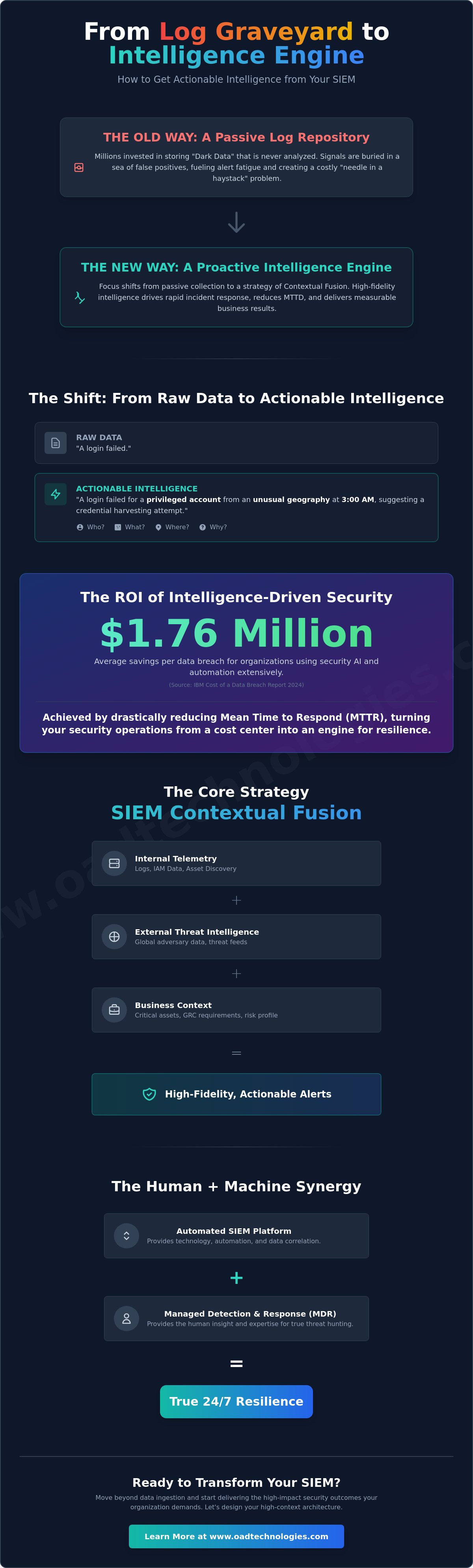
What if the millions you’ve invested in log storage are actually burying the signals that could save your network? Most security leaders feel the crushing weight of alert fatigue, where high-fidelity signals are lost in a sea of false positives. You’ve likely spent years fine-tuning correlation rules only to find that your team still lacks the context needed to respond to a breach in real time. This guide explores how to get actionable intelligence from siem by shifting your focus from passive data collection to a strategy of Contextual Fusion.
We'll show you how to transform your SIEM from a costly log repository into a proactive intelligence engine that drives rapid incident response. You'll learn to integrate AI-driven automation, reduce your Mean Time to Detect (MTTD), and ensure your operations align with 2026 standards like DORA and CIRCIA. This approach bridges the gap between raw telemetry and business results, providing a clear roadmap to move beyond data ingestion and start delivering the high-impact security outcomes your organization demands.
Key Takeaways
- Learn to distinguish between raw log data and interpreted intelligence to uncover the critical who, what, and why behind every security event.
- Discover how to get actionable intelligence from siem by fusing internal telemetry with external threat feeds for a comprehensive view of your risk profile.
- Align your detection capabilities with global standards by mapping SIEM rules directly to the MITRE ATT&CK framework and strategic regional intelligence.
- Implement the "So What?" framework to eliminate alert fatigue through advanced correlation, ensuring your team focuses only on high-fidelity threats.
- Explore the synergy between automated SIEM platforms and Managed Detection and Response (MDR) to provide the human insight required for true 24 X 7 resilience.
Beyond Log Management: Defining Actionable Intelligence in SIEM
For decades, many organizations treated Security Information and Event Management (SIEM) as a digital basement. It was a place where logs were stored for compliance and then largely forgotten. This passive approach creates "Dark Data," which is information that is collected and stored at a significant cost but never analyzed for risk. Understanding how to get actionable intelligence from siem requires a fundamental shift in perspective. You aren't just collecting data; you're seeking the "Who, What, Where, and Why" of a potential threat. Raw data tells you a login failed. Intelligence tells you that a login failed for a privileged account from an unusual geography at 3:00 AM, suggesting a credential harvesting attempt.
A common objection from security leaders is that more data leads to better visibility. In reality, expanding your ingestion without a clear intelligence strategy often leads to less clarity. When you flood your analysts with low-context logs, you create a "needle in a haystack" scenario that fuels alert fatigue. High-fidelity intelligence acts as the filter that removes the straw, leaving only the sharpest threats visible. It’s the difference between hearing a car alarm a mile away and receiving a notification that your front door has been forced open.
The Anatomy of a High-Fidelity Alert
A high-fidelity alert must stand on four pillars: Source, Intent, Impact, and Remediation. If an alert identifies that a server is communicating with a known malicious IP but doesn't tell you how to isolate that server, it's just noise. True intelligence includes a recommended "next step" that empowers your team to act immediately. This is why a refined SIEM strategy is critical. It moves the needle from "something happened" to "here is exactly what we do about it," ensuring that every notification leads directly to a resolution.
The ROI of Intelligence-Driven Security
Investing in intelligence isn't just a technical choice; it's a strategic business decision. Organizations that leverage security AI and automation extensively save an average of $1.76 million per data breach compared to those that don't, according to the IBM Cost of a Data Breach Report 2024. By focusing on actionable data, you drastically reduce your Mean Time to Respond (MTTR). This shift allows your team to move from reactive firefighting to proactive threat hunting, transforming your security operations from a cost center into an engine for operational resilience.
The Three Pillars of SIEM Contextual Fusion
To move beyond simple log collection, you must master "Contextual Fusion." This isn't a marketing buzzword; it's the technical intersection of internal telemetry, external threat intelligence, and business-specific risk. Understanding how to get actionable intelligence from siem depends on your ability to layer these three pillars. Without this fusion, a security event is just a coordinate without a map. You might see an alert, but you won't know if it's a critical breach or a routine system update.
Start with identity. An alert about a failed login means very little until you correlate it with Identity and Access Management (IAM) data. If that account belongs to a system administrator who is currently on leave, the risk level skyrockets. By integrating automated asset discovery, your SIEM gains "location" context. This allows the system to distinguish between a test server and a production database containing sensitive customer information. If you're looking to refine these integrations, our team at OAD Technologies specializes in designing these high-context architectures.
External threat intelligence provides the "who" regarding global adversaries. However, the most effective teams prioritize these based on business context. Mapping alerts to critical assets and Governance Risk and Compliance (GRC) requirements ensures that your response efforts align with organizational priorities. This is especially vital when navigating complex regional regulations like the UAE Information Assurance (IA) Standards or the Data Protection Law, where specific data residency and reporting timelines are mandatory.
Enriching Logs with Identity and Asset Data
Knowing that "User A" holds privileged credentials changes the priority of every alert they trigger. If your SIEM can automatically map an internal IP to a specific business function, such as Finance or Guest Wi-Fi, it can prioritize the alert before an analyst even sees it. Automating this enrichment at the moment of ingestion prevents data from becoming stale. It ensures that when an incident occurs, the "who" and "where" are already answered, allowing your SOC to focus entirely on the "how" and "when" of the remediation.
Aligning SIEM with GRC Frameworks
Intelligence isn't just for stopping hackers; it's for proving resilience. By informing your SIEM correlation rules with GRC frameworks, you create a system that generates audit-ready reports automatically. This level of integration is a hallmark of CIS Managed Detection and Response standards, which emphasize the need for continuous monitoring that reflects actual business risk. Using these frameworks is a primary way how to get actionable intelligence from siem while simultaneously satisfying the rigorous demands of national cybersecurity auditors.
Integrating Multi-Tiered Threat Intelligence (TI)
Threat intelligence is the fuel that powers your detection engine, but not all data is created equal. To understand how to get actionable intelligence from siem, you must categorize incoming data into three distinct tiers: strategic, tactical, and operational. Strategic intelligence provides the high-level vision, focusing on the broader threat landscape. For organizations in the UAE, this involves monitoring geopolitical shifts and cyber-campaigns targeting national infrastructure or regional financial hubs. This top-down view ensures your security roadmap aligns with the actual risks your business faces in 2026.
The technical core of your system relies on tactical and operational data. Ingesting these feeds requires more than just a simple API connection. You must normalize and map this data to your SIEM schema, ensuring that external indicators can be correlated with internal telemetry in real time. Without this structured ingestion, your SIEM becomes a graveyard for stale data. The danger of "TI Overload" is real; ingesting every available free feed without a filter will flood your dashboard with false positives, burying the few signals that actually matter.
Modern platforms are evolving to handle this volume. For instance, the Microsoft Sentinel graph tool, introduced in early 2026, allows for the visual exploration of relationships between identities and threats. This type of visualization helps analysts see the "story" behind the data, making it easier to validate whether a threat feed indicator is truly relevant to your specific environment. Using AI-powered playbooks to automatically verify and enrich these indicators can further streamline the process, ensuring your team only spends time on verified, high-risk events.
Tactical vs. Operational Intelligence
Operational intelligence consists of short-lived technical indicators, such as malicious IPs, domain names, and file hashes. These indicators have a rapid decay rate; an IP address used for a botnet today might belong to a legitimate cloud provider tomorrow. Tactical intelligence, on the other hand, focuses on Adversary Tactics, Techniques, and Procedures (TTPs). By mapping your SIEM rules to the MITRE ATT&CK framework, you detect the behavior of an attacker rather than just the tools they use. This behavioral detection is far more resilient, as it remains effective even when an attacker changes their file hashes or infrastructure.
Selecting Feeds for Regional Relevance
Global threat feeds often miss localized campaigns. If your business operates in the Middle East, a feed focused on North American retail threats won't provide the intelligence you need to stop a targeted attack on regional industrial control systems. You should prioritize feeds from industry-specific ISACs (Information Sharing and Analysis Centers) and regional partners. Validating the accuracy of these feeds against your own internal logs is a critical step in how to get actionable intelligence from siem, as it allows you to discard irrelevant data and reduce the noise that leads to analyst burnout.
The "So What?" Framework: Converting Data to Action
Data is only as useful as the action it inspires. Many security operations centers (SOC) struggle because they stop at detection, failing to answer the critical "So What?" question. Understanding how to get actionable intelligence from siem requires a five-step pipeline that filters raw telemetry into a strategic response. It begins with aggregation and normalization, where disparate log formats are unified into a readable, standardized schema. This is followed by correlation and de-duplication, a process that reduces noise by grouping thousands of related logs into a single, manageable incident. Without this initial filtering, your team is simply reacting to data points rather than managing threats.
Once the data is refined, the focus shifts to contextual enrichment and prioritization. We previously discussed adding identity and asset data; here, we apply that context to rank threats by business impact rather than just their CVSS score. A medium-severity alert on a mission-critical database is more urgent than a high-severity alert on an isolated test machine. The final stage is an orchestrated response. Whether through manual intervention or automated playbooks, the goal is to trigger a predefined set of actions that neutralize the threat. Modern platforms are making this easier; for example, ManageEngine Log360 added a native SOAR module in May 2026 to facilitate these unified workflows.
Automating the Triage Process
Efficiency depends on your ability to automate the mundane. By using machine learning to establish a baseline of "normal" behavior, your SIEM can identify subtle anomalies that traditional, static rules might miss. Automation should also handle the closing of low-risk, repetitive alerts, such as routine service account logons or known-safe internal scans. This ensures your analysts only spend their cognitive energy on Level 2 and Level 3 threats that require human intuition and investigation. If your current setup feels overwhelmed by the volume of low-value alerts, OAD Technologies can help you architect a more streamlined and intelligent triage workflow.
Building Effective Incident Response Playbooks
A playbook is your tactical roadmap for an incident. It should define clear "If-This-Then-That" scenarios, such as automatically isolating a host if it displays ransomware-like behavior. To make these playbooks even more effective, you must integrate VAPT findings into your SIEM. When an alert triggers on a system with a known, unpatched vulnerability, the priority should escalate immediately. The global SOAR market is projected to reach USD 4.42 billion by 2030, reflecting the industry's shift toward these automated frameworks. Measuring the success of these playbooks through Mean Time to Respond (MTTR) metrics allows for continuous refinement, ensuring your defense remains the most effective way how to get actionable intelligence from siem while maximizing your existing security investments.
Synergizing SIEM with Managed Detection and Response (MDR)
Even the most advanced SIEM remains a passive tool without a dedicated team to interpret its output. This is the final piece of the puzzle in how to get actionable intelligence from siem. While automation handles the bulk of the noise, sophisticated adversaries specialize in staying below the threshold of automated detection. This is where Managed Detection and Response (MDR) becomes essential. It provides the human intelligence layer that turns a high-fidelity alert into a decisive defensive action, ensuring that your technology empowers people rather than just creating more work for them.
A proactive defense requires 24 X 7 monitoring, a capability that many internal teams find difficult to sustain. MDR providers act as an extension of your own team, bringing a solution-oriented mindset backed by rigorous engineering standards. They don't just notify you of an event; they provide the "human intelligence" needed to validate the threat and initiate remediation. For organizations operating under the 2026 regulatory landscape, such as CIRCIA or DORA, this level of constant vigilance is no longer optional. It is a fundamental requirement for maintaining digital relevance and operational resilience.
The SIEM + EDR + MDR Power Trio
Combining SIEM with Endpoint Detection and Response (EDR) creates a comprehensive visibility fabric. SIEM provides the breadth, correlating events across the network, identity providers, and cloud environments. EDR provides the forensic depth needed to see exactly which process or file initiated a malicious action on a specific device. An MDR analyst uses the fused intelligence from both tools to hunt for stealthy attackers. Imagine a scenario where a SIEM identifies a suspicious login and EDR simultaneously shows an unusual script execution on that same host. An MDR provider can intervene within minutes to stop a ransomware kill chain before it reaches the encryption phase, a level of speed that manual internal processes rarely match.
OAD Technologies: Your Partner in Strategic Intelligence
OAD Technologies acts as a master designer in this complex ecosystem. We understand that a standardized approach to security often fails to address the unique challenges of the UAE cybersecurity landscape. Our team specializes in customized SIEM tuning and threat intelligence integration, ensuring that your system reflects your specific business risk profile. We bridge the gap between high-level innovation and practical results, helping you master how to get actionable intelligence from siem through a blend of technical authority and strategic partnership. By focusing on the synergy between human insight and technological capacity, we position ourselves as the guardian of your long-term success in an ever-changing market.
Securing Your Digital Future through Intelligence-Driven Resilience
The evolution of the threat landscape in 2026 demands a departure from legacy log management. By mastering how to get actionable intelligence from siem, you move beyond simple detection and into a state of proactive resilience. This transition requires a meticulous fusion of identity context, regional threat intelligence, and automated response playbooks. When you align these technical capabilities with strategic business goals, your security operations become a source of competitive advantage rather than a cost center.
Achieving this level of maturity doesn't have to be a solo journey. Our UAE-based SOC provides the national data residency and NESA compliance expertise your enterprise requires to thrive. We specialize in tailored SIEM and MDR integrations that bridge the gap between complex telemetry and real-world results. Optimize your SIEM with OAD Technologies’ Managed Security Services to ensure your defense is built for long-term viability. With the right partnership, your security system becomes a visionary engine for growth, protecting your digital relevance in an increasingly complex world. Let's build a more secure future together.
Frequently Asked Questions
What makes SIEM intelligence "actionable" versus just informative?
Actionable intelligence provides the four pillars of Source, Intent, Impact, and Remediation. While informative data simply reports that an event occurred, actionable insights tell you exactly what the threat is and how to stop it. It transforms a raw log into a clear directive for your security team, ensuring every alert leads directly to a resolution rather than just more questions.
How does threat intelligence integration reduce SIEM false positives?
Threat intelligence acts as a high-fidelity filter by correlating your internal logs with verified external indicators. By cross-referencing activity with known malicious IPs and file hashes, your system can distinguish between a routine administrative task and a genuine attack. This context allows your team to focus on how to get actionable intelligence from siem instead of chasing ghost signals in the noise.
Can a SIEM replace the need for an EDR or MDR service?
A SIEM cannot replace EDR or MDR because they serve different architectural purposes. Your SIEM provides the breadth of visibility across the entire network; however, EDR offers the forensic depth needed for endpoint investigations. MDR adds the critical human intelligence layer required for 24 X 7 proactive hunting. True resilience requires the synergy of all three components working as a unified defense system.
How often should SIEM correlation rules be updated to remain actionable?
Correlation rules require review at least quarterly or immediately following major infrastructure shifts and new threat discoveries. Static rules quickly become obsolete as attacker tactics evolve. Continuous tuning is a fundamental part of how to get actionable intelligence from siem, ensuring your detection logic remains aligned with the most current Adversary Tactics, Techniques, and Procedures (TTPs).
What is the role of the MITRE ATT&CK framework in SIEM intelligence?
The MITRE ATT&CK framework provides a standardized map of adversary behavior. By mapping your SIEM rules to this framework, you move beyond simple indicator matching and begin detecting the actual techniques attackers use. This behavioral approach is far more resilient. It allows your security operations center to identify visibility gaps and prioritize detections based on the actual stages of a cyberattack.
How can small security teams manage SIEM alerts without burning out?
Small teams must leverage automation to established baselines for "normal" behavior. By using machine learning to handle low-risk, repetitive triage, you free your analysts to focus on Level 2 and Level 3 threats. Many organizations also find success with a co-managed model, where an MDR provider handles the 24 X 7 monitoring while the internal team focuses on strategic security improvements.
Does SIEM intelligence help with UAE PDPL compliance?
SIEM intelligence is vital for meeting the rigorous demands of the UAE Personal Data Protection Law (PDPL). It provides the necessary audit trails and detection capabilities to identify unauthorized access to personal data. Actionable intelligence ensures that your organization can meet mandatory breach notification timelines by providing the context needed to confirm a data compromise quickly and accurately.
What are the most common mistakes when setting up SIEM intelligence feeds?
The most frequent error is "TI Overload," which occurs when teams ingest too many unfiltered feeds. This creates a flood of false positives that buries legitimate signals. Another common mistake is ignoring regional relevance. Global feeds often miss localized campaigns targeting UAE infrastructure, so prioritizing feeds from regional partners and industry-specific ISACs is essential for maintaining an effective defense.
Disclaimer
Content by OAD Technologies is for general informational purposes only and does not constitute professional or cybersecurity advice. No warranties are made regarding accuracy or completeness; reliance is at your own risk. OAD Technologies shall not be liable for any direct or indirect losses arising from use of this content.


