

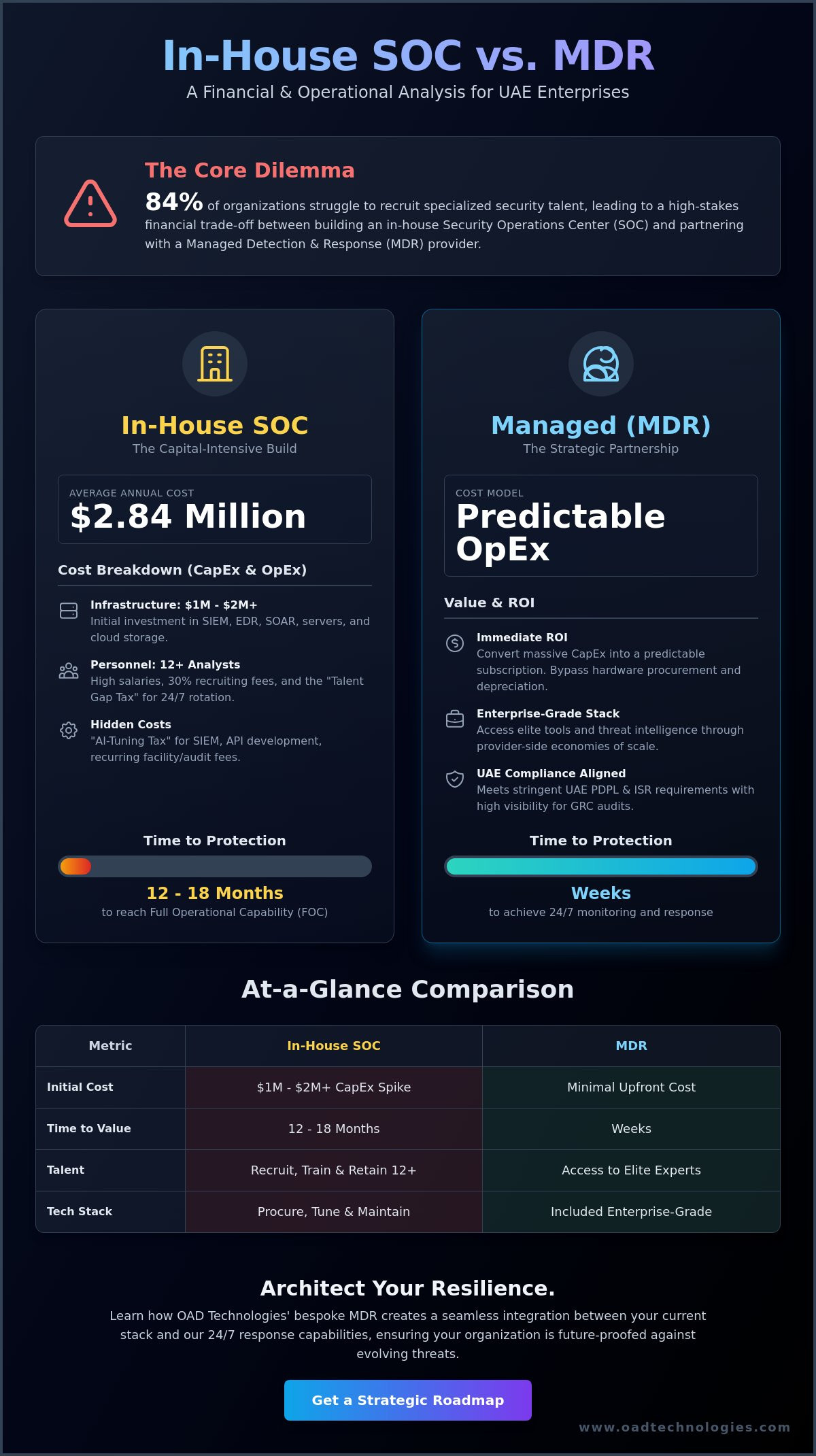
84% of organizations currently struggle to recruit the specialized talent required to defend their digital perimeter. Building a 24 X 7 in-house Security Operations Center now carries an average annual price tag of $2.84 million. This figure includes the escalating "Talent Gap Tax" and premium recruiting fees that often reach 30%. You likely recognize that an in-house soc vs mdr cost analysis is no longer just a technical exercise; it's a high-stakes financial architecture problem. Balancing the need for data control with the complexity of a 24 X 7 rotation can feel like an impossible trade-off for any UAE-based enterprise.
We'll deliver a comprehensive comparison of Total Cost of Ownership and demonstrate how Managed Detection and Response meets the stringent UAE PDPL and ISR requirements. This guide provides a transparent breakdown of the financial and operational realities of these two paths, highlighting how the intersection of human intelligence and machine capability can empower your team. We're providing a clear strategic roadmap for your transition or hybrid adoption to ensure your organization remains future-proofed against evolving threats.
Key Takeaways
- Breakdown the $2.5M baseline investment required for internal operations and see why it's common for initial infrastructure costs to exceed $1M.
- Use our in-house soc vs mdr cost analysis to calculate the "Talent Gap Tax" and the financial impact of maintaining a 12-analyst rotation.
- Align your security architecture with UAE PDPL and ISR requirements while maintaining the high level of visibility your GRC audits demand.
- Compare the immediate time-to-value of predictable subscription models against the massive CapEx spikes associated with building bespoke internal systems.
- Learn how OAD Technologies' architectural philosophy creates a seamless integration between your current tech stack and our 24 X 7 response capabilities.
The $2.5M Baseline: Dissecting the Capital Intensity of an In-House SOC
Building an internal security function is a monumental undertaking that extends far beyond hiring a few analysts. It's a capital-intensive commitment to personnel, high-end technology, and the grueling logistics of 24 X 7 operations. When performing an in-house soc vs mdr cost analysis, organizations often discover that the initial infrastructure investment alone typically ranges between $1 million and $2 million. This baseline covers the essential architecture required to host a functional Security Operations Center (SOC), including Endpoint Detection and Response (EDR) and Security Orchestration, Automation, and Response (SOAR) platforms.
Operational lead time remains a significant hurdle for most enterprises. Reaching Full Operational Capability (FOC) isn't an overnight achievement; it generally takes 12 to 18 months to move from initial procurement to a mature, responsive state. During this period, the organization remains vulnerable while capital is locked in depreciating hardware and long-term software licenses. This delay in "time-to-protection" represents a hidden risk that many financial models fail to capture accurately.
Infrastructure and the 'Tuning Tax'
The core of any internal SOC is the SIEM, but licensing is only the starting point. Cloud storage costs for log retention can spiral quickly, especially when meeting UAE-specific data residency requirements. In 2026, the 'AI-Tuning Tax' has emerged as a significant hidden expense for internal teams. We define the Tuning Tax as the continuous labor required to reduce SIEM false positives and refine detection logic. Without this constant engineering, machine learning models become noisy and ineffective. Integrating disparate tools into a "single pane of glass" often requires bespoke API development, adding further complexity to the total cost of ownership.
Facility and Physical Security Costs
The environment housing your security team must be as resilient as the digital network it protects. A professional SOC requires redundant power supplies, industrial-grade cooling, and sophisticated physical access controls. Maintaining a secure environment that meets international standards like ISO 27001 or local ISR requirements involves recurring audits and facility upgrades. For UAE organizations, ensuring these physical sites are compliant with the latest National Cyber Security Strategy adds another layer of mandatory, non-negotiable expenditure to the annual budget.
Managed Detection and Response (MDR): Analyzing the Subscription ROI
Shifting from a capital-intensive model to a predictable operational expense (OpEx) structure changes the financial trajectory of your security posture. While the previous section detailed the massive upfront spikes associated with internal builds, Managed Detection and Response offers a streamlined alternative. This model leverages provider-side economies of scale to grant access to elite threat intelligence and enterprise-grade tool licensing that would be cost-prohibitive for a single organization to procure independently. By partnering with a specialist, you effectively bypass the procurement hurdles and long-term depreciation cycles of hardware.
The "Time-to-Value" advantage is perhaps the most compelling operational metric. While an internal build-out can languish in a 12 to 18 month development phase, MDR providers typically achieve 24 X 7 monitoring and response capability in just a few weeks. This rapid deployment significantly reduces the window of exposure. Historical data, such as the DOD cost estimates for SOC implementation, highlights the staggering investment required to maintain parity with modern threats. MDR offsets these costs by distributing the expense of high-tier threat hunting across a broader client base, ensuring you receive advanced protection without the full financial burden of a dedicated internal research team.
Subscription Models vs. Hidden Costs
In 2026, pricing models have matured into two primary categories: per-endpoint and per-user. Per-endpoint models provide granular visibility into your device landscape, while per-user models offer predictability for organizations with high device-to-employee ratios. It's vital to identify what these subscriptions exclude, such as extensive on-site physical remediation or hardware replacement. MDR's primary financial benefit is the total elimination of 'shelfware' costs, ensuring every dollar spent translates directly into active, managed protection rather than unused software licenses. If you're looking to optimize your budget, you might explore our tailored security architectures to see how these models fit your specific environment.
The Scalability Factor
A robust MDR framework handles a 50% increase in log volume without requiring a corresponding 50% increase in your internal headcount. This elasticity is critical for organizations undergoing rapid cloud expansion or navigating the complexities of mergers and acquisitions. When performing an in-house soc vs mdr cost analysis, the ability to scale security operations instantly provides a distinct ROI advantage. It ensures that strategic growth doesn't create security gaps or necessitate emergency hiring rounds in a depleted talent market.
The Talent Gap Tax: Why Personnel Costs are Redlining in 2026
While infrastructure and software licenses are significant, the human element represents the most volatile variable in your in-house soc vs mdr cost analysis. The global cybersecurity workforce gap now exceeds 4 million professionals, creating a hyper-competitive environment where talent acquisition is both expensive and ephemeral. In the UAE market, securing Tier 2 and Tier 3 analysts requires a significant recruitment premium; organizations often face agency fees of up to 30% for a single hire. This constant pressure creates a "Talent Gap Tax" that erodes ROI long after the initial setup is complete.
Maintaining a team's relevance also demands a heavy investment in continuous education. SANS courses and specific certifications like the CISSP now cost between $5,000 and $8,000 per employee. When you factor in the 18-month average tenure for security analysts, you're essentially subsidizing the training for their next employer. Comparing the cost and resources of an in-house SOC vs. MDR reveals that these recurring "people costs" are the primary driver of long-term budget overruns.
The 4.2 FTE Reality
The "calendar math" of 24 X 7 coverage is often misunderstood at the board level. A single "seat" in a security operations center requires a minimum of 4.2 full-time equivalents (FTEs) just to cover basic shifts. Once you account for holidays, sick leave, and mandatory training time, that number realistically jumps to 8 or 12 analysts for a resilient rotation. We've observed that attempting to run a SOC with fewer people leads to catastrophic burnout. Fatigued analysts suffer from a documented loss in productivity and are significantly more likely to miss critical alerts, negating the value of your entire security stack.
Hidden Recruitment and Retention Expenses
The financial impact of an "empty chair" during a six-month hiring cycle is profound. During these gaps, your existing team's workload increases, accelerating the burnout cycle and potentially triggering more resignations. Sign-on bonuses have become a standard requirement in the UAE to lure experienced threat hunters, further inflating the initial cost of ownership. By outsourcing the "people problem" to an MDR partner, you shift the burden of recruitment, training, and retention to the provider. This strategic move allows your internal leadership to focus on high-level architecture and business alignment rather than managing the logistics of a revolving door of analysts.
Beyond the Spreadsheet: Evaluating Control, Visibility, and UAE Compliance
Financial metrics alone don't tell the full story of your security architecture. Many executives fear losing control when outsourcing, yet internal visibility is often fragmented across siloed tools. A robust in-house soc vs mdr cost analysis must account for the qualitative value of operational maturity. While an internal SOC offers perceived sovereignty, a modern MDR provider delivers structured transparency through unified dashboards that often surpass the manual reporting capabilities of a decentralized internal team.
UAE organizations face a particularly rigorous regulatory environment. The Federal Decree-Law No. 45 of 2021, known as the Personal Data Protection Law (PDPL), mandates strict data processing standards and a 72-hour breach notification window. Compliance with the Information Assurance Regulation (ISR) and NESA standards isn't a secondary concern; it's a strategic requirement. Specialized MDR providers already possess the infrastructure to ensure logs remain within UAE borders, satisfying data residency laws without the massive CapEx required to build compliant local storage facilities from scratch.
Maintaining compliance with these local mandates requires the same level of precision as managing your broader corporate fiscal obligations; for example, navigating the complexities of the UAE's evolving fiscal landscape is made easier with the specialized expertise of CTC Tax & Accounting.
The pressure of the 72-hour notification window under the PDPL shouldn't be underestimated. An internal team might spend those critical first hours just identifying the scope of the incident. In contrast, an MDR partner's automated detection and response capabilities ensure you meet these legal deadlines with precision. If you need to verify that your current architecture meets these local standards, you can consult with our expert architects for a compliance gap analysis.
Compliance as a Cost Driver
Integrating Identity and Access Management with your security operations is essential for modern GRC audit readiness. Internal teams often suffer from the 'Reporting Tax', which involves hundreds of manual hours spent gathering evidence for auditors. MDR platforms significantly reduce this burden by automating data collection, turning a multi-week ordeal into a streamlined, real-time report generation process.
Incident Response and Liability
The financial impact of a security event is directly tied to the Mean Time to Detect (MTTD). With the average cost of a data breach reaching $4.44 million in 2025, every minute of latency carries a heavy price. Cyber insurance providers now scrutinize these metrics when calculating premiums. A documented partnership with a high-performance MDR provider often results in lower insurance costs because it demonstrates a lower risk profile compared to an understaffed or maturing internal SOC.
Architectural Resilience: Why OAD Technologies’ Bespoke MDR Wins
Choosing between total internal control and a managed service doesn't have to be a binary decision. At OAD Technologies, we operate as an "Expert Architect," building a sophisticated bridge between your current digital assets and our 24 X 7 response infrastructure. This collaborative approach ensures that your in-house soc vs mdr cost analysis reflects a strategic partnership rather than just a line-item expense. We prioritize seamless integration with your existing technology stack, ensuring that our presence enhances your current investments rather than forcing a costly "rip and replace" cycle.
Many UAE enterprises are now moving toward a hybrid SOC model to maximize their ROI. This strategy allows your internal team to focus on high-level security architecture and business-specific logic during core hours, while our specialists handle the complex, around-the-clock monitoring and incident response. This eliminates the "4.2 FTE" staffing burden and burnout risks discussed earlier, while keeping your data sovereignty and local expertise intact. By positioning ourselves as a UAE-based extension of your team, we provide the technical authority and responsiveness that distant, global vendors often fail to deliver.
Our commitment to future-proofing involves a deep synergy between continuous monitoring and VAPT. By feeding the results of regular vulnerability assessments directly into our detection logic, we create a feedback loop that hardens your perimeter in real time. This integrated philosophy ensures that your security posture isn't just reactive; it's architected for long-term digital relevance in a market where threat actors are increasingly utilizing AI-driven reconnaissance.
The Expert Architect Advantage
We believe that the most effective security comes from human intelligence empowered by machine capability. Generic, one-size-fits-all templates often result in the noise and "Tuning Tax" that plague internal teams. We develop bespoke playbooks tailored to your specific business risks and operational environment. This precision ensures that our analysts are responding to high-fidelity alerts that actually matter to your organization, significantly reducing the financial impact of potential breaches.
Next Steps for Security Leaders
Before selecting a path, security leaders should conduct a rigorous gap analysis to identify where their current model is redlining. This assessment must go beyond the spreadsheet to evaluate whether your internal team can truly maintain 24 X 7 vigilance without sacrificing their mental health or your organization's compliance status. If you're currently managing an underperforming internal SOC, the transition to a managed or hybrid model can be phased to ensure zero coverage gaps. We're ready to help you navigate this transition with a clear, engineering-backed roadmap. Contact OAD Technologies for a tailored SOC vs. MDR cost-benefit analysis to secure your long-term growth.
Architecting Your Strategic Defense for 2027 and Beyond
Choosing between an internal build and a managed partnership is a decision that defines your organization's digital resilience for years to come. We've explored how the $2.84 million annual baseline for a private SOC often fails to account for the volatile "Talent Gap Tax" or the complex logistics of 24 X 7 rotations. Finalizing your in-house soc vs mdr cost analysis requires looking past the immediate price tags to the long-term architectural maturity of your defense. It's about ensuring your team focuses on strategic growth while a specialist handles the relentless cycle of detection and response.
OAD Technologies brings specialized UAE market expertise to every engagement, ensuring your security posture aligns perfectly with local PDPL and ISR requirements. Our bespoke architectural approach integrates seamlessly with your existing stack, providing the high-fidelity visibility needed to drastically reduce your Mean Time to Detect. We don't believe in generic security; we believe in precision engineering that empowers your people. Secure Your Enterprise with OAD’s Bespoke MDR Solutions and take the first step toward a future-proofed digital perimeter. Your path to operational excellence starts with a partner who understands the stakes.
Frequently Asked Questions
What is the average annual cost of an in-house SOC in the UAE for 2026?
Building an in-house SOC in the UAE for 2026 typically costs between $1 million and $4 million annually, with $2.84 million being the industry average. This figure encompasses infrastructure, licensing, and high staffing costs driven by the regional talent shortage. Organizations must also budget for recruitment fees and ongoing training to maintain a competitive defense against evolving threats.
How many full-time employees are needed for a 24 X 7 SOC?
A minimum of 8 to 12 full-time employees is required to sustain a resilient 24 X 7 rotation. While "calendar math" suggests 4.2 employees per seat, real-world factors like holidays, sick leave, and mandatory training hours necessitate a larger team. Attempting to operate with fewer staff leads to catastrophic burnout and a dangerous increase in missed security alerts.
Can MDR satisfy UAE Personal Data Protection Law (PDPL) requirements?
Yes, a specialized MDR provider satisfies UAE PDPL requirements by ensuring data residency and enabling rapid breach notifications. Under Federal Decree-Law No. 45 of 2021, organizations must notify the UAE Data Office within 72 hours of a breach. MDR platforms automate the detection and reporting processes needed to meet these strict legal deadlines without the cost of building compliant local storage.
What is the 'Tuning Tax' in security operations?
The 'Tuning Tax' refers to the continuous labor required to refine detection logic and reduce false positives in a SIEM environment. Without constant engineering, machine learning models become noisy and ineffective. This hidden cost is a critical factor in any in-house soc vs mdr cost analysis. It demands high-level expertise that most organizations struggle to retain internally, leading to increased operational spend.
Is a Hybrid SOC model more cost-effective than a purely in-house one?
A Hybrid SOC model is often more cost-effective for mid-market organizations because it combines internal business logic with outsourced 24 X 7 monitoring. By utilizing an MDR provider for nights and weekends, you eliminate the massive overhead of staffing a full graveyard shift. This approach allows your internal team to focus on strategic growth and high-level architecture during core business hours.
How long does it take to deploy a Managed Detection and Response service?
Deployment of a Managed Detection and Response service usually takes a few weeks. This provides a significant time-to-value advantage over internal builds. While establishing an in-house SOC typically requires 12 to 18 months to reach full operational capability, MDR leverages existing infrastructure to offer immediate protection. This rapid integration ensures your enterprise remains resilient without long procurement delays.
Does OAD Technologies provide on-site incident response support in the UAE?
OAD Technologies functions as a UAE-based extension of your team, providing expert architectural support and incident response tailored to the local landscape. We prioritize seamless integration with your existing stack to ensure rapid remediation. Our bespoke solutions bridge the gap between remote monitoring and the practical results required by UAE enterprises. We act as a collaborative partner rather than a distant vendor.
What are the hidden costs of building a SOC internally?
Hidden costs include recruitment fees of up to 30%, continuous training expenses, and the 'shelfware' cost of unused software licenses. Organizations also face escalating cloud storage fees for log retention and the productivity loss associated with high analyst turnover. These variables often cause the total cost of ownership to exceed initial budget estimates by a significant margin.
Disclaimer
Content by OAD Technologies is for general informational purposes only and does not constitute professional or cybersecurity advice. No warranties are made regarding accuracy or completeness; reliance is at your own risk. OAD Technologies shall not be liable for any direct or indirect losses arising from use of this content.


