

What if the actions you take to "fix" a cyberattack are actually leaving the door open for the next one? Many organizations mistake a tactical patch for a strategic cure; however, with the average cost of a data breach reaching $4.45 million, the price of this confusion has never been higher. It's a common frustration for leaders who face the dual pressure of minimizing downtime while meeting strict UAE ISR and PDPL compliance standards. You don't just want a quick recovery; you need a system that evolves.
This guide helps you master the critical transition from rapid threat containment to long-term systemic recovery through expert-led incident response and remediation services. We'll show you how to move beyond reactive fire-fighting to achieve a lower Mean Time to Remediate (MTTR) and build a resilient infrastructure that strengthens itself after every incident. We explore the specific frameworks that align your technical defenses with UAE cybersecurity laws, ensuring your enterprise remains both secure and compliant in the 2026 digital environment.
Key Takeaways
- Learn the technical distinction between tactical threat containment and strategic remediation to ensure your enterprise moves beyond temporary fixes toward permanent systemic hardening.
- Discover why the "Preparation" phase is the bedrock of modern resilience and how framing the response lifecycle as a continuous wheel drives ongoing operational performance.
- Understand how a mature framework for incident response and remediation services aligns your technical infrastructure with UAE ISR and PDPL regulatory standards.
- Gain insight into the synergy between MDR, EDR, and SIEM, and how these integrated tools provide the visibility needed to significantly reduce your Mean Time to Remediate (MTTR).
- Master the transition from reactive firefighting to a master-designed security posture that empowers your team and protects your long-term digital relevance.
Beyond Containment: The Critical Role of Incident Response and Remediation
True enterprise resilience requires a clear understanding of two distinct yet inseparable disciplines. Incident Response (IR) represents the immediate, tactical effort to identify, analyze, and contain an active threat. It is the digital equivalent of first responders arriving at a scene to stop the immediate danger. Remediation, however, is the strategic process of addressing the underlying root causes to ensure the same vulnerability cannot be exploited again. For modern organizations, Computer Security Incident Management is no longer just about stopping a breach; it's about the precision-engineered recovery that follows.
Relying on incident response and remediation services as a unified strategy is essential for UAE enterprises. If you treat containment and recovery as isolated silos, you risk leaving systemic gaps that attackers will inevitably find. This fragmentation often leads to "revolving door" breaches where the same threat actor returns weeks later through the same unpatched entry point. Beyond the immediate technical failure, a delayed or disjointed response erodes digital asset valuation and can cause irreparable harm to a brand’s market standing.
The High Stakes of Digital Resilience in 2026
The threat environment has shifted toward highly sophisticated supply chain compromises and multi-stage ransomware. These attacks don't just encrypt files; they exfiltrate sensitive data and dwell within systems for months. Proactive measures like Vulnerability Assessment and Penetration Testing (VAPT) serve as a critical precursor to any incident response plan, identifying the cracks before they're exploited. In the UAE, the regulatory environment has become significantly more demanding. Under the PDPL and ISR frameworks, organizations often face strict 72-hour reporting windows. Meeting these deadlines while maintaining operational continuity requires a level of readiness that legacy systems simply can't provide.
Why Reactive Security is a Legacy Mindset
The era of "firefighting" security is over. At OAD Technologies, we advocate for a visionary shift toward master-designed security systems that prioritize long-term stability over quick fixes. Successful defense relies on the synergy between human insight and technological capacity, where automated tools handle the scale while expert analysts provide the strategic context. We don't just want to stop the bleeding; we want to rebuild the system to be stronger than it was before the attack. Resilience is the ability to evolve through adversity.
The Lifecycle of Resilience: Phases of Modern Incident Response
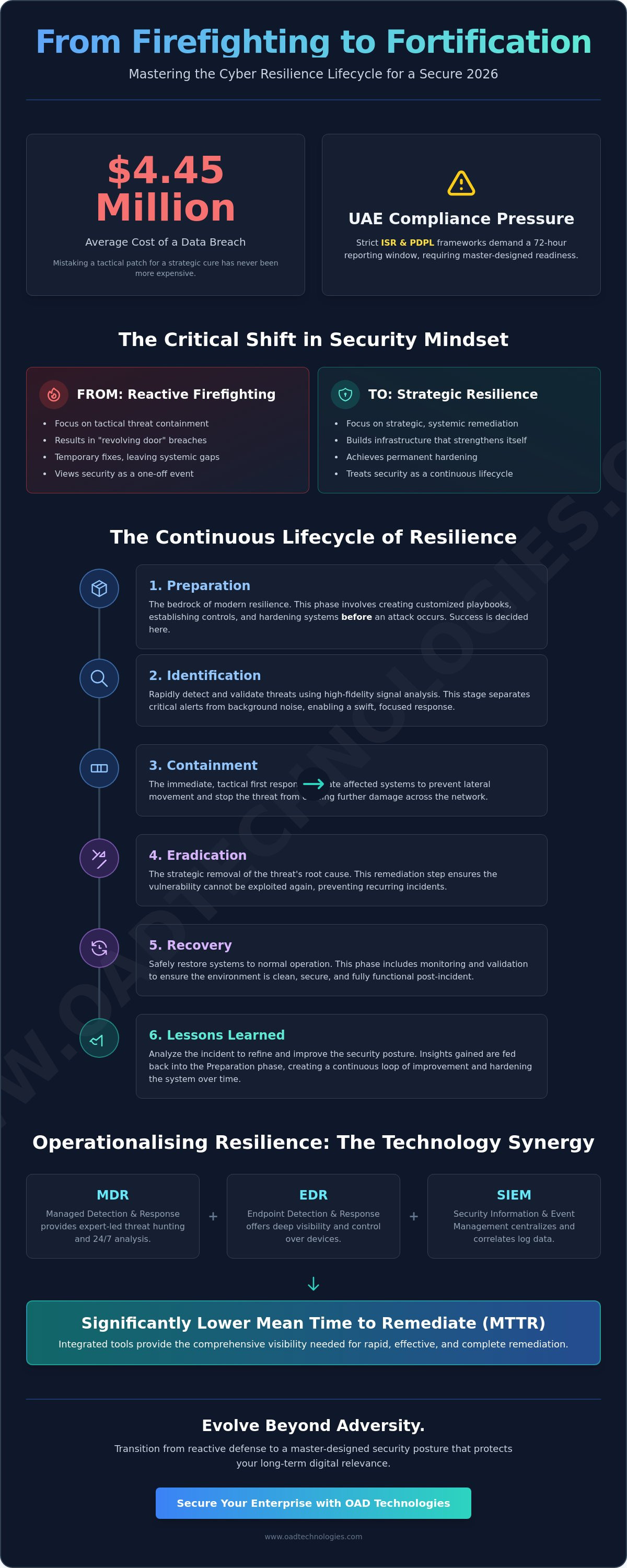
Resilient organizations don't view security as a linear path with a fixed finish line. Instead, they treat the lifecycle of incident response and remediation services as a continuous wheel of improvement. This circular approach ensures that every threat encountered becomes fuel for future hardening. Without a robust foundation, the entire cycle collapses. Preparation is the most critical phase of any strategic defense; it’s the difference between a controlled response and chaotic firefighting.
While many firms treat the six phases of incident management as a checklist to be completed and filed away, visionary leaders recognize that the loop never truly closes. In an environment where the average cost of a data breach is $4.45 million, the speed at which you move through this cycle determines your long-term viability. By structuring your response as an evolution rather than a one-off event, you transform technical debt into strategic resilience.
Phase 1-3: Preparation, Identification, and Containment
Successful outcomes are decided long before an alert triggers. Preparation involves building customized playbooks and technical runbooks that address the specific nuances of the UAE’s threat profile, such as targeted business email compromise. Once the groundwork is laid, rapid triage depends on high-fidelity signal analysis. By integrating Managed Detection and Response (MDR), teams can identify anomalies in real-time. Research shows that in MDR-enabled environments, incidents are resolved up to 90% faster, a statistic that underscores the importance of the identification phase. Containment then follows, utilizing SIEM and EDR technologies to surgically isolate affected network segments. This precision prevents the spread of malware while minimizing the high cost of downtime for unaffected business units.
Phase 4-6: Eradication, Recovery, and Lessons Learned
The shift from containment to eradication marks the pivot toward long-term remediation. Eradication focuses on removing the root cause, which frequently necessitates comprehensive Identity and Access Management (IAM) resets to invalidate compromised credentials and close backdoors. During recovery, systems are restored under intense monitoring to detect any lingering lateral movement. This phase must be handled with care to ensure the environment is actually cleaner than it was before the breach. Finally, the "Lessons Learned" phase closes the loop. Data gathered during the incident informs your next DLP strategy, turning a past vulnerability into a future strength. This transition ensures your infrastructure learns from every incident, meeting the 72-hour reporting requirements of UAE laws while building a more robust posture.
Building this level of maturity requires more than just tools; it demands a partner who understands the architecture of resilience. You can explore how our team implements these frameworks at OAD Technologies.
Response vs. Remediation: Bridging the Gap Between Recovery and Prevention
Enterprise leaders often overlook the synergy within incident response and remediation services, viewing them as sequential steps rather than a symbiotic loop. A common misconception is that remediation simply means "fixing the bug" that allowed an entry. In reality, effective remediation involves re-designing the very weakness that created the opportunity. While tactical response focuses on the "what" and "how" of an attack, strategic remediation addresses the "why." This distinction is what separates a resilient organization from one that is perpetually trapped in a cycle of reactive patching.
Tactical patching is a temporary measure designed to close a specific hole. Systemic hardening, however, is a comprehensive upgrade of the environment's defensive architecture. Digital forensics plays a vital role in this transition by identifying the exact telemetry needed to understand where the perimeter failed. This intelligence doesn't just stay within the IT department; it feeds directly into Governance, Risk, and Compliance (GRC) frameworks. By integrating these findings into your GRC strategy, you ensure that every technical lesson learned becomes a documented part of your risk management and regulatory alignment.
Tactical Response: Stopping the Bleeding
The first 24 hours of an incident are defined by the need for speed and clear human accountability. Tactical response is about immediate threat neutralization. SOC teams utilize automated playbooks to execute containment actions at machine speed, which significantly reduces the manual burden during high-pressure scenarios. The primary goal here is business continuity. We focus on isolating compromised assets and ensuring that the attacker's foothold is severed before they can escalate privileges or move laterally toward your most sensitive data stores.
Strategic Remediation: Curing the Disease
Once the immediate fire is out, the focus shifts to long-term infrastructure hardening. This phase often involves complex configuration changes that go far beyond a simple software update. For example, addressing persistent misconfigurations in cloud environments requires robust CSPM tools to ensure that security policies are applied consistently across hybrid stacks. Root Cause Analysis serves as the bridge between an incident and an upgrade. It provides the technical roadmap for transforming a singular point of failure into a master-designed system that is inherently more difficult to penetrate in the future.
Operationalising Resilience: Integrating MDR, EDR, and SIEM into Your Strategy
Deploying a robust architecture for incident response and remediation services requires more than just isolated tools; it demands a synchronized ecosystem where visibility and action are inextricably linked. Security Information and Event Management (SIEM) serves as the central nervous system of this operation, aggregating vast streams of telemetry to provide the visibility needed for rapid identification. When an anomaly is detected, Endpoint Detection and Response (EDR) provides the hands-on containment capabilities required at the device level. This integration ensures that the moment a threat is identified, the technical means to isolate it are already in place, preventing a localized infection from evolving into a widespread breach.
While SIEM and EDR handle the detection and containment, Identity and Access Management (IAM) acts as the primary barrier against lateral movement. In an active breach scenario, attackers immediately seek to escalate privileges. By enforcing strict identity controls and just-in-time access, you effectively neutralize the attacker's ability to move through the network, even if they've compromised an initial endpoint. This multi-layered approach transforms your security posture from a series of reactive checkpoints into a master-designed system where every tool reinforces the others.
The Role of MDR in Rapid Incident Response
Technology alone cannot solve the problem of dwell time. Managed Detection and Response (MDR) bridges the gap by providing the human-led expertise necessary for 24 X 7 monitoring and proactive threat hunting. Modern response time requirements, especially under UAE regulatory frameworks, leave no room for manual delays. MDR teams identify subtle indicators of compromise that automated systems might overlook, discovering incidents before they escalate into full-scale crises. At OAD Technologies, we act as a collaborative extension of your internal team, ensuring that high-level human insight is always paired with machine-speed automation to maintain your operational continuity.
Leveraging CSPM for Remediation in Multi-Cloud Environments
As enterprises migrate to hybrid and multi-cloud stacks, standard incident response often misses cloud-native vulnerabilities like misconfigured S3 buckets or overly permissive security groups. This is where Cloud Security Posture Management (CSPM) becomes vital for strategic remediation. CSPM allows you to automate the remediation of open ports and configuration drifts in real-time, ensuring that your cloud environment remains hardened against exploitation. By maintaining a continuous assessment of your cloud assets, you ensure that your long-term security posture evolves alongside your digital infrastructure. To see how these integrated tools can protect your specific architecture, consult with our security architects at OAD Technologies.
Fortifying Your Digital Assets with OAD Technologies’ Strategic Partnership
OAD Technologies serves as the master designer of resilient cybersecurity systems, moving beyond the role of a simple vendor to become a strategic extension of your enterprise. We understand that while immediate response stops a threat, true resilience is built through a holistic integration of incident response and remediation services alongside robust Governance, Risk, and Compliance (GRC) frameworks. This unified approach ensures that your technical defenses and regulatory obligations evolve in parallel. By treating these functions as a single, cohesive strategy, we help you build an environment that is fundamentally more difficult to compromise.
Managing the complexities of the UAE Information Assurance Regulation (ISR) and the Personal Data Protection Law (PDPL) requires more than global best practices. It demands local expertise that understands the regional threat landscape and the specific reporting mandates of national authorities. Our team provides the strategic roadmap necessary to transform your security from a reactive cost center into a resilient foundation for long-term digital growth. We bridge the gap between high-level innovation and practical business results, ensuring your organization remains compliant and competitive in a volatile market.
Why OAD Technologies is the Partner for Long-Term Viability
Our commitment to precision engineering and high-quality craftsmanship defines every engagement. Much like the specialized restoration work performed by Advanz Tech on luxury vehicles in Dubai, we believe that high-value assets require meticulous attention to detail and expert care. We reject standardized, one-size-fits-all response plans because your infrastructure is unique. A generic playbook won't account for your specific customized integrations or proprietary data flows. Instead, we build individualized strategies that anticipate your organization's specific vulnerabilities. Establishing an incident response retainer with OAD provides you with a predictable framework for both emergency action and ongoing system hardening. We invite you to a strategic consultation to evaluate your current infrastructure resilience and identify the gaps that could hinder your future expansion.
The Synergy of Human Insight and Advanced Technology
We believe that the most effective security systems don't replace people; they empower them. Our methodology focuses on the synergy between high-fidelity technological capacity and deep human insight. This combination allows your team to maintain focus on core business objectives while our experts handle the intricate details of threat hunting and remediation. Becoming a resilient enterprise in 2026 requires a partner who acts as a guardian of your digital relevance. We provide the technical authority and visionary planning needed to ensure you aren't just keeping pace with hackers but actively shaping a secure future for your clients. Partner with OAD Technologies for Strategic Incident Response to begin your journey toward systemic resilience.
Transforming Adversity into Strategic Advantage
True digital resilience in 2026 depends on your ability to look beyond the immediate crisis. We've established that while rapid containment stops the bleeding, only systemic hardening prevents the next attack. By integrating advanced MDR and SIEM capabilities, your organization gains the visibility needed to move from a reactive posture to one of proactive evolution. This transition is essential for maintaining compliance with UAE ISR and PDPL standards while protecting your brand's long-term value and operational continuity.
OAD Technologies stands as a premier UAE-based strategic security integrator, offering the precision engineering required to master incident response and remediation services. We don't believe in standardized plans; we design customized ecosystems that empower your team and safeguard your digital assets. Our expertise in local regulatory landscapes ensures that your recovery is both technically sound and legally compliant. It's time to build a foundation that learns from every challenge and emerges stronger.
Secure Your Infrastructure with OAD Technologies’ Incident Response Services
Your journey toward a more resilient enterprise starts with a single strategic decision. We're ready to help you architect a secure and prosperous digital future.
Frequently Asked Questions
What is the primary difference between incident response and incident remediation?
Incident response focuses on the immediate tactical actions to identify and contain a threat, while incident remediation is the strategic process of eliminating the root cause to prevent recurrence. Think of response as stopping the bleeding and remediation as the surgery that repairs the underlying damage. This ensures your infrastructure doesn't just recover but actually evolves into a more resilient state after an attack.
Why does my UAE-based business need an incident response retainer?
A retainer provides guaranteed access to elite specialists during a crisis, ensuring you meet the strict 72-hour reporting windows mandated by UAE regulations. It shifts your posture from reactive emergency spending to a predictable, master-designed resilience program. Beyond emergency access, retainers often include proactive services like tabletop exercises that prepare your team for specific regional threat scenarios, such as targeted business email compromise.
How does an incident response plan help with UAE PDPL compliance?
An incident response plan provides the documented framework required to prove technical and organizational measures for data protection under the UAE PDPL. It establishes clear protocols for identifying personal data breaches and notifying the Data Office within the legal timeframe. This structured approach demonstrates accountability and significantly reduces the risk of heavy non-compliance fines during a regulatory audit or post-incident investigation.
What role does SIEM play in the remediation process?
SIEM provides the comprehensive telemetry and visibility needed to conduct an accurate Root Cause Analysis (RCA) during the remediation phase. By aggregating logs from across your hybrid environment, it helps engineers identify exactly how a perimeter was breached. This historical data ensures that your remediation efforts target the actual vulnerability rather than just the symptoms, preventing attackers from using the same entry point twice.
Can incident remediation be fully automated?
Full automation is rarely effective for complex remediation because strategic hardening requires human context and architectural insight. While tools like CSPM can automate the fixing of misconfigured cloud ports, systemic changes often involve business trade-offs that only a specialist can navigate. The most resilient organizations utilize a synergy where automated tools handle the scale while human experts lead the strategic redesign of the security architecture.
How often should we update our incident response playbooks?
You should review and update your playbooks at least once a year or immediately following any significant change to your IT infrastructure or the threat landscape. Regular updates ensure that your response remains effective against evolving tactics like advanced ransomware. Testing these playbooks through quarterly tabletop exercises keeps your team’s skills sharp and identifies gaps in your current incident response and remediation services.
What are the most common remediation steps after a ransomware attack?
Common steps include a comprehensive reset of all privileged credentials through Identity and Access Management (IAM) to sever any remaining attacker access. You must also perform deep-level forensic cleaning of backups before restoration to ensure no dormant malware is reintroduced. Finally, systemic hardening of the initial entry point, such as closing RDP vulnerabilities or updating email security filters, is essential to prevent a repeat incident.
How do we measure the success of our incident response and remediation services?
Success is measured through key performance indicators such as Mean Time to Remediate (MTTR) and the reduction of attacker dwell time. A high-quality engagement with incident response and remediation services should also result in a zero-recurrence rate for the specific vulnerability exploited. Monitoring these metrics over time provides a clear view of your organization’s growing maturity and its overall return on your security investment.
Disclaimer
Content by OAD Technologies is for general informational purposes only and does not constitute professional or cybersecurity advice. No warranties are made regarding accuracy or completeness; reliance is at your own risk. OAD Technologies shall not be liable for any direct or indirect losses arising from use of this content.


