

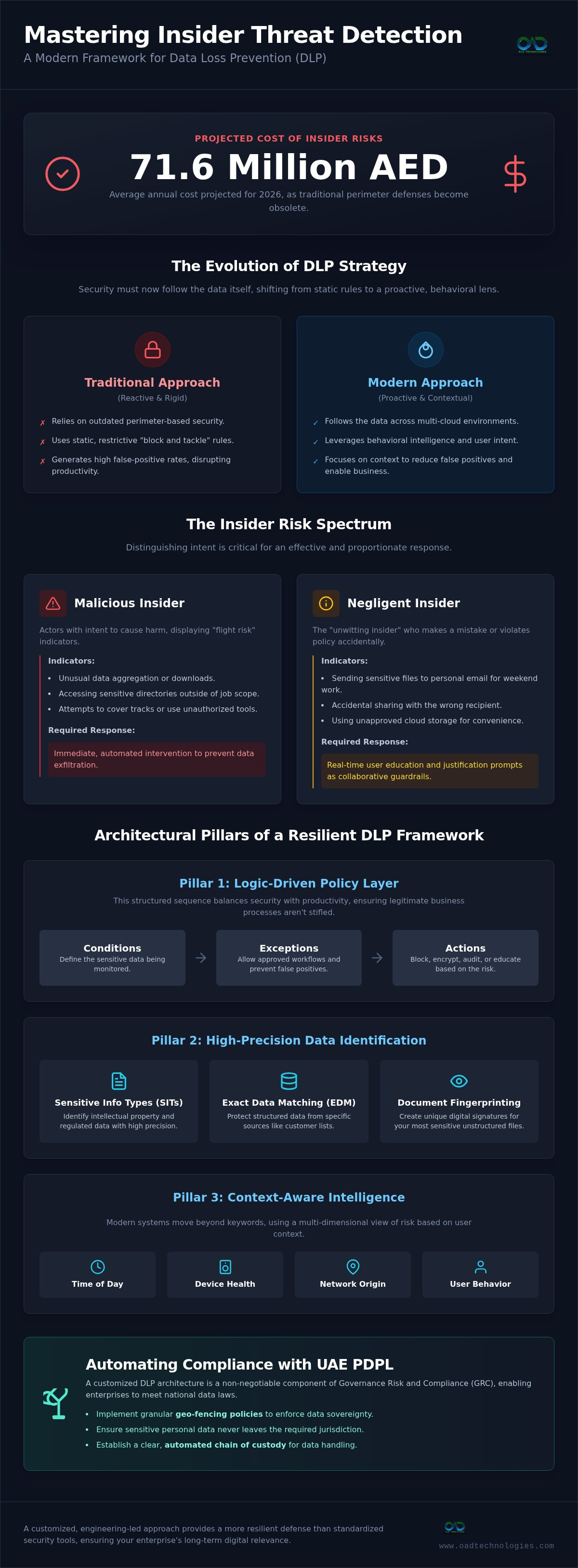
With the average annual cost of insider risks climbing to over 71.6 million AED in 2026, your most critical defense line is no longer at the perimeter. You've likely experienced the exhaustion of managing high false-positive rates that disrupt employee productivity while still worrying about visibility gaps in your multi-cloud environment. It's a common struggle to align rigid technical rules with the specific requirements of the UAE Personal Data Protection Law (PDPL) without stalling your business operations.
Mastering insider threat detection with dlp requires a strategic shift from static monitoring to a sophisticated synergy between behavioral intelligence and granular controls. We'll provide a resilient framework that neutralizes insider risks while automating compliance with national data laws. This guide outlines the architectural evolution necessary to reduce your time-to-detection and secure your enterprise's long-term digital relevance. We'll examine how to bridge the gap between high-level innovation and practical results, ensuring your data remains protected across every digital touchpoint.
Key Takeaways
- Evolve your security posture beyond perimeter defenses by implementing context-aware insider threat detection with dlp that focuses on user intent and data movement.
- Build a logic-driven policy architecture using specific Conditions and Exceptions to protect intellectual property without compromising employee productivity.
- Leverage the synergy between Identity and Access Management (IAM) and behavioral analytics to transform static alerts into actionable intelligence.
- Follow a phased implementation roadmap designed to align technical data residency rules with the requirements of the UAE Personal Data Protection Law (PDPL).
- Discover why a customized, engineering-led approach provides a more resilient defense than standardized security tools, ensuring your enterprise's long-term digital relevance.
The Evolution of Insider Threat Detection with DLP
Modern insider threat detection with dlp has transitioned from a reactive "block and tackle" tool to a proactive behavioral lens. In 2026, the hybrid work environment across the UAE has rendered traditional perimeter-based security a relic of the past. When your data lives in multi-cloud environments and your employees access it from diverse locations, the network edge no longer exists. Security must now follow the data itself. This evolution defines Data loss prevention (DLP) not just as a set of restrictive rules, but as the intelligent monitoring of data movement based on user intent and situational context.
Your DLP configuration serves as the technical manifestation of your organization’s strategic risk appetite. It's a master-designed system that balances the need for fluid collaboration with the necessity of rigorous protection. By moving beyond simple keyword matching, insider threat detection with dlp identifies anomalies that suggest a departure from normal business operations. This strategic approach ensures that your security posture supports operational performance rather than hindering it, bridging the gap between high-level innovation and grounded business results.
The Insider Risk Spectrum: Malicious vs. Negligent
Regulatory Mandates: DLP and the UAE PDPL
For national enterprises, DLP is a non-negotiable component of Governance Risk and Compliance (GRC). The UAE Personal Data Protection Law (PDPL) mandates strict controls over how personal data is handled and stored. A customized DLP architecture allows you to meet these data sovereignty requirements through granular geo-fencing policies, ensuring sensitive information never leaves the required jurisdiction. By establishing a clear, automated chain of custody, you don't just avoid regulatory penalties; you position your business as a reliable guardian of digital relevance in an increasingly scrutinized market. This alignment between technical controls and national law creates a foundation for long-term viability and trust.
Architectural Pillars of Modern DLP Policies
Building a resilient framework for insider threat detection with dlp starts with a master-designed logic layer. This architecture relies on a structured sequence of Conditions, Exceptions, and Actions. While Conditions define the sensitive data being monitored, Exceptions ensure that legitimate business processes aren't stifled. This balance is critical for maintaining productivity across national enterprises. By utilizing Sensitive Information Types (SITs), organizations can identify intellectual property with high precision. For even greater accuracy, we implement Exact Data Matching (EDM) and document fingerprinting. These methods create a unique digital signature for your most sensitive assets, ensuring that high-fidelity detection replaces the noise of legacy systems.
Effective policy triggers also depend heavily on metadata and file labeling. When data is classified at the point of creation, the DLP engine can instantly recognize the risk level associated with its movement. This classification acts as a persistent tag that follows the file across multi-cloud environments. Aligning these technical pillars requires a customized security architecture that reflects your specific operational reality rather than a one-size-fits-all template.
Context-Aware Condition Logic
Standard Regular Expressions (Regex) are no longer sufficient for detecting sophisticated threats. Modern systems utilize proximity analysis and confidence-level scoring to significantly reduce false positives. We incorporate user-context variables like time of day, device health, and network origin to create a multidimensional view of risk. As outlined in CISA's Insider Threat Mitigation Guide, identifying concerning behaviors requires looking at both technical and human indicators. AI-driven content inspection now allows us to parse unstructured data types, identifying intent where traditional tools see only text.
Response Actions: Beyond the Simple "Block"
A binary "block" action often causes more friction than it solves. Sophisticated insider threat detection with dlp leverages dynamic encryption, ensuring data remains protected even if it's shared through approved channels. We often recommend an "Audit Only" mode during the initial deployment phase. This allows security teams to gather threat intelligence and refine rules without disrupting the workflow. Automated justification workflows further empower employees by allowing them to explain their actions in real-time, providing the security team with valuable context while maintaining rigorous oversight and accountability.
Static Rules vs. Behavioral Context: Choosing the Right Framework
Traditional DLP systems often rely on signature-based detection, which searches for fixed patterns like credit card numbers or specific keywords. While these are useful for basic compliance, they frequently fall short in insider threat detection with dlp because they lack situational awareness. Modern Adaptive DLP shifts the focus from the data itself to the behavior surrounding it. By integrating Identity and Access Management (IAM), we enrich every security alert with critical user context. A finance manager accessing payroll data is standard procedure; a sales associate doing the same is a high-risk anomaly that requires an immediate response.
This contextual enrichment is the most effective way to combat the alert fatigue that plagues many security teams. When your system understands behavioral baselines, it stops triggering alarms for minor, legitimate policy deviations. According to recent behavior log analysis research, machine learning models that analyze historical activity logs can identify subtle deviations that human analysts might miss. At OAD Technologies, we act as master designers of these synergistic systems, ensuring your security tools communicate effectively to provide a unified, clear picture of organizational risk.
The Fallacy of the One-Size-Fits-All Policy
Standardized templates often fail because they don't account for the unique operational workflows of UAE-based national enterprises. If a policy is too restrictive, employees will inevitably turn to "Shadow IT" solutions to maintain their productivity, creating visibility gaps that are impossible to monitor. Regulatory safety should never compromise strategic business momentum. We design customized policies that respect the fluid nature of modern collaboration while maintaining a hard line on data protection, ensuring your infrastructure remains both secure and agile.
Machine Learning and Anomalous Data Movement
Malicious actors rarely trigger loud alarms; they prefer "low and slow" exfiltration tactics designed to bypass simple threshold rules. Detecting these patterns requires the integration of User and Entity Behavior Analytics (UEBA) with your insider threat detection with dlp triggers. Machine learning excels at identifying micro-deviations over long periods, such as an employee slowly moving small amounts of data to a personal cloud storage account. However, the necessity of human expertise remains absolute. Our engineers refine machine-generated exceptions, ensuring the system evolves alongside your business needs and secures your long-term digital relevance.
A Phased Roadmap for DLP Implementation
Implementing a master-designed framework for insider threat detection with dlp requires a structured, multi-phased approach. We reject the "flip-the-switch" mentality that often leads to operational paralysis. Instead, we guide national enterprises through a steady, deliberate lifecycle that ensures long-term viability without creating friction. This roadmap moves logically from identifying blind spots to active, intelligent response.
Phase 1 focuses on Discovery and Classification. You can't protect what you can't see. We identify data residency across your entire national network, ensuring total visibility into multi-cloud environments. In Phase 2, we architect policies specifically aligned with the UAE Personal Data Protection Law (PDPL). This ensures regulatory safety while maintaining business momentum. Phase 3 introduces Simulation and "Audit Mode," a critical step that allows us to test policy impact without blocking a single legitimate transaction. Finally, Phase 4 moves into Enforcement and Managed Response. By integrating your DLP triggers with Managed Detection and Response (MDR), we transform technical alerts into actionable security intelligence.
Data Classification: The Policy Foundation
A robust policy is only as good as the data it targets. We help you categorize assets into Public, Internal, Confidential, and Secret tiers. By utilizing SIEM integration, we automate the classification process, tagging data as it moves through your ecosystem. This isn't just a technical exercise; it's a strategic one. We engage cross-departmental stakeholders to define "Data Value" accurately. This ensures the insider threat detection with dlp system reflects the actual priorities of your business rather than generic industry templates.
Testing and Baseline Simulation
The simulation phase is where we bridge the gap between theory and practice. We execute rigorous "What-If" analyses to predict how new rules will affect your daily operations. During this time, we analyze false-positive ratios to fine-tune sensitivity levels. Our goal is to establish a "normal" data movement baseline for specific user groups. This proactive problem-solving approach ensures that when we move to active enforcement, your team remains productive and your security posture remains unshakeable. It's about empowering your people while securing your processes.
If you're ready to design a roadmap tailored to your unique infrastructure, consult with our engineering team today to begin your journey toward resilient data protection.
The OAD Approach: Strategic Data Protection
OAD Technologies operates as a guardian of digital relevance for UAE national enterprises. We reject the standardized, "out-of-the-box" security models that often fail under the weight of complex, modern infrastructure. Instead, we advocate for rigorous, customized engineering that treats Data Loss Prevention (DLP) not as a siloed product, but as a foundational pillar of infrastructure protection. Our methodology ensures that insider threat detection with dlp provides tangible investment returns by safeguarding intellectual property while maintaining high operational performance.
We view security as a master-designed ecosystem. By bridging the gap between high-level strategic goals and technical execution, we help you achieve a state of resilient data management. This approach prioritizes long-term viability over quick-fix tool implementation. It ensures your business remains competitive in an ever-changing digital market. Our commitment is to act as a strategic partner, projecting confidence in your ability to solve complex challenges without resorting to empty marketing clichés.
Integrating DLP Across the Security Stack
A truly resilient defense requires a multi-layered strategy where different security domains inform one another. At OAD, we combine DLP with VAPT to proactively close exfiltration paths that traditional scanners might overlook. While a penetration test identifies a weak point, our DLP rules are adjusted to monitor that specific vector for unauthorized data movement. We also leverage CSPM synergy to secure data across multi-cloud environments, providing a unified view of risk. This integration ensures that technology empowers human insight. It allows your security team to focus on high-value decision-making while automated systems handle the heavy lifting of continuous monitoring.
Continuous Governance and Policy Evolution
Security is never a static achievement. Policy refinement must be a continuous lifecycle that evolves alongside your business and the shifting regulatory landscape. As the UAE Personal Data Protection Law (PDPL) continues to mature, your technical controls must adapt to new enforcement standards. We provide the expertise to maintain this alignment, ensuring your insider threat detection with dlp framework remains effective against emerging threats. Partnering with a visionary architect of digital resilience means your organization isn't just reacting to the market; it's actively shaping its own secure future. We act as an extension of your team, dedicated to solving complex challenges through precision engineering and strategic partnership.
Future-Proofing Your National Enterprise Data
The shift toward a hybrid workforce requires a definitive departure from legacy perimeter security. By integrating behavioral intelligence with technical controls, your organization can transform data protection into a strategic asset rather than a restrictive barrier. We've explored how a phased roadmap ensures that your insider threat detection with dlp remains effective without hindering daily productivity. Aligning these systems with the UAE Personal Data Protection Law (PDPL) isn't just about avoiding penalties; it's about establishing long-term digital resilience and trust.
OAD Technologies acts as a strategic partner, providing visionary security architectures designed for national resilience. Our expert GRC consulting ensures your framework remains unshakeable in an evolving regulatory landscape. We reject standardized fixes in favor of precision engineering that reflects your specific business reality. Secure your enterprise assets with a customized DLP strategy from OAD Technologies.
You have the opportunity to turn security into a sustainable competitive advantage. We're ready to help you design a master-designed system that empowers your people while protecting your most valuable digital assets. It's time to build a defense that grows alongside your ambition.
Frequently Asked Questions
What is the difference between a DLP policy and a data classification policy?
A data classification policy defines the sensitivity levels of your information, such as Public or Confidential, and assigns labels to assets. In contrast, a DLP policy uses these labels as triggers to enforce technical controls. While classification identifies what needs protection, DLP actively monitors and blocks unauthorized movement based on those identifiers. Both are essential components of a master-designed security architecture that secures your long-term digital relevance.
How do DLP policies help with UAE PDPL compliance?
DLP policies serve as the primary technical control for meeting the requirements of the UAE Personal Data Protection Law (PDPL). These policies automate the identification of personal data and enforce geo-fencing rules to prevent unauthorized cross-border transfers. By maintaining a detailed chain of custody and providing automated audit logs, they ensure your enterprise meets national data sovereignty mandates while protecting the privacy rights of data subjects across the UAE.
Can DLP policies prevent data loss from encrypted files?
Yes, modern solutions for insider threat detection with dlp can prevent data loss from encrypted files by inspecting content at the endpoint before it's encrypted. Alternatively, gateway-based tools can decrypt, scan, and re-encrypt traffic using authorized certificates. This visibility ensures that malicious actors don't use encryption as a tunnel to exfiltrate sensitive intellectual property. It bridges the gap between necessary privacy and the need for rigorous security oversight.
What is "policy override" and when should users be allowed to use it?
A policy override allows a user to bypass a block by providing a business justification for their action. This feature is useful when rigid rules clash with urgent, legitimate operational needs. You should allow overrides for "Confidential" data where a human decision is required, but never for "Secret" or highly regulated assets. This approach empowers people while ensuring every deviation is logged for future review by your security team.
How often should DLP policies be reviewed and updated?
You should review and update your DLP policies at least once every quarter to account for evolving threat patterns and business growth. Major changes to your multi-cloud environment or updates to UAE national regulations also necessitate an immediate audit. Regular refinement prevents the buildup of false positives and ensures your technical rules remain aligned with your organization's strategic risk appetite. This continuous lifecycle is vital for maintaining long-term operational performance.
Do DLP policies work on mobile devices and unmanaged endpoints?
DLP policies extend to mobile devices and unmanaged endpoints through cloud-native architectures and Secure Access Service Edge (SASE) integrations. By using cloud-based proxies, you can monitor data movement into personal storage or web applications even when the device isn't under direct corporate control. This ensures that insider threat detection with dlp remains effective in the 2026 hybrid work landscape where employees frequently utilize diverse hardware to access corporate resources.
What are the most common reasons for DLP policy failure?
The most frequent causes of policy failure include inadequate data classification and the use of standardized templates that don't reflect unique business workflows. When policies trigger excessive false positives, they disrupt productivity and lead to alert fatigue among security analysts. Failure also occurs when technical rules lack behavioral context, making it difficult to distinguish between a negligent mistake and a malicious exfiltration attempt. A customized, engineering-led approach is necessary to avoid these common pitfalls.
How does DLP integrate with Managed Detection and Response (MDR)?
Integration occurs when DLP triggers are fed into the MDR telemetry stream for deeper analysis. While DLP identifies the unauthorized movement of sensitive files, MDR analysts use that data to investigate the intent behind the action. This synergy allows for a faster response to complex threats that a standalone tool might miss. It combines automated technical capacity with expert human insight to create a more resilient defense for your enterprise infrastructure across the national network.
Disclaimer
Content by OAD Technologies is for general informational purposes only and does not constitute professional or cybersecurity advice. No warranties are made regarding accuracy or completeness; reliance is at your own risk. OAD Technologies shall not be liable for any direct or indirect losses arising from use of this content.