
If your security team only has 72 hours to report a breach under the CIRCIA mandate, can you afford to spend the first two days manually stitching together siloed logs? Most security leaders recognize that having powerful tools isn't enough if those tools don't talk to each other. You're likely dealing with the exhaustion of alert fatigue and the blind spots that come from fragmented visibility across your endpoints and network. Effectively integrating siem with edr is no longer just a technical checkbox; it's a strategic necessity for maintaining operational resilience in 2026.
You'll discover how to bridge the telemetry gap and architect a resilient security posture through the strategic integration of these core systems. We'll show you how this unified approach creates a single pane of glass for threat detection, significantly reduces your Mean Time to Respond (MTTR), and automates compliance reporting for national regulators like DORA. This guide provides the architectural framework you need to transform disparate data into a proactive, high-performance defense strategy that empowers your team and secures your digital evolution.
Key Takeaways
- Understand the architectural requirements for closing the telemetry gap to detect "living off the land" attacks that bypass siloed defenses.
- Evaluate the technical advantages of different integration pathways, from API-based connections to utilizing standardized data schemas like OSSEM.
- Learn how integrating siem with edr streamlines your GRC framework and automates the reporting timelines required by national regulators.
- Follow a structured five-step roadmap to audit your current telemetry sources and establish a unified data schema for cross-tool compatibility.
- Discover why bespoke security integration provides a more resilient foundation for long-term digital growth than standardized, one-size-fits-all software stacks.
The Visibility Crisis: Why Siloed SIEM and EDR Create Security Blind Spots
The modern threat environment has evolved beyond simple malware signatures. By 2026, adversaries increasingly favor "living off the land" techniques, utilizing legitimate administrative tools to blend into standard operations. This shift exposes a critical telemetry gap that exists in most disconnected security stacks. When your tools operate in isolation, you lose the ability to see the full narrative of a sophisticated attack. Log management alone is no longer a viable defense strategy; it's a reactive posture that leaves your team blind to the early stages of a breach.
Siloed environments create a massive operational burden. Without correlation, your analysts are forced to play a high-stakes game of "connect the dots" during an active incident. This leads to profound alert fatigue, where high-fidelity endpoint signals are buried under a mountain of uncorrelated network noise. Strategically integrating siem with edr is the only way to close these visibility gaps and transform disparate data points into actionable intelligence. To understand how these systems work together at scale, you can explore Managed extended Detection and Response (MXDR) as a framework for unified threat visibility. Without this synergy, your organization remains vulnerable to lateral movement and identity-based attacks that leave no single, obvious trail.
The Limitations of Standalone EDR
While Endpoint Detection and Response is essential, its visibility effectively stops at the operating system boundary. EDR excels at identifying malicious processes on a specific workstation, but it struggles to track an attacker's movement across network segments or cloud environments. If an adversary uses a compromised credential to jump from an endpoint to a sensitive database, standalone EDR won't see the identity shift or the network handshake. It lacks the broader context of the enterprise ecosystem, making it difficult to detect sophisticated campaigns that exploit the spaces between your endpoints.
The Problem with Unenriched SIEM Data
Traditional Security Information and Event Management (SIEM) platforms often turn into expensive data graveyards. When a SIEM ingests logs without high-fidelity endpoint context, it generates a high volume of low-value alerts. Manual correlation in high-velocity environments is nearly impossible, leading to missed threats and delayed responses. In many cases, the sheer cost of ingesting uncorrelated logs outweighs the actual security value they provide. By integrating siem with edr, you enrich your central log repository with deep endpoint forensic data, ensuring that your investment in security analytics actually results in faster detection and reduced risk.
The Mechanics of Synergy: How SIEM and EDR Data Correlation Functions
The technical handshake between endpoint forensics and centralized analytics defines the modern Security Operations Center. In 2026, architectural design favors API-based integration over traditional agent-based log forwarding. APIs allow for high-fidelity data exchange without the overhead of additional software layers, ensuring that rich endpoint metadata reaches the SIEM in near real-time. Integrating siem with edr requires rigorous data normalization to be effective. Utilizing standardized schemas like the Open Source Security Events Metadata (OSSEM) ensures that different vendor outputs speak the same language, preventing the loss of granularity that often plagues generic log ingestion.
Centralizing this data is not just about storage; it's about meeting rigorous operational standards. For instance, the IRS guidelines on SIEM highlight how essential robust event management is for protecting high-value data environments. By aligning your technical pathways with these standards, you transform your security stack into a strategic asset. If you're looking to refine these technical pathways, exploring bespoke SIEM solutions can help bridge the gap between raw data and actionable insights.
Real-Time Telemetry Enrichment
The process of integrating siem with edr allows for the seamless mapping of endpoint processes directly to network traffic logs. When an analyst views a suspicious network connection, they can immediately see the specific parent process and user context on the originating device. This unified timeline is critical for forensic investigations, enabling teams to perform root cause analysis in minutes rather than hours. Incorporating User and Entity Behavior Analytics (UEBA) further refines this process by identifying subtle anomalies, such as an administrative tool executing at an unusual hour, which might otherwise go unnoticed in a siloed environment.
Bidirectional Orchestration
The most advanced frameworks move beyond passive monitoring into active, bidirectional orchestration. This means the SIEM doesn't just receive data; it sends commands back to the EDR. When the SIEM correlates a set of events that indicate a high-severity threat, it can automatically trigger endpoint isolation through the EDR interface. This automated feedback loop reduces dwell time by executing pre-configured playbooks instantly. Your team can contain an infected host directly from the SIEM dashboard, ensuring that response actions are as fast as the threats they aim to stop.
Strategic Impact: Enhancing GRC and Data Loss Prevention
Security architecture serves a higher purpose than just stopping threats; it provides the verifiable evidence required for enterprise governance. Aligning your technical stack with Governance, Risk, and Compliance (GRC) standards transforms security from a cost center into a pillar of business integrity. By integrating siem with edr, organizations create a robust audit trail that links specific endpoint actions to broader network events. This level of transparency is essential for board-level reporting, where the focus shifts from technical metrics to operational risk and long-term resilience.
Unified visibility simplifies the increasingly complex requirements of national regulatory reporting. Under mandates like CIRCIA or DORA, the window for incident notification has shrunk significantly. You can't meet a 72-hour reporting deadline if your data is trapped in separate silos. A synchronized environment allows your team to pull high-fidelity forensic evidence instantly, ensuring that compliance isn't a frantic scramble but a controlled, automated process. This strategic alignment ensures your organization remains digitally relevant and legally protected in a tightening regulatory environment.
Managing data sovereignty presents a unique challenge for global enterprises in 2026. You must maintain centralized security operations while respecting local data residency laws. A well-designed integration allows you to keep raw endpoint data within specific jurisdictions while forwarding only the necessary security metadata to a central SIEM. When integrating SIEM and EDR workflows to validate these controls, you ensure that your security posture doesn't compromise your privacy obligations. This balance is key to scaling operations across diverse markets without increasing your legal exposure.
Compliance Automation
Generating audit-ready reports becomes a byproduct of your daily operations rather than a manual project. A unified data source allows you to demonstrate continuous monitoring as required by national standards like NIST CSF 2.0. By mapping integrated alerts directly to specific risk management frameworks, you provide auditors with clear, contextual proof of your defensive capabilities. This reduces the time spent on manual documentation and lets your specialists focus on proactive threat hunting.
DLP and Insider Threat Detection
Strengthening your Data Loss Prevention (DLP) strategy requires more than just monitoring file transfers. Integrating siem with edr allows you to correlate file access on an endpoint with network upload logs, providing the context needed to distinguish between a legitimate business process and unauthorized exfiltration. This multi-layered visibility is crucial for detecting insider threats, where signals of malicious intent are often subtle. You can quickly determine if a data leak was an accidental policy violation or a deliberate theft, allowing for a more precise and effective response.
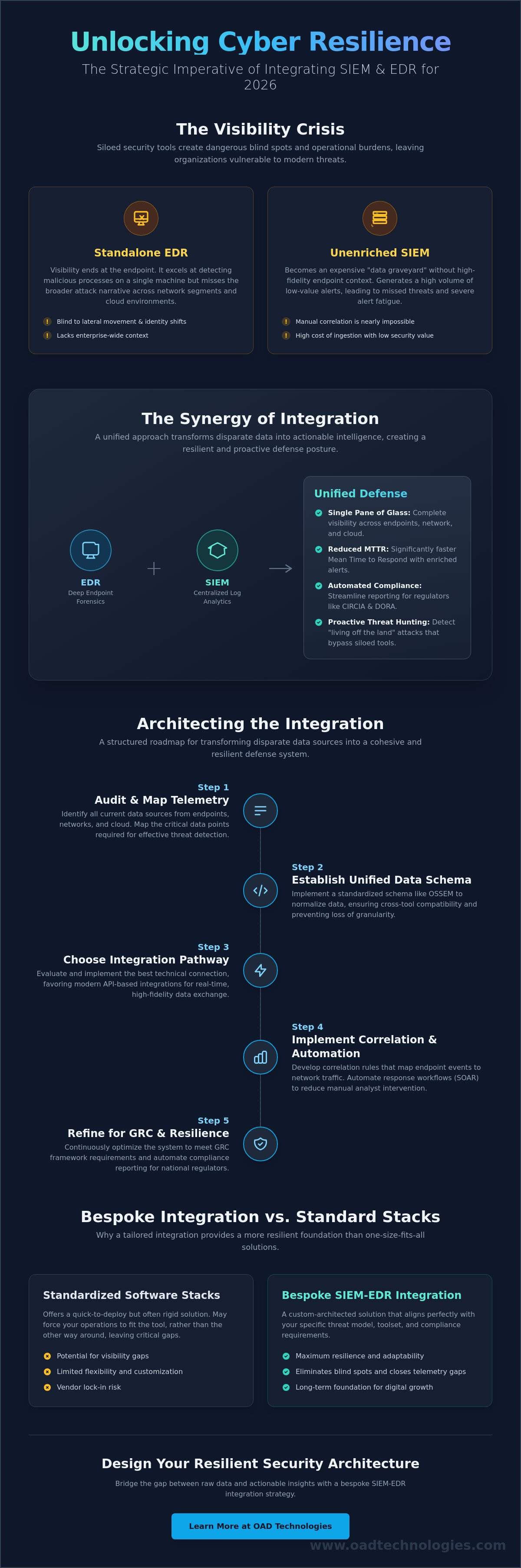
Architecting the Integration: A 5-Step Roadmap for Security Leaders
Transitioning from strategic governance to technical implementation requires a structured architectural approach. Security leaders shouldn't treat integrating siem with edr as a simple software installation. It's a design lifecycle that demands precision and a clear understanding of how data flows across your ecosystem. To build a resilient posture that meets 2026 standards, follow this five-step roadmap:
- Audit Telemetry: Map your current telemetry sources and pinpoint high-priority gaps in your visibility. Focus on areas where endpoint activity and network logs currently fail to overlap.
- Define Schema: Establish a unified data schema to ensure cross-tool compatibility. Using a framework like OSSEM prevents data loss during ingestion.
- Bidirectional Link: Establish bidirectional communication between your SIEM and EDR. This ensures that your central hub can trigger active containment on the endpoint.
- Develop Playbooks: Create and test automated response playbooks for common attack vectors. Focus on high-frequency threats like credential harvesting to maximize your return on investment.
- Continuous Tuning: Iterate through regular threat hunting and model refinement. Tuning your detection rules based on real-world telemetry reduces the noise that leads to analyst burnout.
If you're ready to move beyond standardized security stacks, consider a partnership for bespoke security integration that aligns with your specific business goals.
Phase 1: Discovery and Normalization
Identifying critical endpoints and high-value log sources is the foundation of a successful deployment. You must ensure rigorous time-synchronization across the entire security stack; even a few seconds of drift can break your correlation logic during a fast-moving incident. Data normalization is the systematic reformatting of diverse event logs into a consistent structure to facilitate efficient AI-driven extraction and analysis. This phase ensures that the data entering your system is clean, searchable, and ready for advanced analytics.
Phase 2: Automation and Refinement
Configure low-latency alerts for high-fidelity endpoint signals to ensure your team reacts to threats in real-time. It's essential to balance automated blocking with human oversight to prevent operational disruption. You don't want an automated policy to accidentally isolate a mission-critical server during peak hours. Training your SOC team on the unified investigation workflow is the final piece of the puzzle. When analysts understand how to navigate the combined data set, they can close cases faster and with greater confidence.
Designing Resilience: Custom SIEM-EDR Integration with OAD Technologies
True resilience isn't found in a box. It's built through careful architectural design that respects the unique footprint of your enterprise. OAD Technologies acts as a master designer of bespoke security ecosystems, moving beyond the limitations of standardized software stacks. While off-the-shelf solutions offer a baseline, they rarely account for the specific operational nuances of a growing business. By integrating siem with edr through a customized lens, we ensure that your telemetry isn't just collected but strategically utilized to drive business performance and risk reduction.
This integration reaches its full potential when combined with Managed Detection and Response (MDR). Automation handles the high-velocity noise, but human expertise remains the final arbiter of complex threat hunting. Our approach emphasizes this synergy, empowering your people with high-fidelity data rather than burying them in it. We focus on long-term viability, positioning your organization to stay ahead of the rapidly evolving 2026 threat landscape where static defenses often fail. Integrating siem with edr provides the foundation, but our engineering standards provide the lasting strength.
Our Collaborative Approach
We don't operate as a distant third-party vendor. Instead, we act as an extension of your internal security team. This collaborative mindset allows us to bridge the gap between high-level executive strategy and the technical execution required on the ground. To ensure total infrastructure protection, we extend the scope of our work to include customized Identity and Access Management (IAM) and Cloud Security Posture Management (CSPM) integration. This holistic view ensures that identity, endpoint, and cloud signals are all part of a single, unified defense narrative that protects every layer of your digital stack.
The Promise of Long-Term Security
Security isn't a project with a start and end date; it's a continuous commitment to your digital relevance. Our proactive engineering standards allow us to anticipate future attack vectors before they impact your operations. As the guardian of your digital relevance in the national market, we focus on building systems that grow with your business. We reject quick fixes in favor of high-quality craftsmanship and rigorous standards that ensure your defense remains effective for years to come. Contact OAD Technologies today to architect a unified defense that secures your future in an unpredictable market.
Securing Your Digital Future through Unified Architecture
The transition from siloed telemetry to a unified security ecosystem is the defining challenge for enterprise architects in 2026. You've seen how closing the telemetry gap reduces dwell time and ensures your organization meets the strict notification windows set by national regulators. Integrating siem with edr isn't just a technical upgrade; it's a commitment to long-term operational resilience and verifiable governance. By bridging the divide between endpoint forensic data and centralized analytics, you empower your team to act with precision and speed during critical incidents.
OAD Technologies brings specialized UAE national expertise and bespoke integration engineering to every partnership. We don't believe in standardized approaches that ignore your unique infrastructure needs. Our comprehensive GRC and VAPT support ensures that your technical defenses remain aligned with your broader business objectives and regulatory obligations. Architect your unified security posture with OAD Technologies and transform your defensive strategy into a strategic enterprise asset. Your digital evolution deserves a foundation built on rigorous engineering and visionary partnership.
Frequently Asked Questions
Why is integrating SIEM with EDR better than using them separately?
Integration provides a correlated view of the entire attack lifecycle by linking endpoint activity with network and cloud logs. When used separately, these tools create visibility gaps that allow lateral movement to go unnoticed. By integrating siem with edr, you transform isolated data points into a unified timeline. This allows analysts to see the full context of an alert without the need for manual data stitching during an incident.
Can SIEM replace EDR for endpoint security?
No, SIEM cannot replace EDR because they serve distinct architectural purposes. EDR provides deep, kernel level visibility and active response capabilities directly on the host. SIEM functions as a centralized correlation engine for diverse data sources across the entire enterprise. Relying solely on a SIEM for endpoint protection leaves you without the ability to perform granular process monitoring or immediate host isolation during an active breach.
What are the main technical challenges when integrating SIEM and EDR?
Data normalization and high ingestion volumes are the primary hurdles during the integration process. EDR tools generate massive amounts of telemetry that can overwhelm a SIEM if not properly filtered and mapped to a consistent schema. Ensuring low latency communication through robust API handshakes is also critical. This prevents delays in threat detection and ensures that automated response actions occur across the enterprise in near real time.
How does SIEM-EDR integration improve incident response times?
Integration reduces the Mean Time to Respond (MTTR) by automating the initial stages of investigation and containment. Instead of manually cross referencing IP addresses between different consoles, analysts receive enriched alerts that already include endpoint process details and user context. This immediate access to forensic evidence allows teams to validate threats and execute containment playbooks in minutes rather than hours, significantly limiting potential damage.
Does integration increase the cost of my security operations?
While the initial engineering requires a strategic investment, integrating siem with edr typically lowers long term operational costs by reducing manual labor. It helps prevent the data graveyard effect where organizations pay for log storage without gaining actionable insights. By focusing on high fidelity alerts, you optimize your analyst's time and reduce the financial impact of data breaches through significantly faster detection and remediation.
How do these integrated tools help with national compliance regulations?
Unified security stacks provide the verifiable audit trails required by frameworks like DORA and NIST CSF 2.0. These regulations mandate real time monitoring and strict incident notification timelines that are difficult to meet with siloed tools. An integrated environment automates the generation of compliance reports. This proves to regulators that your organization maintains continuous visibility and a proactive risk management posture across all digital assets.
What is the role of automation in an integrated SIEM-EDR environment?
Automation serves as the connective tissue that executes response actions at machine speed. In an integrated setup, the SIEM can automatically instruct the EDR to isolate an infected host or terminate a malicious process based on correlated signals from the network. This reduces the burden on human analysts. It allows them to focus on high level threat hunting while the system handles the immediate containment of known attack patterns.
Can OAD Technologies manage the integration for us?
OAD Technologies specializes in designing and managing bespoke security ecosystems tailored to your specific infrastructure and business goals. We act as a collaborative extension of your team to ensure that your SIEM and EDR tools are architected for maximum synergy. Our experts handle the technical complexities of data normalization and playbook development. This ensures your defense remains resilient while your leadership focuses on strategic enterprise growth.
Disclaimer
Content by OAD Technologies is for general informational purposes only and does not constitute professional or cybersecurity advice. No warranties are made regarding accuracy or completeness; reliance is at your own risk. OAD Technologies shall not be liable for any direct or indirect losses arising from use of this content.