
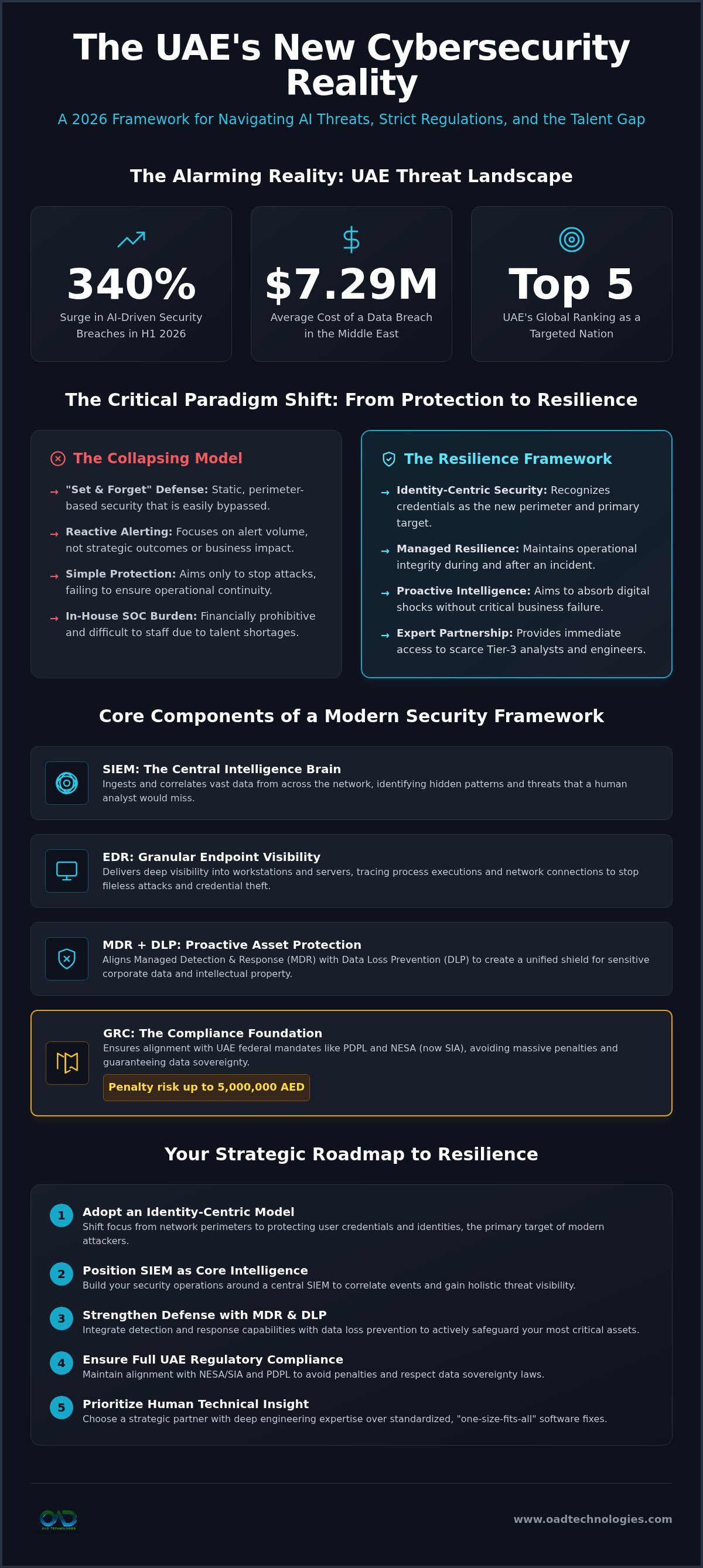
With AI-driven security breaches in the UAE surging by 340% in the first half of 2026, the traditional "set and forget" approach to IT defense has officially collapsed. Many regional leaders recognize that the average cost of a data breach in the Middle East has reached $7.29 million, making the search for effective managed security services dubai a top strategic priority. You're likely balancing the complexity of multi-cloud architectures against the strict requirements of the UAE Personal Data Protection Law. It's a high-stakes environment where a single oversight in data residency can lead to massive administrative penalties while the local talent shortage leaves your internal teams stretched thin.
This article provides a framework that moves beyond simple alert monitoring to build true enterprise resilience. You'll discover how to integrate advanced detection and regulatory alignment into a unified shield for your organization. We'll examine how a proactive approach to Managed Detection and Response (MDR) and Governance, Risk, and Compliance (GRC) can drastically reduce your Mean Time to Respond (MTTR). By the end, you'll have a clear roadmap to achieving 24 X 7 threat visibility while ensuring your digital operations remain fully compliant with federal mandates.
Key Takeaways
- Transition from perimeter-based defense to an identity-centric model to effectively address the evolving regional threat landscape.
- Build a resilient framework for managed security services dubai by positioning SIEM as the core intelligence of your security operations.
- Strengthen your defense by aligning Managed Detection and Response (MDR) with Data Loss Prevention (DLP) to protect sensitive corporate assets.
- Ensure full compliance with UAE federal regulations like NESA and PDPL to avoid massive penalties and maintain data sovereignty.
- Adopt a customized security strategy that prioritizes human technical insight over standardized, "one-size-fits-all" software fixes.
The Paradigm Shift in UAE Cyber Resilience for 2026
The cybersecurity landscape in the UAE has reached a critical inflection point. As AI-driven security breaches surged by 340% in early 2026, the era of relying on a hard outer shell has officially ended. Modern enterprises are rapidly moving toward identity-centric security, a shift that recognizes credentials as the primary target for attackers rather than network boundaries. Geopolitical shifts have also intensified the regional threat landscape, contributing to the UAE ranking among the top five most targeted nations globally. This environment requires a move away from reactive models toward a strategy of total resilience.
Standard Managed Security Services (MSS) often fail because they prioritize alert volume over strategic business outcomes. Advanced Persistent Threats (APTs) easily bypass basic signature-based detection, leaving organizations vulnerable despite having monitoring in place. This failure has led to the rise of "Managed Resilience" as the successor to traditional security models. It isn't just about stopping an attack; it's about maintaining operational integrity during and after an incident. For organizations seeking managed security services dubai, the goal has shifted from simple protection to the ability to absorb digital shocks without operational failure.
The Talent Gap and the Necessity of Managed Services
Building an in-house Security Operations Center (SOC) that functions 24 X 7 is financially prohibitive for most UAE firms. The regional talent shortage means that "tier 3" analysts are both scarce and expensive to retain. By partnering with an expert provider, businesses gain immediate access to high-level engineering expertise without the overhead of recruitment. This model of specialized outsourcing is mirrored in other digital sectors; for instance, marketing firms often scale their operations by partnering with a white label agency like Omega Odyss to manage complex SEO and PPC campaigns. It's a transition from capital-intensive, stagnant security to an agile, operational model that scales alongside the business's digital evolution.
Regulatory Evolution: From NESA to PDPL
Compliance has shifted from a technical checklist to a board-level strategic priority. With the UAE Personal Data Protection Law (PDPL) now strictly enforced, administrative penalties for non-compliance can reach 5,000,000 AED. This regulatory pressure, combined with the transition of NESA oversight to the Signals Intelligence Agency (SIA), makes governance risk and compliance a foundational pillar. Modern managed security services dubai must now ensure that data residency and sovereignty requirements are met through localized frameworks that align with federal mandates.
Core Components of a Modern Managed Security Framework
A resilient digital defense requires more than just reactive monitoring; it demands a unified lifecycle that encompasses detection, response, and continuous governance. For enterprises evaluating managed security services dubai, it's vital to view these components as an integrated ecosystem rather than disparate software purchases. In this framework, SIEM acts as the centralized brain of the operation. It ingests vast quantities of data from across the network, correlating logs to identify patterns that would otherwise remain hidden to a human analyst. This holistic approach is why managed security services dubai are becoming the standard for regional resilience.
While the SIEM provides the high-level overview, Endpoint Detection and Response (EDR) delivers the granular visibility needed at the workstation and server level. Traditional antivirus solutions are no longer sufficient against modern fileless attacks or credential theft. EDR records every process execution and network connection on the endpoint, allowing analysts to trace the exact origin of a suspicious activity. This combination ensures that no movement goes unnoticed, whether it occurs deep within the server room or on a remote employee's laptop. By bridging the gap between network-wide logs and device-level telemetry, businesses create a foundation for total operational awareness.
SIEM and EDR: The Foundation of Visibility
The true power of visibility lies in the synergy between log management and endpoint telemetry. By feeding EDR data into a centralized SIEM, security teams can rapidly correlate disparate events that seem harmless in isolation. For instance, a suspicious login attempt on a VPN can be immediately linked to an unusual file modification on a specific host. This transition from reactive antivirus to proactive endpoint detection allows organizations to identify threats in their earliest stages, preventing lateral movement before a breach can escalate into a full-scale catastrophe.
MDR and Proactive Threat Hunting
Automation alone can't stop a determined adversary. As Gartner defines Managed Detection and Response, the value lies in the combination of advanced technology and human expertise. While automated alerts flag known risks, human-led threat hunting searches for the "unknown unknowns" that bypass traditional filters. Analysts utilize the MITRE ATT&CK framework to map attacker behaviors against the specific UAE threat landscape, ensuring defenses are tuned to regional risks. Implementing a robust Managed Detection and Response (MDR) strategy significantly reduces the time between an initial breach and final remediation. This reduction in Mean Time to Respond (MTTR) is critical for minimizing financial impact. If you're looking to refine your current defense strategy, exploring a customized security integration can provide the clarity needed to secure your digital future.
The Synergy of MDR and Data Loss Prevention (DLP)
Threat detection is a partial solution if your security team remains blind to the movement of the very assets they protect. In many legacy environments, detection and data protection exist in silos, creating a gap where an attacker can exfiltrate information before an alert is even triaged. For organizations utilizing managed security services dubai, the strategic integration of Managed Detection and Response (MDR) with data loss prevention (DLP) creates a closed-loop defense. DLP acts as the final guardrail, ensuring that even if an adversary bypasses initial controls, sensitive UAE corporate assets cannot be moved or shared without authorization.
This integration allows for a unified response workflow that significantly reduces risk. Imagine a scenario where an MDR alert identifies a suspicious administrative login. In a fragmented system, the data remains vulnerable during the investigation. In a resilient framework, that alert triggers an immediate, automated data lockdown. This level of coordination aligns with the UAE's National Cybersecurity Strategy, which prioritizes the protection of the nation's critical digital infrastructure through advanced technological synergy.
Protecting Sensitive Data in the Cloud
Cloud misconfigurations are a leading cause of data exposure within the UAE enterprise sector. As businesses scale across multi-cloud environments, maintaining visibility becomes increasingly complex. Implementing cloud security posture management (CSPM) ensures continuous compliance by identifying over-privileged accounts and exposed storage buckets in real time. It secures the data layer across both SaaS and IaaS platforms, providing a consistent security baseline that prevents accidental leaks or malicious exfiltration from the cloud.
Identity as the New Perimeter
In a Zero Trust model, identity is the only constant. Robust identity and access management (IAM) serves as a critical gatekeeper, preventing compromised accounts from accessing or moving sensitive information. It's no longer enough to trust a user because they're on the corporate network. Modern managed security services dubai now integrate Multi-Factor Authentication (MFA) and conditional access policies directly into the security workflow. This ensures that every request for data is verified against context, location, and behavior, effectively neutralizing the threat of stolen credentials.
Navigating UAE Federal Compliance and Sovereignty
Compliance in the UAE has evolved from a passive checklist into a rigorous engineering requirement. Aligning with NESA standards, which are now overseen by the Signals Intelligence Agency (SIA), requires a precise mapping of 188 security controls across 18 domains. For organizations utilizing managed security services dubai, this means your service provider must go beyond basic monitoring. They must act as a strategic partner that understands the technical nuances of local data residency and the necessity of keeping log storage within UAE borders. This localized approach ensures that sensitive metadata never leaves the jurisdiction, maintaining full sovereignty over your digital footprint.
The UAE Personal Data Protection Law (PDPL) introduces even stricter operational demands, including a mandatory 72-hour window for reporting data breaches. This isn't just a legal deadline; it's a technical SLA that your managed security framework must be built to support. Automated compliance reporting is essential here. It reduces the manual burden of federal audits by providing real-time evidence of control effectiveness. When your security operations are natively aligned with federal mandates, compliance becomes a byproduct of good engineering rather than a frantic scramble before an audit.
Technical Assessments: VAPT as a Compliance Mandate
Regulatory alignment isn't possible without a clear understanding of your attack surface. This is why vulnerability assessment and penetration testing (VAPT) has become a compliance mandate rather than an optional exercise. While periodic scanning identifies known flaws, continuous vulnerability management provides the ongoing visibility required by NESA and PDPL. The insights gained from VAPT should directly inform your managed security strategy, allowing for policy updates that address specific weaknesses before they can be exploited. If you need to validate your current posture against federal standards, schedule a comprehensive compliance assessment today.
Managing Cross-Border Data Flows
The UAE's strict stance on data sovereignty complicates the use of global, cloud-native security tools that often backhaul data to international regions. Managed security tools must be specifically configured to respect these boundaries, ensuring that sensitive data flows are mapped and governed. This is where Governance, Risk, and Compliance (GRC) plays a pivotal role. By utilizing GRC frameworks to map data lineages, businesses can clearly demonstrate to regulators where data resides and how it's protected during transit. It's about building a transparent architecture that satisfies both internal security requirements and federal oversight, ensuring long-term viability in the local market.
The OAD Technologies Approach: Strategic Partnership Over Quick Fixes
OAD Technologies approaches digital defense as a master designer rather than a commodity vendor. We believe that true resilience isn't found in a box or a standardized subscription. Instead, we focus on the strategic convergence of high-level innovation and practical business results. For organizations seeking managed security services dubai, we offer a rejection of one-size-fits-all models. Our methodology prioritizes the synergy between advanced AI-driven detection and deep human technical insight. While AI handles the massive scale of modern telemetry, our engineers provide the strategic context necessary to turn data into actionable intelligence.
We don't aim to replace your internal IT teams; we empower them. Through collaborative incident response and shared visibility, OAD acts as a proactive extension of your own organization. This partnership model ensures that your security posture isn't just a defensive barrier but a strategic asset that supports your long-term digital relevance in an ever-changing market. We bridge the gap between complex technical requirements and the operational performance your board demands.
Customized Integration vs. Standardized Security
Standardized security often leaves critical gaps in complex enterprise environments. OAD's process begins with a deep analysis of your specific business objectives and technical architecture. As a specialized system integrator, we build tailored security frameworks that integrate seamlessly with your existing stack. We favor rigorous engineering standards over empty marketing clichés, ensuring that every control serves a defined purpose. This customized approach allows us to solve complex digital challenges without the friction of rigid, vendor-locked solutions. By focusing on individualized integration, we ensure your investment in managed security services dubai yields measurable results and long-term viability.
Building Long-Term Cyber Resilience
Cyber resilience is a journey, not a destination. Our roadmap for your organization involves a continuous evolution of your security posture as the threat landscape shifts. We maintain a proactive, solution-oriented mindset that anticipates changes in technology and regulation. This long-term commitment positions OAD as a guardian of your ongoing digital health. We don't just fix today's problems; we prepare your infrastructure for the challenges of 2026 and beyond. If you're ready to move beyond quick fixes and build a foundation for lasting success, we invite you to begin a strategic dialogue on your security roadmap. Our team is ready to help you design a system that bridges the gap between today's needs and tomorrow's ambitions.
Designing Your 2026 Security Roadmap
The UAE’s digital landscape in 2026 demands a departure from static, perimeter-based defenses. Achieving true resilience requires a sophisticated integration of identity-centric models, continuous vulnerability management, and localized data sovereignty. By aligning your security operations with federal mandates like NESA and PDPL, you transform compliance from a board-level risk into a strategic advantage. Effective managed security services dubai shouldn't just monitor alerts; they must provide the framework necessary to protect your organization’s critical digital assets through the synergy of human expertise and advanced AI.
As a master designer of systems, OAD Technologies offers specialized UAE-based SOC operations and deep expertise in DLP and federal compliance. We reject one-size-fits-all software in favor of a collaborative, visionary approach that ensures your long-term digital relevance. It's time to move beyond quick fixes and build a foundation for lasting success. Partner with OAD Technologies for Strategic Managed Security to design a resilient future for your enterprise. Your journey toward a more secure and compliant digital operation starts with a single strategic dialogue.
Frequently Asked Questions
What is the primary difference between an MSSP and an MDR provider in the UAE?
Traditional MSSPs focus on broad perimeter monitoring and log management to maintain basic hygiene. Managed Detection and Response (MDR) goes much deeper by providing proactive threat hunting and rapid remediation. While an MSSP might simply alert you to a potential issue, an MDR provider uses human technical insight and advanced tools like EDR to actively neutralize threats. This shift from passive monitoring to active response is essential for stopping advanced persistent threats.
How do managed security services help with NESA and UAE PDPL compliance?
Managed security services dubai ensure alignment by mapping your technical controls to the 188 NESA requirements overseen by the Signals Intelligence Agency. These services automate log storage within national borders to satisfy data residency laws. For the UAE Personal Data Protection Law (PDPL), providers implement the monitoring necessary to meet the mandatory 72-hour breach reporting window. This turns complex federal regulations into a structured engineering roadmap for long-term legal viability.
Can managed security services protect my data in a multi-cloud environment?
Yes, modern managed services protect multi-cloud environments using Cloud Security Posture Management (CSPM). This technology identifies misconfigurations and over-privileged accounts across SaaS and IaaS platforms in real time. By integrating CSPM with a centralized SIEM, you gain a single pane of glass for visibility. This ensures that your security policies remain consistent regardless of where data resides, effectively securing the data layer against unauthorized access or accidental exposure.
What technical assessments are included in a comprehensive managed security package?
A comprehensive package includes Vulnerability Assessment and Penetration Testing (VAPT) to identify and exploit security gaps before attackers can. It also features regular audits of Identity and Access Management (IAM) and network security configurations. These aren't just one-time scans; they're continuous evaluations that inform your overall security strategy. By identifying weaknesses in advance, you can proactively update policies and harden your infrastructure against evolving regional threats targeting the UAE.
How does an MSSP handle incident response for UAE-based organizations?
Managed providers handle incident response through a collaborative workflow that integrates directly with your internal IT team. When a threat is detected, the provider initiates containment actions, such as isolating affected endpoints or locking down sensitive data through DLP protocols. This proactive mindset reduces the Mean Time to Respond (MTTR). The process is designed to meet strict federal reporting timelines while maintaining the operational integrity of your business during a digital crisis.
Is it more cost-effective to outsource security or build an in-house SOC in the UAE?
Outsourcing is generally more cost-effective due to the high expense of recruiting and retaining specialized analysts in a competitive market. Building a 24 X 7 in-house SOC requires significant capital investment in infrastructure and continuous training. A strategic investment in managed security services dubai allows leaders to access high-level engineering expertise and advanced tools like SIEM and EDR at a predictable operational cost, supporting sustainable business growth without the overhead.
What role does Data Loss Prevention (DLP) play in managed security operations?
Data Loss Prevention (DLP) acts as the final guardrail for your sensitive corporate assets. Within managed security operations, DLP ensures that even if an account is compromised, the data itself cannot be exfiltrated or shared without authorization. It provides deep visibility into data movement across the network. Integrating DLP with MDR allows for a unified response where threat alerts trigger automated protection measures, securing your organization's most valuable intellectual property.
Disclaimer
Content by OAD Technologies is for general informational purposes only and does not constitute professional or cybersecurity advice. No warranties are made regarding accuracy or completeness; reliance is at your own risk. OAD Technologies shall not be liable for any direct or indirect losses arising from use of this content.