Compliance evidence matters as much as threat detection when choosing a managed SOC provider for a UAE government entity. The provider should show how its controls and reporting support the entity’s applicable DESC ISR, UAE Information Assurance Regulation and sector requirements, then define service scope, responsibilities, pricing and potential extra fees clearly.
A managed SOC provider for UAE government entities should do more than monitor alerts: its operating model should support the entity’s risk priorities and make accountability clear. This article explains how to assess compliance alignment, evaluate government-sector capability, interpret service-level commitments and understand cost factors. It also shows how managed security services can complement existing security operations, helping decision-makers judge whether a proposed arrangement meets practical needs.
Key takeaways
- Assess whether a SOC provider can explain how its controls, monitoring and reporting support your entity’s applicable DESC ISR and NESA obligations.
- Look beyond the stated support hours: understand how alert prioritisation, escalation and incident communication are handled.
- Evaluate government and B2G experience by how well the provider can align its monitoring approach with your operating environment and risk priorities.
- Compare pricing models by clarifying what drives the service scope and which activities could create additional fees.
- Distinguish general security certifications from evidence of suitability for government work, and consider how managed detection, SIEM and VAPT can address different security needs.
Compliance certifications and security measures
For UAE government entities, compliance assessment should connect documented provider controls with the entity’s confirmed DESC ISR, UAE IA and sector obligations. A certificate supports due diligence but does not by itself prove that a SOC service fits the entity’s systems, data or operating requirements.
Security certifications and controls
Security certifications can provide evidence of a defined management-system scope, while operational evidence shows how controls work in the proposed service. Compare certificate scope with the SOC operation, and ask how access, alert handling, evidence retention and escalation support the entity’s applicable requirements.
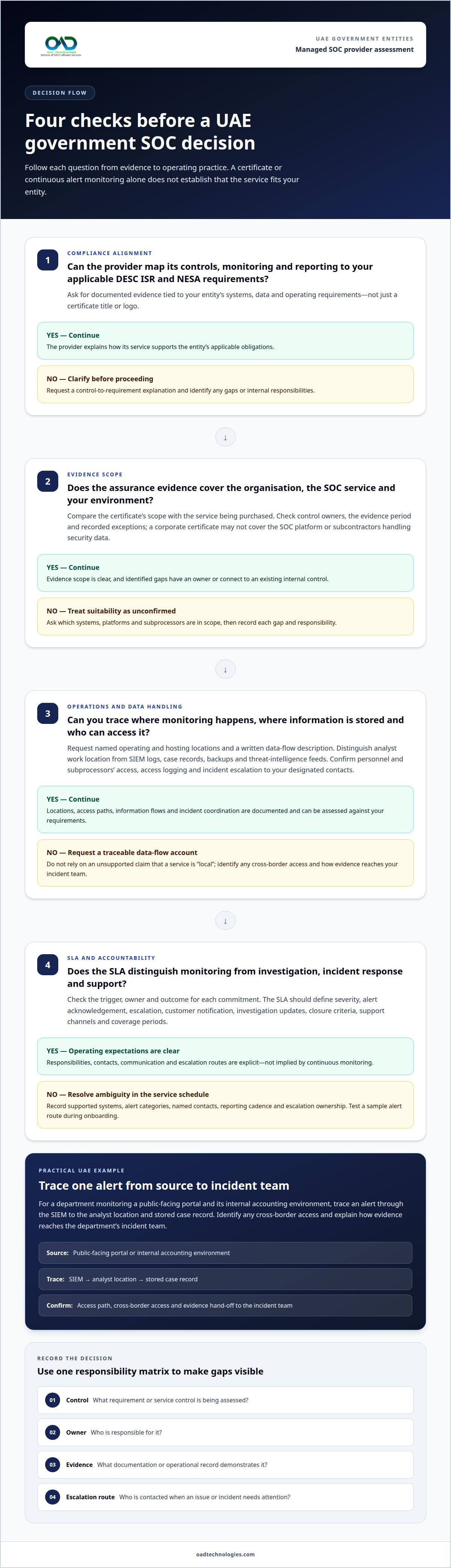
Separate assurance evidence into three parts: the provider’s organisation-wide controls, controls covering the SOC service, and controls relevant to your environment. This distinction matters when a certificate covers corporate processes but not the platform or subcontractors handling security data. Review control owners, the evidence period and any recorded exceptions. Then map each gap to a contract responsibility or an existing internal control.
Certifications should sit alongside technical measures. Compare how the service collects logs, restricts analyst access, records investigations and protects stored evidence. For example, a UAE government department could include a citizen-facing service portal in its asset inventory, then confirm that relevant records and alerts reach the monitoring service. The portal, its hosting environment and the privileged-account register may each have different owners.
UAE operations and data residency
UAE operations and data residency describe where security monitoring takes place and where related information is stored or accessed. They matter because government entities need clarity about operational access, data flows and incident coordination. Ask for named operating and hosting locations, together with a written data-flow description, rather than relying on an unsupported claim that a service is “local”.
Distinguish the analyst’s work location from the hosting location for SIEM logs, case records, backups and threat-intelligence feeds. Ask which provider personnel and subprocessors can access each data type, and how that access is logged. Confirm how analysts escalate a suspected incident to the entity’s designated contacts. These details show whether local operations and data handling match the entity’s requirements.
A practical UAE example is a department that monitors a public-facing portal and its internal accounting environment. Its assessment can trace an alert from the portal, through the SIEM, to the analyst location and stored case record. The same trace should identify any cross-border access and explain how evidence reaches the department’s incident team.
Record the outcome in a service responsibility matrix: control, owner, evidence and escalation route. This makes gaps visible before contract approval and gives technical, compliance and procurement teams a shared basis for evaluation. Government-focused security operations are also shaped by each entity’s operating context, as outlined in cybersecurity for government entities.
Customer support and service-level agreements
A service-level agreement (SLA) turns support expectations into measurable operating commitments. For a UAE government entity, it should distinguish continuous monitoring from analyst availability, incident response and routine service support. A supplier may monitor alerts continuously while limiting investigation or customer assistance to stated coverage periods. The agreement must make that distinction explicit.
Assess each commitment by its trigger, owner and outcome. An alert acknowledgement target measures when a provider begins reviewing an event; it does not necessarily mean containment has started. The SLA should define incident severity, escalation paths, customer notification, investigation updates and closure criteria. It should also state how the entity can raise urgent issues and who receives those reports.
Support coverage needs practical detail. The contract should state whether analysts work continuously, which channels reach the response team, and how coverage changes during public holidays or planned maintenance. It should explain how the provider handles an event if the entity’s incident lead is unavailable. These details help government entities align supplier support with internal approval and escalation procedures.
Implementation depends on clear documentation and assigned responsibilities. A service schedule can record supported systems, alert categories, named contacts, reporting cadence and escalation ownership. The SLA should also explain how service changes are approved, incidents reviewed and unresolved issues escalated to senior contacts. During onboarding, both parties can test a sample alert and confirm its route from detection to notification.
- Coverage: State which monitoring and support activities operate continuously or during defined hours.
- Response: Separate alert acknowledgement, investigation, escalation and containment responsibilities.
- Communication: Specify incident contacts, channels, update frequency and report format.
- Governance: Set review meetings, service reporting and a process for unresolved issues.
If a UAE department detects suspicious access to an electronic records system, for example, the SLA should clarify who validates the alert, who contacts the department and who approves containment. This avoids treating a monitoring notification as an incident-response decision. The same clarity helps during implementation, when teams assign contacts and document escalation routes.
Use these SLA requirements to shape a service scope that reflects your entity’s operational needs. A managed SOC service can be considered alongside the support, escalation and reporting commitments that matter to your environment.
Government and B2G sector coverage
Government and B2G experience matters because public entities have distinct systems, procurement controls and service responsibilities. Assess a provider’s relevant delivery evidence against your entity’s operating context and applicable security requirements.
Government work approval and certification
Government approval and security certification are different forms of evidence. A certificate documents a defined control scope, while approval depends on the procuring entity’s requirements. A general security credential alone does not establish suitability for every UAE government engagement.
Map the proposed service to the entity’s confirmed DESC ISR, UAE IA and sector requirements. Ask the bidder to identify evidence covering the SOC operation, processes, personnel and subcontractors. A certificate covering a different scope should not be treated as proof of the managed service.
There is no universal list of SOC providers approved for all UAE government work. Approval can depend on the tender’s requirements and the entity’s own evaluation. A ministry, for example, may require bidders to show how their monitoring model supports its security controls, escalation paths and evidence needs. Treat approval as engagement-specific unless the relevant authority or procurement documents state otherwise.
Managed SOC procurement and tenders
Procurement is the process an entity uses to define, evaluate and contract for a service. A clear tender helps government buyers compare providers against the same operational and compliance requirements, rather than relying on broad claims about public-sector experience.
Start with a defined scope: systems monitored, reporting, data location, incident responsibilities, containment authority and required regulatory alignment. Separate mandatory requirements from evaluation criteria and require evidence for each.
A UAE ministry planning a new monitoring service could include a scenario involving suspicious access to a citizen-facing portal. Bidders would explain how they would detect, escalate and document the event, including where the ministry’s team must make decisions. This gives evaluators a practical basis for comparing responses without inventing a common service specification.
During evaluation, use a consistent scoring method approved through the entity’s procurement process. Record the evidence behind each assessment, including technical responses, proposed responsibilities and contract exceptions. Avoid crediting general certifications when the tender asks for service-specific evidence. Clarify how implementation decisions, changes to monitored systems and ongoing governance will be handled after award.
A well-scoped tender links public-sector context to measurable service responsibilities. It gives bidders a shared basis for explaining how their SOC operations would fit the entity’s requirements, while leaving final approval with the procuring organisation.
Pricing models and additional fees
Managed SOC pricing reflects the monitoring scope, connected systems and response responsibilities agreed in the contract. For a UAE government entity, compare proposals using the same asset inventory and service boundaries, rather than headline totals alone. This helps show whether differences arise from coverage, integration effort or separately charged work.
Providers may structure charges around monitored assets, log volume, service tiers or a defined package. Each model allocates cost differently. An asset-based proposal depends on which devices and systems are in scope; a volume-based model depends on the data sent for analysis. A service tier may distinguish monitoring from investigation or response activities. Ask each bidder to explain its charging unit and how changes to scope affect invoices.
Integration can affect the work required before monitoring begins. Connecting a ministry’s identity platform, network controls and case-management system, for example, involves different data sources and access arrangements. Define which systems’ security logs are included, rather than assuming every system is covered automatically.
List potential extra charges as contract line items. These may relate to onboarding, additional integrations, changes to monitored systems, investigations beyond the agreed scope or bespoke reporting. The proposal should state the trigger for each charge, who approves the work and how the supplier records it. This makes service changes visible to procurement and finance teams before they affect the contract.
- Scope changes: Define how adding a system or data source changes the service.
- Incident work: Separate included investigation from additional response support.
- Data handling: Clarify storage, retention and export responsibilities.
- Approval: Require an authorised decision before extra work begins.
A UAE ministry could ask bidders to price a common baseline covering its agreed systems, then itemise optional integrations. The contract should clarify whether the SOC analyses relevant security logs or only escalates an event.
The price depends on the case and is provided after a quote request. Key cost factors include monitored assets, data volume, integration complexity, response scope and reporting needs. A clear commercial schedule lets an entity compare the agreed service scope with its operational priorities and identify which changes require formal approval.
Which UAE SOC providers are approved or certified for government work?
Suitability for government work depends on the requirements of the specific UAE entity and tender. A security certificate, government-sector experience and formal approval are different types of evidence. Treating them as interchangeable can leave a buyer with a provider whose credentials do not demonstrate that its SOC service meets the engagement’s requirements.
Separate three questions: does the provider hold relevant certifications, does the proposed SOC service have evidence supporting required controls, and has the procuring entity approved it for this engagement? Certification alone does not establish government approval or suitability.
Check the scope behind each credential. Identify the organisation or service covered, the controls assessed and any exclusions. Then compare that evidence with the tender’s requirements for monitoring, incident handling, access control and reporting. If the provider uses subcontractors, include their role in the assessment. This creates a traceable connection between a credential and the service the entity intends to buy.
A tender evaluation can distinguish these forms of evidence in its scoring criteria:
- Certification: Record the credential’s scope and relevance to the proposed SOC service.
- Control evidence: Map the provider’s documented processes to the entity’s applicable DESC ISR or NESA requirements.
- Sector experience: Assess examples of comparable government work and the provider’s role in each engagement.
- Approval: Document the entity’s decision against the tender requirements, rather than assuming approval from a general certificate.
A UAE ministry assessing two bids, for example, could find that both providers hold security credentials, but only one supplies service-specific control evidence and a relevant public-sector case. The evaluation should record those differences and explain how they relate to the tender’s stated criteria. It should not award government approval based solely on marketing language or unrelated accreditation.
For a managed SOC provider serving a UAE government entity, the practical conclusion is clear: assess the proposed service against the procuring entity’s requirements, then document the decision. This supports a defensible selection without implying that a certificate or sector label grants universal government approval.
OAD Technologies
OAD Technologies supports UAE government entities through enterprise-grade Managed Technology Services delivered on a Fully Managed, Defined Scope basis. Nexoaura Managed SOC can provide 24 X 7 monitoring, AI-assisted detection and human-led investigation where included in the agreed service design, with escalation, containment authority, data handling and reporting responsibilities documented for the engagement.
Consider OAD Technologies when assessing monitoring needs, reviewing security gaps or planning how these capabilities fit existing operations. For example, a government team can use VAPT findings to inform security priorities, then consider how monitoring and data protection support its wider controls. The appropriate scope depends on the entity’s environment and requirements.
Discuss your government entity’s security needs with OAD Technologies.
Shape the next phase of your security operations
Choosing a managed SOC provider for UAE government entities is ultimately about building an operating model that supports your organisation as its systems and risks evolve. Use your assessment to define the capabilities that matter now, identify the gaps that need attention, and set a practical direction for future security investment.
OAD Technologies can support this work through Managed Detection and Response (MDR), Vulnerability Assessment and Penetration Testing (VAPT), and Data Loss Prevention (DLP). These capabilities address different needs, from strengthening detection and response to identifying vulnerabilities and helping protect sensitive information. The right combination depends on your environment and priorities.
A focused discussion can connect your operational requirements with a suitable next step, whether you are refining monitoring priorities or strengthening wider security controls.
With clear priorities and appropriate expertise, your team can develop security operations alongside your organisation.
Frequently asked questions
What UAE government cybersecurity regulations apply to managed SOC services?
Applicable frameworks depend on the entity and its systems. Dubai entities should assess DESC ISR; other applicable entities should assess the current UAE Information Assurance Regulation and sector direction. The UAE PDPL applies where personal data is processed. Contracts should define how potential incidents are communicated to the controller and relevant authority.
What are the UAE NESA, DESC, and UAE IA requirements for SOC providers?
These requirements do not create one universal SOC checklist for every government entity. The relevant authority and the entity’s systems determine the applicable control expectations. A useful governance decision is to assign responsibility for evidence: specify who produces monitoring records, who reviews them and who owns remediation when an issue is identified. This keeps assurance activities connected to operational accountability.
What are typical managed SOC prices and contract terms in the UAE?
There is no single useful price for every government SOC engagement. Beyond the commercial proposal, define how the parties accept the service at launch, review performance, approve scope changes and resolve disputed deliverables. Procurement teams can also set out renewal and termination conditions, including transition responsibilities, so operational decisions remain clear if the agreement changes or ends.
What security risks and data sovereignty issues should UAE government buyers assess?
Consider risks that can weaken monitoring quality or integrity, not only where data is stored. A disconnected log source may create a blind spot, a compromised service account could expose security records, and altered timestamps can complicate investigations. Define how the service identifies collection failures, preserves trustworthy event records and informs the entity when monitoring visibility changes.
What service levels and incident response times should a managed SOC contract specify?
Alongside response targets, define how the provider measures whether monitoring inputs remain usable. The contract can require reports on unavailable log sources, delayed feeds, incomplete event fields and the period affected. For example, if a government department changes an application and its audit events stop arriving, a documented service-health measure can distinguish a collection problem from an absence of suspicious activity.
Disclaimer
Content by OAD Technologies is for general informational purposes only and does not constitute professional or cybersecurity advice. No warranties are made regarding accuracy or completeness; reliance is at your own risk. OAD Technologies shall not be liable for any direct or indirect losses arising from use of this content.