

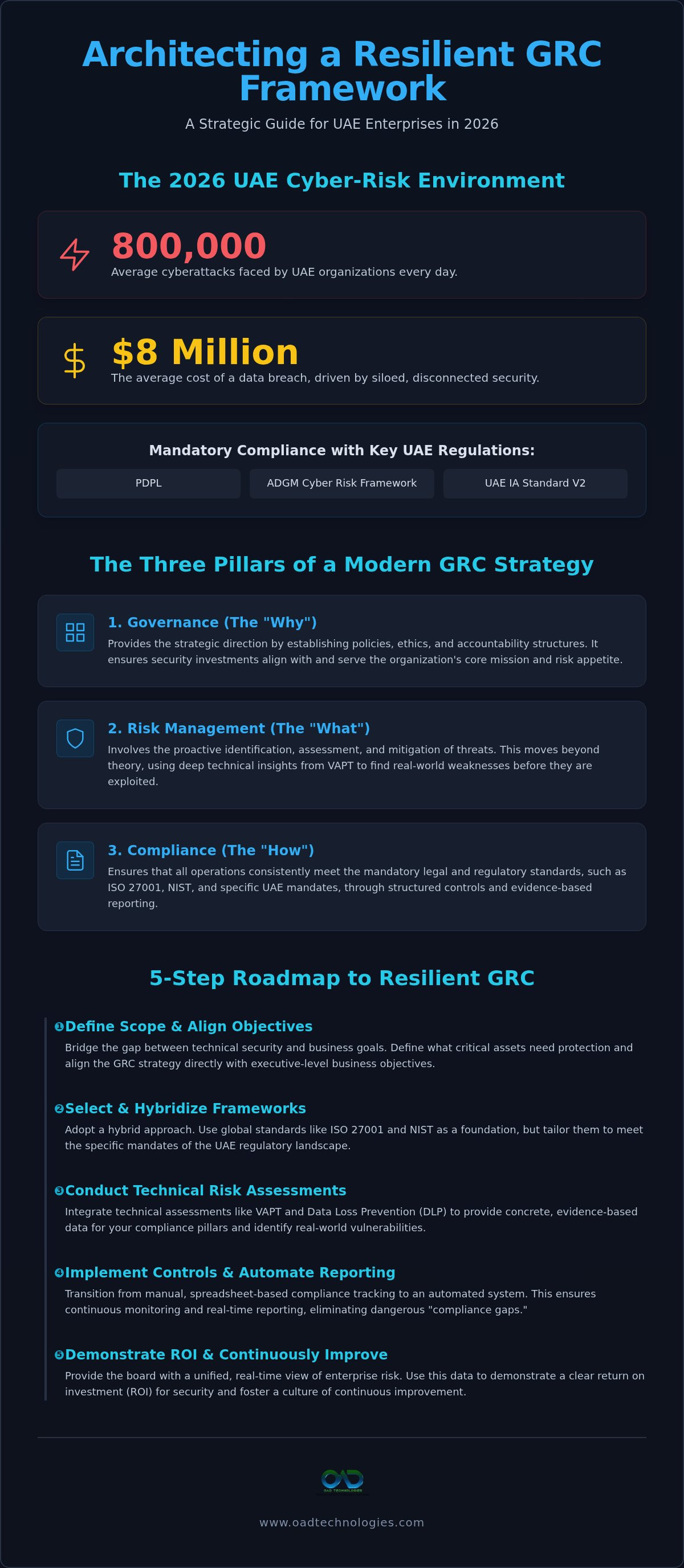
With the UAE facing an average of 800,000 cyberattacks every single day in 2026, the margin for error in your security strategy has effectively disappeared. A robust grc framework is no longer a back-office compliance checkbox. It's the operational nervous system of your enterprise. You're likely feeling the pressure of siloed data and manual reporting, all while the threat of PDPL fines looms over every board meeting. It's frustrating to manage security as a series of disconnected fires rather than a cohesive business strategy.
We understand that proving the ROI of security investments is difficult when you're buried under manual spreadsheets. This guide shows you how to architect a unified grc framework that turns regulatory pressure into a competitive advantage. You'll learn to align security operations with UAE regulations and business objectives. We will explore how to automate reporting, bridge the gap between IT and the executive suite, and ensure your operations meet the demands of the ADGM Cyber Risk Management Framework and the UAE IA Standard V2.
Key Takeaways
- Discover how to bridge the gap between technical security and business objectives by transforming your grc framework into a proactive strategic asset.
- Learn why a hybrid approach to global standards like ISO 27001 and NIST is essential for meeting specific UAE regulatory mandates in 2026.
- Follow a clear, five-step roadmap to transition from manual compliance reporting to automated, resilient risk management.
- Understand how to integrate technical assessments like VAPT and DLP to provide concrete evidence for your compliance pillars.
- Gain the tools to demonstrate clear ROI on security investments by providing the board with a unified, real-time view of enterprise risk.
What is a GRC Framework and Why is it Critical in 2026?
In 2026, the UAE business environment demands more than reactive security measures. A grc framework isn't just a manual or a checklist; it's a structured approach that aligns your IT infrastructure with your core business objectives while managing enterprise-wide risk. As the UAE matures into a global digital hub, the shift toward "Resilience by Design" has become the standard. This means security isn't an afterthought or a separate department. It's woven into the very fabric of how a company operates, ensuring that every digital asset is protected under the umbrella of strategic business goals.
The legal landscape in the UAE has reached a point of high complexity. With the Federal Decree-Law No. 45 of 2021 (PDPL) fully operational and the UAE Cyber Security Council enforcing the IA Standard V2, the stakes for data sovereignty have never been higher. Organizations can't afford to view compliance as a hurdle. Instead, a well-architected Governance, risk, and compliance (GRC) strategy acts as the operational nervous system, translating these strict legal requirements into proactive security postures that protect both reputation and the bottom line.
The Core Components: Governance, Risk, and Compliance
Governance provides the strategic "Why" behind every action your team takes. It establishes the policies, ethics, and accountability structures that ensure your security investments actually serve the organization's mission. Risk Management is the "What." It involves the proactive identification and mitigation of threats. In a modern grc framework, this isn't a theoretical exercise. It requires deep technical insights gained from vulnerability assessment and penetration testing (VAPT) to identify real-world weaknesses before they're exploited. Finally, Compliance is the "How," ensuring that your operations consistently meet standards like ISO 27001:2022 and the ADGM Cyber Risk Management Framework.
The Cost of a 'Siloed' Approach
Fragmented data creates dangerous blind spots that attackers are quick to exploit. When your risk data lives in one spreadsheet and your compliance reports in another, you're left with "compliance gaps" that are impossible to track in real time. In 2026, the average cost of a data breach in the UAE has reached $8 million. A siloed approach doesn't just invite these financial losses; it makes proving the ROI of your security stack to the board an uphill battle.
Connected GRC is the only viable solution for 2026. By integrating high-level strategy with technical enforcement tools like Data Loss Prevention (DLP), organizations create a unified defense. This synergy ensures that every technical control directly supports a regulatory requirement. It transforms your security operations from a series of disconnected fires into a cohesive, value-generating engine that safeguards your organization's long-term digital relevance. Beyond security, ensuring your platforms are inclusive is equally critical, and 216digital helps businesses achieve full compliance with WCAG and ADA standards to mitigate legal risk.
The Three Pillars of a Modern GRC Strategy
A high-performance grc framework operates as a unified triad where each component informs the other. Governance provides the strategic "Why" behind every security investment, ensuring that capital is allocated to protect the most vital business functions. Risk Management identifies the "What," highlighting the specific assets and vulnerabilities that require attention. Compliance acts as the "How," defining the exact controls and reporting standards mandated by law. When these pillars work in concert, they create a loop of continuous improvement that hardens the organization against evolving threats.
Strategic Governance and Board-Level Accountability
Effective governance in 2026 requires the CISO to act as a strategic partner rather than a technical gatekeeper. Their primary mission involves translating complex technical risks into clear business terms that resonate in the boardroom. This shift ensures that the board isn't just seeing a list of patches, but is instead understanding how security protects shareholder value. Establishing transparent decision-making protocols and managing resources based on the organization's risk appetite is critical. Ultimately, strategic governance empowers people with the autonomy to make secure choices rather than merely enforcing rigid processes that stifle innovation.
Enterprise Risk Management (ERM) in the Age of AI
The threat landscape has accelerated beyond human speed. We're seeing cybercriminals using AI to launch sophisticated, deepfake-driven phishing campaigns and automated vulnerability scans that probe networks 24 X 7. To counter this, your risk management strategy must move beyond periodic assessments toward continuous, data-driven monitoring. Integrating real-time telemetry from your SIEM into the broader risk framework allows you to visualize threats as they emerge. It's about building a system that can pivot as quickly as the attackers do, using technical data to drive every strategic decision.
Navigating UAE Regulatory Compliance
Compliance in the UAE is defined by strict adherence to the Personal Data Protection Law (PDPL) and national data sovereignty mandates. By 2026, the focus has shifted heavily toward local data residency, requiring organizations to maintain precise control over where their data sits and who can access it. You can't afford to treat audits as a once-a-year scramble. A robust grc framework serves as your central repository for audit evidence, making it possible to produce automated regulatory reports on demand. This level of organization is vital for avoiding the significant financial penalties associated with non-compliance. Organizations looking to stabilize their posture often benefit from specialized GRC consulting to bridge the gap between regulatory theory and technical reality.
Choosing the Right GRC Framework: ISO vs. NIST vs. UAE ISR
Selecting the structural foundation for your security operations is a high-stakes decision that dictates how your organization will scale. In 2026, a grc framework isn't a one-size-fits-all solution; it's a strategic choice between global interoperability and local regulatory precision. Most UAE enterprises find that a hybrid approach is the only way to satisfy international partners while remaining in lockstep with national mandates. This dual-layered strategy ensures that your resilience efforts are recognized globally while being anchored in the specific requirements of the UAE market.
ISO 27001 and NIST: The Global Gold Standards
For organizations prioritizing international certification, ISO 27001:2022 remains the benchmark. Its focus on a comprehensive Information Security Management System (ISMS) provides a rigorous, audit-ready structure. However, many technical teams favor the NIST Cybersecurity Framework (CSF) 2.0 for its inherent flexibility. The 2024 update to NIST 2.0 introduced "Govern" as a core function, which aligns perfectly with the strategic accountability we've established as a 2026 priority. You should choose NIST if your goal is rapid adaptation and internal risk management, whereas ISO is the better choice when you need a formal, third-party certification to win global contracts.
The UAE ISR and PDPL: Local Mandates You Can't Ignore
Local regulations provide the specific nuances that global frameworks often miss. The UAE Information Assurance (IA) Standard V2, released in 2025, is now the primary anchor for national cybersecurity. It's closely mapped to ISO 27001:2022 but adds critical layers regarding local data residency and the protection of Critical Information Infrastructure (CII). For organizations managing complex industrial assets, you can find out more about specialized OT resilience strategies. Aligning your grc framework with these standards isn't just about avoiding PDPL fines. It's about hardening your enterprise against region-specific threat actors who target the UAE's unique economic landscape. National Electronic Security Authority (NESA) standards serve as the compliance floor for government entities and their suppliers, making local alignment a prerequisite for doing business at scale.
To evaluate which model fits your organization, you must first assess your maturity level. An ad-hoc environment benefits most from the prescriptive controls of ISO, while an optimized organization might use NIST to drive continuous innovation. Regardless of your choice, the synergy between global best practices and UAE-specific mandates creates a posture that's both broad enough to cover international threats and deep enough to satisfy local regulators. This balanced architecture is what transforms a standard compliance exercise into a engine for long-term digital relevance.
For industrial enterprises, achieving this level of relevance often requires a focus on secure digitalization and data integrity. To further explore how these strategies can strengthen your organization's resilience, visit PLM-Sme FZC for specialized consultancy on Siemens Teamcenter and PLM solutions.
Building a resilient grc framework requires a transition from theoretical policies to technical enforcement. In the UAE's high-stakes digital economy, you can't rely on manual spreadsheets to manage enterprise risk. Success depends on a structured, five-step lifecycle that bridges the gap between high-level governance and the daily realities of security operations. This process ensures your resilience strategy isn't just a document on a shelf but a living system that adapts as threats evolve. For property owners who want to apply this same level of risk mitigation to their real estate portfolios, they can visit Takeem to discover specialized rental guarantee services.
Similarly, for those seeking to secure the property transaction itself, DealDeed provides a private matching desk that connects motivated sellers with vetted buyers in the Dubai market.
The journey begins with Discovery and Alignment. You'll need to define the scope of your framework across the entire UAE enterprise, identifying every critical data asset and its corresponding regulatory requirement. This is where you translate technical vulnerabilities into financial terms to gain essential executive buy-in. When the board understands risk as a potential impact on shareholder value, resource allocation becomes a strategic decision rather than a budget battle. An organization's Risk Appetite acts as the cornerstone of the framework, dictating the threshold for acceptable loss versus the cost of mitigation.
Step two involves deep Risk Profiling. This isn't a paper-based exercise; it requires a technical VAPT to identify real-world vulnerabilities within your infrastructure. By conducting these assessments, you gain the empirical evidence needed to prioritize your remediation efforts. It allows you to move away from generic security assumptions and focus on the specific entry points that attackers are most likely to exploit.
Step 3 & 4: Operationalizing Controls and Automation
Once you've identified your risks, you must deploy the right technical and administrative controls. This involves mapping specific security measures directly to frameworks like the UAE PDPL to ensure legal compliance. A vital part of this layer is Identity and Access Management (IAM), which enforces your governance policies by ensuring only authorized users can touch sensitive data. These controls provide the "How" of your compliance strategy, turning policy into practice.
Step four focuses on Automation. To stay ahead of 2026's regulatory demands, you'll need to utilize GRC software that automates reporting and evidence collection. This significantly reduces "audit fatigue," allowing your team to focus on strategic growth rather than manual data entry. Automation provides a real-time view of your compliance posture, making it possible to generate audit-ready reports at the push of a button. If you're ready to move beyond manual reporting, consider a specialized GRC consultation to architect your resilient future.
Step 5: Continuous Monitoring
The final step is establishing a feedback loop through Continuous Monitoring. A grc framework is never "finished." You must establish a constant flow of data between your security operations center and the board. This ensures that as new UAE regulations emerge or new threat actors appear, your framework can pivot instantly. This synergy between human strategic insight and technological capacity is what creates long-term viability in an ever-changing market.
Operationalizing GRC with OAD Technologies
At OAD Technologies, we reject the notion that a grc framework is a static administrative burden. Instead, we view it as the architectural blueprint for your entire security ecosystem. Our approach moves beyond the "compliance for compliance's sake" mentality, focusing on the integration of high-level strategic consulting with deep-tier technical enforcement. By bridging this gap, we ensure that your governance policies aren't just words on a page, but are actively enforced by the very tools your IT team uses every day.
This integration is most visible in how we utilize Data Loss Prevention (DLP) to uphold the compliance pillar of your strategy. While many firms treat DLP as a standalone security tool, we position it as the automated enforcer of your data sovereignty policies. Similarly, the synergy between our GRC consulting and Managed Detection and Response (MDR) provides the continuous evidence required for modern audits. We don't just tell you that you're compliant; we provide the real-time telemetry that proves it to regulators and stakeholders alike.
The Synergy of GRC and Technical Security
A grc framework inevitably fails when it lacks visibility into the technical reality of the network. Without the real-time data provided by SIEM and EDR, governance becomes a series of educated guesses. OAD Technologies acts as a "Master Designer" of integrated systems, ensuring that your technical stack feeds directly into your risk management engine. We leverage technical assessments like VAPT to validate that your GRC controls are actually performing as intended. This creates a closed-loop system where strategic insight and technological capacity empower your people to maintain resilience without the friction of manual reporting.
Why UAE Enterprises Choose OAD Technologies
The UAE's regulatory environment is unique, demanding a partner who understands the intricacies of the Personal Data Protection Law (PDPL) and national IA standards. We bring a sophisticated blend of technical authority and local expertise to every engagement, rejecting standardized, "cookie-cutter" approaches in favor of highly customized solutions. Our commitment to high-quality craftsmanship ensures that your security posture is built for long-term viability, not just a quick fix for an upcoming audit. We act as an extension of your team, providing the grounded, visionary leadership needed to navigate the complexities of 2026 and beyond.
Building a resilient enterprise requires a partner who can translate high-level innovation into practical business results. If you're ready to transform your compliance requirements into a strategic advantage, contact OAD Technologies for a GRC Strategy Consultation today. Let's design a system that secures your digital relevance in an ever-changing market.
Architecting Long-Term Enterprise Resilience
The shift toward "Resilience by Design" in 2026 requires more than just following the law; it demands a fundamental change in how you perceive digital risk. By transforming your grc framework into a unified, technically integrated system, you bridge the gap between high-level strategy and operational reality. We've explored how aligning with UAE-specific mandates like the PDPL and NESA standards doesn't just prevent fines but actually builds a foundation for sustainable growth. It's about moving from a posture of reactive defense to one of proactive, strategic dominance.
OAD Technologies acts as your strategic partner in this evolution, offering dedicated UAE-wide support and a sophisticated blend of technical security and governance expertise. We help you move from manual, siloed reporting to a transparent, automated posture that proves its value in the boardroom and beyond. It's time to stop reacting to threats and start shaping your organization's digital future with confidence. Secure Your Enterprise with OAD's GRC Consulting Services and ensure your ongoing relevance in an increasingly complex market. Your path to a resilient, audit-ready enterprise starts with a single, strategic step.
Frequently Asked Questions
What is the primary purpose of a GRC framework?
It aligns IT operations with business goals, manages risk, and ensures regulatory compliance. It acts as a unified strategy to break down silos between departments. It's about creating a structured approach where governance, risk management, and compliance work together. This ensures every security investment supports the organization's overarching mission and long-term viability. It transforms security from a cost center into a strategic business enabler.
Is a GRC framework mandatory for businesses in the UAE?
While the term itself isn't a legal mandate, the components are required by various UAE regulations. For example, the ADGM Cyber Risk Management Framework became binding for financial entities in early 2026. Government suppliers must also adhere to NESA and the UAE IA Standard V2. Implementing a formal grc framework is the most effective way to meet these enforceable legal obligations across the national landscape.
How does the UAE Personal Data Protection Law (PDPL) affect GRC?
The PDPL mandates strict controls over the processing and sovereignty of personal data for UAE residents. It forces GRC strategies to prioritize data residency and privacy by design. Organizations must maintain detailed records of processing activities and evidence of consent. A robust framework ensures these legal requirements are translated into technical controls like DLP, providing a clear audit trail for the UAE Cyber Security Council and other regulatory bodies.
What is the difference between GRC and Enterprise Risk Management (ERM)?
ERM is a specialized subset focused strictly on identifying and mitigating risks across the enterprise. GRC is a broader umbrella that includes ERM but adds governance structures and compliance monitoring. While ERM tells you what might go wrong, GRC provides the policy framework to manage those risks and the reporting tools to prove you're following the law. They are complementary systems that work best when fully integrated.
How often should an organization update its GRC framework?
Your framework should be a living system that undergoes a comprehensive review at least annually. However, trigger-based updates are necessary whenever the UAE introduces new regulations or your business undergoes a significant digital transformation. In 2026, the rapid evolution of AI-driven threats means that continuous monitoring is more important than static annual updates. This proactive approach ensures your security posture remains relevant and resilient against emerging regional threats.
Can GRC frameworks be automated with software?
Yes, automation is essential for managing the complexity of modern UAE regulations. Software tools can automate evidence collection from technical systems like SIEM and EDR, significantly reducing manual reporting effort. This automation eliminates the compliance gaps caused by human error and siloed data. It allows your team to focus on strategic risk management rather than getting buried in spreadsheets and manual audit preparation during critical review periods.
What are the biggest challenges in implementing a GRC framework in the UAE?
The primary challenge is the rapidly shifting regulatory landscape and the shortage of specialized local expertise. Many organizations struggle to bridge the gap between high-level policy and technical enforcement. Siloed data across different departments often makes it difficult to gain a unified view of risk. Overcoming these hurdles requires a partner who understands both the local legal requirements and the deep technical architecture of modern security systems.
How does GRC improve an organization's cybersecurity posture?
It transforms security from a reactive technical task into a proactive business strategy. By establishing a formal grc framework, you ensure that technical assessments like VAPT are used to validate your compliance controls. This creates a feedback loop where real-world vulnerability data informs your governance policies. It ensures that your security budget is spent on protecting your most critical assets rather than chasing every minor, non-strategic threat.
Disclaimer
Content by OAD Technologies is for general informational purposes only and does not constitute professional or cybersecurity advice. No warranties are made regarding accuracy or completeness; reliance is at your own risk. OAD Technologies shall not be liable for any direct or indirect losses arising from use of this content.