

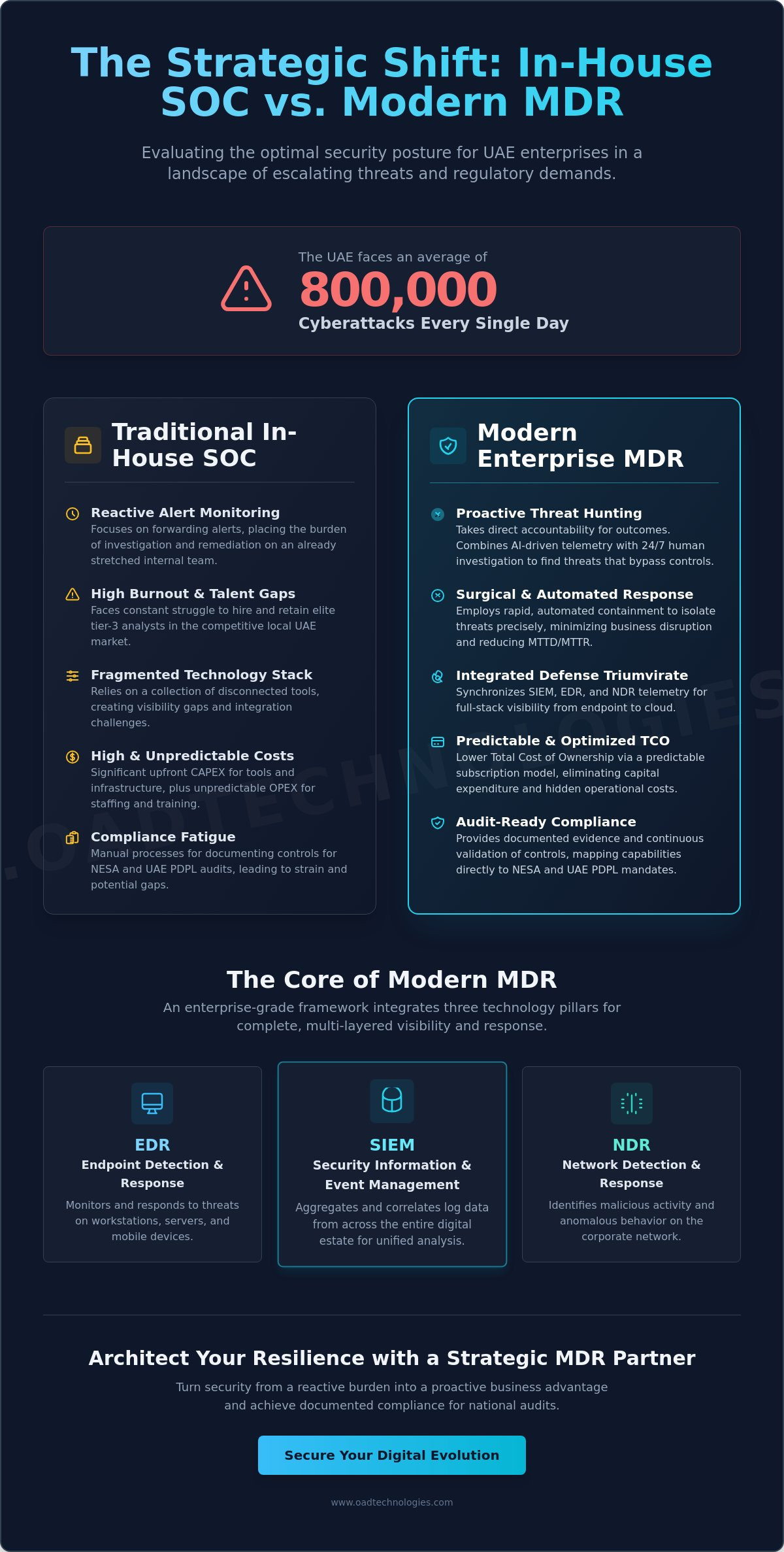
With the UAE facing an average of 800,000 cyberattacks every single day, can your internal security team truly keep pace without burning out? It's a question many leaders ask as they face the dual pressure of sophisticated regional APTs and the constant struggle to hire tier-3 analysts in the local market. You likely feel the weight of compliance fatigue from NESA and UAE PDPL requirements, especially as the UAE Cybersecurity Council shifts toward continuous validation of controls. Implementing mdr for enterprise uae isn't just about outsourcing a SOC; it's about building a resilient foundation that turns security from a reactive burden into a proactive business advantage.
In this guide, you'll discover how modern enterprises leverage Managed Detection and Response to achieve 24 X 7 resilience and documented compliance for national audits. We'll explore the impact of the new May 2026 Cybersecurity Centre of Excellence in Abu Dhabi and explain how to significantly reduce your mean time to detect and respond. From proactive threat hunting to integrating identity-centric security, this strategic roadmap provides the technical clarity you need to secure your digital evolution in an increasingly complex market.
Key Takeaways
- Understand the shift from legacy alert forwarding to modern MDR that combines AI-driven telemetry with high-fidelity human investigation.
- Identify the technical requirements of a resilient framework, including the essential triumvirate of SIEM, EDR, and Network Detection and Response.
- Evaluate the total cost of ownership and strategic benefits of mdr for enterprise uae compared to the challenges of building an in-house SOC.
- Learn how to map your detection and response capabilities directly to NESA IAS requirements and UAE PDPL mandates for seamless regulatory compliance.
- Discover the advantages of a bespoke security architecture that synchronizes managed detection with Identity and Access Management and Cloud Security.
The Evolution of Managed Detection and Response for UAE Enterprises
The cybersecurity landscape in the Emirates has undergone a fundamental transformation. By 2026, mdr for enterprise uae has moved far beyond simple alert monitoring. It's now a sophisticated fusion of human expertise and advanced AI-driven telemetry. While legacy Managed Security Service Providers (MSSPs) typically focused on alert forwarding, leaving the heavy lifting of investigation and remediation to your internal team, modern MDR takes direct accountability for the outcome. This shift is critical as regional Advanced Persistent Threats (APTs) and supply chain compromises become more frequent and harder to detect.
Enterprise-scale organizations in the UAE operate within a high-stakes environment where downtime isn't just a technical issue; it's a threat to national infrastructure and economic stability. A standard, commercial-grade MDR service often lacks the depth required to handle these complexities. According to the foundational definition of Managed Detection and Response (MDR), the service must provide not just tools, but the specialized skills needed to hunt for threats that bypass automated controls. For the UAE enterprise, this means having a partner that understands the nuances of local digital ecosystems and the specific tactics used by regional adversaries.
Beyond Monitoring: The Shift to Active Response
Detection alone is a liability in 2026. If your security posture stops at identifying a threat, you're already behind the curve. Modern mdr for enterprise uae prioritizes active response. This includes rapid, automated containment strategies that isolate compromised assets without disrupting entire business units. It's about surgical precision. Manual response phases allow senior analysts to verify threats and execute remediation steps that preserve business continuity in sectors like energy, finance, and logistics. Proactive 24 X 7 threat hunting is the only way to catch "living off the land" attacks, where intruders use your own administrative tools to hide their movements.
The 2026 UAE Cybersecurity Context
National digital transformation initiatives have accelerated the adoption of cloud and AI, but they've also expanded the enterprise attack surface. Relying on global threat feeds isn't enough. You need localized intelligence that accounts for regional linguistic nuances and cultural attack vectors used in sophisticated phishing campaigns. This localized approach is a core component of the managed detection and response pillar. It ensures that your defense strategy isn't just a generic template but a tailored shield designed for the specific realities of the UAE market. By synchronizing global telemetry with local context, enterprises can achieve a level of resilience that keeps pace with the nation's ambitious digital roadmap.
Core Components of an Enterprise-Grade MDR Framework
Building a resilient security posture requires more than a single dashboard or a collection of disconnected tools. For mdr for enterprise uae to be effective, it must function as a cohesive architecture that synchronizes telemetry across every layer of the digital estate. This enterprise-grade framework relies on a technical triumvirate: Security Information and Event Management (SIEM), Endpoint Detection and Response (EDR), and Network Detection and Response (NDR). By integrating these three pillars, organizations gain full-stack visibility that spans from local endpoints to complex multi-cloud environments and identity providers.
Modern defense has moved past signature-based detection, which often fails against the zero-day exploits and regional APTs targeting the Emirates. Instead, high-performance MDR utilizes behavioral analytics to identify anomalies in user and entity patterns. While AI and machine learning accelerate this process, they aren't a replacement for human intuition. A "Human-in-the-Loop" requirement remains essential for high-fidelity investigations. As noted in Gartner's Market Guide for MDR, the fusion of advanced technology with experienced security analysts is what differentiates a strategic partner from a basic monitoring service. This synergy ensures that every alert is contextualized before it reaches your desk.
Integrated Technology Stack: SIEM and EDR Synergy
The relationship between SIEM and EDR is the heartbeat of modern detection. Advanced SIEM solutions act as the central nervous system, aggregating logs from diverse platforms to provide a unified view of the environment. EDR complements this by providing granular telemetry at the endpoint level, allowing for remote isolation of infected devices. Many enterprises are now evolving toward Extended Detection and Response (XDR) to unify these streams, creating a more direct path to remediation. If you're looking to refine your current architecture, exploring a customized security integration can help bridge the gaps in your existing stack.
Advanced Threat Hunting and Intelligence
Proactive threat hunting is a core differentiator for mdr for enterprise uae. It's a hypothesis-driven search for attackers who have already bypassed perimeter defenses. Rather than waiting for an alert, analysts use global and regional threat feeds to anticipate emerging patterns specific to the Middle East. This intelligence allows for the development of custom "use cases" that protect unique enterprise business logic. By simulating attacker behaviors and searching for subtle indicators of compromise, threat hunters identify "silent" threats before they escalate into full-scale breaches, ensuring long-term operational viability.
MDR vs. Traditional SOC: Evaluating the Strategic Shift
Building a 24 X 7 internal Security Operations Center (SOC) within the Emirates is a massive undertaking that often strains even the most robust budgets. Between specialized infrastructure, licensing fees, and the physical space required, the total cost of ownership (TCO) scales rapidly. The most significant hurdle, however, remains human capital. Finding and retaining tier-2 and tier-3 security analysts in the local market is notoriously difficult. When you opt for mdr for enterprise uae, you bypass the years of recruitment and training needed to reach operational maturity. A professional MDR partnership can be fully integrated within weeks, whereas a mature internal SOC often takes years to refine.
Internal teams frequently drown in a sea of low-fidelity alerts, a phenomenon known as alert fatigue. This noise creates a dangerous environment where critical indicators of compromise are easily overlooked. An MDR partner changes this dynamic by providing filtered, high-context intelligence. They don't just send you more data; they deliver validated, actionable insights. This shift ensures your leadership makes decisions based on high-fidelity security events rather than chasing false positives. It's the difference between reactive firefighting and strategic risk management.
The Force Multiplier Effect
Your internal security staff shouldn't spend their days triaging routine logs. MDR acts as a force multiplier, allowing your team to pivot toward strategic projects that drive business value. You gain 24 X 7/365 coverage without the internal HR burden of managing rotating shifts or the complexities of "on-call" rotations. This model provides immediate access to specialized tools and high-tier expertise that would be cost-prohibitive for most individual enterprises to maintain independently. It empowers your people to lead, rather than just react.
Operational Resilience and MTTR
In a high-stakes environment, Mean Time to Respond (MTTR) is the metric that determines enterprise survival. mdr for enterprise uae prioritizes rapid containment through established playbooks and automated triggers. While an internal manual process might take hours to isolate a threat, an MDR framework acts in minutes. Beyond the immediate response, these partners conduct deep post-incident forensics. This rigorous analysis ensures you don't just stop the current attack but also close the architectural gaps to prevent repeat occurrences, safeguarding your long-term digital relevance.
Navigating the UAE Regulatory Landscape with Managed Security
Regulatory compliance in the Emirates is no longer a "check-the-box" annual exercise. The UAE Cybersecurity Council's shift toward continuous validation means enterprises must demonstrate active, real-time oversight of their digital assets. This is where mdr for enterprise uae becomes a strategic asset. It provides the technical evidence required by the National Electronic Security Authority (NESA) Information Assurance Standards (IAS). By maintaining a persistent record of detection and remediation, you simplify the audit process and significantly reduce the risk of non-compliance penalties.
Beyond NESA, the UAE Personal Data Protection Law (PDPL) mandates rigorous incident response and monitoring protocols for any entity handling sensitive information. If a breach occurs, the law requires specific notification timelines and documented mitigation steps. A robust GRC strategy is significantly bolstered by the continuous auditing capabilities of an MDR framework. Instead of manual data gathering, your GRC team receives automated, high-fidelity reports that prove your security controls are functioning as intended. This integration ensures that your security posture isn't just a technical shield, but a documented pillar of your corporate governance.
Regulatory Alignment: NESA and ISR
MDR serves as the engine for "continuous monitoring" evidence required for national security audits. It's not enough to have a firewall; you must prove you're watching the traffic and acting on anomalies. Localized incident reporting is equally vital, ensuring that any discovered threats are communicated according to UAE federal standards. To ensure no blind spots remain, VAPT assessments should be conducted regularly. These tests identify the architectural gaps that your MDR team will then monitor with heightened scrutiny, creating a closed loop of proactive protection.
Data Sovereignty and Localized Response
National enterprises face strict data residency requirements that global providers often struggle to meet. Choosing a partner that understands these legal frameworks ensures your telemetry stays within the country's digital borders. A UAE-based MDR partner provides more than just technical support; they offer the cultural and legal context necessary for high-stakes decisions. If a critical incident escalates, having a partner capable of providing on-site support across the UAE ensures your recovery is as fast as the initial detection. It's about maintaining sovereignty over your data while leveraging world-class expertise.
If you're ready to align your security posture with national mandates and achieve long-term resilience, consult with our compliance specialists to design your bespoke framework.
Architecting Your Resilience with OAD Technologies
OAD Technologies rejects the "black box" approach common in the cybersecurity market. We believe mdr for enterprise uae requires a bespoke integration that respects the unique architectural nuances of your organization. Our process begins with a rigorous technical assessment to build a customized threat model. This ensures that the telemetry we monitor is directly aligned with your specific business risks. We don't just provide a tool; we act as a strategic partner, bridging the gap between high-level innovation and practical results. This commitment to precision ensures your security posture evolves alongside your business objectives.
True resilience comes from the synergy between specialized security pillars. Our MDR framework integrates seamlessly with Identity and Access Management (IAM) and Cloud Security Posture Management (CSPM). By correlating identity-led signals with cloud environment telemetry, we identify complex attack chains that siloed systems miss. This holistic visibility is essential for the modern UAE enterprise, where digital transformation has expanded the attack surface across hybrid infrastructures. We focus on long-term viability, positioning ourselves as the guardian of your digital relevance.
The OAD Hybrid SOC Model
We function as a direct extension of your existing IT and security departments. Our hybrid model prioritizes transparency, giving your team full visibility into our detection and response platform. You aren't left wondering what's happening behind the scenes. We develop customized runbooks tailored to your internal business processes. This ensures that our response actions are always surgical and never disruptive. It's a collaborative effort that empowers your people while providing the 24 X 7 technical capacity needed for national-scale security. We value deep engineering standards over quick fixes.
Beyond MDR: A Holistic Security Ecosystem
A complete defense requires multiple layers working in concert. While our DLP solutions prevent unauthorized data exfiltration, the mdr for enterprise uae engine monitors for the underlying threats attempting to reach that data. This ecosystem approach ensures your organization remains resilient against the sophisticated regional APTs of 2026. We invite leadership teams to a strategic consultation to map their current security maturity against the emerging threat landscape. Secure your future and Partner with OAD Technologies for National-Scale MDR.
Building Strategic Resilience in the Emirates
Transitioning from reactive monitoring to proactive resilience is no longer optional for organizations navigating the UAE's high-stakes digital landscape. By integrating advanced telemetry with expert human intuition, enterprises can finally close the gap between detection and response. This strategic shift addresses the persistent local talent shortage while ensuring that every security action aligns with NESA and UAE PDPL mandates. Implementing mdr for enterprise uae empowers your team to focus on high-level innovation. It's about turning security into a catalyst for growth rather than an operational bottleneck.
Success in 2026 requires a partner that understands the nuances of regional threat vectors and the necessity of bespoke system design. OAD Technologies provides the technical authority and collaborative spirit needed to safeguard your long-term digital relevance. We offer 24 X 7 proactive threat hunting and seamless integration with your existing enterprise stack to ensure national-scale resilience. Your journey toward a more secure future starts with a strategy built for the next generation of threats.
Secure Your National Infrastructure with OAD Technologies MDR
Frequently Asked Questions
What is the difference between MDR and a traditional SOC?
Traditional SOCs typically focus on log monitoring and generating alerts for your team to handle. MDR goes further by providing active threat containment and remediation. It shifts the focus from simple observation to proactive response. By utilizing human-in-the-loop analysis, MDR validates threats before they reach your desk, ensuring you only deal with high-fidelity security events rather than raw data noise.
How does MDR help UAE enterprises comply with NESA regulations?
MDR provides the continuous monitoring and real-time detection capabilities required by NESA IAS standards. It maintains a persistent audit trail of all security incidents and remediation steps taken. Using mdr for enterprise uae ensures your organization has the documented evidence needed for national audits, proving that your security controls are active and effective 24 X 7.
Can MDR protect our cloud and hybrid environments across the UAE?
Modern MDR is architected to secure hybrid environments by integrating with Cloud Security Posture Management (CSPM) and identity providers. It correlates signals across on-premises infrastructure and multi-cloud workloads to identify lateral movement. This unified visibility ensures that attackers can't hide in the gaps between your local data center and your cloud-based applications.
What is the average deployment time for an enterprise MDR solution?
A sophisticated MDR solution typically reaches operational maturity within weeks. This timeline includes technical assessments, agent deployment, and the customization of detection playbooks. It's a significant advantage over building an internal SOC, which often takes months or years to reach the same level of analytical depth and 24 X 7 coverage required for national-scale protection.
How does MDR handle false positives in a complex enterprise network?
MDR utilizes behavioral analytics and expert human investigation to filter out legitimate network noise. Analysts contextualize every anomaly against your specific business logic before escalating an incident. This rigorous validation process eliminates alert fatigue, allowing your internal security staff to stay focused on strategic projects rather than triaging low-fidelity alerts that don't represent a real risk.
Does OAD Technologies offer incident response as part of the MDR service?
OAD Technologies provides active response and containment as fundamental pillars of our MDR service. We don't just notify you of a threat; we take surgical actions to isolate compromised assets and stop the spread of an attack. Our team collaborates with your staff to execute pre-approved remediation playbooks, ensuring rapid recovery and minimal disruption to your operations.
How is sensitive data protected when using a third-party MDR provider?
Data protection is maintained through strict residency controls and encrypted telemetry channels. We ensure that sensitive security data is handled according to UAE PDPL mandates and national residency requirements. By synchronizing MDR with Data Loss Prevention (DLP) tools, we provide a layered defense that monitors for external threats while simultaneously preventing unauthorized internal data exfiltration.
Is MDR suitable for government-linked companies (GLCs) in the UAE?
mdr for enterprise uae is highly effective for GLCs that manage critical national infrastructure. It provides the high-tier expertise and specialized tools necessary to defend against sophisticated regional APTs. The model supports sovereign security goals by utilizing localized threat intelligence and ensuring that all incident reporting aligns with federal standards and national security requirements.
Disclaimer
Content by OAD Technologies is for general informational purposes only and does not constitute professional or cybersecurity advice. No warranties are made regarding accuracy or completeness; reliance is at your own risk. OAD Technologies shall not be liable for any direct or indirect losses arising from use of this content.


