

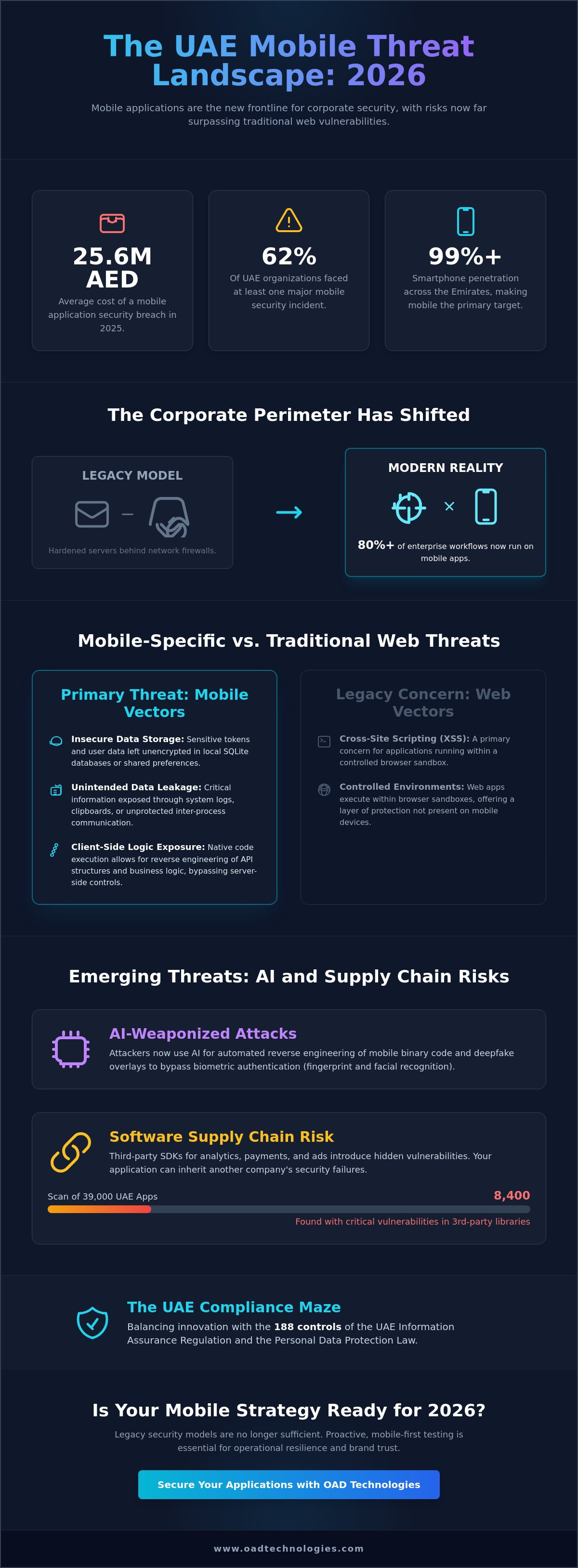
In 2025, the average cost of a mobile application security breach climbed to over 25.6 million AED, yet 62% of organizations still faced at least one major incident. You likely recognize that securing a digital presence in the UAE requires more than just standard encryption or basic mobile application security testing. With smartphone penetration exceeding 99% across the Emirates, it's clear your mobile assets are the primary targets for AI-driven malware. Balancing the complexities of iOS and Android while meeting the 188 controls of the UAE Information Assurance Regulation v1.1 is a daunting task for even the most seasoned technical teams.
This guide provides a strategic framework for mastering the complexities of mobile security through professional testing, compliance, and proactive data protection. We'll explore how to bridge the specialized talent gap, implement rigorous testing protocols, and future-proof your applications against the sophisticated threats of 2026 while ensuring your corporate digital assets remain protected without creating friction in your development lifecycle.
Key Takeaways
- Identify why mobile-specific attack vectors have surpassed traditional web vulnerabilities as the leading threat to UAE corporate digital assets in 2026.
- Implement a rigorous mobile application security testing strategy using the OWASP MASVS to ensure your iOS and Android applications meet global and local standards.
- Evaluate the essential synergy between automated SAST/DAST tools and manual penetration testing to uncover critical business logic flaws that scanners often miss.
- Navigate the complexities of UAE compliance by aligning your mobile development lifecycle with the Personal Data Protection Law and national information security requirements.
- Learn how bespoke security architectures integrate application testing with broader Data Loss Prevention strategies to create a resilient, future-proof mobile ecosystem.
The Evolving Mobile Threat Landscape in 2026
By May 2026, the traditional corporate perimeter has effectively dissolved. As UAE enterprises accelerate their digital transformation under the "We the UAE 2031" vision, the focus of cyber espionage has shifted away from hardened internal servers toward the devices in your employees' pockets. This shift is driven by the fact that mobile applications now handle over 80% of enterprise workflows; however, they often lack the architectural oversight of their desktop predecessors. Understanding The Evolving Mobile Threat Landscape in 2026 is no longer a niche technical concern but a core requirement for operational resilience. Attackers recognize that mobile apps are the weakest link, often bypassing network firewalls by living on untrusted personal hardware that connects directly to sensitive cloud databases.
The financial stakes for regional businesses have never been higher. With the average cost of a mobile data breach reaching 25.6 million AED in 2025, a single vulnerability can disrupt strategic growth and erode years of brand equity. This isn't just about data theft; it's about the erosion of trust in the UAE's digital economy. Relying on legacy web security models is a strategic error because mobile apps introduce unique attack vectors that traditional scanners simply cannot see. This is why rigorous mobile application security testing must be integrated into the earliest stages of your development lifecycle.
Mobile-Specific Vulnerabilities vs. Web Threats
Unlike web applications that run in controlled browser environments, mobile apps execute code directly on the device. This exposes client-side logic to reverse engineering, allowing sophisticated actors to map out your API structures and server-side controls. We frequently see insecure data storage in local SQLite databases or shared preferences where sensitive tokens are left unencrypted. While web threats often focus on cross-site scripting, mobile risks center on unintended data leakage through system logs or the clipboard. Securing these touchpoints requires a bespoke approach that accounts for the specific behaviors of iOS and Android operating systems simultaneously.
Emerging Threats: AI and Sophisticated Malware
The threat landscape in 2026 is defined by the weaponization of artificial intelligence. Attackers now use AI-driven reverse engineering tools to automate the discovery of zero-day vulnerabilities in mobile binary code. Modern malware has also evolved to target mobile biometric authentication, using deepfake overlays to bypass fingerprint and facial recognition. The risk to the software supply chain is equally critical. Many UAE apps rely on third-party SDKs for analytics or payments, yet a 2025 scan of nearly 39,000 applications found over 8,400 critical vulnerabilities hidden within these external libraries. Effective mobile application security testing must now include a deep analysis of these third-party components to ensure your application doesn't inherit someone else's security failures.
The MAST Framework: SAST, DAST, and OWASP Standards
Mobile application security testing is no longer a reactive necessity; it's a foundational pillar of the modern software development lifecycle. In 2026, an effective MAST framework moves beyond simple vulnerability scanning to provide a multi-layered defense strategy. This framework integrates technical rigor with business logic to ensure that every line of code contributes to the enterprise's overall resilience. By adopting a "Shift Left" philosophy, UAE organizations can identify critical flaws during the design and coding phases. This proactive approach prevents the costly delays and reputational damage associated with late-stage security failures.
To implement effective mobile application security testing, enterprises must adopt standardized benchmarks that provide clear, measurable outcomes. Global benchmarks, such as those reflected in Duke University's mobile application testing standards, emphasize the need for a structured approach that combines automated efficiency with human intelligence. Relying solely on automated tools often results in a false sense of security, as scanners frequently struggle to interpret complex business logic or multi-factor authentication workflows unique to the UAE's financial and government sectors.
SAST vs. DAST: Choosing the Right Methodology
Static Application Security Testing (SAST) analyzes the application's source code or binaries without executing the program. It's highly effective at identifying coding errors and insecure patterns early. Conversely, Dynamic Application Security Testing (DAST) evaluates the app in its running state, uncovering issues related to insecure communication and server-side vulnerabilities. For the most sophisticated 2026 requirements, Interactive Testing (IAST) acts as a hybrid, monitoring the application from within while it's being exercised. This real-time visibility allows for deeper insights into how data flows through the system.
The OWASP MASVS Tiers
The Mobile Application Security Verification Standard (MASVS) provides the definitive roadmap for testing depth. We categorize applications into three distinct tiers based on their risk profile:
- MASVS-L1: The baseline for all mobile apps, focusing on best practices for data handling and basic security hygiene.
- MASVS-L2: Essential for UAE finance and healthcare entities, this tier adds rigorous requirements for authentication and sensitive data protection.
- MASVS-Resilience: Specifically designed to defend against reverse engineering and hardware-level tampering, a critical requirement for high-value corporate assets.
Aligning your development pipeline with these tiers ensures that your security investment is proportional to the data's value. Partnering with an expert to design a bespoke security architecture ensures these frameworks translate into tangible business protection rather than just theoretical compliance.
Automated Tools vs. Manual Penetration Testing
Many organizations in the UAE fall into the trap of believing that a subscription to a top-tier automated scanner constitutes a complete security strategy. While these tools are indispensable for maintaining speed in a DevOps environment, they represent only one half of a mature mobile application security testing program. Automated solutions excel at scale. They provide consistent, rapid checks for known CVEs and can be integrated directly into your build pipeline to ensure no obvious regressions reach production. However, relying solely on algorithms leaves a blind spot that sophisticated adversaries are eager to exploit.
The Limits of Automated MAST Tools
Automated tools are fundamentally limited by their inability to understand context. They frequently generate significant noise through false positives, often flagging harmless code patterns while missing nuanced vulnerabilities. For instance, a scanner cannot easily navigate a complex multi-step authentication process that involves out-of-band signals or specific UAE identity integrations like UAE PASS. They also struggle with bespoke encryption implementations. Tools often fail to recognize when a custom cryptographic wrapper is improperly implemented, leading to a false sense of security. If your application relies on unique business logic to process transactions, an automated tool won't understand the intended flow well enough to identify where that logic can be subverted.
The Value of Expert-Led Mobile VAPT
This is where expert-led vulnerability assessment and penetration testing becomes irreplaceable. A human architect doesn't just scan; they simulate real-world adversary tactics tailored to your specific business model. They look for flaws in how your app interacts with integrated third-party services and APIs, ensuring that data doesn't leak between the mobile front-end and the cloud back-end. In the regional market, where apps often serve as the primary interface for high-value financial transactions, manual testing uncovers exploit chains that combine several low risk findings into a single critical breach. By simulating a focused attack, we identify the specific path an intruder would take to compromise your corporate digital assets.
To maximize ROI, we suggest a hybrid schedule. Use automated mobile application security testing for every minor update to catch common errors and maintain a baseline of security. Reserve manual penetration testing for major releases, architectural shifts, or bi-annual deep dives. This approach ensures your security posture remains robust without slowing down your innovation cycle or inflating your operational costs. It moves your defense from a checkbox exercise to a strategic asset that protects your long-term digital relevance.
Building a MAST Strategy for UAE Compliance
Compliance in the UAE's digital ecosystem has evolved into a sophisticated regulatory hurdle that requires more than just surface-level checks. By May 2026, the UAE Personal Data Protection Law (PDPL) has set a clear mandate for how enterprise applications handle resident data. Integrating mobile application security testing into your broader governance risk and compliance framework is the only way to ensure your mobile assets don't become a legal liability. Regulatory bodies like the Dubai Electronic Security Center (DESC) now look for evidence of continuous testing as part of ISR v3.1 audits. Failing to demonstrate these controls can result in significant fines and the suspension of digital services.
The National Cybersecurity Strategy 2025-2031, approved in February 2025, emphasizes a multi-layered approach to protection. For your enterprise, this means aligning mobile security with the 188 controls outlined in the UAE Information Assurance Regulation v1.1. Documentation is key here. During a regulatory audit, your team must provide detailed reports that prove vulnerabilities were not only identified but remediated within established SLAs. This structured reporting transforms security from a technical cost into a documented asset that supports your organization's strategic growth.
Data Sovereignty and Mobile Security
Data residency is a non-negotiable pillar of UAE law. Your mobile application security testing must specifically target how data is cached and transmitted. We often find apps that inadvertently leak sensitive user information to third-party analytics servers located outside the country. Testing protocols must verify that all data egress points comply with national residency requirements. This ensures that personal identifiers remain within the UAE's jurisdiction, protecting you from the legal repercussions of unauthorized cross-border data transfers.
Implementing MAST in the SDLC
A resilient strategy requires embedding security into every phase of the development lifecycle. We recommend a four-step architectural approach:
- Step 1: Threat Modeling: Conduct this during the design phase to identify potential attack vectors before a single line of code is written.
- Step 2: Automated SAST: Integrate static analysis directly into your CI/CD pipeline to catch common errors in real-time.
- Step 3: Deep-Dive Manual VAPT: Perform rigorous penetration testing before major releases to uncover complex business logic flaws.
- Step 4: Continuous Monitoring: Implement Runtime Application Self-Protection (RASP) to defend against active exploits in the production environment.
This structured methodology ensures that security keeps pace with your innovation. If you're ready to align your mobile assets with national standards, request a bespoke compliance roadmap from our expert architects today.
OAD Technologies: Bespoke Mobile Security Solutions
Generic security tools often fail because they don't account for the unique architectural nuances of your specific enterprise environment. At OAD Technologies, we move beyond the industry standard by designing bespoke mobile security architectures that treat mobile application security testing as a continuous strategic asset rather than a periodic hurdle. Our 'Expert Architect' approach ensures that we don't just find vulnerabilities; we build long-term resilience by acting as a collaborative extension of your technical team. This partnership allows us to align every testing cycle with your specific business objectives and the evolving UAE regulatory landscape. We prioritize the intersection of human intelligence and machine capability, ensuring our rigorous engineering standards empower your people rather than just automating processes.
A critical component of our strategy is the seamless integration of MAST with data loss prevention. In 2026, mobile applications are the primary conduits for corporate data. By linking application testing directly to your DLP protocols, we ensure that sensitive information remains protected even when accessed from unmanaged devices or over public networks in the Emirates. This holistic view prevents data leakage at the source, providing a level of operational efficiency that generic testing simply cannot match. We focus on creating a seamless integration between your mobile front-end and your secure data core to protect your long-term digital relevance.
Integrated Security Ecosystems
Mobile security signals shouldn't exist in a vacuum. We ensure your mobile telemetry is funneled directly into your SIEM for unified visibility. This integration allows your security operations center to correlate mobile-originated threats with broader network activity in real-time. By leveraging managed detection and response, we provide the proactive oversight needed to neutralize sophisticated malware before it can pivot to your core infrastructure. Central to this ecosystem is a robust identity and access management framework. This ensures that only authorized users can interact with your high-value digital assets, maintaining a zero-trust posture across all mobile touchpoints.
Securing Your Digital Future
The UAE's digital economy moves too fast for one-size-fits-all software. We believe that mobile application security testing should be as unique as the code it protects. Our commitment to the UAE's national security standards, including NESA and Dubai ISR, means your applications are vetted against the most rigorous local requirements. We focus on future-proofing your assets, ensuring they remain relevant and secure as AI-driven threats continue to evolve. This dedication to craftsmanship and precision is what defines our role as your strategic partner. We don't just offer a service; we offer a roadmap for long-term digital sovereignty and growth.
Contact OAD Technologies for a bespoke mobile security assessment to begin securing your enterprise's digital future today.
Architecting a Resilient Mobile Future
Transitioning from a reactive security posture to a proactive, architected defense is essential for any UAE enterprise navigating the 2026 threat landscape. We've explored how the shift toward mobile-specific attack vectors requires more than just automated scanning; it demands a sophisticated blend of technical rigor and strategic alignment with national standards like the PDPL and NESA. By integrating mobile application security testing into your core development lifecycle, you ensure that digital transformation drives growth rather than creating liability.
OAD Technologies provides the specialized UAE national compliance expertise and deep integration with DLP and MDR frameworks needed to protect your corporate assets. Our Expert Architect model ensures we act as a collaborative partner in your long-term success. Secure your mobile enterprise with OAD Technologies' bespoke VAPT services and build a foundation for secure, scalable innovation. It's time to turn your mobile security into a competitive advantage for the digital decade ahead.
Frequently Asked Questions
What is the difference between web and mobile application security testing?
Mobile testing focuses on device-specific risks like local data storage, binary code vulnerabilities, and biometric sensor security, whereas web testing analyzes browser-based interactions. Mobile apps execute code directly on local hardware, exposing them to reverse engineering and hardware-level tampering that traditional web applications don't face. This requires specialized tools to analyze the application's behavior within the iOS and Android ecosystems.
How does MAST help with UAE PDPL compliance?
MAST ensures that personal data handled by your application is encrypted and stored according to the residency requirements of the UAE Personal Data Protection Law. It identifies unauthorized data egress points that might send sensitive identifiers to non-compliant jurisdictions. This provides the documented evidence of security controls that the UAE Data Office requires during a regulatory audit or incident investigation.
Is automated mobile security testing enough for enterprise apps?
Automated tools are insufficient for enterprise-grade security because they cannot detect complex business logic flaws or multi-step authentication bypasses. While scanners offer speed for CI/CD pipelines, they lack the human intuition needed to simulate a sophisticated adversary's attempt to subvert your specific workflows. A mature strategy requires a hybrid approach that combines automated efficiency with expert-led manual assessments.
How often should we conduct manual mobile penetration testing?
Conduct manual penetration testing at least twice annually or before every major architectural release. High-risk applications in the UAE financial or government sectors often require quarterly testing to remain aligned with the evolving threat landscape and stringent NESA audit schedules. This frequency ensures that new features don't introduce vulnerabilities that could compromise your corporate digital assets.
Can MAST detect vulnerabilities in third-party mobile SDKs?
Yes, professional mobile application security testing analyzes both your proprietary code and the binary signatures of integrated third-party SDKs. Since over 21% of mobile vulnerabilities in 2025 originated from supply chain components, checking these external libraries is a critical step. We verify that these components don't introduce hidden backdoors or insecure data handling practices into your application ecosystem.
What are the most common mobile security risks in 2026?
The most prevalent risks include AI-driven reverse engineering, insecure API communication, and sophisticated biometric authentication bypasses. Attackers also frequently target the software supply chain by exploiting vulnerabilities in common third-party libraries. These threats are designed to bypass traditional network perimeters by living on the device, making client-side code exposure a unique and significant risk factor for UAE enterprises.
Does mobile security testing slow down the development process?
Security testing actually accelerates the long-term development lifecycle by preventing the 25.6 million AED average cost of a mobile breach. By implementing a "Shift Left" strategy with automated mobile application security testing, you identify and remediate flaws during the coding phase. This prevents the costly and time-consuming emergency patches that occur when vulnerabilities are discovered after a public release.
How do we test mobile apps that use biometric authentication?
Testing involves simulating deepfake overlays and checking for improper implementation of local authentication frameworks like FaceID or TouchID. We verify that the application doesn't rely solely on the device's general "unlock" status but instead utilizes secure keychains to protect sensitive session tokens. This ensures that a compromised device doesn't automatically grant an attacker access to your high-value corporate data.
Disclaimer
Content by OAD Technologies is for general informational purposes only and does not constitute professional or cybersecurity advice. No warranties are made regarding accuracy or completeness; reliance is at your own risk. OAD Technologies shall not be liable for any direct or indirect losses arising from use of this content.


