

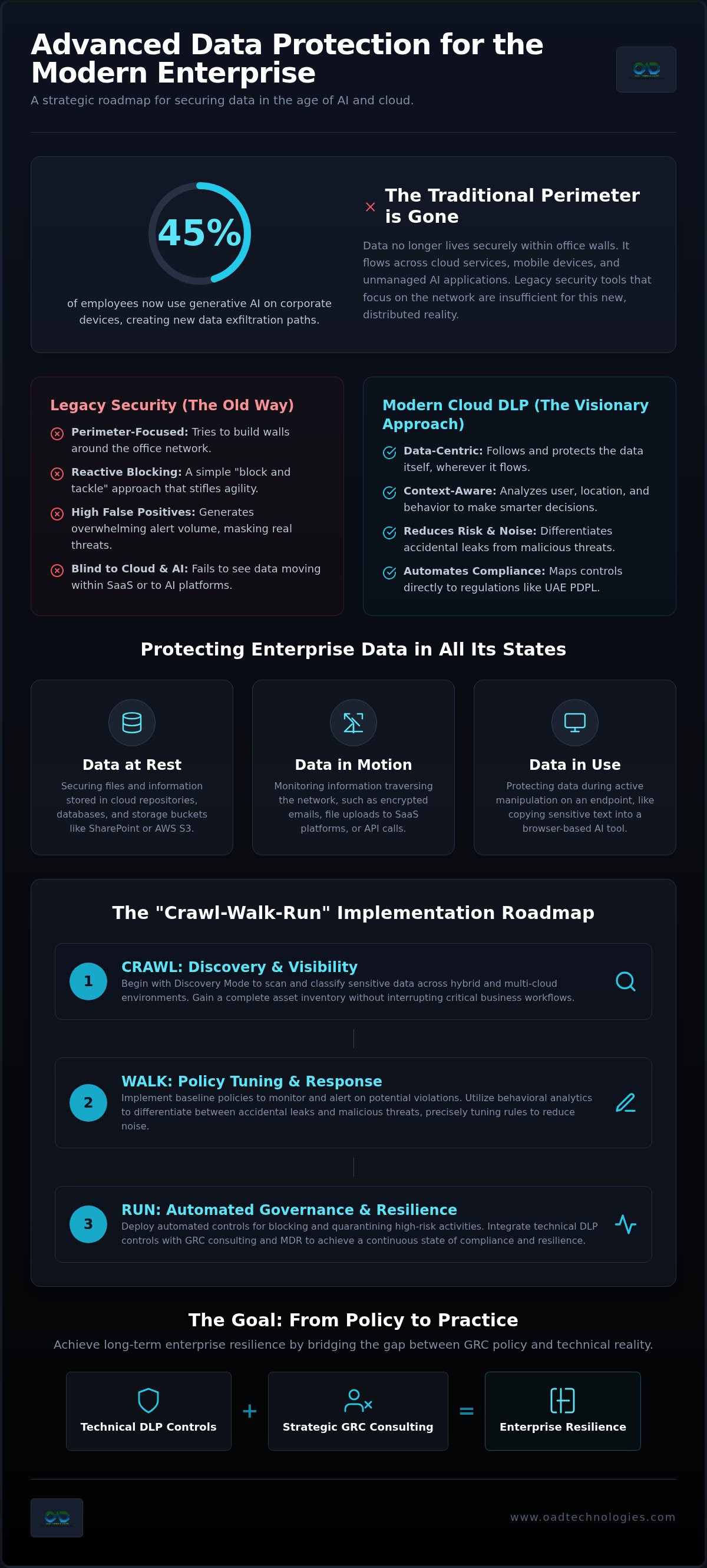
With 45% of employees now utilizing generative AI on corporate devices, the traditional security perimeter hasn't just shifted; it's effectively dissolved. Most security leaders agree that legacy tools are no longer sufficient, especially when seeking cloud dlp solutions that can handle modern scale. These older systems frequently generate an overwhelming volume of false positives that mask genuine exfiltration risks. In our national market, the challenge is even more acute when trying to map technical controls to specific regulatory requirements like the UAE's Personal Data Protection Law (PDPL).
This strategic guide provides a clear roadmap for deploying advanced data protection that safeguards your intellectual property without stifling business agility. You'll learn how to transition from restrictive legacy frameworks to a visionary approach that integrates behavioral analytics and automated compliance reporting. We explore the most critical use cases for 2026, ensuring your organization maintains its digital relevance while securing data across complex hybrid and multi-cloud environments. By the end of this guide, you'll have the insights needed to reduce data risks and transform your security posture into a pillar of enterprise resilience.
Key Takeaways
- Transition from legacy perimeter security to a data-centric framework that ensures visibility across hybrid and multi-cloud architectures.
- Automate the identification of sensitive PII to maintain strict alignment with national regulations, specifically the UAE PDPL, using modern cloud dlp solutions.
- Utilize behavioral analytics to differentiate between accidental data leaks and malicious insider threats for more precise incident response.
- Implement a phased "Crawl-Walk-Run" roadmap that begins with Discovery Mode to protect assets without interrupting critical business workflows.
- Achieve long-term resilience by integrating technical DLP controls with strategic GRC consulting to bridge the gap between policy and practice.
Defining Cloud DLP Solutions in the Modern Enterprise
Modern Data loss prevention (DLP) is no longer a reactive "block and tackle" exercise. It's a strategic framework designed to follow data wherever it flows. Historically, security focused on building walls around the office. Today, that perimeter is gone. Data lives in the cloud, on mobile devices, and within unmanaged AI applications. Transitioning to cloud dlp solutions represents a shift from securing the network to securing the data itself. This data-centric approach is vital in 2026, where generative AI and "Shadow AI" create new exfiltration paths that traditional firewalls simply can't see. For UAE enterprises, this isn't just about security; it's about mapping technical visibility to business risk management.
Data in Motion, at Rest, and in Use
Enterprise data exists in three distinct states, each requiring a tailored protection strategy. Data at rest refers to files stored in cloud repositories like SharePoint or AWS S3 buckets. Data in motion describes information traversing the network, such as an encrypted email sent to a partner or a file upload to a SaaS platform. Data in use involves active manipulation on an endpoint, like a user copying sensitive figures into a browser-based AI tool or an unapproved messaging app.
Effective cloud dlp solutions require different technical controls for each state. While "content-aware" detection looks for specific patterns like national ID numbers or financial records, "context-aware" detection examines the surrounding circumstances. It asks who is accessing the data, where they're sending it, and whether that behavior aligns with their typical role. This nuanced approach ensures that legitimate business processes aren't interrupted by overly restrictive policies that can't distinguish between a routine report and a data leak.
The Role of DLP in Enterprise Resilience
DLP serves as a critical safety net for the inevitable human error. Even the most well-trained employees can accidentally share a sensitive link or misconfigure a cloud folder. By integrating these controls with Managed Detection and Response (MDR), organizations gain holistic visibility that bridges the gap between endpoint security and data governance. This synergy ensures that if a breach occurs, the impact is contained before it escalates into a regulatory crisis or a loss of competitive advantage. DLP is the final line of defense when identity and perimeter controls are bypassed.
Primary Use Cases: Compliance and IP Protection
Regulatory compliance remains the primary driver for data security investments in the national market. While basic tools offer simple blocking, advanced cloud dlp solutions provide the visibility required to manage risk across distributed environments. These systems automate the identification of Personally Identifiable Information (PII), transforming a manual, error-prone task into a streamlined process. This automation is vital for audit readiness; it allows teams to generate real-time reports that prove data is handled according to internal policies and external mandates. Adopting a modern framework for cloud DLP ensures that compliance isn't just a point-in-time check, but a continuous state of operation.
Meeting National Regulatory Requirements (PDPL & NESA)
The UAE Personal Data Protection Law (PDPL) and NESA standards set rigorous benchmarks for how organizations handle resident data. Modern DLP policies must map directly to these requirements to avoid significant penalties. Automated discovery tools scan cloud repositories to locate sensitive data, ensuring it remains within national infrastructure boundaries where required. This capability directly assists in Governance, Risk, and Compliance (GRC) alignment by providing a clear inventory of what data exists and who can access it. Aligning your technical controls with national law requires precision; OAD Technologies can help you architect a data protection framework tailored to your specific infrastructure.
Protecting Intellectual Property and Trade Secrets
Beyond compliance, the protection of "Crown Jewels" like design documents, proprietary source code, and financial models is essential for maintaining a competitive edge. Traditional security often fails here because sensitive data can be obscured in different file formats. Fingerprinting technology solves this by creating a unique digital signature for sensitive files. Even if a user renames a file, changes its extension, or copies a portion of the text into an AI prompt, the system identifies the protected content. This level of granular control is particularly useful during high-stakes business events, such as:
- Mergers and Acquisitions: Securing data rooms and ensuring sensitive financial disclosures don't leak to unauthorized parties.
- Strategic Partnerships: Monitoring data shared with third-party vendors to prevent misuse or unauthorized redistribution.
- Product Development: Safeguarding R&D data from being uploaded to public cloud services or "Shadow AI" platforms.
Deploying cloud dlp solutions with these capabilities ensures that your intellectual property remains a private asset rather than a public liability. This proactive stance empowers organizations to innovate and collaborate globally without compromising their most valuable trade secrets.
Addressing the Insider Threat: Monitoring and Behavioral DLP
Protecting data requires a deep understanding of the people who handle it. Insider threats aren't always born from malicious intent; they frequently stem from simple negligence or an employee's desire to bypass friction to stay productive. Modern cloud dlp solutions now integrate User and Entity Behavior Analytics (UEBA) to differentiate between a routine file transfer and a genuine security incident. By establishing a baseline of normal activity for every user, these systems identify anomalies that static rules might miss. This behavioral lens is essential for maintaining enterprise resilience without creating a culture of suspicion or hindering the pace of innovation.
The rise of "Shadow IT" and unauthorized SaaS applications has created blind spots that legacy tools can't address. When employees use unapproved tools to manage corporate data, they bypass the security controls designed to protect the organization. Behavioral DLP bridges this gap by monitoring data movement regardless of the destination. It provides the visibility needed to manage risks associated with the 45% of employees now using AI on corporate devices, ensuring that sensitive information doesn't leak through unmanaged channels. For organizations aiming to harness this technology safely, Navo Inc. provides specialized coaching on synthetic workforce development and the deployment of AI agents.
Detecting Malicious Data Exfiltration
Malicious actors often follow predictable patterns before attempting to leave an organization. A sudden spike in upload volumes to personal cloud storage or the creation of large, encrypted zip files often signals an attempt to exfiltrate proprietary data. Behavioral DLP identifies these "flight risk" indicators in real time. Beyond mere monitoring, the system can proactively block unauthorized USB devices or prevent the synchronization of corporate folders with private cloud accounts. These controls ensure that sensitive assets don't exit the national market through unapproved or hidden channels.
Preventing Accidental Leaks and Human Error
Most data leaks are unintentional. An employee might paste sensitive customer data into a public generative AI tool to summarize a report, unknowingly exposing PII to a third-party model. Modern cloud dlp solutions provide "Just-in-Time" training by triggering a pop-up notification the moment a policy violation is detected. This educates the user at the point of risk, allowing them to correct their action before the data is lost. Automating the encryption of sensitive emails based on content scanning further reduces the reliance on manual user intervention, turning security into a seamless part of the workflow.
Prioritizing Your Roadmap for Cloud DLP Solutions
Implementing a data protection strategy is a marathon, not a sprint. Organizations that attempt to activate every restrictive policy on day one often face internal friction and operational bottlenecks. A successful deployment follows a "Crawl-Walk-Run" methodology, ensuring that security controls support business velocity rather than hindering it. By aligning cloud dlp solutions with your organization's highest identified risks, you can demonstrate immediate value while building a foundation for long-term resilience. This phased approach allows security teams to refine their logic based on real-world incident data before escalating to automated enforcement.
Phase 1: Visibility and Data Discovery
The first phase focuses exclusively on visibility. You cannot protect what you haven't identified. During this stage, the system operates in "Discovery Mode," scanning repositories across the national infrastructure to locate sensitive assets. This process involves categorizing data based on its sensitivity level without implementing any blocking actions. By monitoring activity silently, you establish a baseline of "normal" data movement within your specific business context. This visibility reveals where PII or intellectual property resides and how it's being shared, highlighting gaps in current employee workflows that might lead to accidental exposure. This foundational insight is critical for designing policies that are accurate and effective.
Phase 2: Policy Enforcement and Automation
Once you understand your data landscape, you can move from passive monitoring to active enforcement. This phase involves transitioning high-risk channels, such as unauthorized cloud storage or unmanaged messaging apps, into "Block" mode. To be truly effective, you should integrate your data controls with Identity and Access Management (IAM). This ensures that data access is tied directly to a user's role and current security status. Automation plays a vital role here; common violations can trigger self-remediation workflows, such as automatically encrypting a file or notifying a manager of a policy breach. This reduces the burden on security analysts while providing instantaneous protection for critical assets.
Continuous policy refinement is the final, ongoing stage of a mature roadmap. As new threats emerge and business processes evolve, your cloud dlp solutions must adapt. Analyzing incident trends helps you identify whether a specific policy is too restrictive or if a new exfiltration path has opened up. This iterative cycle ensures that your data protection remains relevant and robust. If you're ready to define a customized path for your organization, you can request a strategic roadmap consultation from OAD Technologies to align your technical controls with your business objectives.
Strategic DLP Implementation with OAD Technologies
Choosing a national partner provides a distinct advantage in navigating the local threat landscape. We understand the nuances of regional data flows and the specific pressures of local regulatory bodies. This expertise allows us to transform abstract compliance requirements into concrete technical policies that protect your most valuable assets. By acting as an extension of your own team, we provide the proactive, solution-oriented mindset needed to stay ahead of evolving exfiltration risks.
While many vendors focus solely on the platform, OAD Technologies focuses on the synergy between human insight and technological capacity. A managed approach ensures that your security team isn't buried under a mountain of false positives. We filter the noise, identifying the strategic risks that require immediate attention. Our team customizes DLP policies to fit your unique organizational architecture, ensuring that "crown jewel" data is identified and protected across every cloud environment.
This customization often stems from the insights gained through our VAPT services. By simulating real-world attacks, we identify the specific paths an adversary might use to exfiltrate data. This synergy allows us to harden your DLP policies based on proven vulnerabilities, creating a multi-layered defense that is significantly more robust than a standard, out-of-the-box deployment. We don't just tell you where the holes are; we provide the tools and strategy to plug them effectively.
Securing Your Digital Future
Enterprise resilience depends on a scalable data protection framework that grows alongside your business. We design systems that maintain their relevance even as you adopt new technologies or expand your cloud footprint. Our promise is one of proactive partnership, offering continuous policy refinement and strategic guidance rather than reactive support. We act as guardians of your digital relevance, ensuring that your data remains a secure foundation for future innovation.
Building a sophisticated defense requires a clear roadmap and expert execution. We invite you to consult with OAD Technologies for a tailored DLP roadmap that addresses your specific compliance needs and intellectual property risks. Let's work together to architect a solution that secures your data today and preserves your competitive edge for the years to come.
Architecting a Resilient Data Strategy for 2026
Securing your organization's future requires a move beyond traditional perimeter defenses toward a data-centric framework that prioritizes visibility and resilience. We've examined how modern cloud dlp solutions allow UAE enterprises to align technical controls with national regulations like the PDPL while protecting critical intellectual property from both malicious exfiltration and accidental leaks. By integrating behavioral analytics and automated discovery, your security posture becomes a strategic asset that empowers innovation instead of hindering it.
OAD Technologies serves as a specialized system integrator and national cybersecurity expert, providing the sophisticated blend of human insight and technological capacity needed to navigate the 2026 threat landscape. Our comprehensive GRC and MDR integration ensures that your data protection strategy is grounded in reality and optimized for long-term success. We act as a proactive partner, bridging the gap between high-level innovation and practical business results for organizations across the national market.
Secure your enterprise data with OAD Technologies' Strategic DLP Solutions. Let's collaborate to design a customized roadmap that safeguards your digital assets and preserves your competitive edge in an ever-changing market.
Frequently Asked Questions
What are the most common DLP use cases for financial institutions?
Financial institutions primarily use data protection to secure sensitive customer information like IBANs and account numbers. Common use cases include preventing the unauthorized transfer of financial records to personal cloud storage and monitoring database administrators with access to high-value assets. These controls ensure that data remains within the secure corporate environment; this reduces the risk of financial fraud or regulatory penalties for non-compliance with national banking standards.
How do cloud dlp solutions help with UAE Personal Data Protection Law (PDPL) compliance?
Modern cloud dlp solutions automate the identification and classification of personal data as defined by the UAE PDPL. These systems scan cloud repositories to ensure that resident data isn't moved to unauthorized jurisdictions without proper encryption or consent. By maintaining a continuous inventory of PII, organizations can generate the detailed audit reports required by national regulators, proving they've implemented adequate technical measures to protect individual privacy.
Can DLP prevent data leaks to generative AI tools like ChatGPT?
Yes, advanced DLP tools can inspect data sent to generative AI platforms in real time. They identify sensitive patterns, such as proprietary source code or customer lists, and block the upload or paste action before the data reaches the AI model. This capability is essential for managing "Shadow AI" risks, where employees might unknowingly share trade secrets to summarize documents or generate code without following corporate security protocols.
What is the difference between Endpoint DLP and Network DLP use cases?
Endpoint DLP controls data on the local device, monitoring actions like copying to USB drives, printing, or pasting into browser applications. Network DLP focuses on data in transit across the organization's perimeter, such as email traffic or web uploads. While network controls are easier to deploy centrally, endpoint solutions are critical for protecting data when employees work remotely or use devices that aren't currently connected to the corporate network.
How do I avoid 'DLP fatigue' from too many false positive alerts?
Reducing fatigue requires moving beyond simple keyword matching toward behavioral analytics and User and Entity Behavior Analytics (UEBA). By establishing a baseline of normal user activity, the system can prioritize alerts that represent genuine anomalies rather than routine business processes. Implementing a phased roadmap also allows teams to refine policy logic during a "discovery only" period; this ensures that only high-probability risks trigger an active security response.
Is DLP necessary if we already use Cloud Security Posture Management (CSPM)?
While CSPM secures the cloud infrastructure and configuration, it doesn't inspect the actual content of the files stored there. DLP provides the necessary layer of content-aware protection that identifies sensitive data within those buckets. Combining both tools ensures that your cloud environment is correctly configured while also preventing the unauthorized movement of specific intellectual property or PII that might be accessed through legitimate but misused accounts.
Can cloud dlp solutions monitor encrypted data traffic?
Modern cloud dlp solutions can monitor encrypted traffic by utilizing SSL/TLS decryption techniques at the network gateway or through endpoint agents. By decrypting the traffic for inspection before it's re-encrypted and sent to its destination, the system can identify sensitive data hidden within HTTPS sessions. This visibility is vital for securing data sent to SaaS applications and web services that use encryption to bypass traditional, non-inspecting security filters.
What are the best practices for implementing a DLP pilot program?
Start your pilot program by focusing on a specific, high-risk department or a single sensitive data type rather than attempting a company-wide rollout. Operate the system in discovery mode initially to gather data without blocking legitimate workflows. This allows you to tune your policies and demonstrate value to stakeholders before expanding the scope. Partnering with a specialized system integrator ensures the pilot aligns with your broader GRC and infrastructure goals.
Disclaimer
Content by OAD Technologies is for general informational purposes only and does not constitute professional or cybersecurity advice. No warranties are made regarding accuracy or completeness; reliance is at your own risk. OAD Technologies shall not be liable for any direct or indirect losses arising from use of this content.