

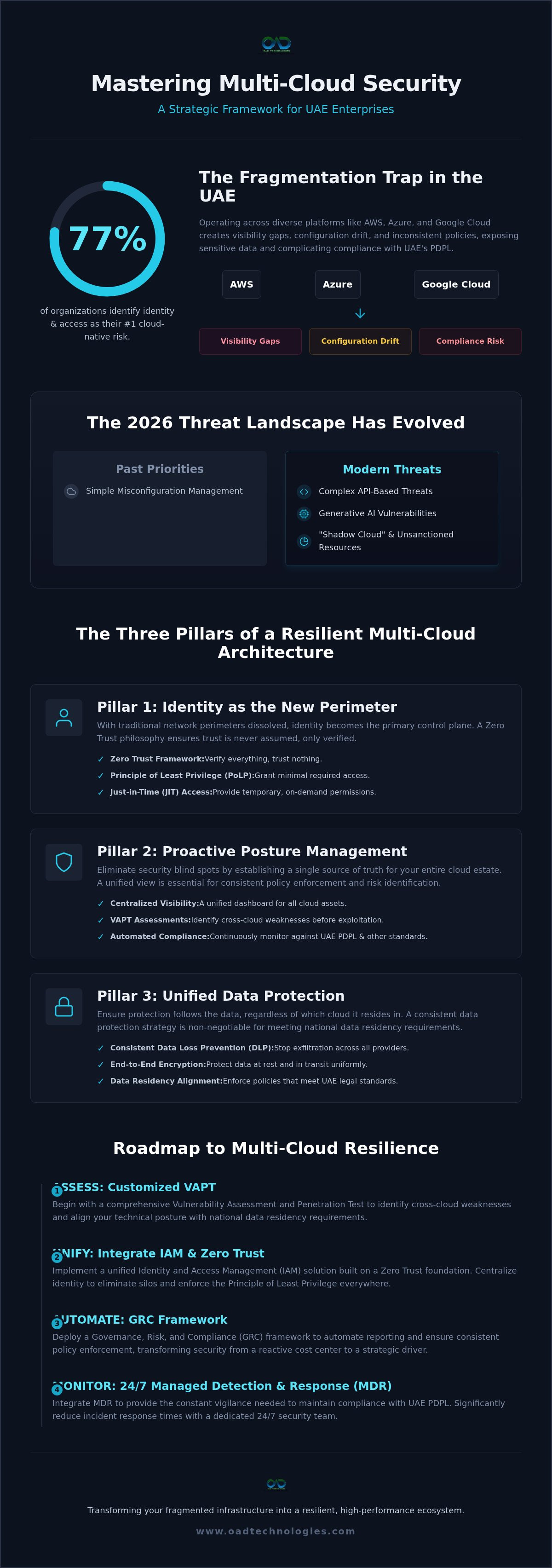
Did you know that 77% of organizations now identify identity and access security as their primary cloud-native risk? For UAE enterprises operating across diverse platforms like AWS, Azure, and Google Cloud, this isn't just a technical hurdle; it's a strategic vulnerability. As you scale, the visibility gaps between different cloud consoles often lead to configuration drift and inconsistent policies that leave your sensitive data exposed. You're likely feeling the mounting pressure of maintaining robust multi-cloud security while ensuring strict adherence to the UAE Personal Data Protection Law (PDPL) and the evolving standards of the Federal Authority for Artificial Intelligence and Data.
It's a complex balancing act, but you don't have to sacrifice innovation for compliance. This guide provides a strategic framework to help you master these diverse environments through a unified approach that balances technical precision with regulatory rigor. We'll explore how to achieve centralized visibility across all cloud assets, automate your compliance reporting for national regulations, and significantly reduce incident response times using integrated Managed Detection and Response (MDR). By the end, you'll have a clear roadmap to transform your fragmented infrastructure into a resilient, high-performance ecosystem.
Key Takeaways
- Understand the transition from cloud-first to multi-cloud-default strategies and why unified orchestration is now essential for UAE enterprise resilience.
- Discover how to build a resilient multi-cloud security architecture by integrating Identity and Access Management (IAM) with a robust Zero Trust framework.
- Identify the hidden operational costs and visibility gaps associated with relying solely on provider-specific native security tools.
- Learn to implement a strategic roadmap that begins with customized VAPT assessments to align your technical posture with national data residency requirements.
- Explore how Managed Detection and Response (MDR) provides the 24 X 7 vigilance needed to maintain compliance with the UAE Personal Data Protection Law (PDPL).
What is Multi-Cloud Security in the 2026 Threat Landscape?
In the UAE, the digital mandate has shifted. While the 2023 "Cloud First" policy catalyzed initial migration, the 2026 environment is decidedly multi-cloud-default. Understanding what multi-cloud is today requires looking beyond simple storage or infrastructure as a service. True multi-cloud security is the unified orchestration of security policies across IaaS, PaaS, and SaaS layers, ensuring that protection follows the data rather than being tethered to a specific provider's ecosystem.
Many organizations fall into the "Fragmentation Trap." This occurs when teams rely on siloed, provider-specific consoles, creating visibility gaps and security blind spots. When security protocols vary between platforms, configuration drift becomes inevitable. It's a risk that grows with every new service added. In 2026, the multi-cloud perimeter is no longer defined by network boundaries but is strictly identity-centric.
The Evolution of Cloud Security Challenges
The threats we face have matured. Simple misconfiguration management was the priority five years ago; today, we battle complex API-based threats. These vulnerabilities often hide in the connective tissue between different cloud providers, where traditional defenses don't reach. Generative AI workloads have further expanded the attack surface, introducing new vectors for prompt injection and data exfiltration. Additionally, "Shadow Cloud" instances, where departments bypass IT to spin up unsanctioned resources, make robust Data Loss Prevention (DLP) nearly impossible without a centralized view. To stay ahead, enterprises must utilize Vulnerability Assessment and Penetration Testing (VAPT) to identify these cross-cloud weaknesses before they're exploited.
Why a Unified Strategy is Non-Negotiable
Relying on "native-only" security tools fails at scale. Each provider has its own logic, which leads to operational friction and manual correlation for your security team. This complexity often causes compliance drift, where a configuration that meets the UAE Personal Data Protection Law (PDPL) in one cloud fails in another. A unified strategy, supported by a clear Governance, Risk, and Compliance (GRC) framework, ensures that security is consistent and measurable. It aligns your operations with the Federal Authority for Artificial Intelligence and Data, transforming security from a reactive cost center into a driver of long-term digital relevance. By integrating Identity and Access Management (IAM) and Managed Detection and Response (MDR), you create a single source of truth that simplifies oversight and strengthens your overall posture.
The Three Pillars of a Resilient Multi-Cloud Architecture
A fragmented security approach is a liability. To achieve true resilience, UAE enterprises must move beyond reactive fixes and build upon a foundation of three interconnected pillars: Identity, Posture, and Data Protection. This structural approach ensures that your multi-cloud security strategy remains effective even as your digital footprint expands across multiple providers. By treating these pillars as a unified system, you eliminate the silos that attackers typically exploit.
Identity as the New Perimeter
In a borderless cloud environment, the traditional network perimeter has dissolved. Identity is now the primary control plane. By integrating Identity and Access Management (IAM) with a Zero Trust philosophy, you ensure that trust is never assumed, only verified. We prioritize the Principle of Least Privilege (PoLP), which strictly limits access to the bare minimum required for any role. To further tighten security, Just-in-Time (JIT) access grants temporary permissions only when needed, drastically reducing the attack surface. Solving cross-cloud identity federation is no longer optional; it's a prerequisite for operational speed and security.
Continuous Posture Management (CSPM)
Visibility is your greatest defense against configuration drift. Cloud Security Posture Management (CSPM) serves as the continuous monitoring engine for your entire ecosystem. It automates the detection of misconfigurations, such as exposed storage buckets or weak encryption protocols, before they can be exploited. CSPM provides a unified view, mapping your real-time posture against both international benchmarks and national UAE security standards. This automated oversight is essential for maintaining a consistent security baseline without overwhelming your technical teams or requiring manual correlation across different consoles.
Strategic Data Loss Prevention (DLP)
The final layer of protection must focus on the data itself. Many organizations rely on default cloud settings, but these are often insufficient when sensitive information moves between different providers. A strategic Data Loss Prevention (DLP) framework ensures that your assets are encrypted at rest and in transit, regardless of their location. By integrating DLP policies directly into your GRC framework, you enable automated risk assessments that align with the UAE PDPL. This creates a self-healing data environment where security is baked into the lifecycle of every file. If you're looking to strengthen these pillars within your organization, OAD Technologies offers the specialized expertise to design a customized roadmap for your unique needs.
Native Cloud Tools vs. Unified Security Platforms
Choosing between native security tools and unified platforms is a pivotal strategic decision for UAE enterprises. While native tools are often the path of least resistance during initial deployment, they frequently become a bottleneck as the environment scales. True multi-cloud security requires a level of orchestration that transcends the boundaries of any single provider. Relying solely on the built-in features of your cloud host might seem cost-effective at first, but it often leads to a fragmented defense that savvy attackers can easily navigate.
The "Hidden Cost" of native tools often remains invisible until the complexity becomes unmanageable. Licensing fees for premium security tiers across three or four providers quickly add up. Beyond the direct costs, the burden of specialized training for each platform strains IT budgets. Manual correlation of logs between different providers isn't just slow; it's prone to human error. OAD Technologies acts as a master designer to integrate these disparate systems into a resilient, high-performance architecture that safeguards your digital future.
The Limitations of Native Security
Native security suites are built to favor their own ecosystem. This leads to inconsistent feature sets where a specific protection available in one cloud might be missing or implemented differently in another. These silos impede incident response by forcing security teams to toggle between multiple dashboards. Without a "Single Pane of Glass," identifying a lateral movement attack that spans across providers becomes a needle-in-a-haystack operation. It creates a "swivel-chair" security culture where analysts waste valuable time during a breach just trying to aggregate data.
The Value of Vendor-Neutral Orchestration
A vendor-neutral unified platform standardizes security policies across your entire estate. By abstracting the security layer, you ensure that a "high-risk" data classification triggers the same protection protocols whether it resides in a SaaS application or a private cloud. This streamlining significantly reduces the total cost of ownership by centralizing management and reducing the need for platform-specific experts. Correlating signals from diverse sources enhances threat detection, allowing your team to spot patterns that would be invisible in isolated environments. This unified approach transforms multi-cloud security from a reactive chore into a proactive business advantage.
Implementing Multi-Cloud Security: A Roadmap for UAE Enterprises
Transitioning to a secure multi-cloud environment requires a deliberate, phased approach. It isn't merely about deploying tools; it's about orchestrating a defense that scales with your business while remaining anchored in UAE regulatory requirements. A successful multi-cloud security implementation begins with a deep understanding of your current technical debt and visibility gaps across all providers. You can't protect what you can't see, and you can't manage what you haven't measured.
The first step in this roadmap is a comprehensive technical assessment. We recommend starting with Vulnerability Assessment and Penetration Testing (VAPT) to uncover hidden cross-cloud vulnerabilities. Following this, you must define a unified Governance, Risk, and Compliance (GRC) framework. This framework acts as your operational blueprint, ensuring that every asset, whether in a public or private cloud, adheres to the same security standards. Once the rules are set, deploy CSPM for immediate visibility and integrate Managed Detection and Response (MDR) for real-time threat mitigation. If you're ready to secure your infrastructure, consult with OAD Technologies to begin your strategic assessment.
Aligning with UAE National Compliance
OAD Technologies stands as a technical authority in the UAE, acting as the guardian of your digital relevance in an increasingly volatile market. We understand that multi-cloud security isn't a product you buy; it's a state of resilience you achieve through meticulous design and ongoing orchestration. Our approach moves beyond generic software bundles to offer a sophisticated blend of engineering standards and strategic insight. By partnering with us, you gain more than a vendor. You gain an extension of your own team dedicated to solving complex architectural challenges with a proactive, solution-oriented mindset.
Our Managed Detection and Response (MDR) service provides the 24 X 7 vigilance required to monitor diverse cloud environments effectively. We don't just alert you to potential threats; we orchestrate a comprehensive response that minimizes downtime. By integrating SIEM and EDR capabilities, we correlate signals from across your entire estate to identify lateral movements that native tools often overlook. This integrated strategy ensures your defense remains as dynamic as the threats it faces, providing a level of protection that individual cloud consoles simply cannot match.
Beyond Tools: The OAD Strategic Partnership
We bridge the gap between high-level innovation and practical business results. Our team acts as a master designer of systems, ensuring that every component of your security stack works in harmony. We reject standardized, one-size-fits-all approaches in favor of highly customized IAM and CSPM solutions tailored to your unique workload requirements. This commitment to high-quality craftsmanship ensures your security architecture is robust, scalable, and perfectly aligned with your specific operational goals. We don't just keep pace with technology. We actively shape its future application to empower your people and protect your processes.
Secure Your Multi-Cloud Future
UAE enterprises trust OAD Technologies with their most sensitive digital assets because we ground our technology in reality. We focus on investment returns and operational performance, ensuring your multi-cloud security framework supports expansion rather than hindering it. Our expertise in UAE-specific regulations, such as the PDPL and the mandates of the Federal Authority for Artificial Intelligence and Data, provides the reassurance you need to innovate with confidence. We offer a clear roadmap for long-term success, positioning your business to thrive in a digital-first economy. Don't leave your resilience to chance. Contact OAD Technologies today for a customized multi-cloud security assessment and take the first step toward a secure, unified digital future.
Orchestrating Your Digital Resilience
Securing a diverse digital estate requires more than just reactive patches; it demands a unified architectural vision. We've explored how transitioning from fragmented native tools to a cohesive framework centered on identity, posture, and data protection is the only way to maintain resilience. By aligning your technical controls with UAE-specific mandates like the PDPL and ISR, you transform compliance from a burden into a competitive advantage. This strategic orchestration ensures that your multi-cloud security posture remains robust as your enterprise scales.
As a technical authority based in the UAE, OAD Technologies bridges the gap between complex innovation and tangible business results. Our advanced MDR and CSPM integration provides the 24 X 7 vigilance needed to protect your most sensitive assets. We don't just offer tools; we provide the expert craftsmanship and regulatory expertise required to safeguard your digital future. It's time to move beyond the fragmentation trap and embrace a future defined by clarity and control.
Consult with OAD Technologies for a Strategic Multi-Cloud Security Assessment to ensure your infrastructure is ready for the challenges of tomorrow. Your journey toward a resilient, unified cloud ecosystem starts with a single strategic step.
Frequently Asked Questions
What is the primary difference between multi-cloud and hybrid cloud security?
Multi-cloud security focuses on managing risks across multiple public cloud providers, such as AWS, Azure, and Google Cloud, simultaneously. Hybrid cloud security involves protecting a mix of public cloud services and on-premises private infrastructure. While both require unified visibility, multi-cloud strategies must account for the diverse, vendor-specific security logics and APIs inherent to different public platforms to prevent configuration drift and visibility gaps.
How does multi-cloud security help with UAE PDPL compliance?
A unified multi-cloud security strategy centralizes data residency controls and encryption standards across all platforms. This ensures personal data stays within UAE borders as mandated by Federal Decree-Law No. 45 of 2021. By automating audits and maintaining consistent DLP policies, enterprises can prove they maintain "reasonable security" and avoid heavy penalties associated with unauthorized data interception or non-compliant cross-border transfers.
Can I use one security tool for all my cloud providers?
You can use a vendor-neutral unified security platform to manage multiple providers, but it's rarely a single tool in isolation. A resilient architecture typically integrates several specialized categories like CSPM, IAM, and MDR into one orchestration layer. This approach avoids the limitations of native tools while providing a single source of truth. It simplifies operations by standardizing your security posture regardless of which cloud hosts the workload.
What are the most common multi-cloud security threats in 2026?
Identity-based attacks and complex API vulnerabilities are the dominant threats in 2026. As organizations adopt AI workloads, prompt injection and data poisoning have also emerged as significant risks. Additionally, misconfigurations resulting from "Shadow Cloud" instances continue to create blind spots. Attackers exploit inconsistent security policies between different providers to move laterally across an organization's entire digital estate, making unified detection across all platforms essential.
How much does a multi-cloud security assessment cost in the UAE?
The cost varies based on the size of your infrastructure, the number of cloud providers, and the depth of the technical assessment required. Factors like the inclusion of VAPT or specialized GRC consulting for UAE PDPL alignment will influence the final investment. Enterprises should consult with a technical authority to receive a customized quote that reflects their specific architectural complexity and strategic operational performance goals.
Is identity management more difficult in a multi-cloud environment?
It's significantly more complex because each provider uses different IAM structures and permission models. Managing user and machine identities across fragmented silos often leads to over-privileged accounts and visibility gaps. Implementing a centralized IAM solution with Zero Trust principles is the only way to solve this. It allows you to enforce the Principle of Least Privilege consistently, regardless of where the identity is being utilized.
How does MDR improve multi-cloud security compared to standard monitoring?
Standard monitoring often just generates alerts that your internal team must investigate. MDR provides active threat hunting and real-time response by correlating signals from diverse cloud sources. In a multi-cloud security context, MDR identifies sophisticated lateral movements that span across different provider environments. This proactive approach significantly reduces incident response time by providing expert human analysis alongside automated detection tools to mitigate breaches immediately.
What is the role of CSPM in a multi-cloud security strategy?
CSPM acts as the continuous monitoring engine that detects misconfigurations and compliance drift in real-time. It provides a unified view of your entire cloud posture, mapping it against national UAE standards and global benchmarks. By automating the remediation of risks like exposed storage or weak encryption, CSPM ensures your security baseline remains consistent. It's a foundational component for achieving visibility across disparate cloud consoles.
Disclaimer
Content by OAD Technologies is for general informational purposes only and does not constitute professional or cybersecurity advice. No warranties are made regarding accuracy or completeness; reliance is at your own risk. OAD Technologies shall not be liable for any direct or indirect losses arising from use of this content.