

Did you know that under the UAE National Cyber Security Strategy 2025-2031, cyber resilience is no longer voluntary, and non-compliance can now result in penalties reaching AED 3 million? In this high-stakes environment, a standard oad scan must be more than a routine automated check. It needs to serve as a strategic diagnostic that bridges the gap between raw technical data and actual business resilience. We understand the exhaustion that comes from generic vulnerability reports that offer plenty of noise but little clarity on how to satisfy the UAE Personal Data Protection Law (PDPL).
We'll demonstrate how our methodology replaces information overload with a prioritized, human-led roadmap for remediation. You'll discover how to align your technical security posture with mandatory UAE regulatory standards while ensuring your data remains protected against the $10.5 trillion global threat landscape of 2026. This guide provides a clear look at transforming vulnerability discovery into a decisive strategic advantage for your enterprise.
Key Takeaways
- Learn how an oad scan goes beyond automated tools by integrating deep packet inspection with expert human analysis for high-precision vulnerability detection.
- Discover the multi-layered methodology used to map your digital footprint and identify critical weaknesses before they're exploited by zero-day threats.
- Understand how to bridge the gap between technical assessments and UAE regulatory compliance, specifically focusing on the Personal Data Protection Law (PDPL).
- Gain insights into why human expertise is necessary to detect complex business logic flaws that standard scanning software often misses.
- Learn how to utilize diagnostic scan data to optimize Managed Detection and Response (MDR) sensors for long-term enterprise resilience.
What is an OAD Scan? Defining Modern Enterprise Vulnerability Assessments
An oad scan represents a sophisticated shift in how organizations approach digital hygiene. It isn't a simple "point-and-click" utility. Instead, it's a high-level technical assessment designed to identify, categorize, and prioritize security weaknesses across a complex enterprise infrastructure. While a traditional vulnerability scanner might flag outdated software versions, our methodology goes much deeper. It combines automated deep packet inspection with manual expert analysis to reveal the true state of your attack surface. This process forms the essential bedrock for any robust Vulnerability Assessment and Penetration Testing (VAPT) framework, providing the raw intelligence needed to build a defensive roadmap.
The primary goal is to provide a 360-degree view of your organization's digital footprint. We don't just look for holes; we analyze how those holes could be chained together to compromise your core business logic. By prioritizing vulnerabilities based on their actual risk to your operations, we ensure that your security team isn't wasting time on low-impact alerts while critical doors remain unlocked.
The Evolution of Scanning in 2026
The threat landscape of 2026 has moved far beyond simple signature-based detection. Attackers now leverage generative AI to find subtle gaps in application logic that older tools miss. Consequently, scanning has evolved toward behavioral analysis. We look for patterns that deviate from the norm, not just known exploit strings. Compliance in the UAE is no longer a "check-the-box" exercise. Mandatory regulations now require proof of active resilience. AI now accelerates the initial discovery phase of an oad scan, allowing our human analysts to focus their energy on high-impact strategic remediation rather than manual data entry.
Core Components of an OAD Technologies Assessment
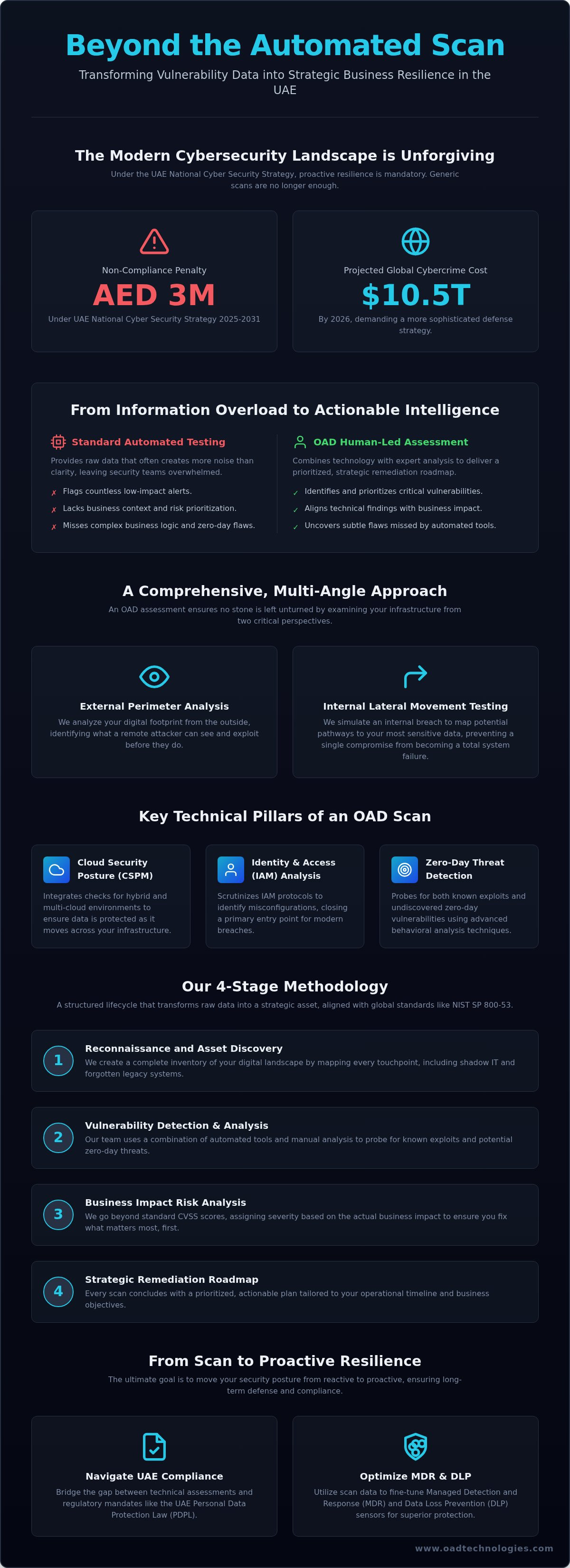
A comprehensive assessment looks at the enterprise from two distinct angles to ensure no stone is left unturned. First, we examine the external perimeter to see exactly what a remote attacker sees. Second, we analyze internal lateral movement potential. This ensures that a single compromised endpoint doesn't lead to a total system breach. Our technical process includes several key pillars:
- Cloud Security Posture Management (CSPM): We integrate CSPM checks to secure hybrid and multi-cloud environments, ensuring your data stays protected as it moves.
- IAM Protocol Analysis: We scrutinize Identity and Access Management (IAM) protocols to identify misconfigurations. Weak IAM remains a primary entry point for modern breaches.
- Lateral Movement Testing: We simulate how an intruder might move through your internal network, identifying the pathways they would take to reach sensitive data.
This structured approach moves your security posture from reactive to proactive. It's about building a system that doesn't just survive an attack but actively discourages one through superior design and visibility.
The OAD Scan Methodology: A Multi-Layered Technical Approach
Executing a successful oad scan requires a structured, multi-phase lifecycle that goes beyond basic automated probing. This isn't just about finding open ports; it's about understanding the architectural context of your enterprise. Our framework aligns with global standards like the NIST SP 800-53 security controls, ensuring every assessment meets the highest international benchmarks for risk management and data integrity. By following a rigorous sequence, we transform raw data into a strategic asset.
The methodology consists of four critical stages:
- Reconnaissance and Asset Discovery: We map every digital touchpoint, including shadow IT and forgotten legacy systems, to create a complete inventory.
- Vulnerability Detection: Our team probes for both known exploits and zero-day vulnerabilities that could compromise your environment.
- Risk Analysis: We don't just look at CVSS scores. We assign severity based on actual business impact, ensuring you fix what matters most first.
- Strategic Roadmap: Every oad scan concludes with a prioritized remediation plan that fits your specific operational timeline.
Organizations looking to strengthen their initial defenses often start by reviewing their current vulnerability assessment and penetration testing (VAPT) strategies to ensure they cover these essential phases.
Active vs. Passive Discovery Techniques
Maintaining operational continuity is a priority for UAE enterprises. We utilize passive scanning to gather intelligence without disrupting active services or causing network latency. This approach is ideal for sensitive industrial control systems or high-traffic financial platforms. When deeper insight is needed for high-risk infrastructure segments, we switch to active probing. This balance ensures we achieve maximum scan depth without sacrificing the network performance your business relies on daily.
The Synergy of Human Intelligence and Automation
Automation provides speed, but it lacks the intuition to understand complex business logic. Machines often flag "false positives" that waste your team's time; our analysts manually validate every finding to ensure accuracy. The OAD Technologies approach focuses on "logic-based" vulnerabilities, such as broken object-level authorization, which standard tools frequently ignore. Modern 2026 VAPT standards mandate a 'human-in-the-loop' approach to ensure that automated outputs are contextually validated against specific business risks. This synergy ensures your security roadmap is both technically sound and strategically relevant.
OAD Scan vs. Standard Automated Testing: Why Human Insight Matters
Standard automated testing often leaves security teams drowning in a sea of low-priority alerts. While these tools provide raw data, an oad scan delivers actionable intelligence by filtering out noise and focusing on high-impact risks. Automated scanners are built for breadth, but they frequently lack the depth to uncover complex business logic flaws. For instance, a standard tool might confirm that your server is patched, yet fail to realize that a misconfigured API allows unauthorized data exfiltration through a legitimate business process. We bridge this gap by prioritizing depth over generic coverage.
Our team customizes assessment parameters based on your specific industry risk profile. A financial institution in Dubai faces different threat vectors than an energy provider in Abu Dhabi. By tailoring the oad scan to these nuances, we ensure the results are relevant to your operational reality. This process isn't a one-off event. It's a foundational component of a long-term Managed Detection and Response (MDR) strategy, moving your organization from point-in-time snapshots to continuous, adaptive resilience.
The Cost of "False Security" from Generic Tools
Generic scans create a dangerous illusion of safety. High false-positive rates consume valuable man-hours, leading to alert fatigue where critical warnings are eventually ignored. More importantly, these tools are often blind to the specific requirements of the UAE Personal Data Protection Law. With the PDPL mandating a 72-hour breach notification window and potential fines reaching AED 5 million, missing a vulnerability is a massive legal liability. We've seen cases where automated scans gave a clean bill of health to networks where our human analysts later discovered hidden lateral movement paths that could have compromised an entire domain controller.
Strategic Partnership vs. Vendor Relationship
We don't just sell software; we act as a master designer of your security architecture. A typical vendor gives you a report and leaves you to figure out the fix. As a strategic partner, OAD Technologies provides deep post-scan consultation to help your team implement remediation effectively. We focus on building long-term viability into your security stack so your defenses evolve alongside emerging threats. This collaborative approach ensures that your investment translates into measurable operational performance and strategic growth rather than just another PDF report sitting on a hard drive.
Navigating Compliance: Supporting UAE Regulatory Frameworks
This technical assessment is particularly critical for Licensed Financial Institutions. The Central Bank of the UAE (CBUAE) now requires these entities to conduct digital impersonation risk assessments, with the first major compliance milestone having occurred on June 30, 2026. By identifying these specific vulnerabilities early, we help you stay ahead of the audit cycle and avoid the AED 5 million maximum fines associated with data violations. It's about more than just avoiding penalties; it's about establishing a reputation for digital integrity in a competitive market.
PDPL and the Requirement for Regular Assessments
The UAE Personal Data Protection Law (PDPL) mandates that organizations implement state-of-the-art security measures to protect personal information. In the event of a security incident, a documented oad scan serves as essential evidence of due diligence. It proves to regulators that you have proactively identified and managed risks rather than waiting for a breach to occur. This technical validation is a core component of our Governance Risk and Compliance (GRC) pillar. Maintaining this documentation is vital for meeting the 72-hour breach notification window, as it allows your team to quickly assess the scope and impact of an incident.
Infrastructure Protection and National Standards
Protecting critical national infrastructure requires mapping technical findings to UAE-specific frameworks, such as the Dubai Electronic Security Center (DESC) ISR v3. Recent 2025 updates to these regulations place a much heavier emphasis on supply-chain security and third-party risk management. Our advanced Vulnerability Assessment and Penetration Testing (VAPT) methodologies ensure that your findings are categorized according to these local requirements.
Localized technical support is a strategic advantage that global vendors often fail to provide. We ensure your data residency needs are met while providing the regional context that generic tools lack. This proximity allows us to act as a collaborative extension of your team, ensuring your security posture remains as ambitious as your business goals. To see how we can align your infrastructure with current UAE mandates, explore our comprehensive compliance and security services.
From Scan to Resilience: Integrating with MDR and DLP
A diagnostic scan is the starting point of a mature security lifecycle, not its conclusion. Identifying a vulnerability is only valuable if it leads to a decisive change in your defensive posture. We use the technical intelligence gathered during an oad scan to harden your entire ecosystem. By integrating these findings with your broader security stack, we transform a static report into a dynamic shield that adapts to the shifting tactics of modern adversaries. This approach ensures that your security investment produces tangible operational results rather than just a list of theoretical risks.
One of the most effective applications of this data is tuning Managed Detection and Response (MDR) sensors. If our assessment reveals a specific weakness in your legacy server architecture, we don't just wait for a patch. We increase the sensitivity of MDR monitoring for those specific assets, ensuring that any suspicious activity is flagged instantly. Similarly, we use discovered leak paths to refine Data Loss Prevention (DLP) policies. If an oad scan identifies an unsecured egress point or a misconfigured cloud bucket, your DLP rules are immediately adjusted to prevent unauthorized data movement through that specific channel.
OAD Technologies provides a unified shield by integrating scan data with SIEM and EDR platforms. This creates a synchronized feedback loop where technical discovery informs real-time response. It bridges the gap between identifying a problem and neutralizing a threat.
Closing the Loop: Remediation and Monitoring
We turn scan results into proactive EDR blocking rules that stop exploits before they can execute. Your SIEM then monitors for the specific indicators of compromise (IoCs) associated with the vulnerabilities identified during the assessment. OAD Scans provide the granular asset visibility required to define the "protect surface" and verify access controls within a Zero Trust architecture. This ensures that every identity and device is verified against the most current risk data, creating a zero-trust environment that is actually enforceable.
The Future of Your Security Roadmap
The 2026 threat environment demands a move from reactive scanning to proactive threat hunting. While annual assessments provide a baseline, continuous assessment cycles are becoming the standard for high-resilience enterprises. This persistent vigilance allows you to catch misconfigurations before they become breaches. We work with you to build a roadmap that ensures long-term viability and strategic expansion. It's time to move beyond simple compliance and toward true digital sovereignty.
Request a Strategic OAD Scan Consultation
Securing Your Digital Legacy in a Transformed Landscape
The transition from voluntary guidelines to mandatory cyber resilience in the UAE marks a new era for enterprise security. We've explored how a strategic oad scan serves as more than just a technical check; it's a foundational diagnostic that aligns your infrastructure with the UAE National Cyber Security Strategy and PDPL requirements. By moving beyond the surface-level data of automated tools, you gain the deep visibility needed to protect your business logic and maintain long-term operational performance. This proactive approach ensures your organization stays ahead of the AED 3 million non-compliance penalties while building a culture of digital integrity.
As a Dubai-based technical authority, OAD Technologies combines sophisticated AI-driven automation with the critical nuance of human expertise. We don't just identify vulnerabilities; we provide a comprehensive remediation roadmap that integrates seamlessly with your MDR and DLP strategies. This collaborative approach ensures your systems aren't just compliant but actively shaped for the future. It's time to transform your security posture into a strategic asset that fuels your organization's growth and stability.
Secure your enterprise infrastructure with a professional OAD Scan
Frequently Asked Questions
What is the primary difference between an OAD Scan and a standard vulnerability test?
An oad scan integrates human-led manual analysis and business logic testing with automated scanning tools to provide a deeper level of insight. While standard tests focus on identifying known software versions and signatures, this methodology prioritizes risks based on their actual operational impact and potential lateral movement paths. This ensures your team focuses on fixing critical flaws rather than chasing low-priority alerts.
How long does a typical OAD Scan take for a UAE enterprise?
The duration depends on the complexity of your digital infrastructure, but most assessments are completed within 5 to 10 business days. This timeframe includes the initial reconnaissance phase, active probing, and the subsequent manual validation required to eliminate false positives. We ensure that the final delivery includes a comprehensive report and a strategic consultation to discuss the findings.
Will an OAD Scan cause any downtime for my network or applications?
The assessment is designed to be non-disruptive by utilizing passive discovery techniques for sensitive infrastructure segments. For high-risk areas where active probing is necessary, we schedule tests during low-traffic windows and tune our tools to ensure network performance remains stable. Our goal is to gather deep security intelligence without impacting your daily business operations or user experience.
Does the OAD Scan help with UAE PDPL compliance audits?
Yes, it provides the technical documentation required to prove due diligence under the UAE Personal Data Protection Law. By identifying potential leak paths and misconfigured access controls, the scan acts as a critical piece of evidence for auditors during a compliance review. It demonstrates that your organization is proactive in maintaining the state-of-the-art security measures mandated by national regulations.
How often should my organization conduct an OAD Scan?
We recommend conducting a comprehensive oad scan at least twice a year or whenever significant changes are made to your network architecture. Organizations in high-compliance sectors, such as finance or government, often opt for quarterly assessments to maintain continuous visibility. Regular testing is essential to identify new vulnerabilities that emerge as your digital footprint expands and threat actors evolve.
Can an OAD Scan detect threats in multi-cloud environments like AWS or Azure?
Yes, the assessment includes Cloud Security Posture Management (CSPM) to identify misconfigurations across AWS, Azure, and Google Cloud. We specifically look for unsecured storage buckets, overly permissive IAM roles, and architectural gaps that could lead to cross-cloud data exfiltration. This ensures your cloud-native assets are as secure as your on-premises infrastructure within a unified security framework.
What kind of report will I receive after the OAD Scan is complete?
You'll receive a detailed technical report that categorizes findings by business risk rather than just generic severity scores. This documentation includes a prioritized remediation roadmap, technical evidence for every vulnerability, and a high-level executive summary. We design these reports to be actionable for technical specialists while remaining clear and informative for executive leadership and stakeholders.
How does OAD Technologies handle the sensitive data discovered during a scan?
We follow strict data residency protocols and utilize encrypted communication channels for all discovered intelligence during the assessment. As a UAE-based technical authority, we ensure that all data is handled in accordance with local regulations and best practices. We never exfiltrate actual sensitive business data; our process focuses solely on identifying the vulnerabilities that could allow such exfiltration to occur.
Disclaimer
Content by OAD Technologies is for general informational purposes only and does not constitute professional or cybersecurity advice. No warranties are made regarding accuracy or completeness; reliance is at your own risk. OAD Technologies shall not be liable for any direct or indirect losses arising from use of this content.