

By the end of 2026, Gartner predicts that 70% of global enterprises will have transitioned to a Zero Trust model. This isn't just a trend. It's a fundamental survival strategy in an era where credential abuse accounts for 22% of all breaches. You've likely felt the tension of privilege creep making your audits feel like an impossible climb, or perhaps you've hesitated to tighten controls because you don't want to break critical workflows. This principle of least privilege implementation guide is designed to resolve that friction, offering a sophisticated roadmap to balance ironclad security with operational agility.
Mastering this architectural shift requires more than just a software update; it demands a precision-engineered approach to access management. We'll provide a comprehensive, 5-phase framework designed for modern enterprise resilience. By the end of this guide, you'll have a clear path to integrate Identity and Access Management (IAM) with your Governance, Risk, and Compliance (GRC) strategy. This ensures a reduced attack surface and simplified reporting for complex regulations like the UAE cybersecurity standards, DORA, and the SEC's 2026 disclosure rules.
Key Takeaways
- Adopt a 'default deny' posture to eliminate the inherent risks associated with obsolete perimeter-based security models.
- Utilize Just-in-Time (JIT) access and Just-Enough Administration (JEA) to provide precise enablement without creating permanent security gaps.
- Strengthen your Data Loss Prevention (DLP) strategy by restricting lateral movement through granular, role-based access controls.
- Leverage this principle of least privilege implementation guide to execute a structured, 5-phase transition that protects critical workflows.
- Integrate IAM and GRC frameworks to simplify compliance reporting and ensure your architecture remains resilient against evolving 2026 threats.
Defining PoLP in the 2026 Zero Trust Ecosystem
The Principle of Least Privilege (PoLP) is the security discipline of limiting access rights for users, accounts, and computing processes to the absolute minimum required to perform a specific task. In a digital environment where the traditional network perimeter has dissolved, a "default deny" posture is the only viable starting point. This approach assumes that no entity is inherently trustworthy; instead, access is granted only after rigorous verification and solely for the necessary duration. As you utilize this principle of least privilege implementation guide, it's vital to recognize that PoLP isn't just a restriction of movement, but a precision-engineered method for ensuring operational continuity without exposing unnecessary risk.
Modern security strategies must distinguish between human users and non-human entities, such as service accounts, APIs, and automated bots. While human access is often governed by identity-centric policies, non-human entities often possess broad, hard-coded permissions that stay active indefinitely. These "ghost" privileges are high-value targets for attackers. Securing these connections requires the same level of granularity applied to your workforce, ensuring that every automated process operates within a strictly defined scope. PoLP is the foundational layer of a Zero Trust Architecture.
The Evolution of Access: From Static to Dynamic
Legacy security models relied on "set and forget" permissions that granted broad access based on a user's department or job title. This static approach is a liability in 2026. Modern threat actors, often utilizing AI-driven identity harvesting, specifically hunt for "standing privileges" in cloud environments. These are long-lived permissions that remain active even when the user isn't logged in. A sophisticated principle of least privilege implementation guide prioritizes dynamic, context-aware access. By leveraging Identity and Access Management (IAM) systems, organizations can automate enforcement, adjusting permissions in real-time based on the user's location, device health, and current risk score.
PoLP vs. Role-Based Access Control (RBAC)
It's common to confuse Role-Based Access Control (RBAC) with PoLP, but they aren't interchangeable. RBAC is a delivery method; PoLP is the strategic objective. While RBAC simplifies management by grouping users into roles, it often leads to "Role Explosion," where organizations create hundreds of hyper-specific roles that become impossible to audit. To maintain granularity without excessive complexity, many enterprises are shifting toward Attribute-Based Access Control (ABAC). ABAC acts as a preferred partner for PoLP by using specific attributes, such as the time of day or the sensitivity of the data being accessed, to make instantaneous authorization decisions. This synergy allows for a highly customized security posture that scales alongside your business growth.
The Mechanics of Modern Access: JIT and Just-Enough Admin
Eliminating permanent access is the most effective way to shrink an organization's attack surface. While the previous section defined the strategic "why," the actual execution relies on two pillars: Just-in-Time (JIT) access and Just-Enough Administration (JEA). These mechanisms ensure that permissions aren't just granted, they're orchestrated. This principle of least privilege implementation guide emphasizes that standing privileges, or "always-on" admin rights, are a relic of the past. In 2026, time-bound credentials are the standard, significantly narrowing the window of opportunity for attackers who manage to compromise a set of credentials.
Implementing Just-in-Time (JIT) Workflows
JIT workflows transform access from a static state into a dynamic event. The process is straightforward: a user requests access, an automated or manual approval occurs, privileges are elevated for a specific window, and then they're automatically revoked. This lifecycle is essential for reducing the "blast radius" if an account is compromised. Integrating these workflows with existing ITSM tools ensures that security doesn't become a bottleneck for productivity. For a deeper look at operational standards, the NCSC implementation guide for least privilege provides excellent baseline requirements for these elevation protocols.
Just-Enough Administration (JEA) for Power Users
Standard PoLP often focuses on which systems a user can touch. JEA takes this further by restricting what they can do once they're there. For system architects and DevOps teams, JEA limits the specific commands or scripts an administrator can execute on a server. Technologies like PowerShell JEA allow you to create virtual endpoints where users only see the tools they need. This level of granularity is a powerful deterrent against insider threats and accidental system misconfigurations. When paired with Managed Detection and Response (MDR), any attempt to bypass these command restrictions triggers an immediate alert. This synergy between human insight and automated guardrails is exactly what modern enterprises need to maintain resilience. Partnering with experts to design customized security frameworks ensures these technical controls align with your business objectives.
Finally, session recording and auditing provide the necessary layer of accountability. It isn't enough to restrict access; you must also verify how those privileges were used. Recording privileged sessions creates a forensic trail that simplifies compliance audits and helps identify behavioral anomalies. This principle of least privilege implementation guide advocates for a "trust but verify" approach where every elevated action is logged and reviewable. This transparency doesn't just satisfy auditors; it provides the data necessary to refine your access policies over time.
Strategic Impact: Mitigating Lateral Movement and Data Loss
Internal lateral movement is often the most difficult phase of a cyberattack to detect. Once an attacker gains a foothold via a single compromised account, they typically spend weeks or months silently probing the network for high-value targets. Without the constraints established in this principle of least privilege implementation guide, that initial entry point often provides enough mobility to reach sensitive databases or domain controllers. By enforcing granular access, you effectively strip away the attacker's ability to move, turning what could have been a network-wide crisis into a localized event that your security team can identify and remediate quickly.
PoLP serves as a critical control for mitigating insider threats, which remain a persistent risk for modern enterprises. Whether an employee acts with malicious intent or simply makes an accidental configuration error, the damage is strictly capped by their existing permissions. If a user doesn't have the right to delete a production database or export a client list, the risk of a catastrophic data event is virtually eliminated. This proactive containment is far more effective than relying solely on reactive alerts after a breach has already begun to spread.
PoLP as a Catalyst for Data Protection
Restricting access to sensitive data repositories directly lowers the risk of unauthorized exfiltration. However, you cannot restrict access to data you don't know exists. A successful principle of least privilege implementation guide must begin with a rigorous discovery phase to map every data silo and identify which accounts currently have access to them. Integrating these findings with Data Loss Prevention (DLP) policies creates a multi-layered defense. While DLP monitors the movement and usage of the data itself, PoLP ensures that only the most trusted, verified entities can interact with that data in the first place.
Containing the Breach: The Blast Radius Concept
In cybersecurity, the "blast radius" refers to the potential damage an attacker can cause from a single point of compromise. Least privilege acts as a series of internal firewalls that significantly shrink this radius. Consider a real-world scenario: an attacker compromises a marketing associate's workstation through a phishing link. In a legacy environment, that workstation might have broad network visibility; in a PoLP-mature environment, that account is restricted to specific SaaS applications and local files. The attacker is trapped within a narrow segment of the network, unable to reach the domain controller or financial systems. In a PoLP-mature environment, a single compromised credential is a contained incident, not a corporate catastrophe.
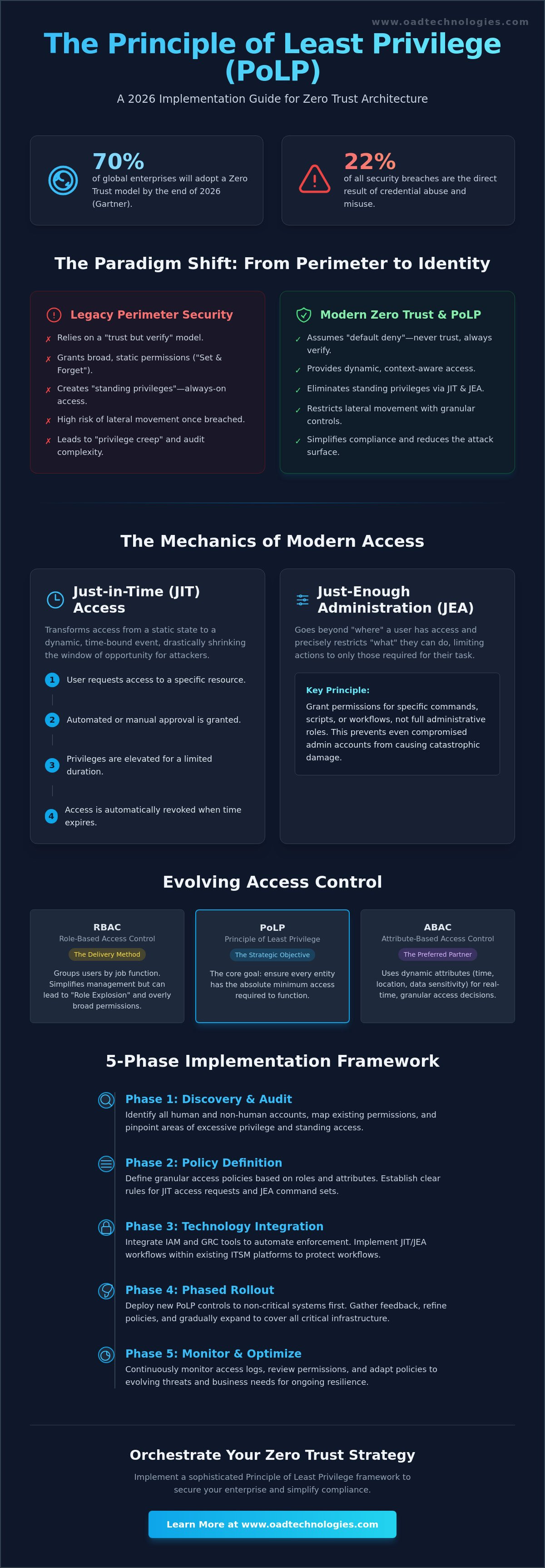
A 5-Phase Implementation Guide for Enterprise PoLP
Transitioning from a legacy permissive environment to a restricted one requires a structured, multi-stage approach. This principle of least privilege implementation guide treats PoLP not as a static configuration, but as a continuous lifecycle that evolves with your business. Moving too quickly can disrupt critical workflows; moving too slowly leaves your most sensitive assets exposed. Success lies in the balance between rigorous discovery and automated enforcement.
Phase 1 & 2: Discovery and the 'Default Deny' Mindset
The first phase involves a comprehensive Privilege Discovery and Audit. You must identify every human and non-human account, including service accounts, APIs, and "shadow" IT that often bypasses traditional oversight. Utilizing VAPT services is essential here to uncover over-privileged accounts that could be exploited by attackers. Once the landscape is clear, you must establish the foundation by moving to a "Default Deny" posture. This policy ensures that no new account is created with local admin rights by default, forcing access to be justified and granted based on actual business necessity rather than convenience.
Phase 3 & 4: Engineering Granularity and Automation
Phase 3 focuses on Role and Attribute Engineering. Rather than broad departmental access, you define permissions based on specific attributes like project requirements, time of day, or device compliance. This sets the stage for Phase 4: the implementation of Just-in-Time (JIT) access and Privileged Access Management (PAM). By automating the elevation and revocation process, you remove the human error associated with manual provisioning. This automation ensures that privileges are only active when needed, drastically reducing the window of opportunity for credential abuse.
Phase 5: The Governance Loop and Compliance
The final phase integrates PoLP into your broader Governance, Risk, and Compliance (GRC) framework. This is a critical requirement for meeting UAE regulations and international standards like DORA or the SEC's 2026 disclosure mandates. To prevent "Privilege Creep," where users accumulate access over time, you must automate regular access reviews. Integrating your access logs with a SIEM solution allows you to alert on any attempts to bypass these controls, providing a real-time feedback loop for your security posture. This principle of least privilege implementation guide ensures that your defenses remain as dynamic as the threats they face. To begin your transition, you can secure your enterprise architecture with a customized roadmap designed by our engineering experts.
Orchestrating PoLP with OAD Technologies
Implementing a robust security posture requires more than just following a checklist; it demands a strategic partnership that bridges the gap between high-level innovation and practical business results. OAD Technologies acts as a master designer of your digital environment, crafting individualized frameworks that reflect your unique operational needs. While this principle of least privilege implementation guide provides the structural foundation, our team provides the engineering precision required to execute it without disrupting your business momentum. We believe the synergy between human insight and technological capacity is the only way to achieve true resilience in 2026.
Our approach integrates PoLP within our broader managed security services, specifically our Endpoint Detection and Response (EDR) and Managed Detection and Response (MDR) offerings. By embedding least privilege controls directly into your detection ecosystem, we ensure that any attempt to abuse credentials or move laterally is met with an immediate, automated response. This isn't a "set and forget" solution. It's a commitment to continuous security posture optimization, ensuring your organization maintains its digital relevance in an ever-changing market. This principle of least privilege implementation guide serves as the starting point for a long-term strategy that evolves alongside your system growth.
Customized Integration for the UAE Market
Operating within the UAE requires a deep understanding of local regulatory requirements. We align every PoLP implementation with the UAE Personal Data Protection Law (PDPL) and national cybersecurity standards like the Information Assurance Regulation (ISR). Our Governance, Risk, and Compliance (GRC) consulting ensures that your access controls satisfy both legal mandates and technical best practices. To validate these controls, we utilize our Vulnerability Assessment and Penetration Testing (VAPT) services to simulate real-world attacks. These assessments prove that your restricted access model can withstand sophisticated intrusion attempts and satisfies the rigorous audit requirements of modern regulators.
Beyond Implementation: Ongoing Resilience
The transition to a Zero Trust model is a journey, not a destination. Our proactive Security Operations Center (SOC) provides continuous monitoring of privileged account behavior, identifying anomalies that automated tools might miss. We don't just alert you to problems; we work as an extension of your team to refine your access policies based on real-time threat intelligence. This ensures that your implementation remains effective long after the initial rollout is complete, protecting your investment and your reputation. It's time to move beyond standardized approaches and embrace a security model designed for your specific challenges. Consult with OAD Technologies to secure your enterprise with a tailored PoLP roadmap.
Securing Your Digital Future with Precision Access
The transition to a Zero Trust architecture hinges on your ability to replace broad, standing permissions with granular, time-bound access. By leveraging this principle of least privilege implementation guide, your organization can effectively contain potential breaches and eliminate the structural complexities that often plague legacy systems. True resilience isn't just about restricting movement; it's about empowering your team through automated workflows like JIT and JEA while maintaining strict alignment with evolving regulatory standards.
As a specialized system integrator for the UAE market, OAD Technologies provides the technical authority and strategic partnership needed to master this shift. We combine deep expertise in PDPL and ISR compliance with proactive MDR and SIEM monitoring to ensure your security posture remains optimized against the most sophisticated threats. Secure Your Enterprise with OAD Technologies' IAM and GRC Expertise. Your journey toward a more resilient, precision-engineered infrastructure starts with a single, strategic step.
Frequently Asked Questions
What is the primary goal of the principle of least privilege?
The primary goal is to reduce the attack surface by ensuring every user and system operates with the minimum set of permissions required for their specific function. This strategy prevents an initial compromise from escalating into a full-scale network breach. By strictly limiting what an account can touch, you effectively contain the "blast radius" of any potential security incident.
How does PoLP differ from Zero Trust?
PoLP is a foundational mechanism within the broader Zero Trust framework. While Zero Trust is a holistic strategy centered on "never trust, always verify," PoLP is the specific tool used to define the scope of access once an identity is verified. You can find more details on this synergy in our principle of least privilege implementation guide sections above.
Can PoLP be implemented in a legacy environment without modern IAM tools?
Implementation is possible in legacy environments using manual configurations like Group Policy Objects (GPOs) or file system permissions, but it lacks scalability. Without modern Identity and Access Management (IAM) tools, the administrative burden of manual updates often leads to errors. Automated tools are essential for maintaining the dynamic, context-aware access required in modern enterprise architectures.
What are the biggest challenges in a PoLP rollout?
The most significant hurdles include "privilege creep" and the inherent fear of disrupting critical operational workflows. Many organizations struggle with identifying every non-human service account or managing temporary access for third-party vendors. Overcoming these challenges requires a structured audit phase to map existing permissions before attempting to tighten any restrictions.
How often should access privileges be reviewed?
Organizations should conduct access reviews at least quarterly for privileged accounts and annually for standard users. However, a role change or employee departure should trigger an immediate, automated review. Continuous monitoring via SIEM can help identify accounts that possess unused permissions, allowing your security team to prune access rights proactively before they become a liability.
Is PoLP required for compliance with UAE data protection laws?
Yes, PoLP is a critical component for meeting the "technical and organizational measures" required by the UAE Personal Data Protection Law (PDPL). National standards like the Information Assurance Regulation (ISR) also mandate strict access controls to protect sensitive infrastructure. Implementing these controls ensures your organization remains compliant while significantly lowering the risk of a punishable data breach.
What happens if a user needs emergency access that exceeds their current privilege?
Emergency access should be managed through "break-glass" accounts or Just-in-Time (JIT) elevation workflows. These protocols allow for temporary permission increases that are strictly time-bound and automatically revoked once the task is finished. This approach provides the necessary flexibility for urgent fixes without leaving high-level privileges active indefinitely.
How does PoLP impact developer productivity?
If implemented poorly, PoLP can create bottlenecks, but automated Just-Enough Administration (JEA) actually supports productivity. Developers get the specific tools and permissions they need for a task without the security risks of permanent admin rights. This principle of least privilege implementation guide advocates for using automation to ensure security measures don't hinder the development lifecycle.
Disclaimer
Content by OAD Technologies is for general informational purposes only and does not constitute professional or cybersecurity advice. No warranties are made regarding accuracy or completeness; reliance is at your own risk. OAD Technologies shall not be liable for any direct or indirect losses arising from use of this content.


