

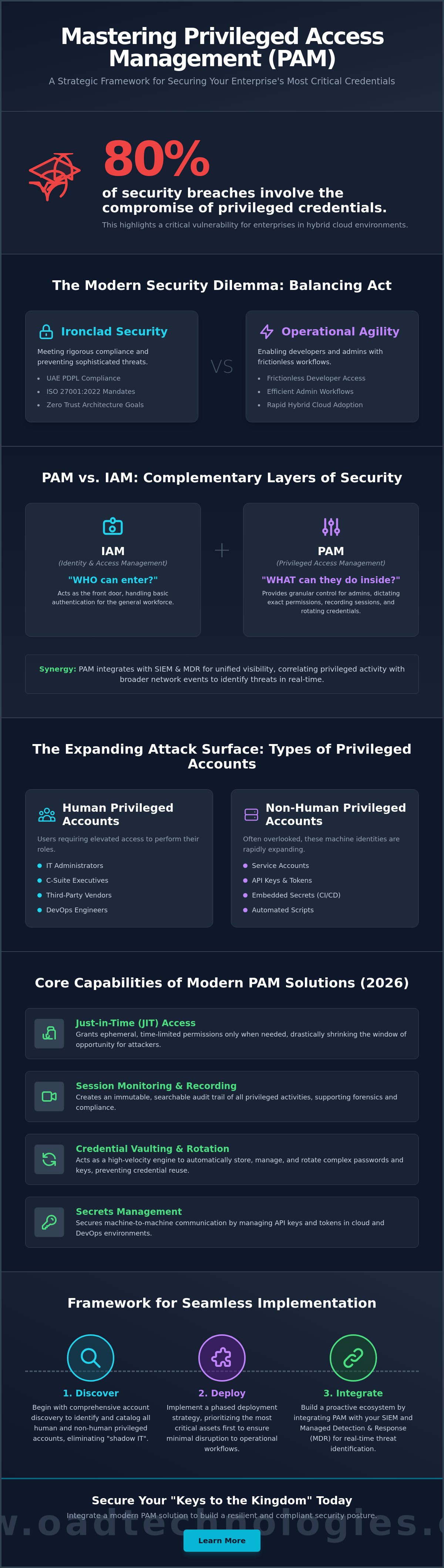
Did you know that 80% of security breaches involve the compromise of privileged credentials? It's a sobering reality for any leader trying to implement effective privileged access management pam solutions while managing high-stakes access across hybrid cloud environments. You likely feel the pressure of balancing ironclad security with the need to keep developer and admin workflows moving without friction. Meeting the rigorous demands of UAE PDPL and the now-mandatory ISO 27001:2022 standards only adds another layer of complexity to your strategic roadmap.
This guide helps you master these complexities to secure your enterprise’s most critical credentials through a strategic, identity-centric framework. You'll learn how to move beyond traditional password vaulting toward a more sophisticated model that prioritizes agility and precision. We will examine the path to a Zero Standing Privileges architecture, the integration of AI-driven behavioral analytics, and the automation of compliance reporting to ensure your organization remains resilient and compliant throughout 2026.
Key Takeaways
- Distinguish between standard identity management and high-risk administrative access to effectively protect your organization's most sensitive digital assets.
- Leverage modern privileged access management pam solutions to automate credential rotation and create immutable audit trails for every administrative session.
- Align your security posture with UAE PDPL and national GRC frameworks to provide the documented "proof of control" required for regulatory audits.
- Implement a phased deployment strategy that begins with comprehensive account discovery to eliminate "shadow" IT without disrupting critical operational workflows.
- Explore the strategic synergy between PAM and Managed Detection and Response (MDR) to build a proactive ecosystem that identifies identity-based threats in real-time.
What are Privileged Access Management (PAM) Solutions?
At its core, What is Privileged Access Management? It's a specialized sub-domain of identity and access management that focuses exclusively on securing the "keys to the kingdom." While standard user accounts allow employees to perform daily tasks, privileged accounts possess the elevated permissions required to manage systems, change configurations, and access sensitive databases. By 2026, simply "vaulting" these credentials isn't enough. Modern privileged access management pam solutions have evolved to prioritize ephemeral, just-in-time (JIT) access. This approach ensures that elevated permissions only exist for the duration of a specific task, effectively shrinking the window of opportunity for attackers and reducing the potential blast radius of a credential breach.
The Anatomy of a Privileged Account
Understanding the modern threat landscape requires a clear view of what constitutes a privileged account. These are generally categorized into two groups:
- Human Privileged Accounts: These include IT administrators, C-suite executives with sensitive data access, and third-party vendors who require temporary entry into your environment.
- Non-Human Privileged Accounts: Often overlooked, these include service accounts, API keys, and secrets embedded within DevOps pipelines or automated scripts.
As UAE enterprises accelerate their digital transformation, the identity attack surface expands with every cloud service and automated workflow integrated into the corporate ecosystem.
PAM vs. IAM: Understanding the Synergy
While often used interchangeably, IAM and PAM serve distinct yet complementary roles in a Zero Trust framework. You can think of IAM as the system that identifies the "who" at the front door. It handles basic authentication for the general workforce. In contrast, PAM provides granular control over the "how much," dictating exactly what an administrator can do once they're inside. Relying solely on standard IAM for administrative accounts creates a critical security gap because it lacks the session recording and credential rotation capabilities necessary to thwart sophisticated lateral movement.
Strategic privileged access management pam solutions don't operate in a vacuum. They must integrate seamlessly with your existing SIEM platform. This connection provides unified visibility, allowing your security team to correlate privileged activity with broader network events. This synergy is vital for identifying anomalous behavior before a minor incident escalates into a full-scale breach.
Core Capabilities of Modern PAM Solutions in 2026
Modern privileged access management pam solutions have transitioned from passive security tools into active defensive systems. In 2026, the focus is on reducing the attack surface through dynamic, real-time controls rather than just static storage. Credential vaulting remains a foundational requirement; however, it now functions as a high-velocity rotation engine for passwords and SSH keys. Secrets management extends this capability to machine-to-machine communication, ensuring that API keys and tokens in cloud environments aren't hardcoded or left vulnerable. Core Capabilities of Modern PAM Solutions now also prioritize Privilege Elevation and Delegation Management (PEDM). This allows users to perform specific administrative tasks within an application without granting them full rights to the underlying operating system, maintaining the principle of least privilege at a granular level.
- Credential Vaulting: Automated storage and rotation of complex passwords to prevent credential aging and reuse.
- Session Monitoring and Recording: Creation of an immutable audit trail for all privileged activities to support forensic investigations.
- Just-in-Time (JIT) Access: Granting elevated permissions only when needed and for a strictly limited duration.
- Secrets Management: Securing the high-volume machine-to-machine communication essential for modern, containerized cloud environments.
The Rise of Zero Standing Privileges (ZSP)
Persistent administrative access is a massive liability in the 2026 threat landscape. If an account has "always-on" privileges, it remains a permanent target for attackers. ZSP solves this by ensuring no account has standing permissions. Instead, accounts are created or permissions are granted on-the-fly only after a request is approved. This dynamic approach removes the permanent "bullseye" from your IT staff's backs. It's a fundamental shift from managing permanent accounts to managing specific, time-bound tasks.
Advanced Session Analytics and AI
Visibility is only useful if you can interpret the data quickly. Modern solutions use machine learning to establish a baseline of normal behavior for every privileged user. If an administrator suddenly accesses a database they haven't touched in months, the system flags the anomaly instantly. Integration with EDR allows for automated session termination if a risk score crosses a predefined threshold. This reduces "audit fatigue" by using AI to summarize hours of recorded sessions into actionable insights. If you're looking to refine your approach to these complex sessions, you might consider how MDR services can provide the continuous oversight needed for a resilient architecture.
The Strategic Value: PAM as a Catalyst for GRC and UAE Compliance
Implementing privileged access management pam solutions is a strategic move that goes far beyond technical security. It's a critical component for meeting the strict mandates of the UAE Personal Data Protection Law (PDPL). Under this framework, your organization must demonstrate rigorous control over who accesses sensitive data and why. By utilizing PAM as a Catalyst for GRC, you transform your security posture from reactive to audit-ready. This integration ensures every elevated action is logged and tied to a specific business requirement, directly supporting your broader governance, risk, and compliance (GRC) objectives.
Mature privilege management is also a prerequisite for modern cyber insurance policies. Insurers now frequently require proof of automated credential rotation and session recording before issuing or renewing coverage. There's a powerful synergy here between PAM and Data Loss Prevention (DLP). While DLP monitors the movement of sensitive files, PAM secures the accounts that have the power to bypass standard security filters. This creates a multi-layered defense that prevents unauthorized data exfiltration from the inside out.
Satisfying the Principle of Least Privilege (PoLP)
PoLP serves as the bedrock of a resilient cybersecurity strategy. It dictates that users should only have the minimum level of access necessary to complete their tasks. Modern privileged access management pam solutions automate this enforcement across complex hybrid and multi-cloud estates. This automation is vital for preventing "privilege creep," where employees retain old permissions after changing roles. By dynamically adjusting access based on current job functions, you significantly reduce the internal attack surface and limit the potential for lateral movement during a breach.
UAE Regulatory Alignment: PDPL and ISR
For organizations operating in the UAE, aligning with Information Assurance (IA) standards and the Information Security Regulation (ISR) is a top priority. PAM provides the technical controls needed to meet these requirements, such as localized session logging and secure vaulting that respects data sovereignty. These tools allow you to maintain an immutable record of administrative activity within the region's borders. PAM facilitates "justified access" for UAE auditors by providing a clear, time-stamped rationale for every elevated session.
A Framework for Implementing PAM Without Workflow Disruption
Successfully deploying privileged access management pam solutions requires more than just installing software; it demands a cultural shift that respects operational velocity. Many organizations fail because they treat security as a roadblock rather than an enabler. A structured, phased roadmap ensures that your security posture strengthens without bringing business processes to a halt. By moving through these stages deliberately, you build a system that supports your team instead of hindering them.
- Phase 1: Discovery and Inventory. This initial stage involves identifying every privileged account across your network. You must hunt for often-overlooked "shadow IT," forgotten service accounts, and orphaned credentials left by former employees. You simply can't secure what you haven't documented.
- Phase 2: Policy Definition. Once you've mapped your environment, categorize access levels based on risk and business necessity. Not every admin needs the same level of authority. Setting clear boundaries here ensures that permissions are proportional to actual responsibilities.
- Phase 3: Automation of Rotation. Transition from manual password management to automated vaulting. This removes the human element from credential rotation, which significantly reduces the risk of administrative errors or "password fatigue" among your staff.
- Phase 4: Implementation of JIT Access. Phase out standing privileges for your most high-risk assets. This ensures that elevated rights only exist when a specific task requires them, leaving no permanent target for an attacker to exploit.
- Phase 5: Continuous Monitoring and Optimization. Use the session analytics discussed earlier to refine your policies. This constant feedback loop helps you identify and eliminate unnecessary friction points that might tempt users to bypass security protocols.
Overcoming the "Complexity" Objection
Developers and system admins often resist PAM because they fear it'll slow down their daily routines. To solve this, integrate your solution directly with existing tools like command-line interfaces (CLIs) and IDEs. Using transparent proxies allows you to monitor and record sessions without changing the user's native experience. This "invisible security" approach, when backed by clear executive buy-in, fosters a security-first culture where compliance doesn't feel like a burden. It's about empowering your people to work safely without adding extra steps to their workflow.
The Role of VAPT in PAM Implementation
Your implementation strategy should be validated by rigorous, real-world testing. Utilizing Vulnerability Assessment and Penetration Testing (VAPT) helps identify exposed privileged credentials that your internal scans might miss. Red team exercises simulate real-world attacks to see if your PAM policies actually hold up under pressure. This continuous testing serves as a vital feedback loop, ensuring your defense evolves alongside emerging threats. If you're ready to identify these gaps in your own environment, you can schedule a comprehensive VAPT assessment to ground your implementation strategy in hard data.
OAD Technologies: Integrating PAM into Your Managed Security Ecosystem
OAD Technologies acts as your strategic partner in the UAE's evolving security environment. We don't just provide software; we design and integrate privileged access management pam solutions that fit into your specific operational context. By aligning PAM with our Managed Detection and Response (MDR) services, we close the gap between identity security and active threat detection. When an MDR team has visibility into privileged session logs, they can identify and neutralize lateral movement before it compromises your core infrastructure. This synergy ensures that identity is not just a perimeter, but a data source for real-time defense.
Our approach centers on customized architecture. Every enterprise has unique infrastructure requirements, from legacy on-premises servers to complex multi-cloud environments. We move beyond standard deployments to build systems that reflect your specific risk profile. This includes ongoing optimization through our GRC and technical assessment teams, ensuring your PAM policies evolve alongside your business growth. We don't leave you with a static tool. Instead, we provide a living security ecosystem that adapts to new threats as they emerge in the 2026 landscape.
Beyond Tools: The OAD Strategic Approach
We reject "one-size-fits-all" security in favor of high-precision engineering. Standardized approaches often create blind spots or unnecessary friction for your staff. Instead, we focus on empowering your human teams. We provide the advanced technology and strategic insight they need to make informed, secure decisions. Our goal is to bridge the gap between high-level innovation and practical business results. We ensure that your investment in privileged access management pam solutions translates directly into operational resilience and long-term viability.
Next Steps for Your Identity Security Journey
Securing your organization's most critical credentials requires a clear roadmap. Your journey begins with a comprehensive identity security assessment to identify current vulnerabilities and "shadow" accounts. From there, we help you develop a practical strategy for achieving Zero Standing Privileges. This transition ensures your high-risk assets are protected by dynamic, time-bound access controls. If you're ready to integrate your identity security with a broader IAM and MDR framework, contact OAD Technologies for a professional consultation. We'll work as an extension of your team to design a system that secures your digital future.
Securing the Future of Enterprise Identity
The transition toward a Zero Trust architecture in 2026 demands a fundamental shift in how you manage administrative power. Moving beyond traditional password vaults to embrace Just-in-Time access and Zero Standing Privileges isn't just a technical upgrade; it's a strategic necessity. By automating the principle of least privilege, you effectively remove the permanent targets from your environment. This approach shrinks your attack surface and ensures you remain fully aligned with the UAE's evolving PDPL and GRC frameworks.
Implementing privileged access management pam solutions effectively requires a partner who understands the synergy between identity, data protection, and managed response. OAD Technologies brings high-precision cybersecurity engineering and deep localized expertise to your digital transformation. We specialize in end-to-end integration with MDR and DLP stacks, ensuring your security ecosystem is resilient and compliant. Secure your critical assets with OAD Technologies’ strategic PAM solutions and take the next step in your security journey. We're here to help you build a defense that empowers your people while protecting your most vital systems.
Frequently Asked Questions
What is the difference between PAM and IAM?
IAM manages the identity of every employee within an organization, while privileged access management pam solutions focus specifically on the high-risk accounts that hold administrative rights. You can think of IAM as the general building security and PAM as the vault's biometric lock. This distinction is vital because standard user accounts don't require the session recording or automated credential rotation that protect your most sensitive core systems.
Why is Privileged Access Management critical for UAE compliance?
PAM provides the immutable audit trails and granular access controls required by the UAE Personal Data Protection Law (PDPL) and Information Security Regulation (ISR). These frameworks mandate that organizations demonstrate exactly who accessed sensitive data and for what purpose. Without the documented proof of control that PAM provides, enterprises risk failing national audits and facing significant regulatory penalties for non-compliance during mandatory reviews.
How does Just-in-Time (JIT) access improve security?
Just-in-Time (JIT) access improves security by eliminating standing privileges, ensuring that elevated permissions only exist when an active task requires them. By granting access for a strictly limited duration, you remove the permanent target from your administrative accounts. This dynamic approach ensures that if a credential is stolen while not in use, it has zero permissions; this effectively neutralizes an attacker's ability to move laterally.
Can PAM solutions be deployed in multi-cloud environments?
Modern privileged access management pam solutions are designed to be cloud-agnostic, providing unified visibility across AWS, Azure, Google Cloud, and on-premises infrastructure. They use secrets management and transparent proxies to secure machine-to-machine communication and administrative sessions regardless of where the workload resides. This centralized control prevents the fragmentation of security policies that often occurs when managing multiple cloud providers and hybrid setups simultaneously.
How does PAM help in preventing ransomware attacks?
Ransomware typically relies on the theft of privileged credentials to encrypt files across an entire network. PAM prevents this by enforcing the principle of least privilege and isolating administrative sessions from the local endpoint. If an attacker compromises a standard user, they can't easily escalate their rights or move laterally to sensitive servers because those paths are protected by multi-factor authentication and time-bound access protocols.
Is PAM only for large enterprises, or should SMEs implement it too?
SMEs are increasingly targeted by credential-based attacks because they often lack the robust defenses of larger enterprises. While the scale of deployment differs, the risk to critical data remains the same. Modern SaaS-based PAM offerings allow SMEs to implement enterprise-grade security without heavy infrastructure costs. Protecting even a small number of administrative accounts is essential for maintaining business continuity and client trust in 2026.
What are the risks of not having a PAM solution?
Operating without a PAM solution leaves your organization vulnerable to unmonitored administrative activity and the permanent risk of standing privileges. An attacker who gains access to a single always-on admin account can move through your network undetected, exfiltrating data or deploying malware at will. Beyond the technical risks, you face insurance denials and legal liabilities if you can't demonstrate adequate controls over sensitive access points.
How do we manage third-party vendor access using PAM?
You can manage third-party access by providing vendors with secure, browser-based portals that don't require a VPN. This allows you to grant granular, time-limited access to specific systems rather than your entire network. Every action the vendor takes is recorded and monitored in real-time; this allows your security team to terminate the session instantly if they detect any unauthorized or suspicious behavior during the task.
Disclaimer
Content by OAD Technologies is for general informational purposes only and does not constitute professional or cybersecurity advice. No warranties are made regarding accuracy or completeness; reliance is at your own risk. OAD Technologies shall not be liable for any direct or indirect losses arising from use of this content.


