

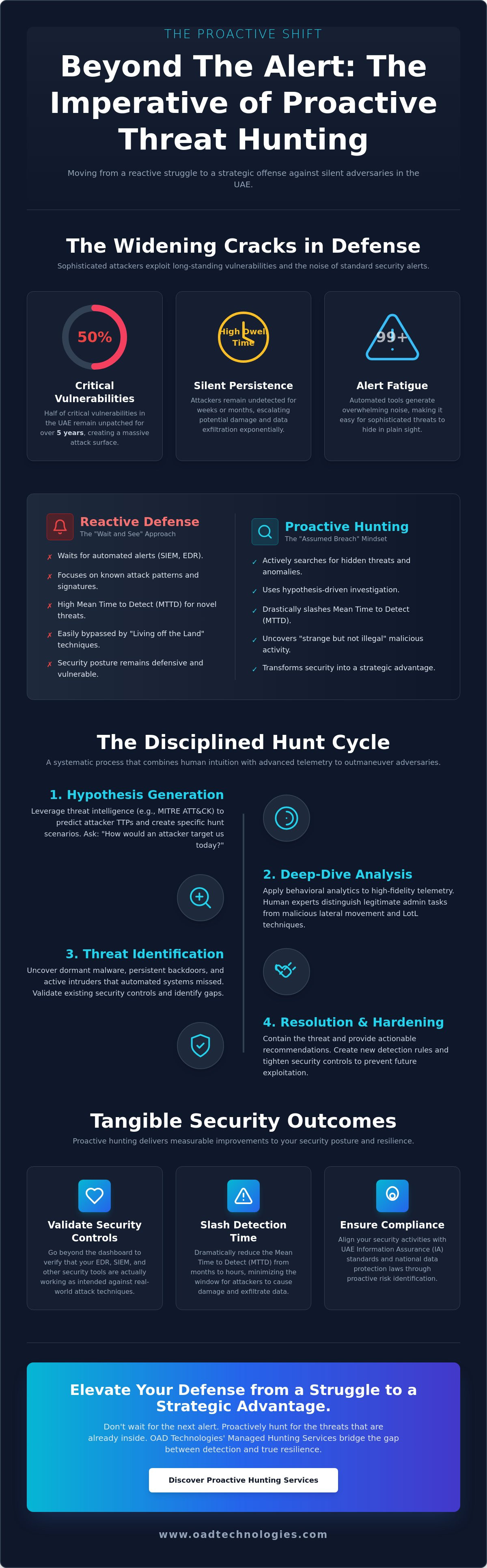
Half of the critical vulnerabilities in the UAE have remained unaddressed for over five years, creating a substantial digital debt that stealthy adversaries are eager to exploit. As the UAE National Cyber Security Strategy for 2025-2031 shifts focus toward active defense, relying on automated alerts is no longer enough to protect enterprise assets. This is why proactive threat hunting services have become a strategic requirement. These services move beyond the limitations of standard tools to find the silent actors that your SIEM or EDR might miss.
It's frustrating to manage constant alert fatigue while knowing that sophisticated attackers often maintain high dwell times within your network. You need a way to validate your existing security controls and fill the gap left by a lack of specialized in-house forensic talent. This article demonstrates how a shift to proactive hunting transforms your security posture from a reactive struggle into a strategic offense. We'll examine how this approach significantly reduces cyber risk, slashes your mean time to detect (MTTD), and ensures your organization remains resilient against the increasingly fragmented ransomware landscape.
Key Takeaways
- Adopt an "assumed breach" philosophy to identify stealthy threats that have already bypassed your perimeter defenses.
- Master the methodology of hypothesis-driven hunting, using threat intelligence to predict attacker behavior before they can execute their payload.
- Differentiate between reactive alerts and active investigation by integrating proactive threat hunting services into your existing security stack.
- Ensure regulatory compliance by aligning your hunting activities with the UAE Information Assurance (IA) standards and national data protection laws.
- Leverage the synergy between human insight and technological capacity to transform your security posture from a defensive struggle into a strategic advantage.
Defining Proactive Threat Hunting in the 2026 Threat Landscape
The UAE's 2025-2031 National Cyber Security Strategy signals a decisive move from passive capacity building to active defense. For the modern enterprise, this means perimeter security is no longer the finish line. We've entered an era of "assumed breach," where the most dangerous adversaries aren't the ones pounding on the front door, but the ones already inside, moving silently through your infrastructure. Proactive threat hunting services represent the strategic response to this shift, transforming security from a reactive struggle into a disciplined search for hidden danger.
Dwell time remains the silent killer of enterprise security. When an attacker remains undetected for weeks or months, the potential for data exfiltration and catastrophic system failure grows exponentially. In the Middle East, where data breach costs rank as the second highest globally, every hour of dwell time carries a heavy price tag. Moving from alert response to threat discovery allows your SOC to find these persistent actors before they can execute their final payload. It's a fundamental shift from waiting for a bell to ring to actively seeking out the quietest anomalies in your telemetry.
The Core Objectives of an Enterprise Hunt Team
Modern hunt teams focus on identifying "Living off the Land" (LotL) attacks. These techniques involve using legitimate administrative tools already present in your environment, making them nearly invisible to a standard Intrusion Detection System (IDS). By uncovering dormant malware and persistent access backdoors, hunters validate whether your existing security stack is actually working. They don't just trust the dashboard; they verify the integrity of every endpoint and cloud asset, addressing the digital debt created by years of unpatched vulnerabilities.
Why Automation Alone is Insufficient for Sophisticated Actors
Sophisticated attackers love the "noise" of a busy corporate network. They know that standard correlation rules in a SIEM are designed to catch known patterns, so they intentionally mimic normal user behavior. While automation is excellent for high-volume, low-complexity threats, it lacks the intuition to recognize "strange but not illegal" activity. Proactive threat hunting is the search for anomalies that automated tools are not programmed to recognize. Human hunters apply technical authority and a deep understanding of your business context to see the subtle footprints that algorithms ignore, ensuring your proactive threat hunting services stay one step ahead of evolving tactics.
The Hunting Methodology: How Experts Outmaneuver Advanced Adversaries
Effective proactive threat hunting services don't rely on luck or random log reviews. They operate through a disciplined cycle of hypothesis generation and deep-dive analysis. This process begins by using current threat intelligence to predict how an adversary might target your specific infrastructure. For instance, knowing there's been a 44% increase in underground recruitment efforts by ransomware affiliates targeting GCC countries allows hunters to create specific scenarios focused on initial access. It's a proactive stance that seeks to answer "How would an attacker get in today?" rather than "Did an alarm go off?"
The analysis phase is where human intuition meets high-fidelity telemetry. Hunters apply behavioral analytics to distinguish between legitimate administrative tasks and malicious lateral movement. This involves following ransomware threat hunting best practices to ensure no corner of the network remains unexamined. Once a threat is identified, the cycle concludes with resolution and hardening. Every hunt should result in permanent security improvements, such as new correlation rules or tighter access controls. This ensures that the same vulnerability can't be exploited twice. If you're looking to refine your own internal processes, OAD Technologies' tactical approach can help bridge the gap between detection and true resilience.
Leveraging the MITRE ATT&CK Framework for Systematic Hunts
A systematic hunt requires a common language. By mapping internal telemetry against the MITRE ATT&CK framework, hunters can identify gaps in visibility and coverage. We focus heavily on the "middle" of the attack chain, specifically lateral movement and credential access. These are the stages where attackers are most likely to leave subtle footprints while trying to escalate privileges. Comprehensive coverage across the entire enterprise kill chain ensures that even if an initial entry point is missed, the adversary is caught before they reach their objective.
Data Sources That Power a Successful Hunt
- Endpoint telemetry: This includes granular process execution logs, registry changes, and memory forensics. It's the most direct way to see what's happening on individual machines.
- Network metadata: Hunters look for beaconing behavior and unauthorized data exfiltration. Identifying these patterns helps pinpoint command-and-control (C2) activity that bypasses standard filters.
- Cloud infrastructure logs: With misconfiguration accounting for 32% of cyber incidents in the UAE, monitoring cloud security posture management (CSPM) data is vital. It allows hunters to detect identity-based attacks and exposed assets in real time.
Threat Hunting vs. Traditional MDR and SIEM: Resolving the Security Paradox
Many enterprises fall into the trap of believing that a robust stack of security tools equals total protection. While having a high-performance SIEM and EDR is foundational, these systems can't operate in a vacuum. They rely on pre-defined rules to trigger alerts. This creates a security paradox where the more data you collect, the easier it is for a sophisticated adversary to hide in the noise. Proactive threat hunting services resolve this by treating your security telemetry as a starting point for investigation rather than a final destination for alerts.
The divide between reactive and proactive defense is stark. Traditional alerts tell you what happened after a signature was matched, but hunting tells you what's currently happening before a signature even exists. This approach directly addresses the "Dwell Time" gap that automated systems often miss. When an attacker uses legitimate credentials to move laterally, they don't trigger a standard alarm. A hunter identifies this by looking for the subtle deviation in behavior. Most importantly, the findings from a successful hunt feed back into your detection engine, creating more resilient rules that prevent future incursions. While SIEM monitors for known bads, threat hunting searches for unknown suspicious patterns.
The Synergy Between MDR and Dedicated Hunting Services
Managed Detection and Response (MDR) acts as your 24 X 7 watch, handling the high volume of daily threats with speed and precision. However, a professional managed detection and response (MDR) provider must include proactive hunting to be truly effective. Think of MDR as the automated perimeter watch and hunting as the deep-tissue scan of your internal environment. Consider a "low and slow" exfiltration attempt where data is moved in tiny increments over several months. Such an attack often triggers zero automated alerts because each individual action looks benign. A dedicated hunting service identifies the cumulative pattern of these actions, neutralizing the threat before significant data loss occurs.
Threat Intelligence: The Compass for the Hunter
It's vital to distinguish between threat intelligence and threat hunting. Intelligence is the data, while hunting is the action taken based on that data. OAD Technologies uses a blend of global and regional threat feeds to inform local hunt hypotheses, ensuring our efforts are relevant to the UAE's specific threat profile. We don't just look for generic malware; we look for the specific TTPs used by actors currently targeting the Gulf's energy and finance sectors. This intelligence-led approach ensures that proactive threat hunting services are always focused on the most likely and most dangerous risks to your specific business operations.
Implementing a Hunting Framework Aligned with UAE National Standards
The UAE regulatory environment is maturing rapidly, moving from general guidelines to stringent, enforceable standards. For government entities and critical infrastructure operators, compliance with the UAE Information Assurance (IA) Standards is mandatory. These standards, overseen by the Signals Intelligence Agency (SIA), include 188 security controls that demand more than just passive firewalls. Integrating proactive threat hunting services into your security framework ensures you don't just meet these requirements on paper but actually verify the security of your critical assets. This approach aligns perfectly with the National Cyber Security Strategy (2025-2031) and its core pillar of active defence.
Beyond federal regulations, the UAE Personal Data Protection Law (PDPL) mandates continuous monitoring of data processing activities. Traditional security audits are periodic, leaving massive gaps between assessments. Proactive hunting fills these gaps by providing a continuous, human-led verification of your security posture. It's particularly vital for the finance and energy sectors, which remain the most targeted industries in the region. By hunting for unauthorized access or anomalous data movement, you provide the evidence-based assurance that GRC stakeholders require to manage organizational risk effectively. Translating these technical hunt findings into actionable business intelligence allows leadership to make informed decisions about future security investments.
Regulatory Resilience Through Proactive Discovery
Meeting NESA’s mandate for proactive security assessments requires a shift in how you document incident readiness. Hunt teams provide the forensic depth needed to satisfy national audit requirements by proving your environment is free of stealthy adversaries. This discovery process is also a critical component of data loss prevention (DLP). By identifying hidden exfiltration channels or dormant malware designed to steal sensitive information, you bolster your data protection strategy before a breach occurs, ensuring your organization remains compliant with both sectoral and national mandates.
Strategic Partnership: Bridging GRC and Technical Security
Effective hunting generates high-fidelity data that should live within your GRC framework. Instead of treating compliance as an annual checklist, you move toward a model of evidence-based security. This allows you to update your risk registers with real-world findings rather than theoretical possibilities. As the National Cyber Accreditation Programme (NCAP) rolls out in 2026, having a documented hunting framework will be a key differentiator for critical infrastructure providers. To ensure your organization is ready for these upcoming regulatory shifts, consult with our experts to align your technical defenses with national mandates.
Elevating Your Defense with OAD Technologies’ Managed Hunting Services
True resilience isn't found in a software license. It's built through the relentless application of human curiosity and rigorous engineering. OAD Technologies' proactive threat hunting services represent a departure from standardized, "black-box" security solutions. We don't just hand you a dashboard and call it a day. Instead, our SOC-integrated hunters act as an extension of your own team, applying deep technical authority to uncover the subtle behavioral shifts that automated systems ignore. This collaborative approach ensures that every hunt isn't just a search for malware, but a strategic assessment of your entire digital asset profile.
Our methodology focuses on creating a closed-loop system where hunt findings directly optimize your broader security stack. When we identify a new adversarial tactic, we don't just remediate the immediate threat. We translate that technical insight into permanent improvements for your SIEM and GRC frameworks. This transparency is a core OAD pillar. You'll receive detailed, actionable reporting that explains the "why" behind every hunt, empowering your internal specialists to understand the nuances of your evolving risk landscape. It's a commitment to long-term viability over quick, superficial fixes.
Why UAE Leaders Trust OAD for Strategic Security
Operating within the UAE requires a nuanced understanding of both global threat actors and local regulatory mandates. We combine this regional expertise with a commitment to precision and high-quality craftsmanship. By integrating hunting with our other core offerings, such as VAPT and Identity and Access Management (IAM), we create a unified defense architecture. This synergy allows us to identify misconfigurations and credential abuse before they escalate into full-scale incidents. We don't just keep pace with technology; we actively shape its application to protect your organization's future.
Getting Started: Your Roadmap to a Proactive Posture
Transforming your security posture begins with a thorough environment assessment and a telemetry health check. We verify that your endpoints, network, and cloud assets are providing the high-fidelity data required for a successful hunt. From there, we define a customized 90-day hunt plan focused on your highest-value assets. This ensures immediate impact and clear ROI, demonstrating the value of proactive threat hunting services from day one. Contact OAD Technologies today for a strategic consultation on your threat hunting needs and begin your journey from reactive defense to strategic offense.
Securing Your Digital Future through Active Defense
Transitioning from a reactive security posture to a strategic offensive is no longer optional for UAE enterprises. Embracing the "assumed breach" mindset shifts the focus from managing noisy alerts to uncovering the silent footprints of advanced adversaries. This approach ensures that proactive threat hunting services bridge the critical gap between automated detection and true organizational resilience. Human-led forensics, combined with regional threat intelligence, transforms your security stack into a robust barrier against sophisticated attackers who hide in the noise.
OAD Technologies brings deep expertise in UAE national security standards like NESA and ISR to every engagement. Our sophisticated integration of human forensics and AI-driven telemetry provides national coverage for both government and enterprise sectors. We don't just find threats; we harden your entire infrastructure against future incursions. It's time to reclaim the advantage from the adversary and ensure your long-term digital relevance in an evolving market.
Secure your enterprise with OAD Technologies’ Proactive Threat Hunting Services today. Let's build a resilient future for your organization together.
Frequently Asked Questions
What is the difference between a vulnerability assessment and proactive threat hunting?
Vulnerability assessments focus on identifying and patching security gaps before they're exploited, whereas proactive threat hunting services assume an adversary is already present. VAPT tells you where your defenses are weak; hunting finds the attacker who bypassed those defenses. It's the difference between checking if a lock is broken and searching the house for a burglar who's already inside.
How often should an enterprise conduct proactive threat hunting sessions?
Enterprise leaders should aim for continuous hunting to match the persistent nature of modern threats. While quarterly sessions provide a snapshot, the UAE National Cyber Security Strategy for 2025-2031 emphasizes "active defense," which requires ongoing vigilance. High-value sectors like finance or energy benefit most from 24 X 7 SOC-integrated hunting to minimize the dwell time of stealthy actors.
Can proactive threat hunting be fully automated with AI and Machine Learning?
Automation cannot replace the human-led, hypothesis-driven nature of a professional hunt. AI and machine learning are powerful tools for normalizing telemetry and spotting high-volume anomalies, but they lack the intuition to recognize "strange but not illegal" behavior. Human hunters apply business context and technical authority to identify sophisticated tactics that algorithms are not yet programmed to recognize.
What are the primary indicators of compromise (IoCs) that hunters look for?
Hunters look for behavioral indicators rather than just static file hashes. This includes lateral movement using legitimate administrative tools, unusual outbound traffic suggesting command-and-control beaconing, and anomalous credential use. By focusing on these Tactics, Techniques, and Procedures (TTPs), hunters identify adversaries who have successfully blended into the "noise" of your daily enterprise operations.
How does threat hunting help in achieving UAE NESA or PDPL compliance?
Proactive hunting directly supports the 188 security controls within the UAE Information Assurance (IA) Standards by providing evidence of continuous monitoring. It transforms compliance from a checklist into a dynamic verification process. For PDPL, it ensures you're actively identifying risks to sensitive data, fulfilling the mandate for robust security measures in high-stakes digital environments.
Do I need to install new software on my network to start threat hunting services?
Most proactive threat hunting services leverage the telemetry already gathered by your existing SIEM and EDR platforms. You don't always need to install new software if your current tools provide sufficient visibility into process executions and network metadata. A health check of your telemetry is usually the first step to ensure hunters have the data they need to be effective.
What kind of reports should I expect from a managed threat hunting service?
You should expect detailed forensic reports that translate technical findings into strategic business risks. These reports include the hypotheses tested, the specific anomalies discovered, and a clear roadmap for remediation and hardening. This documentation is vital for updating your organizational risk registers and proving incident readiness to national regulatory auditors.
How does threat hunting specifically protect against advanced ransomware attacks?
Threat hunting stops ransomware by identifying the early stages of the attack chain, such as credential harvesting or lateral movement. Since many ransomware groups now use smaller, more agile affiliate models, they often dwell in the network for weeks before encrypting data. Hunting neutralizes these hidden threats during their reconnaissance phase, preventing the catastrophic final payload from ever being executed.
Disclaimer
Content by OAD Technologies is for general informational purposes only and does not constitute professional or cybersecurity advice. No warranties are made regarding accuracy or completeness; reliance is at your own risk. OAD Technologies shall not be liable for any direct or indirect losses arising from use of this content.


