
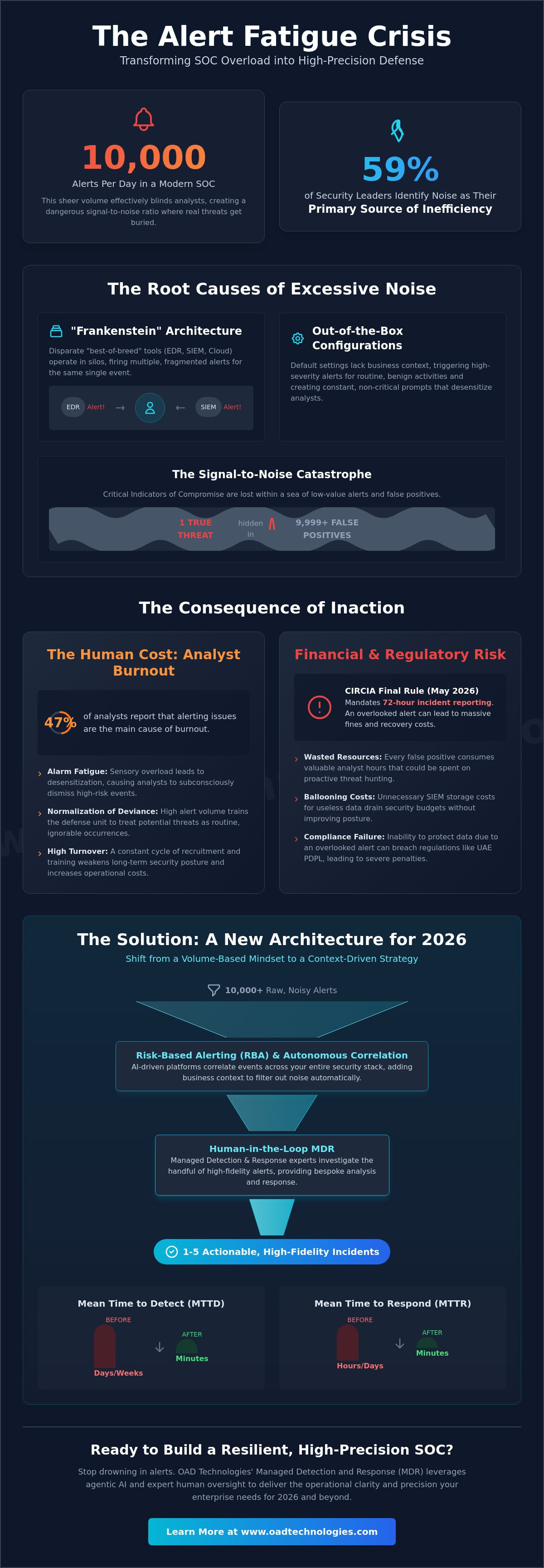
When a Security Operations Center (SOC) receives 10,000 alerts in a single day, your analysts aren't just busy; they're effectively blind. In 2026, 59% of security leaders identify this excessive noise as their primary source of operational inefficiency. You're likely feeling the pressure of high analyst turnover and the constant fear that a critical breach will slip through the cracks while your team sifts through false positives. Reducing cybersecurity alert fatigue is no longer just about buying more tools. It's about shifting from a volume-based mindset to a context-driven architectural strategy that prioritizes precision over noise.
We understand that the current model is unsustainable, especially with the May 2026 CIRCIA final rule mandating 72-hour incident reporting for critical infrastructure. You've watched SIEM storage costs balloon while 47% of your analysts report that alerting issues are the main cause of burnout. This article provides a clear roadmap to transform your overwhelmed SOC into a high-precision defense unit by leveraging bespoke Managed Detection and Response (MDR) and agentic AI. You'll learn how to improve your mean time to detect (MTTD) and respond (MTTR) while creating a sustainable workload that empowers your human experts rather than burying them under a mountain of data.
Key Takeaways
- Understand how alert fatigue creates a strategic vulnerability by masking critical threats within a high signal-to-noise ratio.
- Identify the architectural flaws in modern security stacks, such as tool silos and default configurations, that contribute to operational friction.
- Discover a proven framework for reducing cybersecurity alert fatigue through Risk-Based Alerting (RBA) and autonomous event correlation.
- Learn a structured roadmap for auditing your current alert baseline and consolidating redundant tools into a managed, high-precision ecosystem.
- Explore how a "Human-in-the-Loop" Managed Detection and Response (MDR) approach provides the bespoke precision needed for 2026 enterprise resilience.
What is Cybersecurity Alert Fatigue and Why is it a Strategic Risk?
Alert fatigue occurs when the sheer volume of security notifications surpasses the cognitive capacity of your team to investigate them accurately. In a modern SOC environment, analysts can face as many as 10,000 alerts in a single day. This creates a dangerous signal-to-noise ratio where critical indicators of compromise are buried under thousands of benign events. When 59% of security leaders report that excessive alerts are their primary source of inefficiency, we must recognize that this is a strategic risk rather than a technical nuisance. Beyond the immediate threat of a breach, this environment fosters the "normalization of deviance." This is a psychological state where analysts begin to treat security exceptions as routine occurrences rather than active threats, effectively training your defense unit to ignore the very signals they are paid to monitor.
Reducing cybersecurity alert fatigue is essential for maintaining compliance with the UAE Personal Data Protection Law (PDPL). Under these regulations, failing to protect sensitive data due to an overlooked alert can lead to significant financial penalties and a total loss of digital trust. Precision is no longer a luxury; it's a regulatory mandate for any enterprise operating in the Middle East. The hidden costs are equally staggering. High analyst turnover and the subsequent recruitment expenses create a cycle of instability that weakens your long-term security posture. When 47% of analysts indicate that alerting issues contribute directly to burnout, the problem isn't just technical; it's a threat to your human capital.
The Psychology of the Overwhelmed Analyst
The cognitive load of processing 500 or more alerts during a single shift leads to a condition known as Alarm fatigue. This phenomenon causes sensory overload, making analysts desensitized to the repetitive stimuli of your security dashboard. It results in the subconscious dismissal of high-risk events because they look identical to the thousands of false positives seen previously. We define alert fatigue as a structural failure of system architecture rather than a failure of staff diligence. Your analysts are capable experts; your current framework is simply overwhelming their natural limitations.
Financial and Regulatory Implications in 2026
Operational inefficiency carries a heavy price tag in the current landscape. Every false positive consumes analyst hours that could be spent on proactive threat hunting or vulnerability management. In 2026, the financial implications are even more severe. With the CIRCIA final rule expected in May 2026, covered entities must report significant incidents within 72 hours. An uninvestigated alert that turns into a breach results in massive fines and ballooning recovery costs. Investing in precision ensures that your security budget drives strategic growth rather than just paying for the storage of useless data. Digital resilience in 2026 requires high-fidelity detection that protects both your data and your bottom line.
The Root Causes: Why Modern Security Stacks Generate Excessive Noise
Enterprises often fall into the trap of purchasing "best-of-breed" solutions for every niche threat. While these tools are powerful in isolation, they rarely communicate. This lack of integration creates a "Frankenstein Architecture" where EDR, SIEM, and Cloud Security platforms fire independent alerts for the same event. Instead of one clear signal, an analyst receives five fragmented notifications. This redundancy is a primary hurdle in reducing cybersecurity alert fatigue. Without a unified visibility layer, your team spends more time de-duplicating data than investigating threats. This fragmented approach is why 59% of security leaders cite excessive alerts as their biggest inefficiency.
Many organizations also rely on default, "out-of-the-box" configurations. These settings lack the bespoke context of your specific business environment. A NIST study on security fatigue highlights how constant, non-critical prompts cause users to feel hopeless and act recklessly. The same applies to SOC analysts. When a system triggers a high-severity alert for a routine administrative task, it erodes the analyst's trust in the platform. Precision requires tailoring these tools to recognize what "normal" looks like in your unique network. Without this customization, your security stack becomes a source of friction rather than a shield.
Tool Sprawl and the Integration Gap
Fragmented security stacks generate a massive volume of telemetry without correlation. If your network security solution doesn't talk to your endpoint protection, your analysts must manually piece together the attack lifecycle. This integration gap leads to data silos that hide the true path of an intruder. We believe the solution lies in a managed ecosystem where every tool serves a strategic purpose within a larger framework. If your current stack feels like a collection of isolated islands, it might be time to audit your security architecture for better operational efficiency.
Poor Data Hygiene and Identity Ambiguity
Identity is the new perimeter, yet many alerts arrive without clear user context. When a system lacks robust identity and access management, alerts often flag "unknown users" or "system accounts" rather than specific individuals. This ambiguity forces Tier 1 analysts to perform manual lookups, wasting valuable minutes. Similarly, unclassified data triggers meaningless Data Loss Prevention (DLP) events. If your system can't distinguish between a public marketing PDF and a confidential financial report, it will flood your dashboard with noise. Contextless alerts are essentially useless. They provide data without intelligence, leaving your defense unit overwhelmed and your enterprise vulnerable in the 2026 threat landscape.
Strategic Mitigation: Moving from Reactive Tuning to Autonomous Correlation
Moving beyond the reactive cycle requires a fundamental shift in how your security stack processes data. Instead of treating every log entry as a potential catastrophe, sophisticated architectures now utilize Intelligent Alert Grouping. This method collapses 100 disparate events, such as multiple login failures followed by a successful connection from an unusual IP, into a single, high-fidelity incident. This consolidation is a cornerstone of reducing cybersecurity alert fatigue, allowing your team to focus on the narrative of an attack rather than chasing individual data points. By implementing these autonomous correlation techniques, you transform your SOC from a reactive clearinghouse into a proactive defense unit.
A critical component of this evolution is the integration of the MITRE ATT&CK framework. By mapping incoming signals against known adversary tactics, AI-driven correlation can validate whether a series of events actually constitutes a threat. This technical rigor ensures that your analysts aren't wasting time on anomalies that have no path to exploitation. To maintain this level of precision, you must establish a continuous feedback loop between your Tier 3 analysts and SIEM engineers. This collaboration ensures that the logic governing your alerts evolves alongside the threat landscape, preventing the "set and forget" mentality that leads to system decay and operational friction.
The Power of Risk-Based Alerting (RBA)
RBA represents a departure from traditional "Any-to-Any" alerting. Rather than firing a notification for every suspicious packet, RBA assigns a dynamic score based on asset criticality and threat severity. For instance, a suspicious login on a public-facing web server carries more weight than the same event on a guest Wi-Fi network. This strategy shifts the focus from investigating isolated "events" to investigating "entities" like specific users or high-value hosts. In practical enterprise deployments, shifting to an RBA workflow can reduce alert noise by up to 70%. This reduction doesn't just clear the dashboard; it provides the headspace for analysts to perform the deep work required for complex threat hunting and strategic growth.
Leveraging AI for Contextual Enrichment
Modern machine capability excels at the repetitive tasks that drain human energy. When an alert triggers, an AI-enriched SIEM acts as the central brain, automatically pulling WHOIS data, threat intelligence feeds, and historical user behavior. This Guide to Reducing Alert Fatigue highlights how automation provides the necessary context before a human ever sees the ticket. This enrichment ensures that AI assists rather than replaces human intuition. Your analysts receive a complete dossier on the incident, including the "who, what, and why" already mapped out. This synergy between machine precision and human intelligence is the only way to maintain resilience against the high-velocity attacks of 2026 while ensuring a high ROI on your security investments.
A Roadmap to Operational Clarity: Architecture for 2026
Achieving operational clarity begins with a rigorous audit of your current alert baseline. Your first objective is to identify the "Top 10" noise makers, which often account for over 50% of your total alert volume. By isolating these specific triggers, you can determine if they require bespoke tuning, temporary suppression, or a fundamental change in the underlying system logic. This diagnostic phase is the foundation for reducing cybersecurity alert fatigue. It allows you to move away from the "Frankenstein Architecture" of isolated tools and toward a managed ecosystem where every component serves a documented strategic purpose.
Once you've identified the primary sources of noise, the next step is consolidating redundant tools. Many enterprises pay for overlapping features in their EDR and SIEM platforms, leading to dual notifications for the same event. By streamlining your stack, you ensure that alerts are routed through a single, authoritative visibility layer. This consolidation isn't just about cutting costs; it's about establishing a clear chain of command for your data. A unified architecture allows your team to spend less time managing software and more time defending the perimeter. If your current stack feels fragmented, you can schedule a strategic architecture review to identify opportunities for consolidation.
The Role of Bespoke DLP in Noise Reduction
Precise data loss prevention policies act as a massive filter for your SOC. Without bespoke configuration, DLP tools often flag every file movement as a potential breach, burying analysts in thousands of false positives. By implementing rigorous data classification, you ensure the system only triggers an alert when sensitive or regulated information is at risk. Knowing exactly where your high-value data lives reduces the scope of required monitoring. This targeted approach prevents your team from chasing "ghost" threats involving public or non-critical documents, directly improving your MTTD for genuine data exfiltration attempts.
VAPT as a Filter for Alert Prioritization
Integrating continuous vulnerability assessment results into your monitoring workflow provides a powerful prioritization lens. When your SIEM knows which systems are already patched, it can automatically deprioritize alerts targeting those specific vulnerabilities. This synergy between offensive testing and defensive monitoring turns raw telemetry into actionable intelligence. Instead of investigating every exploit attempt, your analysts focus only on those that target truly exploitable gaps. This strategic alignment with GRC goals ensures that your security efforts are always focused on the areas of highest business risk, maintaining your resilience in the face of an evolving 2026 threat landscape.
Managed Detection and Response: The OAD Approach to Precision
We view Managed Detection and Response (MDR) as the ultimate architecture for operational clarity. While previous sections outlined the technical roadmap for 2026, OAD’s Managed Detection and Response (MDR) provides the execution layer that makes resilience possible. We act as the "fatigue killer" by absorbing the operational friction of high-volume telemetry. Our "Human-in-the-Loop" philosophy ensures that while agentic AI handles the autonomous correlation of thousands of events, a dedicated expert provides the final validation. This synergy is the most effective method for reducing cybersecurity alert fatigue in complex enterprise environments. We handle the noise so your internal team can focus on strategic growth and digital transformation.
Our commitment to future-proofing your digital assets extends beyond simple monitoring. We integrate seamlessly with your existing stack, whether you're navigating the May 2026 CIRCIA reporting requirements or managing a transition to a more scalable cloud posture. By providing a unified visibility layer, we eliminate the data silos that traditionally hide the full attack lifecycle. This approach ensures that your security posture isn't just a collection of tools, but a high-precision defense unit capable of meeting the rigorous engineering standards of the modern tech landscape.
Bridging the Gap Between Innovation and Results
OAD Technologies functions as a collaborative extension of your own team. We don't believe in the one-size-fits-all approach that characterizes many legacy providers. Instead, we offer bespoke rule-tuning tailored to specific industry verticals and the unique regulatory landscape of the UAE. This precision ensures that your dashboard remains clear of the "normalization of deviance" we discussed earlier. We provide your C-suite with high-level visibility into strategic risk without the technical clutter of raw log data. It's about delivering actionable intelligence that supports business continuity rather than just adding another layer of notifications.
Operational Efficiency and Strategic Partnership
In a market where MDR pricing for mid-market firms in May 2026 typically ranges from $7 to $25 per endpoint per month, the real value lies in the efficiency of the response. OAD Technologies ensures your SOC remains a value center by providing a clear ROI through improved MTTD and MTTR. We've built our reputation on bridging the gap between high-level innovation and practical business results. Our roadmap for long-term success involves continuous architectural refinement to stay ahead of evolving threats. Consult with OAD Technologies to architect a noise-free security future and reclaim the productivity of your security team.
Architecting a Noise-Free Security Future
The path to enterprise resilience in 2026 requires more than just better tools; it demands a fundamental architectural shift toward precision. You've seen how moving from volume-based monitoring to Risk-Based Alerting can reduce noise by up to 70%. By integrating bespoke DLP policies and continuous vulnerability assessments, you transform your SOC into a high-fidelity defense unit. Reducing cybersecurity alert fatigue is the only way to ensure your team remains focused on the threats that actually matter to your bottom line. It's a strategic necessity for any organization looking to maintain digital trust in an increasingly complex environment.
OAD Technologies stands ready to help you navigate this transition. Our Dubai-based team brings specialized expertise in aligning your security stack with the UAE Personal Data Protection Law (PDPL) and strategic GRC goals. We believe in a "Human-in-the-Loop" philosophy that empowers your analysts rather than overwhelming them. Optimize your security architecture with OAD Technologies’ bespoke MDR and SIEM solutions. Let's build a future where your security operations drive strategic growth instead of operational friction. Your journey toward a more resilient and sustainable defense starts with a single, strategic choice.
Frequently Asked Questions
What is the primary cause of alert fatigue in cybersecurity teams?
The primary cause is the proliferation of disconnected security tools that generate redundant, fragmented notifications. This "Frankenstein Architecture" forces analysts to manually correlate events across isolated dashboards rather than seeing a unified attack lifecycle. When a SOC receives up to 10,000 alerts daily, the lack of seamless integration makes it impossible to distinguish critical threats from benign noise.
Can automation completely eliminate alert fatigue?
Automation cannot completely eliminate fatigue, but it dramatically shifts the workload toward high-value investigative tasks. Agentic AI and autonomous correlation are designed to augment human intelligence rather than replace it. The goal is achieving a manageable signal-to-noise ratio where your expert analysts only intervene when human intuition is required for complex decision-making.
How does alert fatigue impact UAE PDPL compliance?
Alert fatigue creates a direct risk of non-compliance with the UAE Personal Data Protection Law (PDPL) by increasing the likelihood of an uninvestigated breach. With the CIRCIA final rule effective in May 2026, organizations must report significant incidents within 72 hours. An overwhelmed team is far more likely to miss these critical regulatory windows, leading to heavy fines and lost digital trust.
What is the difference between alert tuning and risk-based alerting?
Alert tuning is a reactive process of adjusting individual thresholds to reduce false positives, while risk-based alerting (RBA) is a strategic framework that scores alerts based on asset criticality. RBA is a foundational component for reducing cybersecurity alert fatigue because it prioritizes high-value entities rather than isolated packets. This architectural shift can reduce operational noise by as much as 70%.
How can Managed Detection and Response (MDR) help with analyst burnout?
MDR helps by absorbing the Tier 1 noise that leads to 47% of analysts reporting burnout. By acting as an extension of your team, an MDR provider handles the repetitive investigative work and initial triage. This allows your internal staff to move away from the "normalization of deviance" and focus on strategic growth and high-level architectural refinement.
Is it better to hire more analysts or invest in better SIEM architecture?
Investing in better SIEM architecture provides a higher long-term ROI than simply increasing headcount. Hiring more analysts into a noisy, unoptimized environment only scales the existing inefficiency and leads to higher turnover. A bespoke, well-architected system ensures that your current team can operate at peak performance without the constant need for recruitment and training.
How often should security alert rules be reviewed and updated?
Security alert rules require a continuous feedback loop between Tier 3 analysts and SIEM engineers to remain effective. While major architectural audits should happen quarterly, rule-tuning should be a weekly occurrence. This steady rhythm ensures your defense evolves at the same pace as the 2026 threat landscape and prevents the decay of your detection logic.
What role does Data Loss Prevention (DLP) play in reducing SOC noise?
DLP reduces SOC noise by ensuring that only sensitive or regulated data movements trigger a high-priority alert. When you implement precise data classification, the system automatically ignores the movement of public or non-critical files. This targeted approach prevents your analysts from wasting time on meaningless events that don't represent a true risk to the enterprise.
Disclaimer
Content by OAD Technologies is for general informational purposes only and does not constitute professional or cybersecurity advice. No warranties are made regarding accuracy or completeness; reliance is at your own risk. OAD Technologies shall not be liable for any direct or indirect losses arising from use of this content.


