

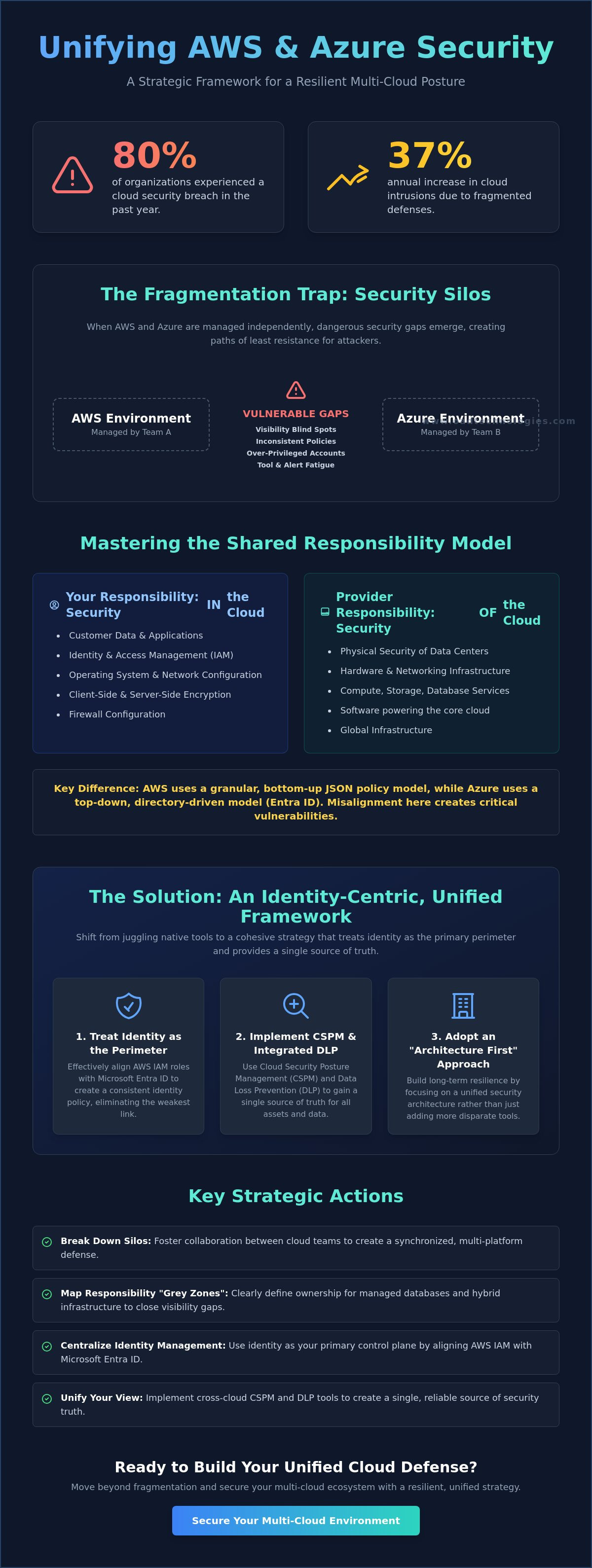
80% of organizations experienced a cloud security breach in the past year, a stark reminder that fragmented defenses are no longer a viable strategy. If you're currently juggling native consoles while watching cloud intrusions climb by 37% annually, you know the stakes. The complexity of securing aws and azure environments often leads to tool fatigue and over-privileged accounts, leaving your enterprise vulnerable despite a high security spend.
We understand that maintaining a consistent identity policy while meeting strict UAE PDPL data residency requirements feels like chasing a moving target. It’s a common frustration for leaders who need precision, not just more alerts. This article provides a unified strategic framework to master these complexities by aligning AWS and Azure controls into one resilient posture. You'll learn how to establish a single source of truth for your cloud security, simplify compliance with local regulations, and reduce your mean time to respond across your entire digital footprint. We'll break down the shift toward identity-centric protection and show you how to build an abstraction layer that keeps your data secure, regardless of the underlying provider.
Key Takeaways
- Learn why breaking down operational silos is the first step toward a synchronized defense across heterogeneous cloud platforms.
- Identify the "grey zones" in the Shared Responsibility Model to ensure managed databases and hybrid infrastructures don't become invisible vulnerabilities.
- Discover how to treat identity as your primary perimeter by effectively aligning AWS IAM roles with Microsoft Entra ID when securing aws and azure environments.
- Implement Cloud Security Posture Management (CSPM) and integrated Data Loss Prevention (DLP) to gain a single source of truth for all cloud assets.
- Understand the "architecture first" approach to building long-term cloud resilience that empowers your team rather than just adding more tools.
The Multi-Cloud Reality: Why Securing AWS and Azure Requires a Unified Approach
Enterprise security has moved past the era of choosing a single provider. Most organizations now operate in a multi-cloud environment, often by design to leverage specific service strengths or due to rapid regional expansion. However, this architectural diversity creates a dangerous "Security Silo" trap. When separate teams manage AWS and Azure independently, they inadvertently create seams in the defensive perimeter. Multi-cloud security must be defined as the synchronized protection of assets across these heterogeneous environments, ensuring that a workload's safety doesn't depend on which data center it calls home.
The 2026 threat landscape shows that attackers no longer focus solely on compromising a single cloud instance. Instead, they exploit the functional gaps between providers. If your identity policies are strict in Azure but permissive in AWS, threat actors will find the path of least resistance. Achieving "Policy Parity" is the new gold standard for modern cloud architecture. This means maintaining identical security outcomes across different technical implementations, ensuring your enterprise posture remains resilient regardless of the underlying infrastructure.
The Hidden Risks of Cloud Fragmentation
Fragmentation is the enemy of visibility. You cannot protect what you cannot see, and cross-region blind spots often hide misconfigured storage or unpatched instances. Inconsistent configuration leads to "severity drift," where a risk labeled as "High" in AWS might only be flagged as "Medium" or "Critical" in Azure due to differing native scoring systems. This creates a cognitive load on your security team that leads to burnout. Furthermore, the talent gap remains a significant hurdle. Finding engineers who possess deep expertise in both AWS GuardDuty and Microsoft Defender is increasingly difficult, making the process of securing aws and azure environments a constant struggle for internal HR teams.
Moving Beyond Native Security Tools
While native tools are excellent for their specific ecosystems, they rarely provide a true "single pane of glass" view. Relying solely on provider-specific consoles forces your team to swivel-chair between interfaces, which increases the likelihood of missing a cross-cloud lateral movement. Third-party Managed Security Service Providers (MSSPs) bridge this gap by providing an abstraction layer that unifies telemetry. This approach allows leaders to focus on business outcomes rather than the nuances of vendor-specific API calls. Multi-cloud security is a strategy that prioritises visibility over vendor-specific features. By adopting this mindset, you ensure that your investment in securing aws and azure environments translates into long-term digital relevance and operational stability.
Mastering the Shared Responsibility Model Across Hybrid Cloud Infrastructures
Many technical teams operate under the dangerous assumption that cloud providers handle the bulk of security. While providers are responsible for the security "of the cloud," your organization remains accountable for security "in the cloud." Understanding where this line is drawn is the first step toward effectively securing aws and azure environments. While both platforms follow the same high-level logic, their technical execution varies significantly, often leaving gaps in your defensive posture if not mapped correctly.
AWS vs. Azure: Divergent Approaches to Infrastructure Security
AWS favors a bottom-up approach, utilizing granular, JSON-based policy controls. This offers immense flexibility for developers but requires high technical precision to avoid misconfigurations. In contrast, Azure adopts a top-down strategy, tightly integrating with the broader Microsoft ecosystem and Entra ID. This directory-driven experience simplifies management for enterprise environments but can lead to complexity when managing cross-tenant permissions or inherited roles. Documenting these differences is a non-negotiable requirement for modern governance risk and compliance audits. Auditors require clear evidence of ownership for every configuration layer, from network security groups to storage bucket policies.
The most significant risks often hide in "Grey Zones," such as managed databases or serverless functions. In an AWS RDS instance or Azure SQL Database, the provider manages the physical hardware and OS patching. However, you remain responsible for encryption at rest, network access rules, and data classification. Misunderstanding these boundaries is a leading cause of accidental data exposure. Utilizing Cloud Security Posture Management (CSPM) allows you to automate the verification of these controls. It ensures that your team isn't manually checking thousands of settings across two different platforms, which drastically reduces the margin for human error.
Regulatory Alignment in the UAE Market
For organizations operating in the Middle East, the UAE Personal Data Protection Law (PDPL) introduces specific mandates for data residency and sovereignty. You must ensure that sensitive personal data remains within local borders, specifically utilizing the AWS Middle East (UAE) and Azure UAE North regions. Simply selecting the right region isn't enough to guarantee compliance. You need rigorous technical security assessments to validate that provider-side controls actually align with local legal requirements.
Managing third-party risk is equally vital. When cloud providers update their underlying infrastructure or introduce new service features, the scope of your responsibility might shift without warning. Establishing a framework for continuous auditing ensures your posture remains resilient even as the platforms evolve. If you're looking to streamline this complex mapping process, OAD Technologies provides the strategic oversight needed to bridge these provider gaps and maintain a unified compliance posture.
Identity as the New Perimeter: Aligning AWS IAM and Microsoft Entra ID
Identity is the only constant in a modern cloud architecture. While network configurations and server instances change, the user or service account requesting access remains the primary point of control. When securing aws and azure environments, the goal is to create a seamless identity fabric that spans both providers. This approach prevents the "Identity Sprawl" that occurs when teams create local users in AWS while maintaining a corporate directory in Azure, which often leads to orphaned accounts and over-privileged access.
AWS IAM and Azure Role-Based Access Control (RBAC) operate on different philosophies. AWS utilizes highly granular, JSON-based policies attached to roles, providing deep technical control at the resource level. Azure, however, leverages the strength of Microsoft Entra ID, focusing on hierarchical management groups and subscriptions. Aligning these two systems requires more than just technical mapping; it demands a unified strategy that enforces the Principle of Least Privilege (PoLP) across every resource. This ensures that no identity has more power than necessary for its specific function.
Federated Identity Strategies
Centralizing your identity source is a core component of multi-cloud security best practices. Most enterprises find success by using Microsoft Entra ID as the primary Identity Provider (IdP) for AWS access. By establishing a SAML-based federation or utilizing AWS IAM Identity Center, you can ensure that when an employee leaves the company, their access is revoked across both clouds simultaneously. This eliminates the risk of "backdoor" access through forgotten local accounts.
This setup isn't without challenges. Establishing trust relationships and managing cross-account access requires meticulous planning to avoid permission creep. Implementing a robust identity and access management framework ensures that your federation strategy remains manageable as your cloud footprint scales. It provides the structure needed to govern who can access what, regardless of whether the asset resides in a VPC or a VNet.
Managing Privileged Access
Static credentials are a liability that modern attackers exploit with ease. When securing aws and azure environments, you should prioritize Just-In-Time (JIT) access. This ensures that administrative permissions are only granted when needed and for a limited duration. It's a proactive way to minimize the blast radius of a potential credential compromise, as the elevated permissions expire automatically after the task is complete.
Continuous monitoring for dormant accounts and strictly enforced credential rotation are equally vital. While automated IAM auditing tools can flag anomalies, they work best when paired with human insight. Your security team knows the context of business operations, allowing them to distinguish between a legitimate developer's late-night troubleshooting and a malicious actor's lateral movement. This synergy between human expertise and technological capacity is what defines a truly resilient enterprise posture for 2026.
Closing the Gaps: Implementing Cross-Cloud Data Loss Prevention (DLP) and CSPM
Visibility is the foundation of any resilient cloud strategy. Without a centralized view, you're effectively flying blind across disparate infrastructures. Cloud Security Posture Management (CSPM) serves as the essential tool for achieving this visibility, acting as a bridge between the distinct technical languages of AWS and Azure. By aggregating telemetry into a single source of truth, CSPM allows your team to identify vulnerabilities before they can be exploited. This is particularly critical when securing aws and azure environments, where a single misconfiguration in one cloud can compromise the integrity of your entire multi-cloud ecosystem.
Data protection must follow the data, not the provider. Integrating Data Loss Prevention (DLP) directly into cloud storage, such as AWS S3 buckets and Azure Blobs, ensures that sensitive information is protected by a consistent policy regardless of its location. In 2026, the most common misconfigurations leading to breaches include:
- Publicly accessible storage buckets and blobs due to incorrect ACL settings.
- Unencrypted data volumes and database snapshots.
- Over-privileged service accounts with broad administrative access.
- Disabled audit logging and monitoring in production regions.
- Insecure default security groups that allow unrestricted inbound traffic.
Relying on manual intervention to fix these issues is no longer feasible. With cloud intrusions accelerating, your mean time to respond (MTTR) must be measured in minutes, not days. Automated remediation allows your system to instantly correct a configuration drift, such as closing a port that was accidentally opened, ensuring that your posture remains secure 24 X 7 without waiting for human approval.
Unified Data Loss Prevention (DLP) Strategies
Effective data protection requires a proactive approach to scanning for sensitive data, including PII and financial records, across all storage layers. By applying consistent encryption standards, you eliminate the risk of a "weak link" in your architecture. Our data loss prevention framework provides a structured roadmap for identifying and securing these assets. This ensures that your intellectual property remains under your control, even as it moves between different cloud providers or regions.
CSPM: Your Single Source of Truth
Modern CSPM tools do more than just find errors; they map your technical configurations to international standards like ISO 27001 and local UAE mandates. This continuous monitoring approach makes traditional "point-in-time" audits obsolete, as you have a real-time record of your compliance status. For maximum impact, you should integrate your CSPM with managed detection and response capabilities. This synergy allows for real-time threat mitigation, transforming your security from a reactive cost center into a proactive business enabler. If you want to eliminate the gaps in your defense, OAD Technologies can help you implement a unified CSPM and DLP strategy tailored to your specific business needs.
Building Cloud Resilience: How OAD Technologies Secures Multi-Cloud Ecosystems
OAD Technologies acts as a master designer of multi-cloud systems, moving beyond the role of a standard vendor to become a strategic partner. Our approach prioritizes architecture first and tool selection second. This methodology ensures that your security framework is built on a foundation of business logic rather than vendor-specific features. When securing aws and azure environments, we focus on creating a cohesive ecosystem where telemetry flows seamlessly across platforms, providing the clarity needed for decisive action.
A critical component of this resilience is our managed Security Operations Center (SOC), which utilizes advanced SIEM and EDR capabilities. By centralizing logs and endpoint data from both AWS and Azure, we eliminate the blind spots that often lead to breaches. This unified visibility allows our team to detect lateral movement and sophisticated threats that might otherwise slip through the cracks of a siloed defense. We empower your people with the right data, ensuring that technology serves as a force multiplier for your internal security team.
The OAD Advantage: Beyond System Integration
We reject "one-size-fits-all" cloud templates in favor of customized security roadmaps. Our deep expertise in UAE-specific GRC and PDPL compliance ensures that your data residency and protection standards are met with precision. We understand the nuances of the local regulatory environment, allowing us to build frameworks that are both legally sound and technically robust. OAD Technologies bridges the gap between high-level innovation and practical business results by ensuring every technical deployment is grounded in long-term operational performance.
Next Steps for Your Cloud Journey
Before scaling your multi-cloud footprint, it's essential to identify existing weaknesses. A comprehensive vulnerability assessment and penetration testing (VAPT) provides the empirical data needed to harden your defenses against 2026 threats. This assessment serves as the baseline for your strategic expansion, ensuring that growth doesn't come at the expense of security.
Engaging with OAD for a multi-cloud security audit allows you to benchmark your current posture against industry standards. We provide a clear roadmap for securing aws and azure environments, focusing on investment returns and strategic expansion. Our team acts as an extension of your own, dedicated to your ongoing digital relevance in an ever-changing market. Partner with OAD Technologies to secure your digital future.
Future-Proofing Your Multi-Cloud Strategy for 2026
The transition to a multi-cloud architecture is a permanent shift that demands a unified defensive layer. By aligning identity across AWS IAM and Microsoft Entra ID and closing visibility gaps with CSPM, you transform security from a fragmented burden into a strategic asset. Mastering the shared responsibility model ensures your data remains protected even as the underlying infrastructure evolves. This framework allows you to move past the "Security Silo" trap and embrace a posture of synchronized protection.
OAD Technologies provides the specialized expertise needed for securing aws and azure environments in an increasingly complex regulatory landscape. Our deep technical proficiency across SIEM, CSPM, and MDR ensures your enterprise remains resilient against accelerating cloud intrusions. We bring a proven track record in securing complex infrastructures while maintaining strict adherence to UAE PDPL and GRC compliance standards. We act as an extension of your team, ensuring that your technology empowers your people rather than complicating their processes.
Don't let tool fatigue or configuration drift compromise your digital evolution. Secure your multi-cloud environment with OAD Technologies and gain the clarity needed to lead with confidence. Your journey toward long-term digital relevance starts with a posture that is as ambitious as your business goals. We're ready to help you shape a secure and prosperous future.
Frequently Asked Questions
Is AWS or Azure more secure for UAE-based businesses?
Both providers offer enterprise-grade security, so the "more secure" option depends entirely on your configuration and governance. Both AWS and Azure have established local data centers within the UAE to support residency requirements. Your choice should align with your existing technical stack and the specific managed services your applications require to function effectively.
How does the UAE Personal Data Protection Law (PDPL) affect multi-cloud security?
The UAE PDPL mandates strict data residency and sovereignty, requiring sensitive personal data to be stored and processed within the country. When securing aws and azure environments, you must ensure that workloads are pinned to the UAE North or UAE Central regions. This legal framework also requires granular access controls and clear data classification across both platforms to maintain compliance.
Can I use a single SIEM to monitor both AWS and Azure environments?
Yes, a centralized SIEM is the best way to achieve a unified view across your entire infrastructure. Modern SIEM solutions aggregate logs and telemetry from both providers through native API integrations. This allows your security team to correlate events and detect lateral movement that might span across different cloud boundaries, significantly reducing your response time.
What is the most common security mistake in multi-cloud deployments?
The most frequent error is managing each cloud as an isolated silo with inconsistent security policies. This fragmentation leads to visibility gaps where a vulnerability in one environment isn't mirrored or monitored in the other. Relying on manual configuration instead of automated policy enforcement often results in publicly exposed storage or over-privileged service accounts that attackers can exploit.
How do I manage Identity and Access Management (IAM) across both clouds?
You should centralize your identity source using a primary Identity Provider (IdP) like Microsoft Entra ID and federate it with AWS. This ensures that permissions are managed from a single location, reducing the risk of orphaned accounts. Implementing the Principle of Least Privilege across both environments is essential to minimize your attack surface and prevent unauthorized access.
What is the role of CSPM in securing AWS and Azure?
Cloud Security Posture Management (CSPM) provides continuous, automated monitoring of your cloud configurations to identify drifts from security baselines. It plays a vital role in securing aws and azure environments by mapping technical settings to international standards and local UAE regulations. This proactive approach ensures that misconfigurations are flagged and remediated before they can lead to a breach.
Should I use native cloud security tools or third-party solutions?
Native tools are excellent for provider-specific deep dives, but third-party solutions or MSSP platforms offer the cross-cloud visibility needed for a unified posture. Using a mix allows you to leverage the strengths of each platform while maintaining a centralized management layer. This strategy prevents tool sprawl and ensures your team isn't overwhelmed by disparate consoles and conflicting alerts.
How often should I conduct a VAPT on my cloud infrastructure?
You should conduct a Vulnerability Assessment and Penetration Testing (VAPT) at least once a year or whenever you make significant changes to your cloud architecture. Regular testing identifies new vulnerabilities that may have emerged as cloud providers update their services or as your own internal configurations evolve. For high-risk environments, quarterly assessments are often recommended to maintain resilience.
Disclaimer
Content by OAD Technologies is for general informational purposes only and does not constitute professional or cybersecurity advice. No warranties are made regarding accuracy or completeness; reliance is at your own risk. OAD Technologies shall not be liable for any direct or indirect losses arising from use of this content.


