

Choosing between SIEM and EDR might feel like the wrong question entirely. Security leaders across the UAE are increasingly discovering that framing this as an either/or decision is precisely what leaves critical gaps in their defenses, gaps that sophisticated threat actors are more than willing to exploit.
If you've wrestled with the siem vs edr debate, you're not alone. The pressure is real: disparate tools generating waves of unactionable alerts, a talent pool stretched thin across complex security stacks, and UAE regulatory frameworks like NESA and the ISR demanding demonstrable, auditable controls. It's exhausting to feel like you're investing heavily in security while still flying partially blind.
This article cuts through that tension. You'll come away with a clear understanding of what each technology actually does, where one genuinely outperforms the other, and how integrating both within a coherent strategy eliminates operational overhead rather than adding to it. We'll also map that strategy directly to UAE compliance requirements, so you can build a security posture that's both resilient and audit-ready.
Key Takeaways
- The siem vs edr debate is a false choice — understanding the precise role each technology plays reveals why both are essential layers in a mature enterprise security architecture.
- SIEM and EDR detect threats through fundamentally different mechanisms, and knowing which excels at what determines how you prioritize investment against your specific threat landscape.
- For UAE enterprises operating under NESA and the ISR, SIEM is not optional — it provides the centralized log management and audit trail that compliance frameworks explicitly require.
- Integrating EDR telemetry into your SIEM environment creates cross-layer correlation that dramatically reduces dwell time, turning two good tools into one intelligent defense.
- Even the most capable SIEM and EDR platforms become shelfware without expert management — discover why MDR is the strategic layer that makes your entire security investment perform as intended.
Defining the Scope of Visibility: The Fundamentals of SIEM and EDR
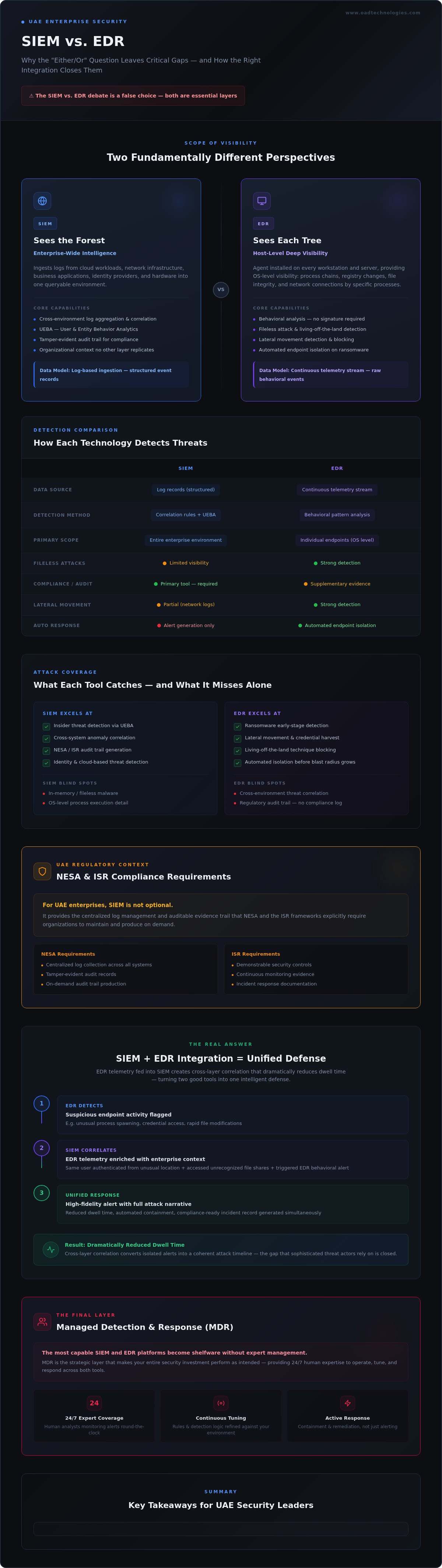
Before resolving the siem vs edr debate, it's worth being precise about what each technology actually does, because the confusion between them is often less about the tools themselves and more about how their fundamentally different scopes of visibility get conflated. One operates at the enterprise level, aggregating signals from across your entire environment. The other operates at the host level, embedding deep within individual endpoints to observe behavior that network-level tools simply cannot see. Both perspectives are necessary. Neither is redundant.
What is SIEM in the 2026 Landscape?
A modern SIEM platform functions as the central nervous system of enterprise security, ingesting log data from cloud workloads, network infrastructure, business applications, identity providers, and physical hardware into a single, queryable environment. That breadth of ingestion is what makes SIEM indispensable for compliance: it creates the centralized, tamper-evident audit trail that frameworks like NESA and the ISR require organizations to maintain and produce on demand.
What's changed significantly in recent years is the intelligence layer sitting on top of that log aggregation. User and Entity Behavior Analytics (UEBA) has become a core capability within leading SIEM platforms, enabling the detection of anomalous patterns that static correlation rules would never surface. Instead of simply alerting on a failed login threshold, a UEBA-enabled SIEM can identify that a specific user is authenticating at an unusual hour, from an unrecognized location, and accessing file shares they've never touched before. That contextual reasoning is what separates modern SIEM from the log repositories of a decade ago.
In short: SIEM is the primary tool for enterprise-wide threat correlation and compliance evidence, providing the organizational context that no other security layer can replicate.
What is EDR and Why It Focuses on the Host?
EDR takes a fundamentally different approach. Rather than aggregating logs from across the environment, an EDR agent installs directly on each workstation and server, giving security teams granular visibility into what's happening at the operating system level: process execution chains, registry modifications, file integrity changes, and network connections initiated by specific processes.
This depth matters enormously when defending against modern attack techniques. Traditional antivirus relied on signature matching, which means it could only stop threats it had already seen. EDR uses behavioral analysis, detecting suspicious sequences of activity regardless of whether the underlying malware has a known signature. That distinction is critical for stopping fileless attacks and living-off-the-land techniques that leave almost no trace in network logs.
EDR is also your primary defense against two of the most damaging attack patterns in the current threat landscape:
- Lateral movement: EDR detects when a compromised process attempts to enumerate network shares, harvest credentials, or spawn remote sessions across systems.
- Ransomware execution: Behavioral rules flag rapid, sequential file encryption activity and can trigger automated isolation of the affected endpoint before the blast radius expands.
The practical implication of the siem vs edr framing becomes clear here. SIEM sees the forest; EDR sees the individual trees, right down to the root system. A security architecture that relies on only one of these perspectives is, by definition, operating with incomplete information.
Operational Mechanics: How EDR and SIEM Detect Threats Differently
Knowing that SIEM and EDR serve different scopes is one thing. Understanding precisely how their detection engines work, and where each one breaks down without the other, is what separates a coherent security strategy from a collection of expensive tools. The distinction runs deeper than vendor marketing suggests, and it starts with the data itself.
Data Acquisition and Analysis Models
SIEM operates on log-based ingestion: it collects structured event records generated by firewalls, identity providers, cloud platforms, and business applications, then correlates them against detection rules and behavioral baselines. That historical depth is genuinely valuable. A SIEM can surface a slow-moving credential abuse campaign that unfolds over weeks by identifying statistical deviations from a user's established access patterns, something no real-time tool is positioned to catch.
EDR works differently at its core. The agent embedded on each host captures continuous telemetry: every process spawned, every registry key touched, every outbound connection initiated by a specific executable. This isn't a log in the traditional sense; it's a live behavioral record. When investigators need to reconstruct exactly how an attacker moved through a compromised workstation, that granular host telemetry functions as a forensic black box, providing a chain of evidence that log files simply don't contain.
For the siem vs edr comparison, this distinction matters operationally. SIEM excels at detecting complex, multi-stage attacks that cross system boundaries, such as a threat actor who compromises an email account, pivots to a cloud storage service, and exfiltrates data over three days. EDR excels at detecting localized endpoint threats in near real-time, typically within seconds of a malicious process executing, because it doesn't need to wait for log forwarding or correlation windows.
Response Capabilities: Automated vs. Orchestrated
The response models reflect the same architectural difference. An EDR platform can autonomously isolate a compromised host from the network and terminate malicious processes the moment behavioral thresholds are crossed, no analyst intervention required. That speed is critical when ransomware begins encrypting files; every second of delay expands the blast radius.
SIEM's response role is different in character. Rather than acting directly on endpoints, a well-configured SIEM triggers coordinated actions across multiple security layers simultaneously, revoking access tokens, updating firewall rules, and creating enriched incident tickets. This is where SIEM's orchestration capability becomes its defining advantage over point tools. SOAR (Security Orchestration, Automation, and Response) extends this further, acting as the connective tissue between SIEM detections and the downstream enforcement actions that contain a threat across your entire environment, not just on a single host.
Neither model replaces skilled human judgment. Automated responses reduce dwell time, but determining whether an isolated host represents a confirmed breach or a false positive, and deciding what happens next, still requires analyst expertise. That human-in-the-loop requirement is precisely why the tools that underpin your detection strategy need expert management to perform as designed.
SIEM vs. EDR: Strategic Prioritization for UAE Enterprises
Knowing what each technology does is only half the equation. The harder question, and the one most security guides sidestep entirely, is which one to prioritize when budget, headcount, and implementation capacity are finite. The answer isn't universal. It depends on three variables that vary significantly across UAE organizations: your dominant threat profile, your regulatory obligations, and the operational maturity of your security team.
Start with your threat landscape. An organization whose workforce is distributed across remote locations, relying on laptops and personal devices to access corporate systems, faces a fundamentally different risk profile than a financial institution managing sensitive data across a hardened on-premises network. The former is overwhelmingly exposed at the endpoint level. The latter faces insider threat and compliance audit risk that demands centralized log visibility. Getting this assessment wrong means investing heavily in the answer to the wrong question.
The Case for SIEM-First (Compliance-Driven)
For UAE enterprises operating under NESA or the Information Security Regulation (ISR), SIEM isn't a strategic preference; it's a compliance prerequisite. Both frameworks require organizations to maintain centralized, auditable log records across their environments and produce that evidence on demand during assessments. An EDR platform, however capable at the host level, cannot satisfy this requirement on its own.
SIEM-first also makes practical sense for organizations with significant cloud footprints or legacy network infrastructure. Cloud platforms generate enormous volumes of access and configuration events that only a SIEM can aggregate, correlate, and retain in a compliance-ready format. If your Governance, Risk and Compliance (GRC) obligations are your most immediate pressure point, SIEM provides the broadest coverage fastest. The tradeoff is that endpoint-level behavioral detection remains limited until EDR is layered in.
The Case for EDR-First (Threat-Driven)
Organizations without a dedicated SOC, or those navigating the siem vs edr decision with a lean security team, often find EDR delivers faster operational value. Deployment is scoped to endpoints rather than requiring organization-wide log source integration, which means time-to-detection is shorter and the configuration burden is lower at the outset.
EDR-first is particularly defensible for remote-first organizations where the traditional network perimeter no longer exists. When every employee device is effectively a network edge, protecting that edge directly is the highest-priority action. Phishing-initiated compromise, credential theft, and ransomware execution all originate at the endpoint, and EDR is the layer purpose-built to intercept them.
The honest framing here isn't SIEM or EDR. It's which one addresses your most acute risk first, with a clear roadmap to integrate the other. Organizations that treat this as a permanent binary choice rather than a sequenced investment strategy consistently find themselves with blind spots that mature threat actors know how to find.
The Power of Synergy: Integrating SIEM and EDR into a Unified Defense
Resolving the siem vs edr debate in favor of integration rather than selection isn't just a philosophical position; it's an architectural one. When EDR telemetry flows into your SIEM environment, the result is qualitatively different from either tool operating independently. You're no longer correlating logs from one layer and behavioral signals from another in separate consoles. You're building a unified detection surface where a suspicious process on a single endpoint can be instantly contextualized against identity events, network traffic anomalies, and cloud access patterns happening simultaneously across your organization.
That cross-layer correlation is what compresses dwell time. An EDR alert in isolation tells you a malicious process executed on a workstation. The same alert correlated inside your SIEM, against a concurrent spike in outbound data transfer and an unusual privileged account authentication, tells you you're likely watching active exfiltration. Those are two very different response postures, and the difference between them is the integration.
Blind spots close in both directions. SIEM surfaces threats that EDR cannot see: cloud misconfigurations, identity-based attacks traversing multiple SaaS platforms, and slow-burn credential abuse campaigns. EDR surfaces threats that SIEM cannot see: fileless malware executing entirely in memory, living-off-the-land techniques that generate no meaningful log entries, and process injection that bypasses traditional network-level detection entirely. Neither tool covers the other's gap. Together, they do.
This integration also underpins a functional Zero Trust architecture. Zero Trust requires continuous verification of every user, device, and connection. SIEM provides the organizational context to evaluate whether a request is consistent with established behavioral patterns. EDR provides the device-level assurance that the endpoint initiating that request hasn't been compromised. Strip either layer out, and Zero Trust becomes an assertion rather than a verified posture.
Step-by-Step Integration Roadmap
Effective integration follows a deliberate sequence rather than a single configuration event. Three steps define the path from parallel tools to unified defense:
- Normalize EDR telemetry for SIEM ingestion. EDR platforms generate high-volume, granular host data in proprietary formats. Before your SIEM can correlate this telemetry against network and identity logs, it must be normalized into a consistent schema. This typically involves configuring your EDR's API output or syslog forwarding to align with the data model your SIEM uses for field mapping. Without normalization, correlation rules produce false negatives because field values don't match across sources.
- Build unified dashboards for a single-pane-of-glass experience. Once telemetry is normalized, consolidate endpoint, network, and identity signals into role-specific dashboards. Analysts shouldn't be pivoting between consoles to reconstruct an attack chain. A unified view that surfaces EDR behavioral alerts alongside SIEM correlation findings reduces investigation time and lowers the cognitive load on lean security teams.
- Develop cross-functional incident response playbooks. Integration without documented response procedures creates a different kind of gap. Playbooks should define exactly which SIEM correlation rule triggers an EDR isolation action, who approves escalation, and how evidence is preserved across both platforms for post-incident forensics and compliance reporting.
Enhancing Data Loss Prevention (DLP)
Integration delivers particularly compelling value when mapped to data protection objectives. EDR monitors file movement at the endpoint level: which process accessed a sensitive file, whether it was compressed or renamed before being written to a removable drive, and whether that behavior deviates from the user's established patterns. SIEM tracks data egress at the network boundary: large outbound transfers to unfamiliar destinations, protocol anomalies, and cloud storage uploads outside business hours.
Individually, each signal is useful but incomplete. A large upload to a personal cloud storage account might not trigger an EDR alert if no malicious process was involved. But when that network event is correlated inside your SIEM against an EDR record showing the same user had bulk-copied files from a sensitive share thirty minutes earlier, the combined picture is unambiguous. This is precisely how integrated SIEM and EDR telemetry strengthens a broader Data Loss Prevention (DLP) strategy, by linking endpoint behavior to network-level enforcement in a way that neither layer can achieve independently.
For UAE enterprises where data sovereignty and regulatory accountability are active compliance pressures, this integrated DLP visibility isn't a feature enhancement. It's a governance requirement. Speak with OAD Technologies about building an integrated SIEM and EDR architecture tailored to your environment.
Beyond Tools: Why Managed Detection and Response (MDR) is the Final Piece
There's a pattern that repeats itself across enterprises that have invested seriously in security technology: the tools are capable, the licenses are paid, and the alerts are firing. But without the expertise to tune detection rules, investigate findings, and respond with precision, even the most sophisticated SIEM and EDR platforms drift toward shelfware. The technology doesn't fail. The operational model around it does.
This is the gap that Managed Detection and Response (MDR) is designed to close. MDR isn't a product layered on top of your existing stack; it's the expert-managed operational layer that makes your entire security investment perform as designed. When you're resolving the siem vs edr question and landing on integration as the answer, MDR is what transforms that integrated architecture from a theoretical advantage into a functioning defense.
OAD Technologies approaches this differently from a traditional MSSP. The focus isn't on tool-vending or handing clients a dashboard and walking away. It's on strategic partnership: understanding the specific threat profile, compliance obligations, and operational constraints of each UAE enterprise, then configuring, managing, and continuously refining the SIEM and EDR environment to match. That distinction matters when your regulatory exposure under NESA or the ISR requires defensible evidence of active security management, not just licensed software.
The Role of Human Insight in Threat Hunting
AI-driven detection has advanced considerably, but it remains a pattern-matching engine. It identifies deviations from what it has been trained to recognize. Skilled security analysts do something fundamentally different: they reason about attacker intent, construct hypotheses about where a threat actor might be hiding within the environment, and pursue those hypotheses through the integrated telemetry that SIEM and EDR together provide. OAD's threat hunting methodology is built on this proactive posture, using cross-layer behavioral signals to surface threats that automated detection hasn't yet learned to flag. The result is a defense that combines the processing scale of technology with the contextual judgment that only human expertise delivers.
Future-Proofing Your Security Stack
Reactive monitoring catches threats after they've materialized. Proactive resilience means validating your detection architecture before an attacker does. Regular Vulnerability Assessment and Penetration Testing (VAPT) serves exactly this function: it stress-tests your SIEM correlation rules and EDR behavioral controls against real attack techniques, surfacing configuration gaps and detection blind spots in a controlled environment rather than during an active incident.
For UAE enterprises, this validation cycle isn't optional. The threat landscape evolves continuously, and a security stack tuned to last year's attack patterns offers diminishing returns against current techniques. Building VAPT into your security calendar ensures your integrated SIEM and EDR environment keeps pace with the threats it's designed to stop.
The path from tool investment to genuine resilience is navigable. It requires the right architecture, the right expertise, and a partner committed to your long-term security posture rather than your next renewal. Partner with OAD Technologies for a customized SIEM and EDR strategy built around your environment, your compliance obligations, and your specific risk profile.
Your Next Move in Building a Resilient Security Architecture
The siem vs edr debate ultimately resolves to a straightforward conclusion: it's not a choice you should be making. SIEM delivers the enterprise-wide visibility and audit-ready compliance evidence that UAE regulatory frameworks demand. EDR delivers the host-level behavioral detection that stops threats before they spread. Integrated and expertly managed, they create a defense that neither tool achieves independently.
Three principles carry through everything covered here. First, your threat profile and compliance obligations should drive sequencing, not vendor preference. Second, integration between SIEM and EDR is where genuine resilience is built. Third, the technology only performs as well as the expertise managing it.
OAD Technologies brings UAE-specific compliance knowledge, strategic MDR capabilities, and VAPT integration to help your security investment deliver measurable results rather than mounting complexity. The architecture is achievable. The expertise is available.
Secure your enterprise with OAD Technologies' Managed SIEM and EDR solutions and build a security posture that's genuinely ready for what comes next.
Frequently Asked Questions: SIEM vs. EDR
Can EDR replace a SIEM for compliance purposes?
No, EDR cannot replace a SIEM for compliance purposes. UAE frameworks like NESA and the ISR require centralized log aggregation across your entire environment, covering network infrastructure, cloud workloads, identity providers, and business applications. EDR only captures host-level telemetry from enrolled endpoints. That scope is too narrow to satisfy audit requirements that demand organization-wide, tamper-evident log retention and on-demand evidence production.
Is SIEM or EDR more effective against ransomware?
EDR is your primary defense against ransomware execution. It detects the behavioral signature of rapid, sequential file encryption in near real-time and can autonomously isolate the affected endpoint before the attack spreads. SIEM contributes at a different stage: it correlates the precursor signals that often precede ransomware deployment, such as unusual credential activity or lateral movement across systems, giving analysts the opportunity to intervene before encryption begins.
Do I need a SIEM if I'm using a cloud-native EDR solution?
Yes. Cloud-native EDR solutions offer improved scalability and deployment flexibility, but they don't change the fundamental scope limitation: they observe endpoint behavior, not the broader environment. Your cloud platform configuration events, SaaS application access logs, and network traffic anomalies remain invisible to EDR regardless of its delivery model. A SIEM is still required to aggregate and correlate those signals into a coherent, compliance-ready picture.
How does the SIEM vs. EDR decision impact my UAE ISR compliance status?
Choosing EDR exclusively creates a direct compliance gap under the ISR. The framework requires demonstrable controls around log management, incident detection, and audit trail integrity across the organization, not just at the endpoint layer. Deploying SIEM addresses those requirements directly. EDR strengthens your overall security posture and supports incident response obligations, but it doesn't substitute for the centralized visibility the ISR mandates. Both tools contribute to compliance; neither satisfies it alone.
What is the typical deployment time for a managed SIEM vs. EDR?
EDR deployments typically move faster because scope is limited to enrolling endpoint agents, which can often be completed across an organization within days to a few weeks depending on fleet size. Managed SIEM deployments take longer because they require integrating log sources across diverse systems, normalizing data schemas, configuring correlation rules, and establishing baselines. A realistic SIEM deployment timeline for a mid-sized enterprise ranges from several weeks to a few months before it's producing reliable, tuned detections.
Can SIEM and EDR be managed by the same team?
What happens if my EDR agent is disabled by an attacker?
This is a real attack technique. Sophisticated threat actors actively attempt to tamper with or disable endpoint agents as an early step in an intrusion. When EDR is integrated with your SIEM, that tampering event itself becomes a detectable signal. The SIEM can correlate the sudden disappearance of telemetry from a specific host against concurrent authentication anomalies or network activity, flagging the silence as suspicious rather than treating it as a routine gap. This is one of the clearest arguments for integration over relying on either tool in isolation.
How does MDR integrate both SIEM and EDR?
MDR functions as the expert operational layer that makes SIEM and EDR work as a unified defense rather than parallel tools. A managed detection and response provider handles the technical configuration that enables EDR telemetry to flow into the SIEM environment, builds the cross-layer correlation rules that surface meaningful threats, and provides the analyst expertise to investigate and respond to findings across both platforms. For UAE enterprises, this integration model also ensures that the evidence generated across both tools meets the documentation standards required during regulatory assessments.
Disclaimer
Content by OAD Technologies is for general informational purposes only and does not constitute professional or cybersecurity advice. No warranties are made regarding accuracy or completeness; reliance is at your own risk. OAD Technologies shall not be liable for any direct or indirect losses arising from use of this content.