
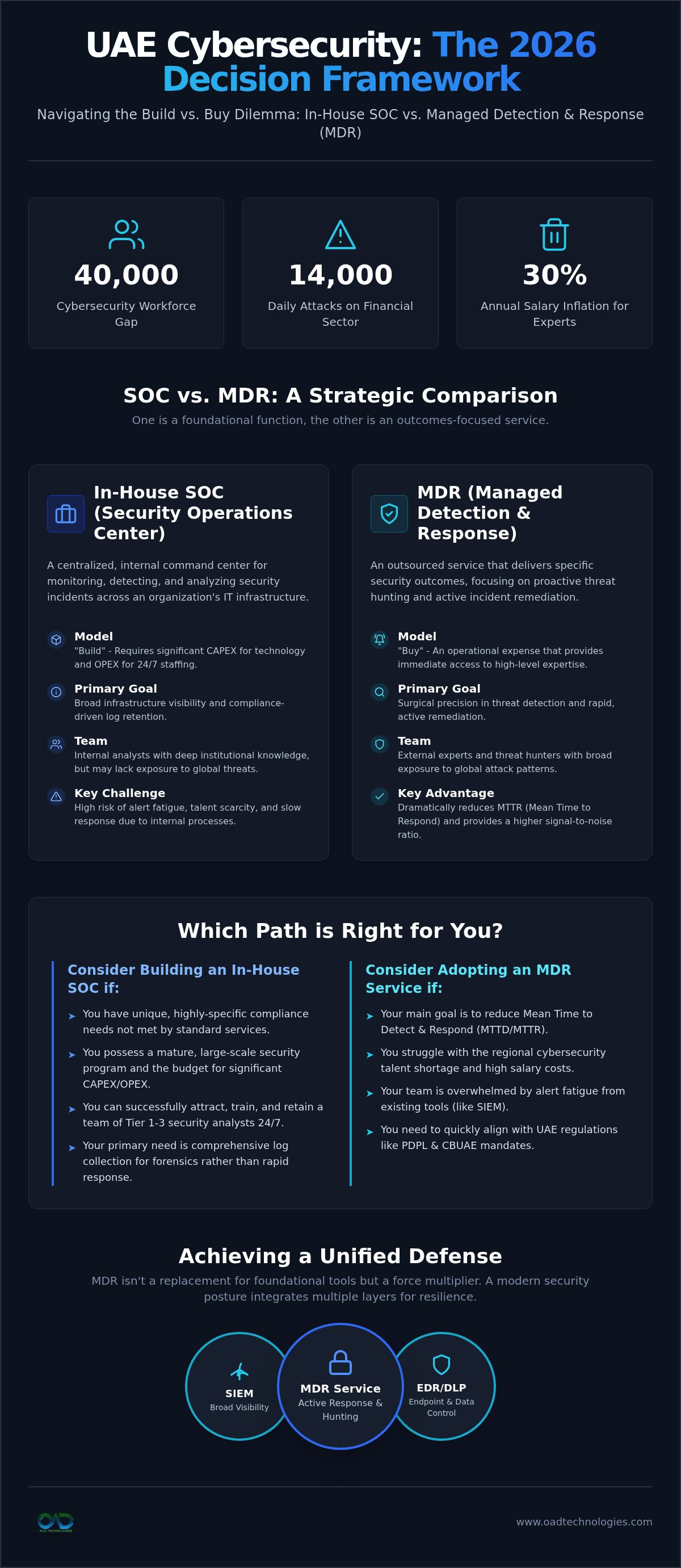
The UAE currently faces a cybersecurity workforce gap of up to 40,000 professionals, a shortage that has driven annual salary inflation for qualified experts to 30%. You've likely realized that simply purchasing tools isn't enough when your team is battling alert fatigue and struggling to meet the CBUAE's latest mandates. The central question for 2026 isn't just about which software to buy, but how to deploy a sustainable capability. When evaluating mdr vs siem, it's vital to recognize that one is a delivery model while the other is a foundational technology.
We understand the complexity of navigating over 12 overlapping regulatory frameworks while trying to lower your capital expenditure. This article provides a strategic comparison between a traditional Security Operations Center (SOC) and Managed Detection and Response (MDR) to help you choose the optimal path for your organization. You'll discover a clear decision framework for the "Build vs. Buy" dilemma and learn how to align with UAE national standards. We'll also explore how to drastically reduce your mean time to detect and respond by bridging the gap between human insight and automated precision. By the end, you'll have a roadmap to secure your digital evolution without the burden of managing a massive internal infrastructure.
Key Takeaways
- Identify the core functional differences between an internal SOC and a managed service to effectively address the regional cybersecurity talent shortage.
- Analyze the technical architecture of mdr vs siem to decide between broad infrastructure visibility and deep, specialized threat response capabilities.
- Align your security operations with UAE PDPL requirements and CBUAE mandates to ensure regulatory compliance and meet strict incident notification timelines.
- Apply a strategic framework to determine the right balance between building in-house and outsourcing based on your organization's risk profile.
- Explore how a unified defense strategy combining SIEM, EDR, and DLP creates a more resilient security posture than relying on siloed tools.
The Cybersecurity Crossroads: Understanding the SOC vs. MDR Distinction
The ongoing conversation regarding mdr vs siem often misses a fundamental point: these aren't necessarily rival technologies. A Security Operations Center (SOC) represents a centralized organizational function, whereas Managed Detection and Response (MDR) is an outcomes-focused service. In 2026, the UAE threat landscape has evolved beyond simple malware; it's a space where the financial sector weathers 14,000 attacks every day. Traditional log-only SOCs are failing to keep pace because modern attackers use AI-assisted methods that don't always leave obvious footprints in standard logs, making reactive monitoring obsolete.
The Traditional SOC: A Centralized Security Hub
A Security Operations Center (SOC) functions as the command center for your digital environment. It relies on a delicate balance of people, processes, and technology, often centered around a SIEM or EDR stack. The primary goal is maintaining total visibility across the enterprise. However, the "Build" model presents steep challenges. The CAPEX required for hardware and the OPEX for 24 X 7 staffing are often prohibitive. In the UAE, where the cybersecurity talent gap is estimated at 30,000 to 40,000 professionals, finding Tier 2 and Tier 3 analysts is increasingly difficult. This scarcity often leads to alert fatigue, where critical threats are buried under a mountain of false positives.
The Rise of MDR: Outcomes-Based Security
Managed detection and response represents a shift in strategy. Instead of just providing a platform for your team to use, managed detection and response delivers specific security outcomes. It moves the needle from passive alerting to active remediation. A core component of this service is proactive threat hunting. Experts don't wait for a SIEM to trigger an alarm; they actively search for indicators of compromise that automated tools might miss. For mid-to-large UAE enterprises, MDR serves as a fast-track to maturity. It provides immediate access to high-level expertise without the overhead of internal recruitment. When evaluating mdr vs siem, remember that MDR often utilizes SIEM technology as a tool to achieve its response-driven goals, acting as a force multiplier for your existing security investments. This approach even allows an existing internal SOC to function more effectively by becoming a client of a specialized service provider.
Architectural Differences: How SOC and MDR Functions Diverge
Choosing between mdr vs siem often comes down to the desired depth of analysis versus the breadth of visibility. While a traditional Security Operations Center (SOC) aims for a comprehensive view of the entire enterprise, Managed Detection and Response (MDR) focuses on the surgical precision of threat detection. Gartner defines managed detection and response as a service that provides customers with modern, remotely delivered security operations center capabilities. The primary architectural split lies in the technology stack. A SOC is typically built around a customized SIEM integration, whereas MDR often utilizes proprietary platforms designed specifically for rapid telemetry analysis.
The human element also differs significantly. An internal SOC team possesses deep institutional knowledge but may lack the specialized exposure to global threat patterns that external hunters provide. In an MDR model, the service provider doesn't just alert your team; they execute the remediation. This shift in accountability ensures that incident response happens in minutes rather than hours, circumventing the internal bureaucracy that often slows down a traditional SOC.
Data Ingestion and Analysis Models
A traditional SOC relies heavily on diverse log sources to satisfy compliance-driven data retention requirements. This approach creates a massive volume of data that can obscure actual threats. MDR prioritizes high-fidelity telemetry from EDR, network sensors, and cloud security tools to identify active attacks. MDR delivers a significantly higher signal-to-noise ratio by focusing on actionable intelligence rather than exhaustive log collection. Much like how AirXPro Global Air Treatment Devices filter out microscopic pollutants to ensure a healthy physical environment, MDR filters through digital noise to protect your organization's integrity. This architectural focus allows analysts to spend more time on remediation and less time sorting through false positives.
The Integration of DLP and Identity
Managing the broader identity and access management (IAM) landscape is a core function of a centralized SOC. However, MDR plays a critical role in detecting sophisticated exfiltration attempts that frequently bypass standard data loss prevention (DLP) rules. By creating a synergy between specialized DLP policies and managed response workflows, organizations can stop unauthorized data movement before it leaves the network. This integrated approach is essential for UAE enterprises looking to optimize their security architecture while maintaining strict regulatory compliance. The collaboration between human insight and technological capacity ensures that even the most subtle deviations in user behavior are flagged and investigated.
Navigating the UAE Landscape: Talent Gaps and Regulatory Pressure
The UAE cybersecurity market has reached a valuation of approximately USD 1.2 billion, yet capital alone can't solve the region's most pressing issue: the talent shortage. With a workforce gap of up to 40,000 professionals, 40% of UAE organizations report they simply can't find the skilled analysts required to staff a 24 X 7 internal SOC. This scarcity has triggered a 20% to 30% annual salary inflation for qualified experts, making the traditional "Build" model financially unsustainable for many. When evaluating mdr vs siem, enterprises must consider if they can realistically recruit and retain a three-shift team to monitor logs effectively in such a competitive climate.
Strategic leaders are looking beyond the tools to the key differences between SOC and MDR regarding operational resilience. While a SIEM provides a necessary data repository, it requires constant tuning and oversight that an understaffed team can't provide. MDR bridges this gap by delivering an outcome-based service that operates independently of your internal HR constraints, shifting the burden from CAPEX to a predictable OPEX model.
The Talent Crisis: A Strategic Impetus for MDR
Achieving 24 X 7 coverage with an internal team requires at least 8 to 12 full-time analysts to account for rotations, leave, and burnout. For most UAE enterprises, this represents a massive investment in recruitment and ongoing training. MDR shouldn't be viewed as a replacement for your existing IT team; it acts as a strategic partner. It allows your internal staff to focus on high-level digital evolution while external threat hunters handle the relentless noise of daily alerts. To justify this transition to executive leadership, you can learn more about ZANGAARD and their comprehensive guide on building a business case for IT outsourcing. Integrating findings from regular VAPT exercises into your detection rules ensures that your managed response is tuned to your specific environmental weaknesses.
The UAE Personal Data Protection Law (PDPL) and various sector-specific mandates from the CBUAE have tightened incident notification timelines significantly. Meeting these requirements is nearly impossible without the continuous monitoring capabilities that MDR provides. Aligning your security operations with governance risk and compliance (GRC) objectives becomes a streamlined process when using a managed model. The reporting generated by these services provides the audit-ready documentation needed to prove ongoing oversight to regulators. GRC consulting can help you determine the specific service levels required to meet national standards, turning compliance from a mandatory hurdle into a genuine trust-builder for your clients.
Building Your Roadmap: When to Choose SOC, MDR, or a Hybrid Model
The roadmap to cyber resilience in the UAE isn't a one-size-fits-all path. Your choice depends on the complexity of your digital footprint, especially as 70% of local businesses migrate to cloud services. This shift requires a strategy that goes beyond simple perimeter defense. When analyzing mdr vs siem, you must weigh your existing investment in legacy infrastructure against the need for rapid, modern response capabilities. Organizations shouldn't view these as mutually exclusive; they're stages on a maturity curve that often lead to a integrated hybrid model.
For financial institutions, the June 30, 2026, deadline for the first CBUAE digital impersonation risk assessment adds a layer of urgency. Your decision framework should prioritize the speed of deployment and the ability to meet these specific regulatory milestones. While a retail firm might prioritize uptime and fraud prevention, a government entity might focus on data sovereignty and absolute control over log ingestion.
The Case for an In-House SOC
An in-house Security Operations Center is the right choice when highly specialized, proprietary legacy systems require deep internal knowledge that an external provider cannot easily replicate. This model offers total control over data residency and sensitive log handling, which is critical for entities managing classified national data. For UAE entities, the choice between an in-house SOC and MDR often hinges on the trade-off between total administrative control and the immediate operational capability required to survive a modern threat landscape. If your organization has already invested heavily in a customized SIEM and has the luxury of a stable, veteran security team, maintaining an internal hub ensures that security remains deeply woven into your specific business logic.
The Case for Managed Detection and Response
Managed Detection and Response offers rapid time-to-value for organizations that need to scale their security maturity overnight. It provides access to global threat intelligence and advanced hunting techniques that an internal team, focused on daily operations, simply cannot replicate. By outsourcing the relentless task of alert triage, you allow your internal resources to focus on business-enabling technology and strategic digital evolution. This is particularly effective for enterprises that have moved to cloud-native environments and need specialized expertise to manage the resulting increase in attack surface. To determine which path best suits your current infrastructure, consult with our security architects for a customized assessment. A hybrid approach often emerges as the winner, where MDR provides the "eyes-on-glass" 24 X 7 monitoring while your internal SOC leads the high-level strategic response and policy definition.
OAD Technologies: Bridging the Gap Between Detection and Resilience
OAD Technologies acts as a strategic architect for UAE enterprises seeking alignment with national security standards. We recognize that the debate over mdr vs siem shouldn't result in a fragmented defense. Instead, we integrate SIEM, EDR, and MDR into a unified ecosystem where each component serves a specific strategic purpose. While a SIEM provides the necessary visibility for compliance, our MDR service delivers the operational response needed to survive modern attacks. By evaluating the technical trade-offs of mdr vs siem through the lens of business outcomes, we help you build a roadmap that balances cost with absolute capability. We champion a DLP-First approach because we believe threat detection is fundamentally incomplete if it doesn't prioritize the protection of your most sensitive digital assets.
Unified Security Operations in the UAE
Our methodology extends into cloud security posture management (CSPM), ensuring that your migration to the cloud doesn't create unmonitored blind spots. We bridge the gap between technical threat data and executive-level GRC reporting, translating complex security telemetry into actionable business risk assessments. Our MDR workflows are specifically tuned for UAE business hours and the unique tactics used by regional threat actors. This localized expertise ensures that your defense isn't just a generic template but a customized shield designed for the specific pressures of the Middle Eastern market. We focus on creating a steady rhythm of communication that keeps your leadership informed without overwhelming them with technical noise.
Securing the Future of Your Digital Assets
True resilience requires moving beyond reactive measures. We combine continuous monitoring with proactive brand and data protection to secure your long-term digital relevance. By integrating the insights from recurring VAPT cycles into our managed environments, we ensure that your detection rules evolve as fast as the vulnerabilities they're meant to guard. This synergy between human insight and technological capacity allows your team to focus on growth while we act as the guardians of your infrastructure. We reject standardized approaches in favor of individualized solutions that respect your organization's unique risk tolerance. The first step toward an optimized security posture is a thorough gap analysis of your current delivery model. Consult with OAD Technologies on your security strategy to discover how a unified approach can reduce your operational risk and satisfy the most stringent regulatory requirements in the UAE.
Future-Proofing Your Enterprise Defense
The choice between building an internal SOC and adopting a managed service is a strategic investment in your organization's long-term viability. We've analyzed how the UAE talent gap and strict PDPL notification timelines make the traditional "Build" model increasingly difficult to sustain. While the architectural debate of mdr vs siem highlights the need for both visibility and response, the most resilient enterprises integrate these functions into a unified defense strategy. This approach ensures you meet CBUAE mandates while reducing the operational burden on your internal staff.
OAD Technologies brings specialized UAE GRC and PDPL expertise to every engagement. We don't just provide tools; we act as a national strategic cybersecurity partner by delivering integrated MDR, DLP, and SIEM solutions that empower your people rather than merely replacing processes. It's time to move beyond reactive defense and start actively shaping your digital future. We're ready to help you design a system that ensures your ongoing relevance in an ever-changing market.
Optimize Your Security Posture with OAD Technologies
Frequently Asked Questions
What is the primary difference between a SOC and MDR?
The primary difference is that a SOC is a centralized organizational function or facility, while MDR is an outcomes-focused service. A SOC provides broad visibility across the entire enterprise, often managing diverse tools and compliance logs. MDR focuses on deep threat detection and active remediation. While a SOC acts as a command center, MDR delivers the specialized human expertise and technology required to hunt for and neutralize threats in real time.
Can an MDR service replace my entire internal security team?
MDR is designed to augment your team rather than replace it. It handles the 24 X 7 alert monitoring and triage that typically leads to analyst burnout. By offloading these repetitive tasks, your internal security professionals can focus on high-level strategy, digital evolution, and internal policy development. This partnership bridges the regional talent gap by providing immediate access to Tier 2 and Tier 3 analysts who act as a specialized extension of your staff.
How does MDR help with UAE PDPL compliance?
MDR services facilitate compliance by providing continuous monitoring and rapid incident notification capabilities. The UAE Personal Data Protection Law (PDPL) requires strict timelines for identifying and reporting data breaches. MDR providers ensure you have the audit-ready documentation and forensic telemetry needed to prove ongoing oversight. By maintaining a steady rhythm of detection and response, you demonstrate the technical and organizational measures required by federal regulators to protect sensitive personal data.
Do I need a SIEM if I already have an MDR provider?
It depends on your specific regulatory requirements and data retention needs. When evaluating mdr vs siem, remember that a SIEM acts as a long-term data repository for all enterprise logs. While many MDR providers utilize their own telemetry tools for detection, you might still require a SIEM for historical archiving or to ingest data from legacy systems. Often, the most resilient strategy involves using both in a complementary fashion.
Is MDR more cost-effective than building an in-house SOC in the UAE?
For most UAE enterprises, MDR is significantly more cost-effective than building an in-house SOC. Recruiting enough analysts for 24 X 7 coverage requires at least 8 to 12 full-time employees, which is difficult given the 30% annual salary inflation in the local market. MDR shifts these high CAPEX and recruitment costs into a predictable OPEX model. This allows you to access enterprise-grade security without the overhead of maintaining a massive internal infrastructure.
How does MDR integrate with existing Data Loss Prevention (DLP) tools?
MDR integrates with Data Loss Prevention (DLP) tools by acting as the response engine for exfiltration alerts. While DLP software identifies unauthorized data movement, MDR analysts investigate the context behind the trigger. This synergy ensures that legitimate business processes aren't interrupted while sophisticated data theft attempts are neutralized instantly. By combining managed response with specialized DLP policies, organizations create a more robust layer of protection for their sensitive corporate assets and intellectual property.
Can MDR protect multi-cloud environments like Azure or AWS?
Modern MDR services are cloud-native and protect multi-cloud environments including Azure, AWS, and Google Cloud. They utilize API-based integrations and specialized monitoring to identify misconfigurations or unauthorized access across diverse platforms. This provides a unified view of your security posture, ensuring that your migration to the cloud doesn't create fragmented visibility. When comparing mdr vs siem in the cloud, MDR often provides deeper, platform-specific insights that traditional log-based tools might miss.
What is the Hybrid SOC model and is it right for my business?
The Hybrid SOC model combines an internal security team with an external MDR partner. It's often the ideal choice for UAE enterprises that want to maintain strategic control while outsourcing 24 X 7 "eyes-on-glass" monitoring. Your internal team focuses on incident management and internal policy while the MDR partner handles proactive threat hunting and initial triage. This model offers the best balance of institutional knowledge and specialized global threat intelligence for organizations with complex digital footprints.
Disclaimer
Content by OAD Technologies is for general informational purposes only and does not constitute professional or cybersecurity advice. No warranties are made regarding accuracy or completeness; reliance is at your own risk. OAD Technologies shall not be liable for any direct or indirect losses arising from use of this content.