

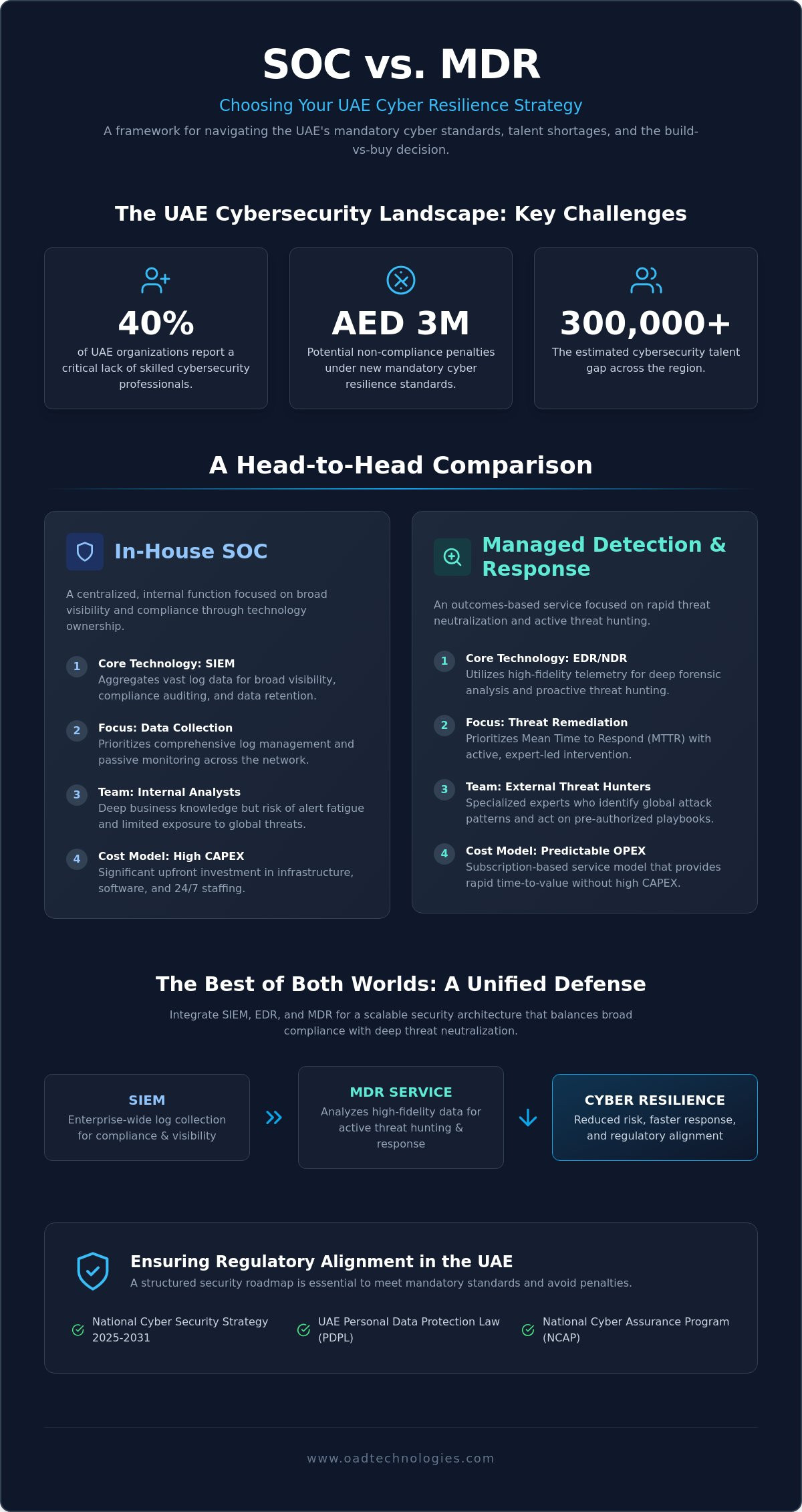
With 40% of UAE organizations currently reporting a critical lack of skilled cybersecurity professionals, the dream of building a fully staffed, 24 X 7 internal Security Operations Center is becoming an expensive impossibility for many. You've likely found yourself weighing the technical merits of mdr vs siem as you navigate the new mandatory cyber resilience standards under the National Cyber Security Strategy 2025-2031. It's a high-stakes decision when non-compliance penalties can reach AED 3,000,000 and the regional talent gap exceeds 300,000 specialists.
We understand that balancing high CAPEX for tooling with the need for rapid incident response feels like an uphill battle. This guide promises to provide a clear decision framework for the build vs. buy dilemma, ensuring your security architecture aligns with UAE PDPL and NCAP requirements. We'll compare the operational depth of a SOC against the agility of Managed Detection and Response to help you reduce your mean time to detect and respond while maintaining long-term digital relevance in an increasingly regulated market.
Key Takeaways
- Distinguish between the SOC as a centralized organizational function and MDR as a specialized, outcomes-based security service.
- Analyze the technical trade-offs of mdr vs siem to choose between comprehensive log management and deep, proactive threat detection.
- Address the acute UAE cybersecurity talent gap by leveraging external expertise to reduce mean time to detect and respond.
- Ensure regulatory alignment with the UAE’s mandatory cyber resilience standards and PDPL enforcement through a structured security roadmap.
- Discover how to integrate SIEM, EDR, and MDR into a unified defense strategy that scales with your organization’s digital evolution.
The Cybersecurity Crossroads: Understanding the SOC vs. MDR Distinction
UAE enterprises face a shifting regulatory tide as we move through 2026. With the National Cyber Security Strategy 2025-2031 now mandating cyber resilience across critical sectors, the conversation often begins with a technical comparison of mdr vs siem. However, viewing this as a simple binary choice misses the strategic nuance required for modern defense. A Security Operations Center (SOC) represents a centralized organizational function, while Managed Detection and Response (MDR) is a specialized, outcomes-focused service model. They aren't necessarily rivals; they are complementary capabilities that address different layers of the security stack.
In the 2026 threat landscape, traditional log-only SOCs are struggling to keep pace. With over 70% of Middle Eastern enterprises reporting at least one ransomware attack annually, simply collecting data is no longer enough. Attackers now leverage AI to accelerate their lateral movement, making the slow, reactive nature of legacy monitoring obsolete. Organizations need a shift from passive observation to active, high-fidelity intervention to meet the stringent notification timelines mandated by the UAE Personal Data Protection Law (PDPL).
The Traditional SOC: A Centralized Security Hub
The classic SOC model relies on a rigorous triad of people, processes, and technology. It functions as the enterprise's central nervous system, utilizing a customized SIEM to aggregate logs from every corner of the network. While this provides broad visibility and supports complex compliance auditing, the "Build" model carries heavy burdens. High CAPEX for infrastructure and the ongoing challenge of 24 X 7 staffing in a market where 40% of organizations report a talent shortage make the traditional in-house SOC a difficult target for many local firms.
The Rise of MDR: Outcomes-Based Security
MDR transforms security from a department you manage into a result you consume. Instead of focusing on the volume of alerts, managed detection and response prioritizes rapid remediation and active threat hunting. This model is particularly effective for UAE enterprises that need to mature their security posture quickly without the multi-year lead time required to build an internal team. By focusing on Mean Time to Respond (MTTR), MDR provides a direct path to resilience, ensuring that when a threat bypasses initial perimeters, a team of experts is already positioned to neutralize it before it impacts operations.
Architectural Differences: How SOC and MDR Functions Diverge
While a Security Operations Center (SOC) provides the wide-angle lens necessary for enterprise-wide visibility, Managed Detection and Response (MDR) offers the high-resolution zoom required to neutralize sophisticated threats. The debate around mdr vs siem often ignores these architectural nuances. A SOC typically centers its operations on a customized SIEM, ingesting vast quantities of logs to satisfy compliance and auditing requirements. In contrast, MDR platforms are built for forensic depth, prioritizing high-fidelity telemetry over raw log volume.
The distinction extends to the human element. Internal SOC analysts possess deep knowledge of your organization's specific business logic, yet they often face alert fatigue. MDR teams operate as specialized external threat hunters who identify global attack patterns before they reach your perimeter. This difference becomes critical during incident response. In a traditional SOC model, the internal team usually retains remediation authority, which can lead to delays. MDR providers often have pre-authorized playbooks to execute immediate containment, such as isolating a compromised workstation within the UAE while your local IT team is still reviewing the initial alert.
Data Ingestion and Analysis Models
A SOC relies on diverse log sources to ensure broad coverage, which is essential for meeting the data retention mandates of the UAE PDPL. MDR shifts this focus toward high-fidelity telemetry from EDR, NDR, and Cloud Security tools. By prioritizing actionable data over exhaustive logging, MDR architectures significantly improve the signal-to-noise ratio by filtering out the routine log chatter that often buries critical indicators of compromise in a standard SIEM. This streamlined approach allows analysts to focus on genuine threats rather than administrative noise.
The Integration of DLP and Identity
Modern defense requires a sophisticated approach to identity and access management. While a SOC manages the broader IAM landscape, MDR plays a vital role in detecting exfiltration attempts that bypass standard data loss prevention rules. For example, if a user accesses sensitive financial data using valid credentials but from an unusual geolocation, MDR hunters can intervene where static DLP policies might fail. This synergy ensures that your data remains protected even when identity is compromised. If you're looking to refine your architectural strategy, you can explore our specialized security integrations to see how these functions align with your goals.
Navigating the UAE Landscape: Talent Gaps and Regulatory Pressure
The decision between mdr vs siem isn't just a technical choice; it's a strategic response to the regional labor market. As of early 2026, 40% of UAE organizations report a critical shortage of skilled cybersecurity professionals. This talent gap, part of a wider MENA shortfall of over 300,000 specialists, makes hiring and retaining Tier 2 and Tier 3 analysts nearly impossible for most individual enterprises. When you consider that a functional SOC requires a substantial team to provide true 24 X 7 coverage, the internal "Build" model often collapses under the weight of recruitment costs and high staff turnover.
This struggle to source qualified personnel is a recurring theme across all security sectors. In the physical security domain, for instance, professional standards are upheld through accredited training like the QQI Level 4 Guarding Skills course Ireland, which provides a structured pathway for entering the workforce—a model of certification that the cybersecurity industry is increasingly emulating to solve its own personnel shortages.
Regulatory pressure further complicates this landscape. The UAE Personal Data Protection Law (PDPL) and the National Cyber Security Strategy 2025-2031 have shifted the goalposts from voluntary best practices to mandatory resilience. Under these frameworks, notification timelines for breaches are aggressive. Failing to detect and report an incident within the required window can lead to penalties ranging from AED 100,000 to AED 3,000,000. MDR provides the constant, vigilant monitoring necessary to meet these legal obligations, converting what would be a massive CAPEX investment in facility and staff into a predictable OPEX partnership.
The Talent Crisis: A Strategic Impetus for MDR
Maintaining a 24 X 7 security posture internally requires a revolving door of specialized talent that many Dubai and Abu Dhabi firms simply can't sustain. MDR serves as a force multiplier, augmenting your existing IT team rather than replacing them. This partnership allows your internal staff to focus on business-aligned projects while external experts handle the relentless tide of alerts. To maximize this efficacy, results from regular VAPT exercises should directly inform your detection rules, ensuring that known vulnerabilities are prioritized within the managed response workflow.
Compliance as a Competitive Advantage
Modern security operations must align with broader governance risk and compliance objectives to be truly effective. MDR reporting provides the granular evidence of continuous monitoring that auditors demand under the National Cyber Accreditation Programme (NCAP) rolling out throughout 2026. By utilizing GRC consulting to bridge the gap between technical alerts and regulatory requirements, enterprises can transform their security posture into a trust-builder for government contracts and international partnerships. This structured approach ensures that every security investment contributes directly to your organization's long-term digital relevance.
Building Your Roadmap: When to Choose SOC, MDR, or a Hybrid Model
Many organizations find that a hybrid model offers the most resilient posture. In this scenario, an external partner provides the 24 X 7 "eyes-on-glass" monitoring and threat hunting, while your internal SOC focuses on high-level strategy, policy orchestration, and business-specific risk management. This approach allows you to leverage global threat intelligence without losing the localized context that only your internal team can provide. It's a way to scale your defenses without the prohibitive costs of building a massive internal department from scratch.
The Case for an In-House SOC
An internal SOC remains a viable option for large-scale entities with highly specialized proprietary systems that require deep, institutional knowledge to manage. This model offers total control over data residency, ensuring that sensitive logs never leave your physical or virtual perimeter. For UAE entities prioritising absolute sovereignty over every byte of security telemetry, the internal SOC provides a level of control that can outweigh the immediate capability gains of an outsourced model.
The Case for Managed Detection and Response
MDR is the logical choice for organizations seeking rapid time-to-value and immediate access to advanced security maturity. It grants your team access to global threat intelligence and specialized hunting techniques that are nearly impossible to replicate with a local internal team. By offloading the burden of alert triage, you empower your internal resources to focus on business-enabling technologies rather than getting buried in the noise of mdr vs siem technical logs. If you're ready to define your own path toward resilience, you can consult with our strategic security architects to build a customized roadmap.
OAD Technologies: Bridging the Gap Between Detection and Resilience
OAD Technologies acts as a master designer of security systems, moving beyond the binary choice of mdr vs siem to build a unified defense architecture. We recognize that for UAE enterprises, national security alignment isn't just about technical checkboxes; it's about maintaining digital relevance in a market governed by the 2025-2031 National Cyber Security Strategy. Our approach integrates SIEM for comprehensive visibility, EDR for endpoint control, and MDR for active response into a single, cohesive ecosystem. This strategy ensures that your organization isn't just reacting to threats but is actively shaping its own digital resilience through rigorous engineering standards.
Crucially, we advocate for a DLP-first methodology. Detection capabilities lose their value if they aren't directly shielding your most critical intellectual property and personal data. By anchoring our managed response in robust data loss prevention, we ensure that every alert handled by our team is prioritized based on the actual risk to your corporate assets. This focus on asset protection grounds our technology in business reality, focusing on investment returns and operational performance rather than just technical metrics. It's a proactive, solution-oriented mindset that values long-term success over quick technical fixes.
Unified Security Operations in the UAE
Our team specializes in cloud security posture management, ensuring your hybrid environments remain compliant with local data residency laws. We bridge the technical gap between low-level detection and executive-level GRC reporting, providing the clarity board members need to understand their risk exposure. Because we understand the local landscape, our MDR workflows are specifically tuned for UAE business hours and the unique tactics used by regional threat actors. This localized expertise allows us to act as an extension of your own team, providing a reliable, forward-thinking presence in an ever-changing market.
Securing the Future of Your Digital Assets
Choosing between mdr vs siem is merely the first step toward long-term viability. Proactive security requires more than just monitoring; it demands continuous brand protection and data safeguarding. We integrate ongoing VAPT results into our managed environment to close security gaps before they can be exploited. This proactive mindset transforms security from a reactive cost center into a strategic partnership that empowers your people rather than just replacing processes. The ideal delivery model for your organization depends on your specific risk profile and current maturity level. We invite you to conduct a comprehensive gap analysis with our experts to determine how a hybrid or managed approach can reduce your MTTD and MTTR. Consult with OAD Technologies on your security strategy to secure your organization's digital future in the Emirates.
Charting a Resilient Path for the Emirates
Deciding on the optimal balance of mdr vs siem is a move toward institutionalizing resilience rather than just managing alerts. As we've explored, the UAE's mandatory cyber resilience standards and the persistent regional talent gap necessitate a shift from traditional, siloed security models to integrated, outcomes-based strategies. Whether you choose a full MDR partnership or a hybrid SOC model, the goal remains the same: reducing exposure and ensuring every byte of data is protected under PDPL mandates.
OAD Technologies acts as your national strategic cybersecurity partner, bringing specialized UAE GRC expertise to every engagement. We don't just provide tools; we design integrated MDR, DLP, and SIEM solutions that align with your specific business logic and regulatory obligations. By focusing on the synergy between human insight and technical capacity, we help you maintain long-term digital relevance. Optimize Your Security Posture with OAD Technologies today. The future of your digital enterprise is built on the strategic decisions you make now, and we're here to ensure those decisions lead to lasting success.
Frequently Asked Questions
What is the primary difference between a SOC and MDR?
The primary difference lies in their operational scope; a SOC is a centralized organizational function managing people and processes, whereas MDR is an outcomes-focused service delivering 24 X 7 threat hunting and remediation. While a SOC provides broad visibility, MDR offers the forensic depth needed to neutralize active threats. Think of a SOC as the infrastructure and MDR as the specialized expertise that acts upon the data that infrastructure generates.
Can an MDR service replace my entire internal security team?
MDR is designed to augment your existing staff rather than replace them. It offloads the relentless burden of alert triage and 24 X 7 monitoring, which allows your internal specialists to focus on high-level security strategy and business-aligned projects. This partnership ensures that your team isn't buried in technical noise, allowing them to manage the localized risks that only an internal stakeholder can fully understand.
How does MDR help with UAE PDPL compliance?
MDR supports UAE PDPL compliance by ensuring your organization meets mandatory breach notification timelines. Its continuous monitoring provides the forensic trail required to report incidents to the Data Office within the legal window, helping you avoid penalties that can reach AED 3,000,000. By providing documented evidence of "security by design," MDR satisfies the rigorous auditing requirements established under the latest national cybersecurity frameworks.
Do I need a SIEM if I already have an MDR provider?
You often need both to maintain a robust posture. In the technical comparison of mdr vs siem, the SIEM serves as your long-term log repository for compliance and auditing, while the MDR service provides the human expertise to hunt for threats across that data. Many UAE firms utilize a SIEM for its broad data ingestion and an MDR provider for its high-fidelity response capabilities.
Is MDR more cost-effective than building an in-house SOC in the UAE?
For most UAE enterprises, MDR is significantly more cost-effective because it eliminates the high CAPEX of building a 24 X 7 facility. You avoid the recruitment and retention costs associated with the regional talent gap of 300,000 professionals. When weighing mdr vs siem from a budget perspective, MDR converts unpredictable staffing costs into a manageable OPEX model that scales with your digital growth.
How does MDR integrate with existing Data Loss Prevention (DLP) tools?
MDR integrates with Data Loss Prevention (DLP) by using its specialized alerts to prioritize response workflows. When a DLP rule triggers on sensitive corporate data, the MDR team receives high-fidelity telemetry to immediately contain the exfiltration attempt. This synergy ensures that your most valuable digital assets are protected by both automated policies and human analysts who can interpret the context of the data movement.
Can MDR protect multi-cloud environments like Azure or AWS?
Yes, modern MDR services utilize Cloud Security Posture Management (CSPM) to protect multi-cloud environments like Azure or AWS. This ensures consistent security policies and threat detection across your entire digital footprint, regardless of where the data resides. It bridges the gap between different cloud providers, giving you a unified view of your security posture and ensuring that misconfigurations don't become entry points for attackers.
What is the Hybrid SOC model and is it right for my business?
The Hybrid SOC model combines an external MDR provider for 24 X 7 "eyes-on-glass" monitoring with an internal team focused on governance and remediation strategy. It's often the right choice for UAE firms that need global threat intelligence while maintaining localized control over their security roadmap. This model provides the agility of a managed service without sacrificing the deep institutional knowledge that your internal security leaders provide.
Disclaimer
Content by OAD Technologies is for general informational purposes only and does not constitute professional or cybersecurity advice. No warranties are made regarding accuracy or completeness; reliance is at your own risk. OAD Technologies shall not be liable for any direct or indirect losses arising from use of this content.