

With an estimated 59,000 new vulnerabilities projected for 2026 and NIST no longer providing immediate enrichment for every CVE, the traditional "patch everything" approach has officially collapsed. You've likely felt the exhaustion of staring at a 200-page PDF report that treats minor configuration quirks with the same urgency as critical, exploited flaws. Prioritizing vulnerabilities after a pentest is no longer just a technical checkbox; it's a high-stakes exercise in business risk management. Leadership demands clear ROI on security spend, yet aligning technical remediation with operational uptime remains a constant struggle.
We're here to help you move past the "PDF problem" and transform your next VAPT report into a defensible, high-impact roadmap. This guide outlines a strategic framework to filter out the noise and focus on the threats that actually jeopardize your digital evolution. You'll learn how to integrate context-based scoring and AI-driven insights to meet rigorous standards like UAE ISR while significantly reducing your breach surface. We'll break down how to bridge the gap between technical findings and strategic business results to ensure your organization's long-term digital relevance.
Key Takeaways
- Adopt a multi-dimensional risk framework that moves beyond traditional "Critical-First" models by balancing technical severity with your unique business context.
- Master the process of prioritizing vulnerabilities after a pentest by identifying "Crown Jewel" assets and data silos that require immediate defensive focus.
- Integrate real-time threat intelligence to filter out noise and target the specific vulnerabilities currently being exploited within the Middle East landscape.
- Establish a clear orchestration strategy that assigns accountability across IT and DevOps teams to transform static findings into a dynamic remediation workflow.
- Discover how a mature VAPT lifecycle creates holistic resilience when integrated with broader security layers like Data Loss Prevention (DLP).
The Post-Pentest Reality: Why Prioritization is the True Security Threshold
A penetration test is a diagnostic tool, not a cure. While the discovery phase unearths the flaws in your architecture, the real security threshold lies in what happens next. Without a structured approach to prioritizing vulnerabilities after a pentest, your team risks drowning in a sea of technical debt. Effective prioritization serves as the vital bridge between initial discovery and long term resilience. It transforms a list of bugs into a strategic roadmap that protects your most critical business operations. We don't just find holes; we help you decide which ones to plug to keep the ship moving.
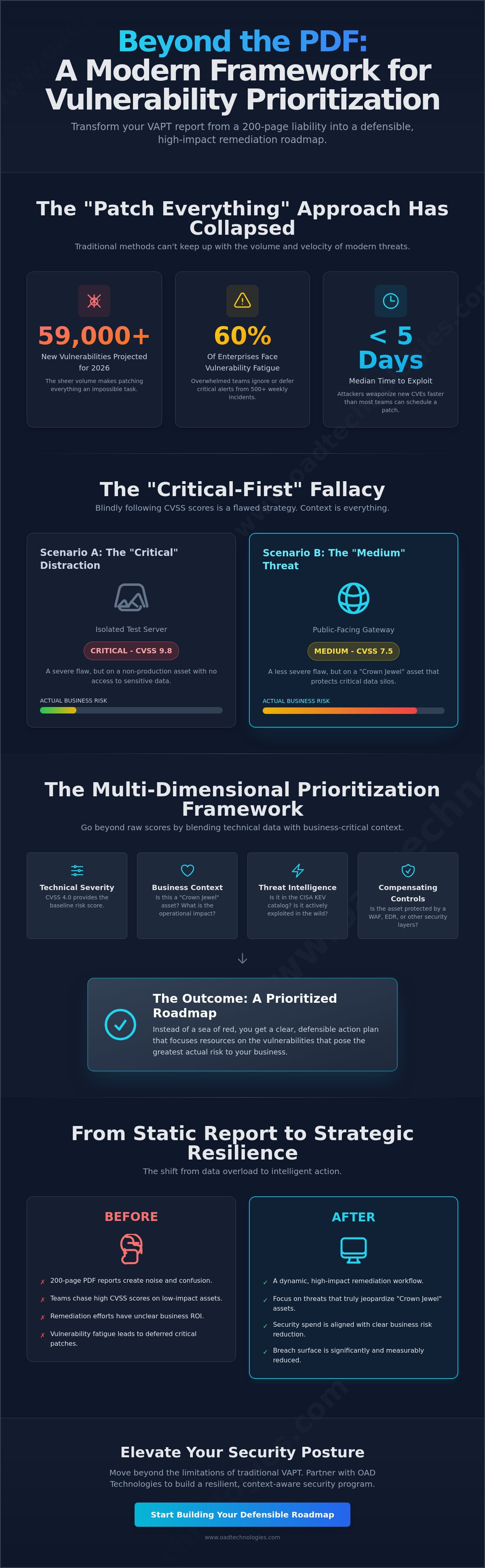
Many organizations fall into the "Critical-First" fallacy. They blindly follow CVSS scores, assuming a 9.8 severity rating always demands immediate action over a 7.5. In a complex enterprise environment, this approach is often flawed. A high-severity vulnerability on an isolated, non-critical test server poses less actual risk than a medium-severity flaw on a public-facing gateway. By 2026, the sheer volume of new CVEs has made this nuance mandatory. With nearly 59,000 new vulnerabilities projected this year, you can't patch your way out of the problem. You must outsmart it.
The Problem of Vulnerability Fatigue
Security teams are reaching a breaking point. Industry data suggests that roughly 60% of enterprises now struggle to manage over 500 remediation incidents every single week. When a pentest report arrives filled with "red" critical findings, the psychological impact is profound. Teams feel overwhelmed, leading to vulnerability fatigue where critical alerts are eventually ignored or deferred. Transitioning to a strategic defense mindset means accepting that not all flaws are equal. It involves using vulnerability assessment techniques to weigh technical severity against real-world business impact. This shift empowers people to focus on meaningful work rather than endless, low-impact patching cycles.
The 5-Day Exploit Window in 2026
The luxury of time has vanished. In 2026, the median window between a vulnerability disclosure and the appearance of a functional exploit has shrunk to less than five days. Attackers now leverage sophisticated automation to scan the global IP space for new CVEs within hours of their announcement. If your process for prioritizing vulnerabilities after a pentest takes weeks to move from the CISO's desk to the developer's backlog, you're already too late. Delayed remediation isn't just a process gap. It's an active invitation for threat actors to weaponize your known weaknesses before you've even scheduled the patch. Speed is the only defense against automated exploitation.
The Multi-Dimensional Framework for Vulnerability Prioritization
Raw data is a liability until it's refined into intelligence. While a standard report might highlight hundreds of flaws, prioritizing vulnerabilities after a pentest requires a move away from one dimensional scoring. We utilize a multi-dimensional framework that evaluates technical severity alongside real world exploitability and business impact. This ensures that your remediation efforts actually move the needle on risk rather than just checking boxes on a spreadsheet.
Technical severity, often represented by CVSS 4.0, provides a baseline for the potential impact of a flaw. However, CVSS 4.0 remains a technical snapshot that doesn't account for your specific environment. A modern risk prioritization framework must distinguish between a theoretical vulnerability and a weaponized threat. If a vulnerability is listed in the CISA Known Exploited Vulnerabilities (KEV) catalog, its priority skyrockets regardless of its base score. We also analyze your compensating controls; if a "Critical" flaw is already shielded by a robust WAF or a managed EDR solution, the immediate urgency for a patch might decrease in favor of more exposed assets.
Scoring Beyond CVSS
Context is the only way to avoid the trap of fixing the wrong things first. A "High" severity finding on an isolated test server is often less critical to your survival than a "Medium" flaw on a production database containing customer PII. To bridge this gap, we introduce the Business Risk Impact (BRI) metric. This metric helps senior leadership understand how a technical flaw translates into operational downtime or financial loss. By factoring in the vulnerability assessment and penetration testing (VAPT) context, you can justify your security spend by showing a direct reduction in business risk.
Regulatory and Compliance Drivers
In the Middle East, prioritization isn't just a best practice; it's a regulatory mandate. Standards like UAE ISR and NESA dictate specific remediation timelines based on asset criticality. Prioritizing vulnerabilities after a pentest must align with these national requirements to avoid legal and financial repercussions. The UAE Personal Data Protection Law (PDPL) further complicates asset valuation, as any vulnerability affecting personal data automatically demands a higher priority. We help you integrate these drivers into your Governance Risk and Compliance (GRC) strategy, ensuring your technical fixes support your broader legal standing. If you're struggling to map these regulations to your technical roadmap, exploring a customized security partnership can provide the clarity your team needs.
Beyond Severity Scores: Contextualizing Risk with Threat Intelligence
Static scores provide a technical baseline, but they don't reflect the active battlefield. Integrating real-time threat feeds into your remediation roadmap allows you to see which "Critical" flaws are actually being weaponized by adversaries. In the Middle East, specific threat actors frequently target legacy systems or specific industrial protocols unique to the region's infrastructure. By prioritizing vulnerabilities after a pentest with this regional intelligence, you ensure your resources aren't wasted on theoretical risks that no one is currently exploiting. As analyzed in Vulnerability Prioritization in 2026, relying solely on CVSS is a dangerous gamble in an era where exploit kits are often available within days of a CVE disclosure.
Sometimes, immediate patching isn't feasible because of business continuity requirements or complex software dependencies. This is where Managed Detection and Response (MDR) becomes a strategic asset. MDR allows your security team to monitor unpatched flaws for any sign of active probing or exploitation. It provides a necessary safety net, giving you the visibility to detect an attempted breach in real time while your IT team prepares a permanent fix. This synergy between assessment and active monitoring transforms your defense from a reactive scramble into a controlled, risk-based operation.
The Power of Vulnerability Chaining
Hackers don't look at vulnerabilities in isolation; they look for pathways. A single low-risk misconfiguration might seem harmless on a spreadsheet, but when chained with a medium-risk credential leak, it can lead to a full domain compromise. This "pathway analysis" is a critical part of prioritizing vulnerabilities after a pentest. You must evaluate how a minor flaw can serve as a stepping stone for lateral movement within your network. If a "Low" finding exists on a path that leads directly to your "Crown Jewel" assets, its true priority is significantly higher than its technical score suggests.
Dynamic vs. Static Prioritization
Your remediation list shouldn't be a static document that gathers dust until the next audit. It must evolve. By utilizing SIEM logs, you can identify if a specific vulnerability discovered during your pentest is already being probed by external scanners. This shift moves your posture from annual, reactive assessments toward a model of continuous security validation. If an exploit goes viral on a Tuesday, your internal priority list should reflect that change by Wednesday morning. This dynamic approach ensures your team is always working on the threats that pose the most immediate danger to your operational uptime.
Orchestrating Remediation: From Technical Fixes to Strategic Resilience
Execution is where most security strategies falter. After prioritizing vulnerabilities after a pentest, you must transition from a list of theoretical risks to a structured action plan. This transition requires more than just technical skill; it demands clear orchestration across diverse teams that often have competing priorities. We view remediation not as a series of isolated tickets, but as a coordinated sprint toward a more resilient architecture. By following a disciplined five step process, your organization can ensure that the most dangerous gaps are closed first without disrupting business momentum.
- Step 1: Triage by Asset Criticality: Categorize findings based on the sensitivity of the data they touch. In the context of the UAE Personal Data Protection Law (PDPL), any asset handling personal identifiable information moves to the top of the queue.
- Step 2: Assign Ownership: Accountability is the cornerstone of success. Assign every high priority finding to a specific owner in IT, DevOps, or Security to ensure no flaw is left in limbo.
- Step 3: Define Remediation Sprints: Group fixes into time bound sprints. Focus your initial 48 to 72 hour window on critical, exploited vulnerabilities before moving to long term architectural improvements.
- Step 4: Implement Virtual Patching: For legacy systems that can't be taken offline, utilize virtual patching via network security solutions or EDR to provide immediate protection while a permanent fix is engineered.
- Step 5: Validate and Verify: Never assume a patch worked as intended. Conduct targeted re-testing to confirm the vulnerability is truly eradicated and that the fix hasn't introduced new stability issues.
Building a Remediation Workflow
Success depends on the tools and communication channels you establish between technical specialists and executive stakeholders. While spreadsheets might work for small teams, enterprise environments require automated GRC platforms to track progress against national standards like UAE ISR. Just as modern retailers use Ommni to manage complex retail operations at scale, security leaders need centralized systems to maintain visibility. Clear reporting ensures that leadership understands the ROI of security efforts in real time. The remediation lifecycle is a continuous process of triaging, fixing, and validating security flaws to maintain an organization's defensive baseline. Effective prioritizing vulnerabilities after a pentest ensures that your team's energy is always focused on the path of greatest risk reduction.
The Role of Verification
Marking a ticket as "fixed" in a tracking system is not the same as securing the asset. We've seen numerous instances where a patch failed to install correctly or where a configuration change was accidentally reverted during the next deployment cycle. Establishing a rigorous feedback loop is essential for continuous improvement. If a specific type of vulnerability keeps appearing in your reports, it's a signal that your underlying development process needs adjustment. To move beyond basic patching and build a truly resilient infrastructure, consider a comprehensive VAPT partnership that guides you from initial discovery through to verified remediation.
Elevating Your Security Posture with OAD Technologies’ VAPT Lifecycle
A penetration test shouldn't be a standalone event; it's a catalyst for systemic improvement. At OAD Technologies, we bridge the gap between initial discovery and long term resilience by embedding our findings into your broader security architecture. Prioritizing vulnerabilities after a pentest is a core component of our VAPT lifecycle, ensuring that technical remediation aligns with your operational goals. We don't just hand over a list of flaws. We provide a managed roadmap that accounts for your specific infrastructure and risk appetite.
A critical advantage of our approach is the integration of VAPT results with Data Loss Prevention (DLP). Many organizations treat these as separate silos, but they're deeply interconnected. If our assessment identifies a high risk vulnerability in a database or file system, we immediately help you adjust your DLP policies to monitor and restrict data movement around that specific asset. This creates a layered defense that protects your sensitive information even while the underlying technical flaw is being patched. This synergy is particularly vital for maintaining compliance with the UAE Personal Data Protection Law (PDPL).
A Strategic Partnership for UAE Enterprises
Meeting the complex requirements of UAE ISR and NESA demands more than just a global perspective; it requires deep local expertise. Our collaborative approach empowers your internal teams with actionable roadmaps that simplify the process of prioritizing vulnerabilities after a pentest. We design security solutions that aren't just rigid boxes but evolving frameworks that grow alongside your digital infrastructure. This ensures your organization remains compliant and resilient against the specific threat actors targeting the region's unique economic sectors.
The Synergy of Human Insight and Technology
Automated tools are essential for scale, but they lack the intuition to understand the nuance of your business logic. Our engineers provide the expert interpretation needed to drive real value from every scan and exploit. OAD’s commitment to your long term viability means we focus on operational performance as much as security. We act as an extension of your team, ensuring that every fix strengthens your posture without creating technical debt. Contact us today to transform your next penetration testing engagement from a simple audit into a strategic asset for your business growth.
Building a Resilient Future Through Strategic Remediation
The transition from a static list of flaws to a high-impact remediation roadmap requires a fundamental shift in perspective. You've seen how context-based scoring and regional threat intelligence transform raw data into a defensible strategy. By prioritizing vulnerabilities after a pentest through the lens of business risk and UAE compliance standards, your team can focus on the threats that truly matter. This approach doesn't just patch holes; it strengthens your entire digital infrastructure against the automated exploits of 2026.
As a Dubai-based technical authority, we specialize in bridging the gap between discovery and defense. Our expertise in UAE ISR and PDPL compliance ensures your security posture meets national mandates while our sophisticated MDR and DLP integration provides continuous protection. We act as a master designer for your systems, ensuring long-term viability in an ever-changing market. Your digital evolution deserves a partner that values precision and operational excellence.
Secure your enterprise with OAD Technologies’ Strategic VAPT Services and take the first step toward a more resilient future. We're ready to help you turn complex technical challenges into measurable business results.
Frequently Asked Questions
How do you prioritize vulnerabilities after a penetration test?
You prioritize vulnerabilities by evaluating technical severity alongside asset criticality and real world exploitability. Use a risk based matrix that weighs the potential business impact against the likelihood of a successful breach. This ensures you address the most dangerous exposures first rather than just following a chronological list of findings. It's about focusing resources where they provide the highest reduction in actual risk.
What is the most effective way to manage a large volume of pentest findings?
Implement automated triaging and group findings by asset type or remediation owner to streamline the workflow. Use a centralized GRC platform to track progress and prevent the common "PDF problem" of static, unmanageable reports. This structured approach allows your team to tackle vulnerabilities in logical batches. It improves overall efficiency and ensures direct accountability across your IT and security departments during the remediation lifecycle.
Should we always fix "Critical" vulnerabilities first?
Not necessarily. While technical severity is high, a "Critical" flaw on an isolated, non production system is often less urgent than a "Medium" flaw on a public facing gateway. Effective prioritizing vulnerabilities after a pentest requires looking at the reachability and business value of the affected asset. You must decide which flaws pose a legitimate threat to your ongoing operations before allocating your team's time.
How does business context change the priority of a security flaw?
Business context shifts the focus from technical bugs to operational risks. A flaw that threatens a revenue generating application or sensitive customer data, often called "Crown Jewels," automatically receives higher priority. Context helps you align security spend with the strategic goals of the organization. It ensures that protection is strongest where a breach would cause the most significant financial or reputational damage.
What are compensating controls and when should they be used?
Compensating controls are alternative security measures used to mitigate risk when a direct patch isn't feasible or safe to implement immediately. Examples include updating WAF rules or tightening EDR monitoring around a vulnerable server to provide strategic resilience. Use them for legacy systems that lack vendor support or during the gap between initial discovery and your next scheduled maintenance window.
How long should remediation take for high-risk vulnerabilities?
Remediation for high risk flaws should ideally occur within 48 to 72 hours of discovery to minimize the window of exposure. Given the speed of modern exploit development, rapid action is essential to prevent automated weaponization. Organizations should establish clear SLAs that define expected turnaround times. This helps prevent operational downtime and ensures that the most dangerous gaps are closed before attackers can find them.
Why is re-testing important after the remediation phase?
Re-testing confirms that a patch was correctly applied and hasn't introduced new instability into your environment. It provides the final validation needed to close a security finding with confidence and completes the feedback loop for your development team. Without this step, you risk a false sense of security while the original vulnerability remains open due to simple installation errors or configuration drifts.
How do UAE regulations like ISR impact vulnerability remediation timelines?
UAE ISR mandates specific remediation windows based on the criticality of the information asset being protected. Organizations must align prioritizing vulnerabilities after a pentest with these national standards to remain compliant and avoid legal repercussions. Failure to meet these timelines can result in regulatory penalties. It also increases your exposure to regional threat actors who specifically target organizations with lagging defensive postures.
Disclaimer
Content by OAD Technologies is for general informational purposes only and does not constitute professional or cybersecurity advice. No warranties are made regarding accuracy or completeness; reliance is at your own risk. OAD Technologies shall not be liable for any direct or indirect losses arising from use of this content.


