

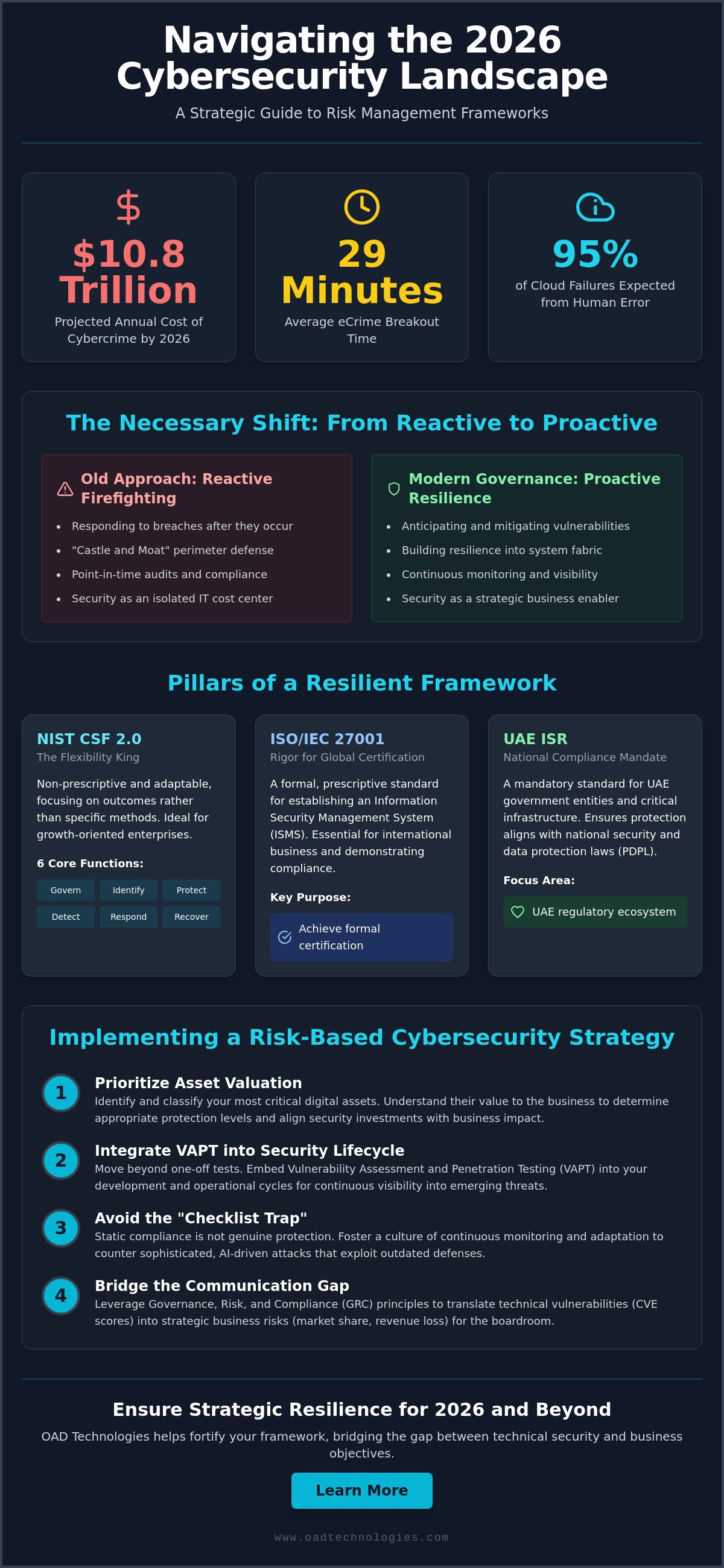
With the annual global cost of cybercrime projected to reach $10.8 trillion in 2026, the margin for error in enterprise defense has effectively vanished. Implementing a robust risk management framework for cybersecurity is no longer just a compliance exercise. It's a fundamental requirement for operational survival in an era where eCrime breakout times have plummeted to just 29 minutes. We understand that you're likely feeling the pressure of navigating the labyrinth of international standards while trying to satisfy rigorous national mandates like the UAE ISR. It's a complex challenge to bridge the gap between technical vulnerabilities and the strategic risk conversations happening in the boardroom.
This guide empowers you to master the architectural principles necessary to protect your national enterprise assets against the hyper-accelerated threats of the 2026 landscape. We promise to provide a clear, actionable roadmap for framework selection that aligns your technical security with business objectives. You'll learn how to foster better communication between your technical teams and the board, ultimately reducing the likelihood of catastrophic data loss and ensuring your organization remains resilient in a volatile digital economy.
Key Takeaways
- Transition from reactive "firefighting" to a proactive governance model by adopting a structured process for identifying and mitigating modern digital threats.
- Compare NIST CSF 2.0, ISO/IEC 27001, and the UAE ISR to identify which risk management framework for cybersecurity best fits your industry vertical and compliance mandates.
- Avoid the "checklist trap" by understanding why static compliance often fails to provide genuine protection against the sophisticated, AI-driven attacks of 2026.
- Implement a phased strategy that prioritizes asset valuation and integrates VAPT into your security lifecycle to ensure continuous visibility and protection.
- Leverage GRC consulting to bridge the communication gap between technical security teams and the board, ensuring cybersecurity investments translate into strategic business resilience.
Defining the Modern Risk Management Framework for Cybersecurity
A Risk Management Framework (RMF) serves as the foundational architecture for an organization's digital safety. It isn't just a manual; it's a structured, repeatable process designed to identify, assess, and mitigate digital threats before they escalate into crises. For years, enterprises operated in a state of reactive "firefighting," responding to breaches as they occurred. Today, that approach is a liability. Modern governance demands a shift toward a proactive risk management framework for cybersecurity that anticipates vulnerabilities rather than just documenting them.
By 2026, the traditional network perimeter has effectively dissolved. With hybrid cloud environments and AI-driven adversaries capable of 29-minute breakout times, relying on a "castle and moat" defense is obsolete. Threats are now decentralized and automated. This evolution requires a framework that integrates deeply with your business operations, acknowledging that every digital asset represents a potential entry point or a critical failure node. It's about building resilience into the fabric of the system, not bolting it on as an afterthought.
The Core Objectives of an Enterprise CRMF
The primary goal is to establish a common language for risk. When IT teams talk about "CVE scores" and the board talks about "market share," a CRMF bridges that gap by translating technical vulnerabilities into business impact. It also moves the organization away from point-in-time audits toward continuous monitoring. With 95% of cloud failures expected to stem from human error or misconfigurations in 2026, real-time visibility is the only way to achieve operational resilience and minimize the fallout of inevitable data breaches.
Framework vs. Strategy: Understanding the Relationship
Think of the framework as the "rules of engagement" and the strategy as the "mission." While the strategy defines where you're going, the framework ensures you have the structural integrity to get there safely. A CRMF is the structural blueprint for organizational digital integrity. Without executive buy-in, even the most sophisticated framework remains a shelf-ware document. Successful adoption requires leaders to view security not as a cost center, but as a guardian of long-term digital relevance in a volatile market. This proactive approach to protection is equally important in personal legal affairs; for instance, if you are navigating family or inheritance law in Israel, you can find out more about the expertise of משרד עורכי דין מורן גוהר.
The Pillars of a Resilient Framework: NIST, ISO, and National Standards
Selecting the right risk management framework for cybersecurity is a strategic pivot that determines how your enterprise absorbs and recovers from digital shocks. While dozens of models exist, three primary standards dominate the 2026 landscape: the NIST Cybersecurity Framework (CSF) 2.0, ISO/IEC 27001, and the UAE Information Security Regulation (ISR). Each serves a distinct purpose. NIST provides the flexibility for growth; ISO offers the rigor for global certification; and the ISR ensures compliance within the national regulatory ecosystem. Aligning these standards with the UAE Personal Data Protection Law (PDPL) is essential for any enterprise handling sensitive local data.
NIST Cybersecurity Framework (CSF): The Flexibility King
The release of NIST CSF 2.0 in February 2024 marked a significant evolution in defensive philosophy. By adding "Govern" as a sixth core function alongside Identify, Protect, Detect, Respond, and Recover, NIST signaled that cybersecurity is an enterprise-wide responsibility, not just an IT task. This framework is non-prescriptive, meaning it tells you what outcomes to achieve rather than how to achieve them. It's built on the logic found in NIST Special Publication 800-37, which outlines a multi-step process for managing risk. Implementation tiers allow organizations to measure their maturity, moving from partial, reactive states to robust, risk-informed operations.
ISO/IEC 27001: The Global Certification Standard
ISO/IEC 27001 focuses on establishing a comprehensive Information Security Management System (ISMS). Since the transition period for the 2022 version ended on October 31, 2025, all new certifications now require adherence to updated controls that prioritize cloud security and data privacy. For enterprises seeking international partnerships, ISO certification is a badge of trust. It proves your risk management framework for cybersecurity meets rigorous, audited standards. While NIST is about internal improvement, ISO is about external validation. It's the preferred choice for organizations operating across multiple jurisdictions that need a unified security language.
National Compliance: Aligning with the UAE ISR
For government entities and critical infrastructure in the UAE, the ISR isn't optional. It's a mandatory set of controls designed to protect national interests. While international standards are broad, the ISR is often more prescriptive regarding local data residency and specific technical configurations. Smart organizations don't treat these as separate silos. Instead, they adopt a "map once, comply many" strategy. By aligning your core controls with a master framework, you can satisfy NIST, ISO, and ISR requirements simultaneously. If you're struggling to harmonize these overlapping mandates, exploring customized GRC solutions can help streamline your compliance roadmap and reduce administrative overhead.
Why Static Frameworks Fail in the Face of 2026 Threats
"We have a framework, so why were we breached?" This is the most common objection from executive leadership. The reality is that a risk management framework for cybersecurity often fails when it's treated as a static document rather than a living system. Many organizations fall into the "Checklist Trap," where checking a box for compliance is mistaken for actual security. Compliance proves you met a standard at a specific moment in time. Security requires maintaining that standard against a moving target. If your framework doesn't evolve as fast as the adversaries, it's just a historical record of what used to be safe.
Static assessments often ignore the growing threat of Shadow IT. In 2026, employees frequently adopt AI productivity tools and SaaS platforms without IT's knowledge, creating blind spots that bypass traditional risk controls. When your framework only accounts for "official" assets, it leaves a massive surface area unprotected. Relying on a rigid document also ignores the human element. Human error and misconfigurations are expected to account for 95% of cloud security failures this year. Building a resilient defense requires a "Risk Culture" where every employee understands their role, rather than a "Risk Document" that sits in a digital drawer.
The Velocity Gap: Frameworks vs. Adversaries
The speed of modern attacks has rendered annual or even quarterly risk reviews insufficient. With eCrime breakout times dropping to just 29 minutes, a defender's response must be instantaneous. AI-automated attacks can identify and exploit a vulnerability before a traditional risk committee even schedules a meeting. To stay relevant, the NIST Risk Management Framework (RMF) emphasizes continuous monitoring, yet many enterprises still struggle with the execution. This is why moving toward a Managed Detection and Response (MDR) model is critical. Real-time telemetry provides the only objective way to validate that your framework's controls are actually functioning as intended under pressure.
Misalignment with Business Objectives
Security frameworks shouldn't act as a handbrake on operational agility. When a framework is too rigid, it creates friction that leads departments to find workarounds, inadvertently increasing risk. "Right-sizing" your risk management framework for cybersecurity means tailoring controls to your specific threat profile and business goals. For example, a framework that neglects Data Loss Prevention (DLP) while focusing heavily on network perimeters is fundamentally misaligned with a cloud-first strategy. A successful framework empowers the mission. It doesn't just restrict it.
Step-by-Step: Implementing a Risk-Based Cybersecurity Strategy
Moving from a theoretical model to a functional defense requires a disciplined execution lifecycle. A resilient risk management framework for cybersecurity is built in four distinct phases that transform abstract goals into technical reality. This process ensures that every security dollar spent is directly mapped to a verified threat, preventing the common mistake of over-investing in low-priority areas while leaving critical assets exposed.
Phase 1 begins with Asset Discovery and Valuation. You cannot protect what you cannot see, and in 2026, visibility must extend across hybrid cloud environments and decentralized identities. Phase 2 moves into Threat Modeling and Vulnerability Analysis. This is where you integrate VAPT as a continuous lifecycle component rather than a yearly event. By simulating modern attack vectors, you identify the paths of least resistance before adversaries do.
Phase 3 focuses on Control Selection and Gap Analysis. Here, you choose specific tools, such as Identity and Access Management (IAM) or Data Loss Prevention (DLP), to address the vulnerabilities identified in the previous stage. Finally, Phase 4 establishes Continuous Monitoring and Improvement. Utilizing SIEM and EDR provides the real-time telemetry needed to verify that your controls are functioning. If you are ready to move beyond generic templates, you can partner with our GRC specialists to design a framework tailored to your specific enterprise architecture.
Asset Discovery: The Foundation of Risk
Effective risk management starts by distinguishing between crown jewel data and commodity systems. Protecting a public-facing marketing site requires different controls than securing a database containing sensitive national identifiers. Modern enterprises leverage Cloud Security Posture Management (CSPM) to maintain visibility over cloud-native assets that often bypass traditional inventory tools. Accurate asset inventory is the non-negotiable first step of any CRMF. Without this baseline, your risk assessments are based on incomplete data, making your entire security posture inherently unstable.
Gap Analysis: Bridging the Security Divide
Once you understand your assets and threats, you must measure the distance between your current state and your desired framework maturity. A thorough gap analysis prioritizes remediation based on two factors: exploitability and business impact. High-impact vulnerabilities that are easily exploitable by AI-driven tools must be addressed first. This analysis forms the basis of a 12-month roadmap for framework maturity, allowing you to demonstrate steady, measurable progress to the board while systematically reducing your overall risk profile.
Strategic Resilience: How OAD Technologies Fortifies Your Framework
Building a resilient risk management framework for cybersecurity isn't about following a generic template. It's about precision engineering. At OAD Technologies, we act as the master designers of your security architecture. We reject standardized, one-size-fits-all approaches because they fail to account for the unique operational DNA of your enterprise. Our GRC consulting doesn't just produce compliance reports. It bridges the critical gap between deep technical assessments and the high-level strategic reporting required by your executive board.
We believe in the synergy of human expertise and automated tools. While AI handles the massive volume of data, our specialists provide the essential context that machines often miss. This bespoke integration ensures that your framework functions as a dynamic operating system, not a static binder. We invite you to participate in a technical security assessment to benchmark your current framework against the 2026 threat landscape. This process identifies the specific pivots needed to ensure your organization remains ahead of evolving adversaries.
Operationalizing the Framework with Managed Services
A framework only lives when it's operationalized through tactical action. Our SIEM and MDR services provide the essential "Detect and Respond" functions that many organizations struggle to maintain with internal teams alone. We place a heavy emphasis on Identity and Access Management (IAM) as the primary control plane for modern risk mitigation. By securing the user journey, we neutralize common attack vectors before they reach your core assets. OAD’s commitment is to your long-term viability, ensuring your digital relevance remains intact as the market shifts.
National Expertise for UAE Enterprises
Navigating the local regulatory nuances of the UAE requires a partner with deep roots in the national landscape. We understand the specific demands of the UAE ISR and how they intersect with international standards like ISO 27001. Our proactive approach extends beyond traditional perimeters to include brand protection and email security, treating these services as vital extensions of your risk management framework for cybersecurity. Local knowledge combined with global standards allows us to offer a level of protection that generic providers cannot match. Secure your enterprise future with a comprehensive GRC strategy from OAD Technologies.
Securing Your Enterprise Legacy in a Volatile Digital Future
The 2026 threat landscape demands more than just a defensive posture. It requires an architectural evolution. By shifting from reactive "firefighting" to a proactive risk management framework for cybersecurity, your organization can turn security from a cost center into a strategic advantage. We've explored how the alignment of NIST CSF 2.0 and ISO 27001 controls provides a global standard of trust, while local UAE ISR mandates ensure national compliance. True resilience isn't found in a static document. It's found in the synergy between human insight and real-time telemetry.
As UAE-based GRC experts, OAD Technologies specializes in bridging the gap between technical assessment and executive reporting. Our full-stack MSSP capabilities, ranging from MDR and VAPT to robust DLP strategies, ensure that your framework is fully operationalized against 29-minute breakout speeds. Don't leave your digital relevance to chance. Partner with OAD Technologies for a Strategic GRC Consultation to benchmark your current posture and build a roadmap for long-term success. You have the tools to shape your future; let's design a system that protects it.
Frequently Asked Questions
What is the best risk management framework for a mid-sized UAE enterprise?
The most effective approach for a mid-sized UAE enterprise is a hybrid model that combines the outcome-based flexibility of NIST CSF 2.0 with the mandatory controls of the UAE Information Security Regulation (ISR). While NIST provides a clear roadmap for maturity, the ISR ensures you meet specific national requirements for critical infrastructure. This dual alignment protects your operations while simplifying local regulatory reporting and satisfying stakeholder expectations.
How does a cybersecurity risk management framework differ from a standard IT audit?
An IT audit is a point-in-time assessment that verifies if specific controls were active at the moment of inspection. In contrast, a risk management framework for cybersecurity is a continuous lifecycle that governs how you identify and mitigate threats every day. Audits tell you where you were; a framework tells you how to stay secure as your digital environment and the threat landscape evolve.
Can we use NIST CSF for compliance with the UAE Personal Data Protection Law (PDPL)?
You can use NIST CSF as a foundation, but it requires specific mapping to satisfy the UAE Personal Data Protection Law (PDPL). While NIST handles general security, the PDPL introduces strict requirements for data sovereignty and subject rights. We recommend overlaying the NIST Privacy Framework or ISO 27701 to ensure your technical controls specifically protect the personal data types defined under UAE law.
How often should a risk management framework be updated or reviewed?
Your high-level framework strategy should undergo a formal review annually or whenever significant business changes occur, such as a major cloud migration. However, the tactical risk assessments within that framework must be continuous. Given that AI-driven attacks now operate with hyper-accelerated speeds, relying on a static yearly review leaves your enterprise vulnerable to vulnerabilities that emerge between audit cycles.
What is the role of insurance in a cybersecurity risk management framework?
Cyber insurance serves as a risk transfer mechanism rather than a primary defense. It provides a financial safety net for residual risks that cannot be fully mitigated by your technical controls. Most insurers now require proof of a robust risk management framework for cybersecurity before issuing a policy. They view your framework as evidence that you're a lower-risk client, which can lead to more favorable premiums.
Is it possible to automate the entire risk management framework process?
You can't automate the entire process because risk management requires strategic human judgment. While tools like SIEM and GRC platforms automate data collection and alert you to configuration drifts, they can't define your organization's risk appetite or make complex trade-off decisions. Automation handles the repetitive telemetry; however, your leadership team must still steer the mission and define the rules of engagement.
What are the most common mistakes when implementing ISO 27001?
The most frequent mistake is treating ISO 27001 as a one-off project to get a certificate rather than an ongoing management system. Many organizations also fail to properly define their Statement of Applicability, leading to the implementation of irrelevant controls that create operational friction. Success requires executive buy-in and a commitment to the continuous improvement cycle to ensure long-term viability and digital relevance.
Disclaimer
Content by OAD Technologies is for general informational purposes only and does not constitute professional or cybersecurity advice. No warranties are made regarding accuracy or completeness; reliance is at your own risk. OAD Technologies shall not be liable for any direct or indirect losses arising from use of this content.


