

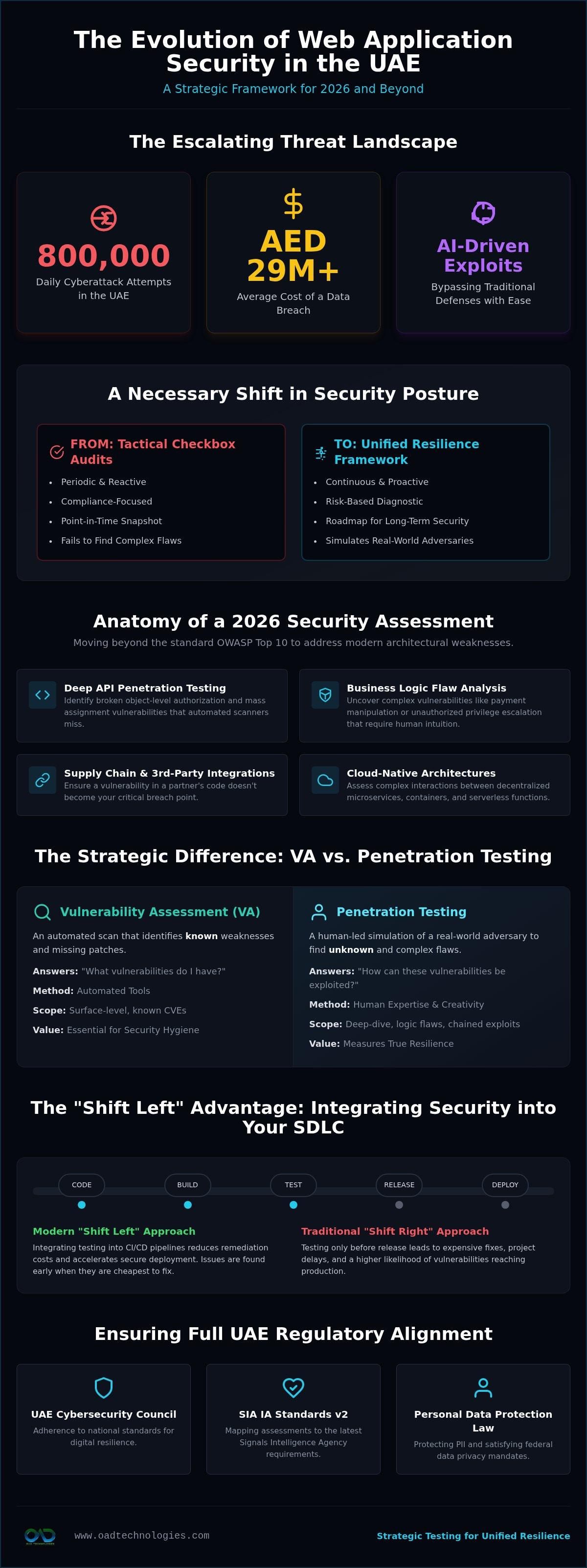
With the UAE Cybersecurity Council reporting up to 800,000 daily cyberattack attempts in mid-2026, the era of treating security as a periodic checkbox is over. Traditional defenses are failing. You've likely felt the pressure of sophisticated, AI-driven exploits targeting your digital architecture. It's a reality where a single vulnerability can lead to breaches costing upwards of AED 29 million. Finding a partner for web application penetration testing in the UAE requires more than technical skill. It demands alignment with the UAE's specific regulatory evolution, including the updated Version 2 Information Assurance Standards.
We've designed this guide to help you move toward a unified resilience framework. You'll gain a roadmap for continuous security that satisfies the latest Signals Intelligence Agency (SIA) requirements and federal data protection laws. We'll show you how to transform penetration test findings into actionable intelligence. This approach strengthens your broader Managed Detection and Response (MDR) and Data Loss Prevention (DLP) strategies. Your security posture should be a strategic asset, not just a defense. It ensures your long-term viability in a volatile national market.
Key Takeaways
- Transition from tactical, checkbox-style audits to a strategic diagnostic approach that counters the sophisticated, AI-driven threat landscape of 2026.
- Ensure your web application penetration testing dubai strategy prioritizes deep API assessments and goes beyond the standard OWASP Top 10 to protect modern, interconnected ecosystems.
- Maintain full regulatory alignment by mapping your security assessments to the latest UAE Signals Intelligence Agency (SIA) standards and the Personal Data Protection Law (PDPL).
- Adopt a "Shift Left" philosophy to reduce remediation costs and accelerate secure deployment by integrating testing directly into your development lifecycle and CI/CD pipelines.
- Build a unified resilience framework by leveraging the synergy between penetration testing and broader strategic tools like Data Loss Prevention (DLP) for long-term digital viability.
The Evolution of Web Application Penetration Testing in 2026
The security climate within the UAE has reached a critical inflection point. With daily cyberattack attempts scaling toward 800,000 as of July 2026, web application penetration testing dubai has evolved from a routine compliance task into a vital diagnostic for enterprise survival. Static defensive perimeters are increasingly obsolete. Today's adversaries utilize AI-orchestrated exploits that bypass signature-based detection with ease. OAD Technologies approaches VAPT as the foundational architecture of your data protection strategy. We ensure that every assessment provides a clear roadmap for long-term resilience rather than a mere point-in-time snapshot. This transition toward a risk-based cadence is necessary to combat the $8 million average cost of a data breach currently seen across Middle Eastern enterprises.
Why Web Applications are the #1 Attack Vector
Web applications serve as the primary gateway to your most sensitive corporate assets and personal identifiable information (PII). The transition to headless architectures and complex microservices has expanded the potential for exploitation. In 2026, your attack surface is the total sum of all decentralized microservices, exposed API endpoints, and serverless functions that an adversary can probe to find a single point of failure. Modern stacks are often built with speed in mind, frequently leaving intricate logic flaws that traditional security tools miss. Securing these gateways is no longer just about patching; it's about understanding the complex interactions between disparate systems that house your critical data.
Vulnerability Assessment vs. Penetration Testing: The Strategic Difference
It's essential to distinguish between a basic scan and a comprehensive test. Automated vulnerability assessments (VA) identify known weaknesses and missing patches; they're the first step in maintaining application security principles. However, they lack the creative intuition required to uncover complex business logic flaws. Human-led penetration testing simulates a focused adversary who understands how to chain minor vulnerabilities into a major breach. This sophisticated methodology is a core component of our VAPT Pillar Article, which explores how a risk-based security cadence provides deeper insights than a simple automated report. By focusing on how an attacker thinks, OAD Technologies helps you secure the underlying logic of your business operations. This ensures that your security investments yield measurable returns in operational performance and regulatory confidence.
The Technical Anatomy of a 2026 Web Security Assessment
A robust approach to web application penetration testing dubai must transcend the familiar boundaries of the OWASP Top 10. While those standards remain foundational, the 2026 threat environment requires a more granular focus on modern architectural weaknesses. OAD Technologies employs a methodology that prioritizes the logic of your specific business processes. We analyze how decentralized microservices interact, ensuring that security is woven into the very fabric of the application rather than applied as an afterthought. This level of precision is vital for maintaining the high standards for digital resilience set by the UAE Cybersecurity Council.
APIs are the lifeblood of modern digital services, yet they often represent the most significant unmonitored risk. Our assessments include deep-dive API penetration testing to identify broken object-level authorization and mass assignment vulnerabilities that automated scanners routinely overlook. We also scrutinize business logic. An automated tool won't understand if a user can manipulate a shopping cart to achieve a zero-dirham balance, but a human tester will. We further evaluate the security of your third-party integrations and supply chain dependencies to ensure that a vulnerability in a partner's code doesn't become your breach.
Modern Methodology: Reconnaissance and Enumeration
Effective testing begins with exhaustive reconnaissance. In cloud-native environments, this involves mapping serverless functions and identifying hidden endpoints that don't appear in standard documentation. We favor 'Gray Box' testing, where our specialists have partial knowledge of the internal system. This approach mimics a sophisticated insider or a persistent threat actor who has already gained a foothold. It balances the speed of black-box testing with the thoroughness of white-box audits, providing a comprehensive view of your digital footprint.
Exploitation and Post-Exploitation in a Protected Environment
Once we identify potential entry points, we safely simulate exploitation to see how far an attacker could pivot. This phase is critical for validating the efficacy of your existing SIEM and WAF configurations. We don't just hand over a list of bugs. Instead, we provide a strategic fix-list that prioritizes remediation based on actual business risk. If you're looking to enhance your defensive posture, you can explore our comprehensive VAPT framework to see how we customize each assessment for your specific operational goals.
Aligning Web App Testing with UAE National Compliance
Regulatory compliance in the UAE has transitioned from advisory guidance to mandatory enforcement. Effective web application penetration testing dubai must now account for Federal Decree Law No. 45 of 2021 on the Protection of Personal Data (PDPL). This law mandates rigorous technical measures to protect the privacy of residents. If your application handles sensitive data, regular security assessments aren't optional; they're a legal prerequisite for operational viability. We integrate these requirements into a broader GRC Strategy Guide approach. This ensures your testing scope matches your specific regulatory risk profile, allowing for a structured and logical defense.
NESA and UAE ISR: Technical Mandates for Web Apps
Critical sectors must adhere to the UAE Information Assurance (IA) Standards. Version 2, published in September 2025, aligns with ISO 27001:2022 but introduces specific national requirements for data sovereignty and resilience. The Signals Intelligence Agency (SIA), which has replaced NESA, requires government-linked entities to maintain strict testing intervals and reporting cadences. For these organizations, web application security isn't a standalone project. It's a continuous obligation that directly impacts national digital assets. We help you navigate these mandates by providing the high-precision technical documentation required for national audits. This proactive stance ensures your security posture reflects the highest standards of national digital resilience.
Global Standards with National Impact
Global frameworks like PCI DSS 4.0 and ISO 27001:2022 heavily influence UAE enterprise security strategies. Financial institutions licensed by the Central Bank of the UAE face a critical deadline: they must complete their first digital impersonation risk assessment by June 30, 2026. Creating a unified testing framework allows you to satisfy multiple regulatory bodies with a single engagement. This strategic alignment reduces operational friction and prevents the disconnect between audit findings and long-term security strategy. By mapping your technical testing to these varied standards, you ensure ongoing digital relevance in an increasingly regulated market. Furthermore, achieving complete digital compliance involves meeting international accessibility standards; for instance, 216digital helps businesses mitigate legal risks by ensuring their platforms remain compliant with ADA and WCAG 2.1/2.2 requirements.
| Regulation | Web App Security Requirement |
|---|---|
| PDPL (Federal Law 45) | Mandatory protection of PII via technical controls and breach reporting. |
| SIA (NESA) Standards | Periodic VAPT for critical infrastructure and government entities. |
| PCI DSS 4.0 | Continuous monitoring and rigorous testing of payment-processing apps. |
| ISO 27001:2022 | Risk-based assessment of application vulnerabilities and logic flaws. |
Actionable Guidance: Integrating Security into the Development Lifecycle
Security must be a design requirement, not a post-production audit. The "Shift Left" philosophy moves web application penetration testing dubai from the end of the development cycle to the very beginning. By identifying architectural flaws during the design phase, you avoid the exponential costs of late-stage remediation. This proactive approach allows your engineering teams to build with confidence, knowing that security is baked into every microservice and API. Integrating VAPT into your CI/CD pipelines ensures that every code commit is scrutinized for potential vulnerabilities, providing a continuous loop of assurance that matches the speed of modern business.
A strategic approach to web application penetration testing dubai requires defining the optimal testing frequency for your specific risk profile. High-frequency release environments require a different cadence than legacy systems. We help you establish triggers for event-driven testing, such as major infrastructure changes or the introduction of new feature sets. This ensures your defense remains current without stalling innovation. Empowering your developers with actionable, technical guidance is the final piece of the puzzle. Instead of generic reports, we provide specific remediation steps that help your team close security gaps quickly and effectively.
Continuous Security vs. Annual Testing
A resilient ecosystem requires a bridge between security auditors and engineering teams. This starts with education and shared goals. Implementing a strategic framework for Identity and Access Management (IAM) is essential for securing your development environments and preventing unauthorized lateral movement. When developers understand secure coding practices, the volume of vulnerabilities drops naturally. This cultural shift transforms security from a hurdle into a core pillar of your engineering excellence. To begin building your unified resilience framework, you can connect with our team of master designers at OAD Technologies for a customized assessment strategy.
The OAD Advantage: Unified Resilience Through Strategic Testing
OAD Technologies approaches security as a master designer. We don't believe in the transactional nature of generic audits. Instead, we customize web application penetration testing dubai to align perfectly with your specific business goals. This strategic partnership ensures that every technical finding serves a larger purpose: maintaining your digital relevance in an increasingly volatile UAE market. We look beyond the code to understand the business logic that drives your revenue. This allows us to provide insights that inform your broader security investments, ensuring high-quality craftsmanship in every layer of your defense.
The true value of our methodology lies in the synergy between disparate security pillars. For instance, the findings from a web assessment directly strengthen your Data Loss Prevention (DLP) strategy. By identifying how data could be exfiltrated through application logic flaws, we help you refine your DLP policies to block those specific pathways. Similarly, our testing informs your Managed Detection and Response (MDR) roadmap. We identify the high-risk areas that require the most intensive monitoring, allowing your MDR team to focus their detection capabilities where they matter most. This ensures that web application penetration testing dubai remains a high-value investment rather than a compliance burden.
From Vulnerability to Resilience
Moving from a state of vulnerability to one of resilience requires precision engineering. We use VAPT results to harden your Cloud Security Posture Management (CSPM). If our testers find a way to exploit a misconfigured serverless function, we don't just patch the function; we help you adjust your CSPM rules to prevent similar misconfigurations across your entire cloud environment. This commitment to rigorous standards ensures that your security posture isn't just fixed; it's evolved. We value long-term success over quick fixes, acting as an extension of your own team.
Next Steps for UAE Enterprises
Your journey toward a unified resilience framework starts with a clear-eyed audit of your current posture. You shouldn't settle for standardized approaches that fail to account for the 2026 threat landscape. Develop a multi-year strategy that treats security as a continuous development lifecycle. This proactive mindset is what separates industry leaders from those vulnerable to the 800,000 daily attacks currently targeting national infrastructure. If you're ready to secure your digital ecosystem with a risk-based approach, consult with OAD Technologies for a Strategic VAPT Assessment today.
Securing Your Digital Future in the UAE
The 2026 threat landscape demands a shift from reactive patching to a proactive, risk-based security cadence. Effective web application penetration testing dubai requires more than a technical audit; it requires a master designer's eye for architectural logic and national compliance. By integrating these assessments into your development lifecycle, you ensure that security powers your innovation instead of slowing it down. This strategic alignment is essential for maintaining operational performance in an environment where attack sophistication increases daily.
Choosing a strategic partner means moving beyond transactional vendors to find a firm that understands the intricacies of UAE ISR and SIA mandates. OAD Technologies provides an integrated framework where VAPT insights directly inform your MDR and DLP strategies, creating a unified resilience model built for long-term viability. This synergy ensures your enterprise doesn't just survive the hundreds of thousands of daily attack attempts but thrives within a secure, high-performance ecosystem. Precision engineering and rigorous standards are the only ways to guarantee your ongoing digital relevance.
Ready to elevate your defense? Partner with OAD Technologies for National-Level Web Application Security and secure your digital assets today. Your resilience journey starts with a commitment to strategic foresight and technical excellence. We're here to help you build a future that's as secure as it is ambitious.
Frequently Asked Questions
What is the difference between a vulnerability scan and a web app penetration test?
Vulnerability scans are automated tools that identify known security flaws and missing patches across your network. In contrast, web application penetration testing dubai involves human experts who simulate real-world attacks to uncover complex business logic errors. While scans provide a broad overview, penetration testing offers a deep diagnostic of how an adversary might chain multiple minor weaknesses to compromise your data. This manual approach is essential for identifying the sophisticated exploits that automated tools routinely miss.
How long does a typical enterprise web application penetration test take?
A typical enterprise-level engagement usually spans between two and four weeks, depending on the complexity of the application architecture. This timeframe includes reconnaissance, active exploitation, and the development of a strategic remediation roadmap. Smaller applications might require less time; however, sprawling microservices environments with extensive API integrations can take longer. We prioritize precision over speed to ensure every potential attack vector is thoroughly analyzed and documented for your engineering teams.
Do we need to test our internal web applications as rigorously as external ones?
Internal applications require the same level of scrutiny as your public-facing assets to prevent lateral movement. Adversaries who gain a foothold through phishing often target internal systems that house sensitive PII or financial data. Rigorous testing of these "behind the firewall" applications is a core component of a zero-trust architecture. It ensures that your internal security controls are robust enough to withstand insider threats or compromised credentials within your national infrastructure.
How does web application penetration testing support UAE NESA compliance?
Penetration testing provides the technical evidence required to satisfy the Signals Intelligence Agency (SIA) Information Assurance Standards. These national regulations mandate periodic security audits for entities operating within critical sectors. By conducting a formal assessment, you demonstrate measurable compliance with mandatory controls related to application security and data sovereignty. Our reports are structured to align directly with these UAE-specific frameworks, simplifying the audit process for your compliance officers and executive leadership.
Can OAD Technologies test applications hosted in multi-cloud environments?
We specialize in assessing applications across multi-cloud and hybrid environments, including AWS, Azure, and local UAE cloud providers. Our methodology accounts for the unique security challenges of serverless functions, containerized microservices, and complex IAM configurations. We evaluate how your application interacts with cloud-native services to ensure that misconfigurations don't create unintended entry points. This comprehensive view is vital for maintaining a strong web application penetration testing dubai posture in decentralized architectures.
What happens if a critical vulnerability is discovered during testing?
If our team uncovers a critical vulnerability, we issue an immediate high-priority notification to your designated security contacts. We don't wait for the final report to communicate risks that could lead to an imminent breach. Our experts provide instant triage advice and technical remediation guidance to help your developers close the gap as quickly as possible. This proactive communication ensures that your most significant risks are addressed in real-time, maintaining your operational resilience.
How often should our organization conduct web app penetration testing in 2026?
Most organizations should conduct a deep-dive assessment at least annually, though high-risk environments often require a more frequent, event-driven cadence. In 2026, any major code deployment, infrastructure migration, or significant feature update should trigger a targeted security review. This risk-based approach ensures your defenses evolve alongside your application. Periodic testing is also a requirement for many financial institutions under the latest UAE Central Bank digital risk assessment mandates due by June 2026.
Is API penetration testing included in a standard web application assessment?
API penetration testing is a standard and essential component of every web security assessment we perform. Since modern applications rely heavily on interconnected endpoints and third-party integrations, testing the web interface alone is insufficient. We scrutinize your API documentation, authorization logic, and data handling processes to identify vulnerabilities like broken object-level authorization. This holistic approach ensures that every gateway to your data is hardened against the sophisticated, AI-driven attacks prevalent in the current landscape.
Disclaimer
Content by OAD Technologies is for general informational purposes only and does not constitute professional or cybersecurity advice. No warranties are made regarding accuracy or completeness; reliance is at your own risk. OAD Technologies shall not be liable for any direct or indirect losses arising from use of this content.