

If your cloud provider manages the underlying infrastructure, why is your organization still legally liable for an AED 5 million fine when a data breach occurs? Many leaders assume that migrating to a world-class cloud environment means inheriting a "bulletproof" security posture by default. It's a logical assumption, but in the complex regulatory landscape of 2026, this misconception is the primary driver of preventable misconfigurations and failed audits. Mastering the shared responsibility model in cloud security is no longer just a technical requirement; it's a strategic necessity for maintaining operational resilience.
We'll help you bridge the gap between innovation and security by defining the exact boundary where your provider's duties end and your obligations begin. You'll gain a clear roadmap for internal security tasks that aligns with the UAE National Cloud Security Policy and the Central Bank’s June 2026 mandates for digital impersonation risk assessments. This guide outlines the essential steps to eliminate coverage gaps, ensuring your architecture remains compliant with UAE data residency laws while protecting your digital assets from evolving threats. By the end of this article, you'll have the framework needed to transform cloud security from a source of anxiety into a competitive advantage.
Key Takeaways
- Master the shared responsibility model in cloud security to clearly distinguish between your provider’s infrastructure duties and your organization’s data liabilities.
- Identify how security obligations shift across IaaS, PaaS, and SaaS environments, including the emerging complexities introduced by AI-as-a-Service models.
- Address critical misconceptions regarding data encryption and identity management to ensure your assets remain protected within the customer’s domain of control.
- Align your cloud governance with UAE-specific frameworks, including the Personal Data Protection Law (PDPL) and local data residency requirements.
- Discover how to operationalize your security duties through Managed Detection and Response (MDR) to maintain constant visibility over your cloud workloads.
What is the Shared Responsibility Model in Cloud Security?
The transition from legacy on-premises data centers to the cloud isn't just a change in hardware; it's a fundamental shift in the very nature of digital ownership. In a traditional setup, your team owned every layer, from the physical locks on the server room door to the software patches on the database. Cloud adoption replaces this total ownership with a strategic partnership. The shared responsibility model in cloud security serves as the governing framework for this partnership, clearly delegating specific security tasks between the Cloud Service Provider (CSP) and the customer.
This framework is the foundational cornerstone of effective Cloud Security Posture Management (CSPM). Without a clear understanding of where the provider’s duties end, organizations often leave critical assets exposed. They assume the vendor is managing risks that actually fall under their own jurisdiction. Fundamentally, the shared responsibility model defines the strict legal and operational boundary between a provider’s underlying infrastructure and a customer’s proprietary data.
Security "Of" the Cloud vs. Security "In" the Cloud
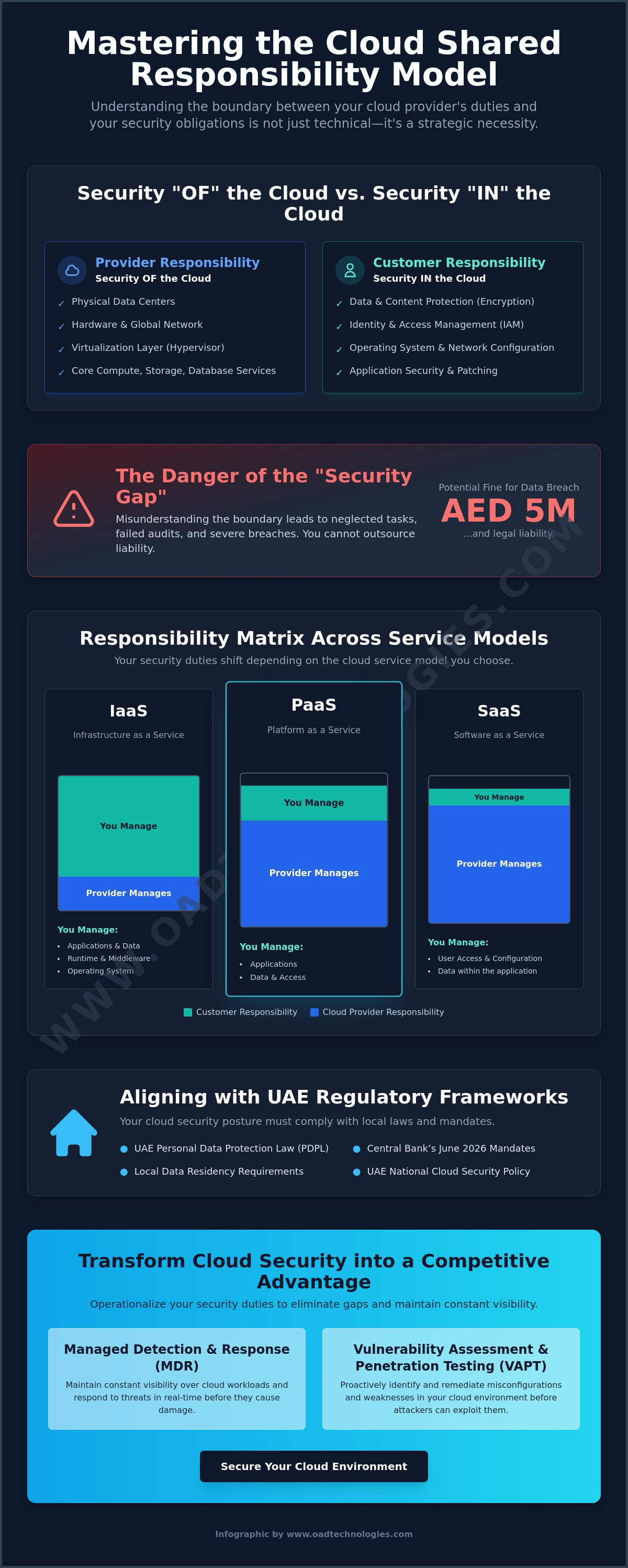
Understanding Cloud computing security requires a clear distinction between the infrastructure and the assets hosted upon it. Providers like AWS, Azure, or Google Cloud take full ownership of the security "of" the cloud. This includes the physical security of data centers, the hardware, the global network, and the virtualization layer. As a customer, you inherit this robust security posture by default. It's often far more sophisticated than what most private enterprises could build independently.
However, security "in" the cloud remains your non-negotiable responsibility. This involves how you configure services, manage identities, and protect your data. Industry data consistently shows that most enterprise breaches aren't the result of a provider's failure. Instead, they stem from customer misconfigurations within the cloud environment. You're responsible for the digital locks you place on the resources provided to you. If a storage bucket is left public or an identity is poorly managed, the provider isn't at fault.
The Consequences of Misunderstanding the Boundary
When the boundary between provider and customer is poorly defined, a "Security Gap" emerges. This gap is a dangerous gray area where critical tasks, such as patch management for virtual machines or database encryption, are neglected. Both parties assume the other is handling them. These assumptions create easy entry points for attackers who specialize in exploiting the seams of a hybrid or multi-cloud architecture.
It's vital to remember that while you can outsource the management of infrastructure, you cannot outsource liability. In the event of a breach, the customer remains legally and financially responsible for data loss, regardless of the provider's status. Utilizing Vulnerability Assessment and Penetration Testing (VAPT) is a proactive way to identify these specific gaps. By simulating real-world attacks, VAPT exposes where your internal security controls have failed to meet the standards required by the shared responsibility model. This allows you to remediate risks before they lead to an audit failure or a catastrophic leak.
The Responsibility Matrix Across Service Models
The division of security labor is not a fixed agreement. It shifts dynamically depending on the consumption model you choose, creating a sliding scale of accountability. Understanding this responsibility matrix across service models is the first step in eliminating operational blind spots. While the provider’s footprint grows as you move from Infrastructure as a Service (IaaS) toward Software as a Service (SaaS), your core liabilities remain anchored in two specific areas: your data and your identities. Mastering the shared responsibility model in cloud security across these models ensures that no asset is left unmonitored during your digital evolution.
IaaS, PaaS, and SaaS: Where the Line Moves
In an IaaS environment, the provider secures the physical facilities and the virtualization layer. You retain control. You manage the operating system, middleware, and the entire application stack. This offers maximum flexibility but demands the highest level of internal security expertise. Moving to PaaS reduces your burden. The provider manages the underlying platform and runtime, leaving you to focus solely on application code and data management. SaaS represents the most significant handoff. Here, the provider manages the entire stack, yet you still hold the keys to user access and the integrity of the data being processed. Because the line of control shifts, Identity and Access Management (IAM) serves as your primary control plane. It's the only security layer that consistently spans every model, acting as the definitive gatekeeper for your digital perimeter.
The New Frontier: Shared Responsibility for AI and LLMs
By 2026, the rise of "AI-as-a-Service" has added a sophisticated new layer to the shared responsibility model in cloud security. When utilizing Large Language Models (LLMs) via API, the provider is responsible for the model’s weights and the massive compute infrastructure supporting it. However, the customer owns the "Prompt Security" layer. This includes ensuring that sensitive corporate data isn't leaked into public training sets and that prompts are sanitized to prevent injection attacks. The risk of data leakage within AI prompts necessitates a robust Data Loss Prevention (DLP) strategy; providers cannot distinguish between a legitimate query and an accidental disclosure of intellectual property. Data quality and the ethical use of outputs are strictly customer-side duties that require proactive oversight.
Navigating these overlapping layers requires a partner who understands the nuance of modern architecture. If you're struggling to map your current assets against these models, a comprehensive security architecture review can provide the clarity needed for long-term resilience.
The Customer Responsibility Deep-Dive: Data, Identity, and Config
The most persistent myth haunting modern IT departments is the belief that cloud migration equals outsourced safety. Many leaders mistakenly assume that "built-in" security means the provider handles backups, data encryption, and configuration by default. This isn't the case. While a provider might offer the tools for these tasks, the activation and management of those tools rest solely on your shoulders. Within the shared responsibility model in cloud security, you aren't just a tenant; you're the primary architect of your own data's integrity. This responsibility extends to the devices accessing your resources. Endpoint security is critical because a compromised laptop can bypass even the most robust cloud firewalls.
Data Governance and Loss Prevention
Data doesn't protect itself just because it's hosted in a top-tier data center. You must define the access policies and data lifecycle rules that dictate who can view, move, or delete information. This is where Data Loss Prevention (DLP) becomes a critical strategic asset. It prevents accidental exposure by enforcing your classification standards across the cloud environment. You also hold the duty of managing encryption keys. If you lose your keys or leave your storage buckets unencrypted, the provider's infrastructure security cannot save you from a breach. Effective governance ensures that your data remains an asset rather than a liability.
Identity and Access Management (IAM) as a Customer Duty
As organizations expand across multiple regions, "Identity Sprawl" becomes a significant threat. Managing user lifecycles, from the moment an employee is onboarded to their eventual offboarding, requires rigorous attention. Implementing Multi-Factor Authentication (MFA) and the principle of Least Privilege isn't optional. It's the core of your defense. In the shared responsibility era, identity isn't just an access tool; it's the new software-defined perimeter that replaces the physical walls of the traditional office. Failing to govern identities effectively leaves the door wide open for credential-based attacks, which remain the top cause of cloud-based data loss.
The complexity of these duties often exceeds the capacity of internal teams. This is why many organizations link their internal controls to Managed Detection and Response (MDR). By integrating MDR, you ensure 24 X 7 oversight of your cloud workloads, bridging the gap between your policy and real-world execution. As noted by industry leaders at Palo Alto Networks, understanding the shared responsibility model is the only way to ensure that critical security tasks don't fall through the cracks of a dual-assumption.
Aligning the Model with UAE Regulatory Frameworks
Compliance in the Emirates has transitioned from a general best-practice exercise into a rigorous, high-stakes operational standard. The shared responsibility model in cloud security directly maps to the UAE Personal Data Protection Law (PDPL), which has governed mainland organizations since January 2022. Under this legal framework, the distinction between a "Data Controller" and a "Data Processor" is fundamental. As the customer, you typically act as the controller. This means that while your cloud provider processes data on your behalf, the primary legal liability for its protection remains with your organization. Failing to uphold your side of the responsibility matrix can lead to severe consequences, with penalties for non-compliance reaching AED 5 million.
Data residency is a non-negotiable factor within this model. While the UAE's National Cloud Security Policy, established in 2023, provides the guiding principles for secure cloud delivery, sector-specific mandates add layers of complexity. For instance, Federal Law No. 2 of 2019 (the Health ICT Law) strictly requires that electronic health data remain within the country. Your responsibility includes not just selecting a local data center, but actively auditing your provider's compliance certificates. You must ensure that your specific configuration doesn't accidentally move sensitive data across borders, a task that requires constant vigilance in multi-cloud environments.
UAE PDPL and Cloud Data Sovereignty
National cybersecurity standards now require explicit evidence of "due care." This means you must be able to prove to regulators that you've implemented robust controls over the layers you own. For financial institutions, this is especially urgent; the Central Bank of the UAE mandated that the first digital impersonation risk assessments be completed by 30 June 2026. These assessments focus on brand protection and takedown controls, areas that fall squarely within the customer’s domain of the shared model. You cannot rely on your provider to monitor for fraudulent domains or impersonation attempts targeting your specific brand; that is a customer-side obligation that requires specialized oversight.
Implementing a GRC Framework for Cloud Security
Documenting these compliance efforts requires a structured approach to Governance, Risk, and Compliance (GRC). Modern GRC tools allow you to map abstract cloud configurations to specific national regulatory requirements, creating a verifiable audit trail. It's vital to distinguish between the "Transfer of Risk" and the "Retention of Responsibility." You might transfer the operational risk of hardware failure to the provider, but you always retain the responsibility for the data stored on that hardware. Continuous monitoring has replaced periodic auditing as the standard for 2026, ensuring that a single misconfiguration doesn't leave you non-compliant for months before discovery.
If you're unsure how your current architecture aligns with these evolving local mandates, our experts can perform a gap analysis to ensure your setup meets all UAE cloud compliance standards.
Operationalising Cloud Security with OAD Technologies
Visibility is the primary currency of cloud defense. While native provider tools offer basic telemetry, they often fail to provide a unified view of risks across multi-cloud or hybrid architectures. We utilize sophisticated Security Information and Event Management (SIEM) solutions to aggregate data from every corner of your digital estate. This centralized intelligence allows our team to provide 24 X 7 oversight through Managed Detection and Response (MDR). By monitoring your cloud workloads in real-time, we identify and neutralize threats before they can exploit the configuration gaps that often lead to data loss.
Bridging the Gap with CSPM and DLP
Automated misconfigurations are the most frequent cause of cloud breaches in 2026. Our Cloud Security Posture Management (CSPM) services continuously scan your environment to detect and remediate these errors instantly. Whether it's an unencrypted storage bucket or an overly permissive identity role, we ensure your infrastructure remains aligned with the shared responsibility model in cloud security. To protect sensitive UAE corporate data, we integrate enterprise-grade Data Loss Prevention (DLP) strategies. These controls safeguard your intellectual property by enforcing strict access rules and preventing the accidental exposure of regulated information within cloud-native applications.
Strategic Partnership and Managed Services
We believe in moving beyond "tool-based" security toward "outcome-based" resilience. This transition requires more than just software; it demands a deep understanding of the local regulatory landscape. Our experts provide customized security assessments and rigorous Vulnerability Assessment and Penetration Testing (VAPT) to stress-test your defenses. Furthermore, our GRC consulting ensures that your documentation and controls remain perfectly aligned with national standards, shielding your business from the legal and financial risks of non-compliance. We don't just act as a vendor; we function as an extension of your team, dedicated to your long-term digital viability.
Don't leave your organization’s security to chance or assumption. Schedule a Cloud Security Assessment with OAD Technologies today to define your roadmap for a secure and compliant digital future.
Architecting a Resilient Cloud Strategy for 2026
Navigating the cloud isn't a solo journey; it's a disciplined partnership where clarity is your greatest defense. As we've explored, the shared responsibility model in cloud security isn't a static document but a dynamic operational requirement. You've identified that while providers secure the "of," you're the sole architect of the "in." This means data governance, identity management, and precise configuration aren't just technical tasks. They're the pillars of your organization's long-term digital relevance and regulatory standing in the UAE.
Success in this landscape requires more than just tools. It demands a strategic system integrator that understands the nuance of local mandates like the UAE PDPL and ISR. OAD Technologies offers advanced MDR and CSPM capabilities designed to bridge the gap between complex software architectures and practical business results. We don't just solve digital challenges; we shape the future of your security posture. Secure Your Cloud Environment with OAD Technologies and gain the confidence to scale without compromise. Your digital evolution deserves a partner committed to your ongoing success.
Frequently Asked Questions
Does the cloud provider back up my data automatically?
No, cloud providers don't automatically manage your data backups. While they provide high-availability tools and redundant infrastructure, the configuration of backup schedules and the verification of data integrity remain customer duties. You're responsible for ensuring that your recovery point objectives (RPO) and recovery time objectives (RTO) align with your business requirements. Relying on provider-side hardware redundancy alone is a common mistake that leads to data loss during logical corruption or accidental deletion.
Is the customer responsible for patching the operating system in SaaS?
No, the cloud provider manages the entire application stack in a SaaS model, including operating system patching. Your responsibility in SaaS is limited to managing user access, identity governance, and the security of the data you input into the application. Because you don't have access to the underlying OS or middleware, the provider assumes the burden of maintaining and securing those layers to ensure service availability and integrity.
How does the shared responsibility model change in a multi-cloud environment?
The shared responsibility model in cloud security becomes significantly more complex in multi-cloud environments because each provider defines its boundaries differently. You must reconcile these varying matrices into a unified security policy. This often requires centralized tools like CSPM to maintain visibility across different cloud ecosystems. Without a cohesive strategy, fragmented responsibilities can create security gaps where critical tasks like logging or encryption are neglected due to differing provider standards.
Who is responsible for PCI-DSS compliance in the cloud?
PCI-DSS compliance is a shared obligation between you and your provider. The Cloud Service Provider (CSP) typically maintains compliance for the physical data center and the hypervisor layer. You're responsible for the compliance of everything you build or host on that infrastructure, including network configurations, encryption of cardholder data, and access controls. You must obtain the provider's Attestation of Compliance (AoC) to satisfy your own audit requirements for the layers they manage.
Can I transfer all security risk to the cloud provider?
You cannot transfer all security risk to a cloud provider. While you can offload the operational burden of managing hardware and physical facilities, you always retain the legal and financial liability for your data. In the event of a breach, regulators and customers hold your organization accountable regardless of where the data was hosted. The shared responsibility model in cloud security ensures that you remain the ultimate guardian of your digital assets and compliance status.
What is the most common customer failure in the shared responsibility model?
The most common failure is the misconfiguration of cloud services, such as leaving storage buckets public or failing to restrict security group rules. These errors occur when customers assume the provider’s infrastructure security covers their specific implementation. Industry data suggests that the vast majority of cloud breaches result from these preventable customer-side oversights. Proactive monitoring and automated remediation are essential to closing these gaps before they are exploited by attackers.
How does IAM fit into the shared responsibility model?
Identity and Access Management (IAM) is the primary control plane that remains a customer responsibility across every cloud service model. You're responsible for defining who has access to your resources and enforcing the principle of least privilege. This includes managing user credentials, implementing multi-factor authentication, and governing the lifecycle of both human and machine identities. Effective IAM ensures that your internal security boundary remains robust even as your physical perimeter disappears.
What role does encryption play in my cloud security duties?
Encryption is a core customer duty for protecting data at rest and in transit. While providers offer encryption tools and Key Management Services (KMS), you must decide which data requires encryption and manage the associated keys. Under UAE PDPL and other global regulations, failing to encrypt sensitive data is often viewed as a failure of "due care." Proper key management ensures that even if the underlying infrastructure is compromised, your proprietary information remains unreadable to unauthorized parties.
Disclaimer
Content by OAD Technologies is for general informational purposes only and does not constitute professional or cybersecurity advice. No warranties are made regarding accuracy or completeness; reliance is at your own risk. OAD Technologies shall not be liable for any direct or indirect losses arising from use of this content.


