
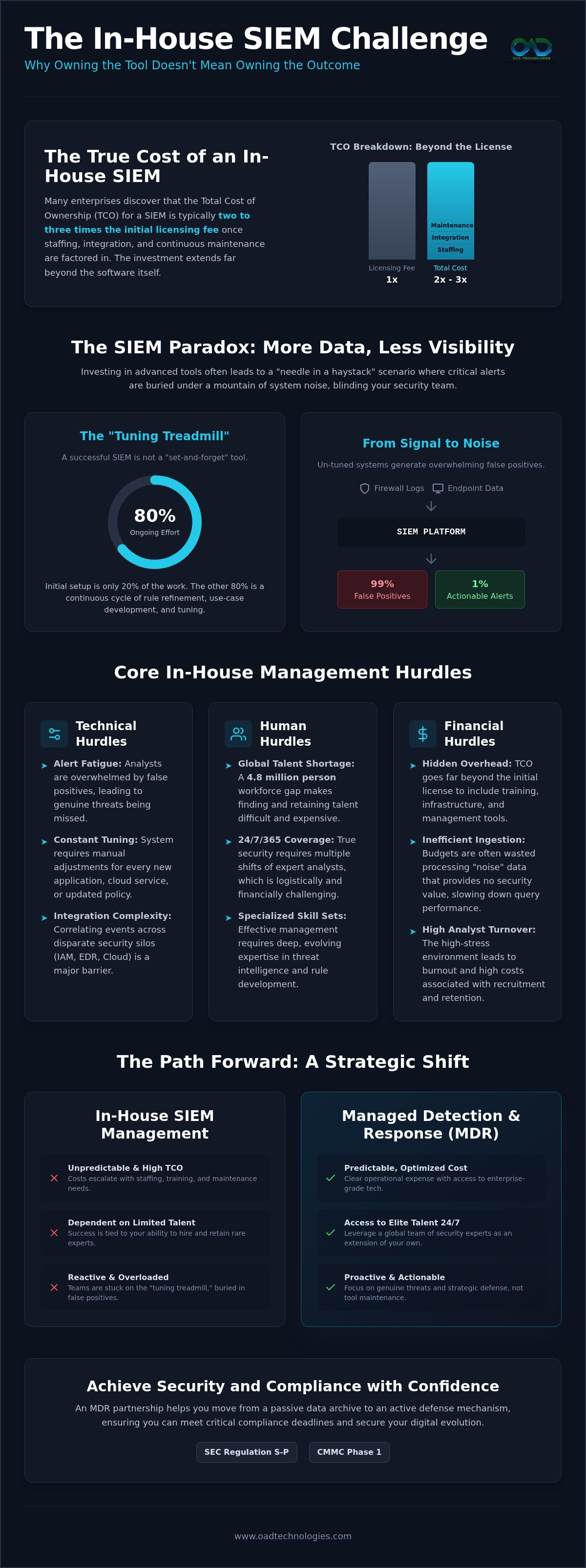
Your SIEM isn't a set-and-forget software product; it's a living ecosystem that requires more human calibration than automated execution. Many UAE enterprises find that the total cost of ownership for an in-house SIEM is typically two to three times the initial licensing fee once staffing and integration are factored in. The challenges of managing a siem in-house have intensified as the gap between data collection and actionable intelligence widens. You're likely facing a relentless volume of false positives and the high cost of retaining specialized analysts in a market with a 4.8 million person workforce gap.
We understand that owning the tool doesn't always equate to owning the outcome. This guide identifies why internal SIEM management often fails to deliver the promised ROI and how to navigate the technical, financial, and human hurdles of modern security. You'll gain a clear framework to decide between building or buying SOC capabilities while learning how to improve threat detection efficiency. We also address how these hurdles impact your ability to meet critical compliance deadlines like the SEC Regulation S-P requirements and CMMC Phase 1 assessments.
Key Takeaways
- Identify why collecting more data often results in less visibility and learn to escape the "tuning treadmill" of manual log management.
- Navigate the core challenges of managing a siem in-house by understanding the technical friction between high alert volumes and actionable intelligence.
- Evaluate the specialized staffing requirements for a 24 X 7 SOC and the impact of the global cybersecurity talent shortage on your internal operations.
- Uncover the hidden components of Total Cost of Ownership (TCO) that extend far beyond software licensing and into operational overhead.
- Explore how transitioning to a Managed Detection and Response (MDR) model provides the strategic partnership needed to secure your digital evolution.
The SIEM Paradox: Why Advanced Tools Often Result in Zero Visibility
The SIEM paradox is a frustrating reality for many CISOs in the UAE. You invest millions of Dirhams into a centralized security hub, only to find that your team is more blinded by data than they were before. This phenomenon occurs because the volume of ingested logs often scales faster than a team's ability to analyze them. One of the primary challenges of managing a siem in-house is that more data doesn't automatically equal more security. Instead, it often leads to a "needle in a haystack" scenario where critical alerts are buried under a mountain of routine system noise.
Modern Security Information and Event Management (SIEM) has evolved far beyond the basic log aggregation of the past decade. It now demands complex security analytics and behavioral modeling to be effective. However, the tool itself is essentially an empty vessel. Its value depends entirely on the logic, correlation rules, and threat intelligence feeds programmed into it by human experts. Without this constant calibration, the system becomes a passive archive rather than an active defense mechanism.
Generic "out-of-the-box" configurations are a common pitfall. These standardized rules are designed for a broad, average environment, but your unique enterprise isn't average. You have bespoke applications, specific cloud integrations, and unique user behaviors that generic rules simply won't capture. When these configurations fail to align with your actual network environment, they either generate endless false positives or, worse, remain silent during a genuine breach.
The Misconception of Set-and-Forget Security
Deployment is only the beginning. In reality, the initial setup represents about 20% of the total effort required for a successful security posture. The remaining 80% is a continuous cycle of use-case development and rule refinement. Threats evolve daily; a detection rule that worked last month might be completely obsolete by next week. Managing this lifecycle internally requires a dedicated team of engineers who can translate new threat patterns into technical logic without disrupting business operations.
Data Gravity and the Cost of Ingestion
Data gravity presents a significant hurdle in hybrid environments. As your data grows in the cloud or on-premise, it pulls other services and logs toward it, creating massive ingestion requirements. Ingesting "noise" data, logs that provide no security value, wastes your budget and slows down query performance. If you throttle ingestion to save on costs, you risk missing the one critical event that signals a lateral movement within your network. Finding the balance between signal and noise is a full-time strategic task.
Technical Hurdles: From Log Fatigue to the Noise of False Positives
In 2026, the volume of security telemetry has reached a critical inflection point. Automated systems and AI-integrated applications now generate logs at an unprecedented scale, often inflating data volumes by nearly 40% compared to just two years ago. This surge contributes directly to the challenges of managing a siem in-house. Your security analysts are likely drowning in a sea of alerts, many of which are false positives triggered by routine automated updates or benign system behaviors. This alert fatigue isn't just a productivity drain; it's a structural vulnerability. When an analyst begins to subconsciously filter out notifications because the previous fifty were noise, a genuine breach can easily slip through the cracks.
Overcoming these challenges to achieve SIEM success requires a relentless focus on what we call the "tuning treadmill." Every time your organization in Dubai or Abu Dhabi deploys a new cloud service or updates an internal application, your SIEM thresholds must be manually adjusted. Without this constant fine-tuning, the system quickly loses its ability to distinguish between legitimate user activity and malicious intent. Furthermore, keeping the platform updated with the latest global threat intelligence feeds is a full-time task. If your signatures are even a few days old, you're effectively defending against yesterday's threats while today's attackers move with impunity.
Correlating events across disparate security silos remains one of the most significant technical barriers. Your Identity and Access Management (IAM) logs, Endpoint Detection and Response (EDR) telemetry, and Cloud Security Posture Management (CSPM) data often speak different "languages." Attempting to bridge these gaps in-house requires deep architectural knowledge and a significant investment in custom integration. If you find the technical debt of your current setup is outpacing your actual security gains, it may be time to consult with a strategic partner to optimize your architecture.
The Problem of Correlation Logic
Modern attackers don't just kick down the digital door. They move laterally, often using valid credentials harvested from one system to escalate privileges in another. Simple, linear correlation rules often miss these complex attack chains because they lack the holistic context of the environment. Writing the sophisticated scripts required for cross-platform detection demands a high level of technical maturity and a well-defined SIEM strategy that many internal teams struggle to maintain alongside daily operations.
Maintaining System Health and Performance
Beyond threat detection, the administrative burden of an in-house deployment is immense. Managing database indexing, optimizing query performance, and ensuring adequate storage for high-volume logs requires specialized skills. If your SIEM cluster experiences downtime or performance degradation during a peak traffic period, you lose visibility at the exact moment you're most vulnerable. High-availability clusters require significant infrastructure investment and constant monitoring to ensure they can scale with your business growth without failing under the weight of their own data.
The Talent Gap: Managing the Human Element in a 24 X 7 Landscape
The human component is the most volatile variable in the security equation. While software licenses are predictable, the challenges of managing a siem in-house often center on the scarcity of qualified personnel. To run an effective operation, you don't just need general IT staff; you need a tiered structure of Tier 1 triage analysts, Tier 2 incident responders, Tier 3 threat hunters, and dedicated SIEM engineers. In the UAE's competitive tech market, retaining this level of expertise is a constant struggle. High turnover rates are driven by chronic burnout and aggressive poaching from competitors, leaving your security posture in a state of perpetual flux.
Many organizations fail to realize that a "9-to-5" security team leaves them vulnerable for 128 hours every week. Adversaries don't respect business hours; in fact, they often strike during weekends or public holidays when they know internal teams are at minimum capacity. This operational gap is one of the Top Three Issues Robbing You Of SIEM ROI, as the tool's effectiveness plummets when no one is there to act on its findings. Keeping these teams updated on 2026 adversary tactics requires continuous, expensive training that adds significant weight to your annual budget. Without this investment, your team will quickly fall behind the sophisticated techniques used by modern threat actors.
The 24 X 7 SOC Requirement
Achieving true 24 X 7 coverage is a numbers game that most mid-market firms lose. To account for three daily shifts, weekend rotations, annual leave, and sick days, a minimum headcount of 8 to 12 full-time employees is typically required. Managing the logistics of night shifts in a region like the UAE, where work-life balance is increasingly prioritized, presents a significant administrative burden. Without a dedicated "eyes-on-glass" team, your mean time to respond (MTTR) will inevitably degrade, giving attackers the window they need to exfiltrate data while your staff is off-duty.
Specialization vs. Generalization
Relying on general IT staff to manage a SIEM is a recipe for missed detections. Security analysis is a distinct discipline requiring deep knowledge of network protocols, digital forensics, and data sources like Identity and Access Management (IAM). When your lead SIEM architect leaves, they take months of custom logic and tribal knowledge with them. This "brain drain" can set your security maturity back by years, forcing you to restart the tuning process from scratch and exposing your organization to unnecessary risk during the transition.
Calculating the Hidden Total Cost of Ownership (TCO) for In-House SIEM
The financial commitment required to maintain a robust security posture often exceeds the initial procurement budget by a significant margin. One of the most overlooked challenges of managing a siem in-house is the accumulation of "soft costs" that don't appear on a software invoice. While licensing is a visible line item, the true TCO includes specialized personnel, high-performance infrastructure, and the constant operational overhead of system maintenance. Diverting your internal IT resources to manage these complexities creates a hidden opportunity cost. Every hour your senior engineers spend troubleshooting log ingestion is an hour they aren't spending on digital transformation or revenue-generating projects.
In the UAE, the stakes for regulatory alignment are exceptionally high. Failing to meet the rigorous data retention and monitoring standards set by NESA or the Abu Dhabi Information Security Regulation (ISR) can result in substantial financial penalties. An in-house SIEM that isn't properly tuned might technically collect logs while failing to meet the audit requirements for real-time detection. This gap between having the tool and being compliant is where many enterprises face their greatest financial risk. To ensure your strategy aligns with these mandates, you should evaluate your Governance Risk and Compliance (GRC) framework alongside your technical stack.
The ultimate cost of an in-house model is the price of a failed detection. By 2026, the average cost of a data breach has reached new heights due to increased litigation and the complexity of hybrid-cloud environments. If your internal team misses a breach because they were overwhelmed by false positives, the resulting cleanup, legal fees, and loss of customer trust can cost millions of Dirhams. Investing in a professional security partnership can often mitigate these risks more effectively than attempting to build a world-class SOC in isolation.
Licensing Models: EPS vs. Data Volume
Licensing models often feel like a tax on your company's growth. Whether you choose Events Per Second (EPS) or volume-based (GB/day) pricing, your security costs will inevitably rise as your business activity increases. Unexpected spikes in log data from a new marketing campaign or a cloud migration can lead to "bill shock" or, even worse, data dropping because you've hit your ingestion cap. Managing these fluctuations requires constant oversight to ensure you're capturing the signal without paying for the noise.
Infrastructure and Redundancy Costs
The physical or cloud infrastructure required to house years of security data is a major capital expense. High-availability clusters require redundant compute power and tiered storage strategies, ranging from expensive hot storage for active searching to cold archives for long-term compliance. If your disaster recovery plan doesn't account for the immediate restoration of security visibility, you remain vulnerable during the most critical moments of a system failure. Maintaining this level of redundancy requires a specialized engineering skillset that adds another layer to your personnel costs.
Beyond In-House Management: Transitioning to an MDR Model
The cumulative weight of the challenges of managing a siem in-house often leads to a critical realization: security is an outcome, not a product. As we've explored, the technical friction and personnel costs of an internal SOC can stifle an organization's digital agility. Managed Detection and Response (MDR) represents the logical evolution of the SIEM model. It shifts the focus from simply collecting data to actively neutralizing threats. By partnering with an MDR provider, UAE enterprises can bypass the multi-year recruitment and training cycles that typically handicap internal security initiatives. You gain instant access to a mature security posture without the administrative burden of building it from scratch.
OAD Technologies advocates for a "Hybrid SOC" model. This approach allows your internal IT team to retain oversight while our specialists handle the heavy lifting of 24 X 7 monitoring and complex correlation. Unlike standard outsourcing, this partnership ensures you maintain full ownership of your data while benefiting from our bespoke security architecture. We move beyond reactive log monitoring to implement proactive threat hunting. This involves searching for subtle indicators of compromise that automated tools might overlook, ensuring that dormant threats are neutralized before they can execute their final payload.
The Strategic Advantage of MDR
MDR providers leverage global threat intelligence to protect your local environment in real time. When a new ransomware variant is identified in Europe or North America, those signatures and behavioral patterns are immediately applied to your defenses in Dubai or Abu Dhabi. The most significant shift, however, is the move from "Alerting" to "Response." Legacy SIEM setups tell you when something happened; MDR takes action to contain it. This might include isolating a compromised endpoint or revoking a suspicious credential the moment an anomaly is detected. For a deeper dive into these capabilities, explore our MDR Strategic Guide.
Selecting the Right Partner for UAE Compliance
Navigating the specific regulatory landscape of the UAE requires more than just technical skill. You need a partner who understands the nuances of NESA and ISR mandates. OAD Technologies provides the local expertise necessary to ensure your security architecture isn't just effective, but also fully compliant with national standards. We don't believe in standardized, one-size-fits-all security. Our approach centers on customized integration that empowers your people and protects your long-term digital relevance. True security is a strategic partnership, not just a procurement exercise.
Securing Your Digital Future Through Strategic Partnership
Managing a SIEM in 2026 is no longer a simple task of log aggregation; it is a complex exercise in human-driven intelligence and architectural precision. As we have explored, the challenges of managing a siem in-house range from the relentless "tuning treadmill" to the significant financial burden of maintaining a 24 X 7 specialized workforce. Owning the technology is only a fraction of the battle. The real value lies in your ability to bridge the gap between intricate technical telemetry and the rigorous GRC mandates required for UAE compliance.
By transitioning to a hybrid SOC or MDR model, you reclaim your internal IT resources while gaining the proactive threat hunting capabilities necessary to stay ahead of modern adversaries. Our Dubai-based expertise provides the localized insight needed to navigate regional regulations while ensuring your security infrastructure scales with your business growth. We act as a dedicated extension of your team, providing the visionary engineering and 24 X 7 vigilance required for long-term digital resilience.
Elevate your security posture with OAD Technologies’ Managed SIEM and MDR services.
The path to enterprise resilience starts with a shift from reactive monitoring to proactive defense. We are ready to help you design a system that secures your ongoing digital relevance.
Frequently Asked Questions
What is the biggest challenge in managing a SIEM in-house?
The most significant hurdle is the "tuning treadmill," which refers to the constant need for expert calibration of detection logic. One of the primary challenges of managing a siem in-house is that the tool quickly becomes obsolete without daily refinement to match your evolving network environment. This requires a level of specialized security engineering that many internal IT teams simply don't have the capacity to maintain alongside their core responsibilities.
How many people are needed to run a SIEM 24 X 7?
A true 24 X 7 operation typically requires a minimum of 8 to 12 full-time employees to ensure continuous "eyes-on-glass" coverage. This headcount accounts for three daily eight-hour shifts, weekend rotations, annual leave, and sick days. Attempting to run a round-the-clock SOC with fewer people leads to rapid burnout and significant gaps in visibility during off-peak hours, which is when many sophisticated attackers choose to strike.
Why are SIEM false positives so common?
False positives occur when generic, out-of-the-box correlation rules fail to account for the unique "noise" of your specific enterprise environment. Automated system updates, routine administrative tasks, and bespoke internal applications often trigger alerts that look like malicious activity to an untuned system. Without constant suppression and refinement of these rules, your analysts will suffer from alert fatigue, increasing the risk that they'll overlook a genuine indicator of compromise.
Is it cheaper to outsource SIEM or keep it in-house?
Total Cost of Ownership (TCO) is almost always lower when partnering with a managed provider because you avoid the massive capital expenditure of infrastructure and the high salaries of a 24 X 7 team. In-house models carry hidden costs, such as continuous training, recruitment fees, and the high price of hardware redundancy. Transitioning to a managed model allows you to convert these unpredictable variable costs into a stable, predictable operational expense.
Can a SIEM replace an EDR solution?
No, a SIEM cannot replace Endpoint Detection and Response (EDR) because they serve fundamentally different purposes in your security stack. A SIEM acts as a centralized aggregator that correlates data from across your entire network, while EDR provides deep, agent-based visibility and response capabilities directly on your workstations and servers. For a robust defense, you need both tools working in tandem to provide both broad context and granular control.
How does SIEM help with UAE compliance like NESA or ISR?
A properly managed SIEM is essential for meeting UAE-specific mandates like the NESA National Cyber Security Strategy or the Abu Dhabi Information Security Regulation (ISR). These frameworks require strict log retention, real-time security monitoring, and the ability to produce detailed audit trails for forensic investigations. By centralizing this data, a SIEM provides the technical evidence needed to demonstrate compliance during official audits and ensures you meet national data residency requirements.
What is the difference between Managed SIEM and MDR?
Managed SIEM focuses primarily on the collection, monitoring, and alerting of security events, often leaving the remediation to your internal team. Managed Detection and Response (MDR) is more comprehensive, as it includes active threat hunting and immediate incident containment. While a SIEM tells you that a breach is happening, an MDR service takes the extra step of isolating the affected systems or revoking compromised credentials to stop the attack in its tracks.
How often should SIEM correlation rules be updated?
Correlation rules should be reviewed and updated continuously, ideally on a weekly basis at minimum. The threat landscape moves too quickly for a monthly or quarterly update cycle to be effective. As new vulnerabilities are discovered and adversary tactics evolve, your SIEM logic must be adjusted to detect these new patterns. This constant state of evolution is why many organizations struggle with the challenges of managing a siem in-house without a dedicated content development team.
Disclaimer
Content by OAD Technologies is for general informational purposes only and does not constitute professional or cybersecurity advice. No warranties are made regarding accuracy or completeness; reliance is at your own risk. OAD Technologies shall not be liable for any direct or indirect losses arising from use of this content.