

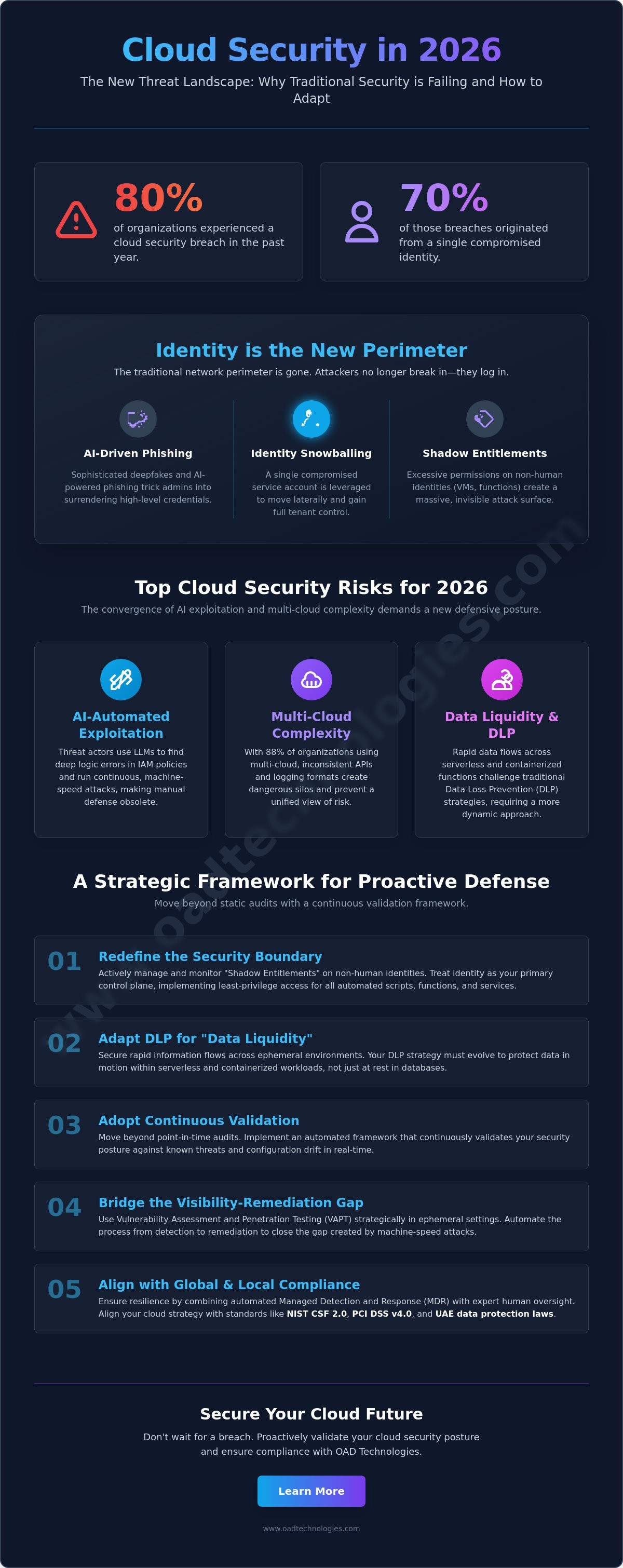
Did you know that 80% of organizations experienced a cloud security breach in the past year, with 70% of those incidents originating from a single compromised identity? It's a sobering reality that confirms the traditional network perimeter is officially dead. As you manage complex multi-cloud environments, you've likely felt the pressure of AI-powered automated attacks and the struggle to maintain visibility across fragmented silos. Staying ahead of the top cloud security risks 2026 brings requires more than just reactive patching; it demands a shift toward identity-centric security and proactive validation.
We understand that balancing rapid innovation with stringent UAE data protection laws creates a unique set of challenges for your team. This guide promises to help you master the evolving threat landscape by providing an expert deep-dive into AI-driven risks and strategic defense frameworks. You'll gain access to a prioritized list of 2026 risks and a practical framework for proactive validation. We'll also show you how to align your cloud strategy with current standards like NIST CSF 2.0 and PCI DSS v4.0 to ensure long-term operational resilience and regulatory compliance.
Key Takeaways
- Redefine your security boundary by addressing the "Shadow Entitlements" crisis where non-human identities carry excessive, unmonitored permissions.
- Adapt your Data Loss Prevention (DLP) strategy for "Data Liquidity" to secure rapid information flows across serverless and containerized environments.
- Move beyond static audits by adopting a continuous validation framework designed to mitigate the top cloud security risks 2026.
- Bridge the gap between visibility and remediation through the strategic application of Vulnerability Assessment and Penetration Testing (VAPT) in ephemeral cloud settings.
- Align your technical infrastructure with UAE compliance standards by combining automated Managed Detection and Response (MDR) with expert human oversight.
The 2026 Cloud Threat Landscape: Why Traditional Security is Failing
The definition of top cloud security risks 2026 has fundamentally shifted from static misconfigurations to a volatile convergence of AI-automated exploitation and hyper-complex multi-cloud architectures. In the past, security teams relied on periodic audits and point-in-time snapshots to maintain their posture. That approach is now obsolete. In 2026, cloud assets are increasingly ephemeral, existing only for minutes or seconds to process specific workloads. A security audit performed yesterday offers zero protection against a machine-speed attack targeting a container that was spun up and exploited five minutes ago.
This rapid evolution has created a dangerous Visibility-Validation Gap. While most enterprises have invested heavily in tools to see their assets, simply seeing a risk no longer equates to stopping it. When an attacker uses automated scripts to weaponize a vulnerability in milliseconds, the "human in the loop" becomes a bottleneck rather than a safeguard. This reality has effectively broken the traditional Shared Responsibility Model. While foundational cloud computing security principles still assign data protection to the customer, the speed of modern threats means you can't wait for a manual response to fulfill your end of the bargain.
The Rise of AI-Automated Exploitation
Threat actors have traded manual reconnaissance for Large Language Models (LLMs) capable of identifying deep logic errors in cloud configurations. They don't just look for open ports; they analyze complex IAM policies to find unintended privilege escalation paths that human auditors often overlook. Malicious actors now run continuous, automated scanning across the entire IPv4 space, looking for even the slightest drift in security posture. AI-driven cloud fuzzing is the systematic, automated injection of unexpected data into cloud interfaces to discover hidden vulnerabilities, and it represents a primary threat to infrastructure in 2026. This shift means that your defense must be as autonomous and persistent as the attacks you face.
Complexity of Hybrid and Multi-Cloud Ecosystems
With 88% of organizations now operating in hybrid or multi-cloud environments, the sheer volume of telemetry has become overwhelming. Each cloud provider uses different naming conventions, API structures, and logging formats, which creates dangerous security silos. These silos prevent a unified view of risk, making it difficult to maintain a consistent security baseline. To bridge these gaps, enterprises are moving toward a unified cloud security posture management (CSPM) approach. This strategy ensures that a security policy defined for one environment is automatically enforced across all others, preventing the configuration drift that leads to 45% of all data breaches occurring in the cloud.
Identity as the New Perimeter: AI and Entitlement Risks
In 2026, the network perimeter has completely dissolved. Security leaders now recognize that Identity and Access Management (IAM) is the only viable boundary left between an enterprise and its adversaries. Data from SentinelOne confirms that 70% of cloud breaches now start with compromised identities. This makes identity exploitation one of the top cloud security risks 2026 organizations must prioritize. Attackers no longer focus exclusively on breaking through firewalls; they simply log in. They utilize AI-driven phishing and sophisticated deepfakes to trick administrators into surrendering high-level credentials. Once inside, they exploit "Identity Snowballing," a process where a single compromised service account provides the leverage needed to move laterally and eventually gain full tenant control.
A significant portion of this risk stems from "Shadow Entitlements." These are overly permissive roles granted to non-human identities such as virtual machines, serverless functions, and automated scripts. Because these identities lack a human user to monitor their behavior, they often accumulate excessive permissions over time without oversight. This creates a massive, invisible attack surface. Understanding these cloud security threats and vulnerabilities requires a fundamental shift in perspective. You aren't just protecting people; you're protecting every automated process and integration in your technology stack.
The Vulnerability of Non-Human Identities (NHIs)
Non-human identities now significantly outnumber human users in typical enterprise cloud environments. These service accounts and API keys are the preferred targets for 2026 breaches because they rarely use Multi-Factor Authentication (MFA) and often rely on static credentials. Rotating these keys within high-velocity DevOps pipelines remains a massive operational challenge for most teams. If a key is hardcoded or stored in an insecure vault, your entire deployment pipeline becomes an entry point. Establishing a robust Identity and Access Management (IAM) strategic framework is essential to automate the lifecycle and rotation of these machine identities.
Zero Trust Architecture: From Buzzword to Necessity
Enterprises are moving beyond marketing hype to implement true Zero Trust architectures. This involves enforcing the Principle of Least Privilege (PoLP) at a granular level. Instead of granting static permissions that stay active indefinitely, the focus has shifted to Just-in-Time (JIT) access. Users and machines receive the minimum permissions necessary only for the duration of a specific, validated task. Continuous authentication monitors session behavior in real time, looking for anomalies that suggest credential theft or session hijacking. Implementing these identity-centric security controls ensures that even if a credential is leaked, its utility to an attacker is severely limited by time and context.
Data Liquidity and the 2026 DLP Challenge
In the 2026 enterprise landscape, data is no longer a static asset sitting in a database; it's a fluid force moving at high velocity. We define this as Data Liquidity. This rapid movement across cloud services, microservices, and external APIs creates a multitude of new leak vectors that traditional security measures simply can't monitor. As data flows through ephemeral environments, it becomes one of the top cloud security risks 2026 leaders must mitigate. Perimeter-based tools fail here because they're designed to watch the "front door," yet most modern data movement happens internally between serverless functions and containerized workloads where no traditional perimeter exists.
A specific, often overlooked threat is Data Residue. When short-lived storage resources are decommissioned, sensitive information can remain in the underlying infrastructure if not properly purged. This "ghost data" remains vulnerable to discovery by subsequent tenants or malicious actors who exploit hypervisor vulnerabilities. These technical failures carry heavy weights. Under the UAE Personal Data Protection Law (PDPL), a cloud breach involving personal data can lead to severe administrative fines and mandatory notification requirements. Protecting this data isn't just a technical necessity; it's a legal imperative for maintaining your license to operate within the region.
Analysis of federal government cloud security initiatives shows that visibility into these complex flows is the first step toward resilience. You must understand where your data lives and how it moves before you can secure it effectively.
Modernising Data Loss Prevention (DLP) for the Cloud
Securing cloud-native applications requires a shift toward context-aware data loss prevention. This means your security stack must understand the intent behind a data transfer, not just the content. You need to secure data-in-motion as it traverses microservices and interacts with external APIs that power your business ecosystem. While cloud-native encryption is a baseline requirement, it's not a comprehensive security strategy on its own.
The Risk of Shadow AI and Unmanaged Data Flows
The rise of generative AI has introduced the "Shadow AI" crisis. Employees frequently upload corporate data to public AI tools to streamline their work, inadvertently creating massive Shadow Data risks. Beyond internal leaks, organizations face adversarial machine learning threats where attackers target cloud-hosted training sets to poison models or extract proprietary information. To combat this, you need aggressive discovery strategies.
- Automate the classification of "dark" cloud data that exists outside known repositories.
- Implement real-time monitoring for unauthorized data uploads to public LLMs.
- Enforce strict data egress policies for all containerized environments.
Identifying these unmanaged flows is the only way to prevent your most valuable intellectual property from becoming public training data. By mapping these hidden pathways, you can apply controls that empower your team to use AI without sacrificing security.
Strategic Remediation: From Visibility to Continuous Validation
Seeing a threat is not the same as stopping it. While visibility tools provide a map of your infrastructure, they don't confirm if your defenses actually hold under pressure. To combat the top cloud security risks 2026 presents, enterprises must transition from reactive alerting to a model of continuous validation. This shift is embodied in Continuous Threat Exposure Management (CTEM), an operational standard that replaces sporadic scanning with a cyclical, five-step process: scoping, discovery, prioritization, validation, and mobilization. By adopting this framework, you move beyond "security by checklist" and toward a state of verified resilience.
The transition starts with scoping your entire attack surface, including the "Shadow AI" and ephemeral data flows discussed earlier. Once discovered, vulnerabilities shouldn't just be ranked by a generic severity score. They must be prioritized based on their actual business impact and exploitability within your specific architecture. This is where Vulnerability Assessment and Penetration Testing (VAPT) becomes critical. Validation proves whether a theoretical weakness can be weaponized in your environment, allowing your team to focus remediation efforts where they matter most. However, automated remediation can fail if it isn't balanced with human-led oversight and strict alignment with your broader business objectives.
Integrating VAPT into the Cloud Lifecycle
Annual penetration testing is insufficient for the dynamic cloud environments of 2026. When your infrastructure changes daily, your testing must keep pace. We advocate for the rise of Purple Teaming, where your defenders (Blue Team) and attackers (Red Team) work in a continuous feedback loop to tune defense mechanisms in real time. This approach balances the speed of automated scanning with expert-led manual testing to uncover deep logic errors that AI tools often miss. It ensures that your security posture isn't just a snapshot in time but a living, breathing shield.
GRC and National Compliance Alignment
Cloud security doesn't exist in a vacuum; it must be anchored in a robust Governance Risk and Compliance (GRC) framework. This is especially vital for organizations navigating UAE-specific regulatory requirements and national audits. Your cloud controls must map directly to regional mandates like the PDPL to ensure data sovereignty and privacy. Automated compliance reporting is no longer optional; it's a baseline requirement for maintaining continuous audit readiness and proving to stakeholders that your cloud expansion is both ambitious and secure. Partner with our experts to validate your cloud security posture and ensure your enterprise remains resilient against evolving threats.
Securing the Future: The OAD Technologies Approach to Cloud Resilience
OAD Technologies acts as a master designer of systems, bridging the gap between high-level innovation and practical business results for UAE enterprises. We recognize that the top cloud security risks 2026 presents cannot be solved by simply stacking more software. Instead, we propose a unified, proactive defense architecture that integrates Security Information and Event Management (SIEM), Endpoint Detection and Response (EDR), and Cloud Security Posture Management (CSPM). This integrated approach ensures that telemetry from every corner of your multi-cloud ecosystem is analyzed in context. We transform fragmented data into actionable intelligence, allowing your leadership to make informed decisions about risk and investment returns.
Beyond Tools: The Power of Managed Security
Technology alone cannot solve the human-centric identity risks or the machine-speed attacks of 2026. Our Managed Detection and Response (MDR) services provide the critical synergy between automated detection and strategic human insight. While AI-powered tools identify anomalies, our expert analysts provide the intuition needed to understand attacker intent and coordinate a precise response. This 24 X 7 capability is essential for mitigating attacks that move faster than a standard internal team can react. We don't just act as a third-party vendor. We function as a collaborative extension of your own team, committed to precision and high-quality craftsmanship in every intervention.
Your 2026 Cloud Security Checklist
CISOs must move beyond reactive patching to a structured model of governance and validation. To effectively mitigate the top cloud security risks 2026 will bring, we recommend focusing on four key pillars:
- Audit: Conduct a comprehensive review of human and non-human identities to eliminate shadow entitlements.
- Validate: Use continuous penetration testing to prove your defenses can withstand AI-automated exploitation.
- Automate: Deploy just-in-time access and automated remediation to reduce the window of exposure.
- Govern: Ensure every cloud control is mapped to UAE-specific data protection laws and national compliance standards.
The first step toward true resilience is a comprehensive Cloud Security Assessment. This process identifies existing gaps and provides a clear, prioritized roadmap for remediation. Don't wait for a breach to reveal the weaknesses in your multi-cloud architecture. Consult with OAD Technologies for expert cloud security guidance and secure your enterprise's future today.
Architecting a Resilient Cloud Future
Success in the next era of digital transformation hinges on your ability to treat identity as the new perimeter and data liquidity as a primary security challenge. We've explored why static audits are no longer sufficient to stop machine-speed attacks. Preparing for the top cloud security risks 2026 requires a shift toward continuous validation through VAPT and a robust GRC framework that respects UAE data protection laws. It's about building a system that doesn't just see threats; it must actively validate and remediate them in real time.
OAD Technologies stands ready as your UAE-based strategic cybersecurity partner. We combine advanced 2026 Managed Security Services with deep expertise in DLP, VAPT, and GRC to ensure your infrastructure remains both compliant and resilient. Don't let the complexity of multi-cloud environments stall your ambition. Secure your enterprise cloud with OAD Technologies’ expert MDR and DLP solutions and maintain your competitive edge. You have the vision for your company's growth; we have the rigorous engineering standards to protect it every step of the way.
Frequently Asked Questions
What are the biggest cloud security risks for UAE enterprises in 2026?
The primary cloud security risks for UAE enterprises in 2026 center on the exploitation of non-human identities and non-compliance with the UAE Personal Data Protection Law (PDPL). As organizations scale across multiple providers, the lack of unified governance creates blind spots that attackers weaponize using AI-automated scanning. Addressing these top cloud security risks 2026 requires a shift toward identity-centric architectures and continuous posture validation to ensure regional data sovereignty remains intact.
How has AI changed the cloud threat landscape since 2024?
AI has accelerated the exploitation lifecycle from days to milliseconds by automating reconnaissance and the discovery of configuration logic errors. Since 2024, threat actors have moved beyond simple phishing to using LLMs for cloud fuzzing and creating high-fidelity deepfakes that bypass traditional biometric authentication. This evolution means your defense mechanisms must now operate at machine speed to counter threats that no longer wait for human intervention or manual approval.
Why is CSPM no longer enough for modern cloud security?
Cloud Security Posture Management (CSPM) is no longer sufficient because it offers visibility into misconfigurations without providing active validation or remediation. While CSPM tools identify that a storage bucket is public, they don't confirm if that configuration is part of a broader, weaponizable attack path. In 2026, you need a move toward exposure management that combines visibility with penetration testing to prove which risks actually threaten your operational resilience.
What is the role of DLP in a cloud-first security strategy?
Data Loss Prevention (DLP) serves as the critical safeguard for data liquidity, monitoring information as it moves between microservices and external APIs. In a cloud-first strategy, DLP must be context-aware to differentiate between legitimate business flows and unauthorized exfiltration to public AI tools. It ensures that sensitive intellectual property doesn't inadvertently become training data for third-party models, maintaining your enterprise's competitive advantage and regulatory standing.
How often should we conduct VAPT for our cloud infrastructure in 2026?
You should transition from periodic, annual VAPT to a continuous validation model that aligns with your rapid deployment cycles. In 2026, static testing is obsolete because a single CI/CD update can introduce new vulnerabilities in seconds. Implementing a Continuous Threat Exposure Management (CTEM) framework allows for event-driven testing, ensuring that every significant change to your cloud infrastructure is validated against the latest exploitation techniques.
Can MDR services help with cloud compliance in the UAE?
Managed Detection and Response (MDR) services provide the continuous monitoring and expert oversight necessary to meet stringent UAE national audit requirements. By integrating SIEM and EDR telemetry, MDR platforms generate the automated compliance reports needed for PDPL adherence. This synergy between technology and human insight ensures that your enterprise can prove its security posture to regulators at any time, reducing the risk of administrative fines.
What is the Identity Perimeter and why does it matter for 2026?
The Identity Perimeter is the concept that access control, not network location, is the primary boundary for modern cloud environments. In 2026, this matters because 70% of breaches start with compromised identities, making traditional firewalls irrelevant. By focusing on Identity and Access Management (IAM), you ensure that every user and machine identity is verified based on real-time risk scores and behavior before granting time-bound access.
How do we secure ephemeral resources like serverless functions?
Securing ephemeral resources requires a shift-left approach that builds security into the container and serverless code from the start. You must enforce Just-in-Time (JIT) access for all non-human identities to ensure credentials exist only for the duration of a specific task. Additionally, implementing strict egress filtering and runtime protection prevents attackers from using short-lived functions as a staging ground for lateral movement or data exfiltration.
Disclaimer
Content by OAD Technologies is for general informational purposes only and does not constitute professional or cybersecurity advice. No warranties are made regarding accuracy or completeness; reliance is at your own risk. OAD Technologies shall not be liable for any direct or indirect losses arising from use of this content.


