

What if the 188 controls of the UAE Information Assurance Standards (IAS) weren't a regulatory hurdle, but the architectural blueprint for your enterprise's digital sovereignty? You've likely found that the transition from NESA to the Signals Intelligence Agency (SIA) has introduced layers of complexity that feel overwhelming. It's difficult to map technical tools like DLP and SIEM to specific mandates while keeping pace with the 2026 focus on AI governance and supply chain risk. We recognize that achieving uae nesa compliance requirements isn't just about passing an audit. It's about securing your place in the nation's critical infrastructure through a proactive, solution-oriented mindset.
This guide provides a technical roadmap to master the IAS, turning mandatory checkboxes into a robust framework for enterprise resilience. We'll break down the 18 domains of the regulation and explore the impact of the National Cyber Accreditation Programme (NCAP). You'll learn how to integrate advanced solutions like IAM and CSPM to ensure you pass your next SIA audit without a single non-conformity. By the end, you'll have a clear strategy to bridge the gap between high-level innovation and practical business results.
Key Takeaways
- Understand the evolution of the National Electronic Security Authority into the Signals Intelligence Agency and how this shift redefines your organization's regulatory mandate.
- Identify the critical Priority One (P1) management controls that form the mandatory foundation for a resilient and compliant security posture.
- Discover how to map technical solutions like Data Loss Prevention and Identity and Access Management to specific uae nesa compliance requirements to eliminate security gaps.
- Follow a structured five-step roadmap to navigate gap analysis and remediation, ensuring your enterprise is fully prepared for a rigorous SIA audit.
- Learn why Managed Detection and Response serves as a strategic alternative to in-house monitoring for satisfying complex real-time reporting and T8 mandates.
Understanding the UAE Information Assurance Standards (IAS)
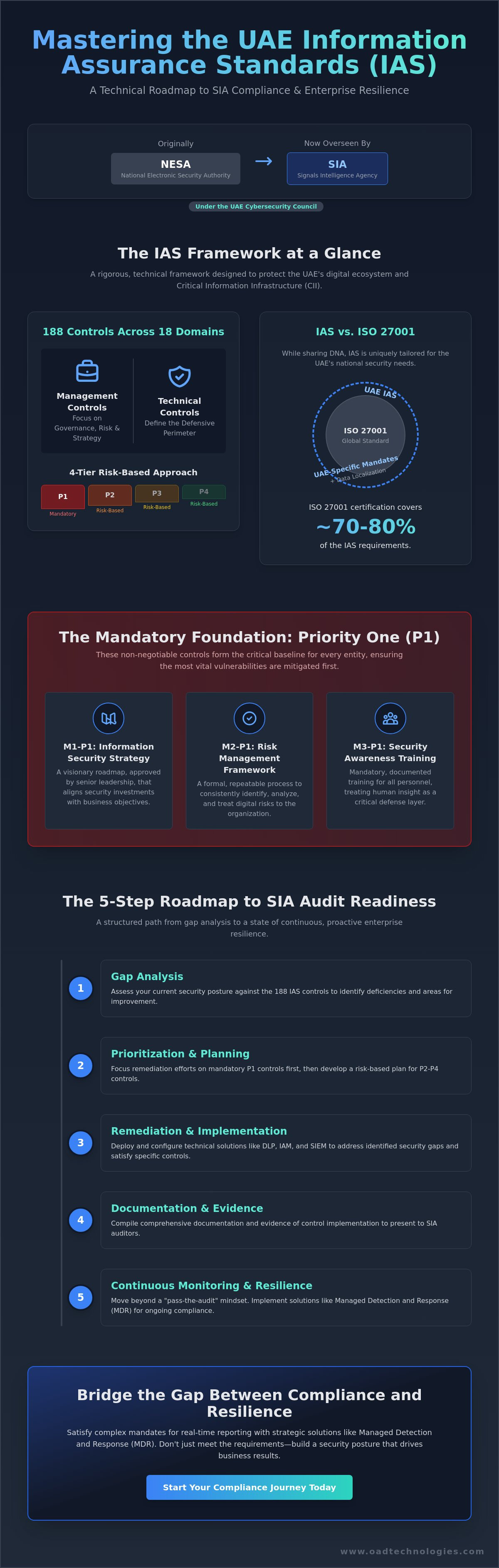
The UAE Information Assurance Standards (IAS) represent the definitive cybersecurity benchmark for the Emirates. This isn't just a set of guidelines. It's a rigorous, technical framework designed to protect the nation's digital ecosystem from evolving cyber threats. Originally established by NESA, regulatory oversight has shifted. Today, the Signals Intelligence Agency (SIA) manages these mandates, operating under the strategic umbrella of the UAE Cybersecurity Council. This transition reflects a move toward a more unified, intelligence-led approach to national security, aligning with the "We the UAE 2031" vision. Organizations must realize that meeting uae nesa compliance requirements is a legal necessity for any entity touching critical national infrastructure. It's about building a collective shield while maintaining the integrity of the nation's digital assets. By adhering to these standards, businesses don't just avoid penalties; they contribute to the nation's digital sovereignty and ensure their own long-term viability. The IAS framework provides a structured path for enterprises to evolve their security posture from reactive defense to proactive resilience. This strategic alignment ensures that technical investments provide clear business value, grounding innovation in the reality of operational performance and strategic expansion. It's a commitment to precision and high-quality craftsmanship in digital defense.
The Scope of NESA/SIA Compliance
Compliance targets entities where a breach would be most severe, including federal and local government bodies and Critical Information Infrastructure (CII) operators in energy, finance, and healthcare. While the IAS framework shares DNA with ISO 27001, it's uniquely tailored for the UAE. ISO 27001 certification covers roughly 70-80% of the requirements, but the IAS adds specific regional mandates for data localization, ensuring every byte of critical data remains under domestic protection.
The Structure of the 188 Controls
The framework consists of 188 security controls distributed across 18 domains as of the 2026 standards. These are split between Management controls, focused on governance and risk, and Technical controls, which define the defensive perimeter. Implementation follows a 4-tier risk-based approach, allowing organizations to prioritize investments based on data sensitivity. This structure ensures that even the most complex uae nesa compliance requirements remain manageable through a logical progression, creating a resilient architecture that supports long-term operational performance.
The Mandatory Priority One (P1) Requirements
Achieving full alignment with uae nesa compliance requirements begins with a laser focus on Priority One (P1) controls. These aren't suggestions; they're the mandatory foundation for every entity within the SIA jurisdiction. While the total framework encompasses 188 controls, the P1 tier represents the critical baseline that must be fully implemented before an organization can effectively address the risk-based P2, P3, and P4 tiers. This prioritization ensures that the most vital vulnerabilities in the national digital infrastructure are mitigated first. Think of P1 as the structural integrity of your security architecture. Without it, higher-level technical defenses remain unstable. This guide to NESA IAS compliance highlights how these tiers prioritize national security interests, moving organizations away from reactive "checkbox" security toward a model of continuous enterprise resilience.
Management & Governance Controls (M1-M6)
Governance is the engine of compliance. Under M1-P1, your organization must establish an Information Security Strategy approved by senior leadership. This document isn't a static policy; it's a visionary roadmap that aligns security investments with business objectives. Closely linked is the M2-P1 mandate for a formal Risk Management Framework. You must demonstrate a repeatable process for identifying, analyzing, and treating digital risks. Finally, M3-P1 requires mandatory Security Awareness Training for all personnel. Human insight remains the most flexible defense layer, and the SIA expects documented proof that staff understand their role in protecting national assets. A robust Governance, Risk, and Compliance (GRC) strategy ensures these management mandates don't become administrative burdens but instead drive operational performance.
Essential Technical Controls (T1-T8)
Technical execution under P1 demands precision. T1-P1 mandates a comprehensive hardware and software asset inventory. You can't protect what you can't see, and an incomplete inventory is an invitation for unauthorized access. Moving to T5-P1, the focus shifts to Access Control and Identity Management. This requires formalized processes for onboarding, offboarding, and the enforcement of least-privilege principles to secure the digital perimeter. Uae nesa compliance requirements also place heavy emphasis on T8-P1, which dictates the establishment of a dedicated Incident Management and Response Team. This team must be capable of identifying, categorizing, and neutralizing threats in real-time, ensuring that a localized breach doesn't escalate into a national security event. Compliance doesn't end with implementation. It requires a steady, deliberate cycle of monitoring and refinement to maintain long-term viability in an evolving threat landscape.
Technical Execution: Mapping DLP and IAM to NESA Controls
Moving from policy to practice requires a precise alignment of technical tools with regulatory mandates. Many organizations struggle to translate the 188 controls of the IAS framework into specific software configurations. To meet uae nesa compliance requirements, you must move beyond manual spreadsheets and implement automated systems that verify security in real-time. This isn't about ticking a box. It's about engineering a system where every technical asset serves a specific regulatory purpose. By mapping specific tools to the T-domain controls, you create a transparent, audit-ready environment that prioritizes national digital sovereignty.
Data Security and Classification (T1 & T4)
Under T1.2, organizations must classify data based on its criticality to national security and operational continuity. Implementing Data Loss Prevention (DLP) allows you to automate the discovery and labeling of sensitive datasets, ensuring that "Confidential" or "Secret" information receives appropriate rigor. This technology secures data in transit across UAE network boundaries by applying encryption and policy-based controls. DLP prevents unauthorized data exfiltration by enforcing policies that block the movement of sensitive information across unsecure channels. This automation reduces the risk of human error, ensuring that data localization mandates are consistently met without slowing down business operations.
Access Control and Privileged Identity (T5)
Access control is the cornerstone of the T5 domain. A robust Identity and Access Management (IAM) framework is essential for enforcing the principle of least privilege. With the UAE Central Bank's mandate to phase out SMS and email-based OTPs by March 31, 2026, organizations must adopt hardware tokens or biometric MFA for all privileged and remote access. Shifting toward Zero Trust architectures ensures that no user is trusted by default, regardless of their location on the network. Integrating these systems with Governance Risk and Compliance (GRC) platforms provides the immutable audit logs necessary to prove compliance during a Signals Intelligence Agency (SIA) review.
Monitoring and Incident Response (T8)
Continuous monitoring is a non-negotiable requirement for 2026. To satisfy T8 mandates, organizations rely on Security Information and Event Management (SIEM) and Endpoint Detection and Response (EDR) to provide visibility across the entire infrastructure. These tools capture and analyze telemetry from every node, enabling the rapid identification of anomalies that could signal a breach. By anchoring your technical stack in these core technologies, you turn uae nesa compliance requirements into a quantifiable measure of enterprise resilience. This approach replaces guesswork with engineering standards, ensuring your security posture remains viable against increasingly sophisticated threats.
The 5-Step Roadmap to NESA Audit Readiness
Preparing for a Signals Intelligence Agency (SIA) audit requires more than a casual review of your security policies. It demands a structured, five-step lifecycle that aligns technical debt with regulatory expectations. This roadmap ensures that your investment in uae nesa compliance requirements yields measurable resilience rather than just paper-thin compliance. By following a steady, deliberate path, you can transform a complex mandate into a manageable engineering project that strengthens your organization's digital sovereignty.
- Step 1: Gap Analysis. Conduct a deep dive into the 188 IAS controls. You must identify exactly where your current posture deviates from the national baseline across all 18 domains.
- Step 2: Remediation Planning. Prioritize your findings based on the P1 designation. Focus on securing your foundation first; you can't build a resilient house on a fractured base.
- Step 3: Control Implementation. Deploy the necessary technical architectures. This includes the integration of DLP, IAM, and SIEM to automate your defensive perimeter and reporting capabilities.
- Step 4: Evidence Collection. Build a robust, digital repository. Auditors require immutable proof that controls aren't just present but have been functioning as intended over a sustained period.
- Step 5: Pre-Audit Assessment. Execute a rigorous internal VAPT. This final stress test verifies that your technical controls can withstand real-world exploitation attempts before the official SIA review begins.
Closing the Compliance Gap
Remediation isn't a linear process. It requires a deep understanding of how specific vulnerabilities interact with the broader national infrastructure risk model. You must integrate patch management and vulnerability assessments into your daily operations rather than treating them as annual events. A common pitfall in evidence collection is the lack of granular timestamps or logs. Without these, proving the effectiveness of a control becomes impossible. By utilizing a proactive, solution-oriented mindset, you can address these gaps before they become audit non-conformities.
Maintaining Continuous Compliance
The 2026 regulatory environment marks a permanent shift from point-in-time compliance to a requirement for continuous monitoring. Point-in-time audits are no longer sufficient to satisfy the SIA's expectations for real-time reporting. You must leverage GRC platforms to automate compliance reporting and identify drift from IAS standards as it happens. Internal audits act as an early warning system, allowing your team to correct course before a formal inspection. If you're ready to turn these mandates into a strategic advantage, explore our Governance, Risk, and Compliance (GRC) solutions to streamline your roadmap.
Strategic Partnership: Why Managed Security is the Key to NESA
Maintaining an in-house Security Operations Centre (SOC) capable of meeting the SIA's 24 X 7 monitoring expectations is an immense operational challenge. The UAE's specialized cybersecurity talent pool is highly competitive. This makes it difficult for individual entities to recruit and retain the expertise needed for continuous compliance. By shifting to a managed model, you gain access to a tier of intelligence that is difficult to replicate internally. This approach ensures that your uae nesa compliance requirements are met with precision, grounding your security strategy in the reality of high-performance engineering rather than administrative hope. It's about more than just software; it's about a strategic partnership that bridges the gap between high-level innovation and practical business results.
Managed Detection and Response (MDR) serves as the technical backbone for satisfying NESA T8 monitoring requirements. While AI-driven tools provide the scale to process millions of events, human insight provides the strategic context required to distinguish between noise and a true national security threat. This synergy is critical for the Security Awareness and Governance mandates of the IAS framework. It empowers your people by providing them with the high-fidelity telemetry needed to make informed decisions. OAD Technologies acts as a master designer of these systems, ensuring that every tool, from EDR to SIEM, is customized to your specific operational environment. This proactive, solution-oriented mindset ensures your security posture remains a guardian of your ongoing digital relevance.
Bridging the Talent and Technology Gap
Managed services provide the specialized skill sets required to navigate the evolving SIA landscape without the prohibitive costs of building a full-scale internal department. This model significantly reduces the total cost of ownership (TCO) for NESA-compliant infrastructure by leveraging shared intelligence and pre-optimized architectures. It ensures long-term viability by keeping your organization ahead of regulatory shifts, such as the 2026 focus on AI governance and supply chain risk. By outsourcing the technical heavy lifting, your leadership can focus on strategic expansion while we manage the complexities of uae nesa compliance requirements.
Next Steps for Your Organisation
The journey toward digital sovereignty is a multi-year commitment that requires a steady and deliberate pace. Your first step should be booking a comprehensive NESA gap assessment to identify immediate technical and governance vulnerabilities. From there, we work with you to develop a resilience roadmap that prioritizes mandatory P1 controls while preparing for the higher-tier risk-based requirements. We value long-term success over quick fixes, acting as an extension of your own team. If you're ready to secure your organization's digital future, contact OAD Technologies for a NESA compliance consultation. We'll help you turn regulatory pressure into enterprise resilience.
Securing Your Position in the UAE's Digital Future
Mastering the 188 controls of the IAS framework is a journey from regulatory necessity to enterprise resilience. By prioritizing P1 mandates and mapping technical solutions like DLP and IAM to specific T-domain controls, you build a foundation that withstands the scrutiny of any SIA audit. The transition toward continuous monitoring and zero-trust architectures isn't just a trend; it's the new baseline for 2026. Successfully navigating uae nesa compliance requirements requires a blend of rigorous engineering and strategic foresight.
OAD Technologies acts as your strategic partner, offering specialized UAE GRC expertise to bridge the gap between innovation and audit readiness. We provide end-to-end technical implementation across DLP, IAM, and MDR, utilizing SIA-aligned assessment methodologies to ensure your security posture remains robust. It's time to transform compliance from a burden into a competitive advantage. Secure Your NESA Compliance Roadmap with OAD Technologies today and ensure your organization's long-term viability in the nation's digital ecosystem. You have the vision; we have the technical roadmap to make it a reality.
Frequently Asked Questions
Is NESA compliance mandatory for private companies in the UAE?
Yes, compliance is mandatory if your private organization is part of a government supply chain or handles Critical Information Infrastructure (CII). While the primary focus remains on government and semi-government entities, the scope has expanded to include private participants in critical sectors like energy and finance. Contractual obligations often force private firms to meet uae nesa compliance requirements to maintain their operational licenses and partnerships within the Emirates' digital ecosystem.
What is the difference between NESA and the Signals Intelligence Agency (SIA)?
SIA is the successor body that integrated NESA's functions to streamline national cyber defense. The National Electronic Security Authority (NESA) has been merged into the Signals Intelligence Agency (SIA), which now operates under the UAE Cybersecurity Council. This shift reflects a more unified, intelligence-led approach to national security. SIA is the specific body responsible for enforcing the Information Assurance Standards (IAS) that organizations must follow today.
How many controls are there in the UAE NESA Information Assurance Standards?
The UAE Information Assurance Standards (IAS) consist of 188 security controls distributed across 18 domains. These controls cover both management and technical disciplines, ensuring a comprehensive defense posture. Organizations must navigate these to ensure full alignment with national security goals. The structure divides these into priority levels, with Priority One (P1) forming the mandatory baseline for every organization within the regulated scope.
Can ISO 27001 certification be used to prove NESA compliance?
ISO 27001 certification provides a strong foundation but doesn't guarantee full compliance on its own. While it covers roughly 70-80% of the IAS framework, the UAE-specific mandates are more stringent and regionally focused. You'll still need to address specific requirements for data localization and unique cryptographic standards. Many organizations use ISO 27001 as a stepping stone to simplify their broader uae nesa compliance requirements strategy.
What are the penalties for non-compliance with NESA standards?
Non-compliance can lead to severe operational and financial consequences depending on the severity of the breach. The SIA and the UAE Cybersecurity Council have the authority to issue formal warnings, impose administrative fines, or revoke the licenses of Critical Information Infrastructure operators. Beyond legal penalties, failing an audit often results in the loss of government contracts and damages your reputation as a trusted partner.
How often does an organisation need to undergo a NESA audit?
Organizations typically undergo a formal audit on an annual basis to verify their security posture. However, the regulatory landscape is shifting toward a model of continuous compliance and real-time reporting. This means the SIA expects ongoing visibility rather than a single point-in-time check. Maintaining a proactive stance through internal assessments and automated monitoring tools ensures you're always ready for an unannounced review by the governing body.
What is a 'Priority One' (P1) control in the IAS framework?
A Priority One (P1) control is a mandatory requirement that every in-scope entity must implement regardless of their risk level. These controls represent the critical baseline of the Information Assurance Standards. Unlike P2 through P4, which are implemented based on specific risk assessments, P1 controls are non-negotiable. They focus on fundamental security disciplines like risk management, access control, and incident response to protect national digital assets.
Does NESA compliance require data to be stored locally in the UAE?
Yes, data localization is a fundamental component of the IAS framework for critical and personal information. Federal Decree-Law No. 45 of 2021 and the updated IAS rules require that personal data and critical national information remain stored within UAE-compliant data centers. This mandate ensures national digital sovereignty and protects sensitive information from foreign jurisdiction. Organizations must verify their cloud providers and internal storage architectures meet these residency standards.
Disclaimer
Content by OAD Technologies is for general informational purposes only and does not constitute professional or cybersecurity advice. No warranties are made regarding accuracy or completeness; reliance is at your own risk. OAD Technologies shall not be liable for any direct or indirect losses arising from use of this content.


