

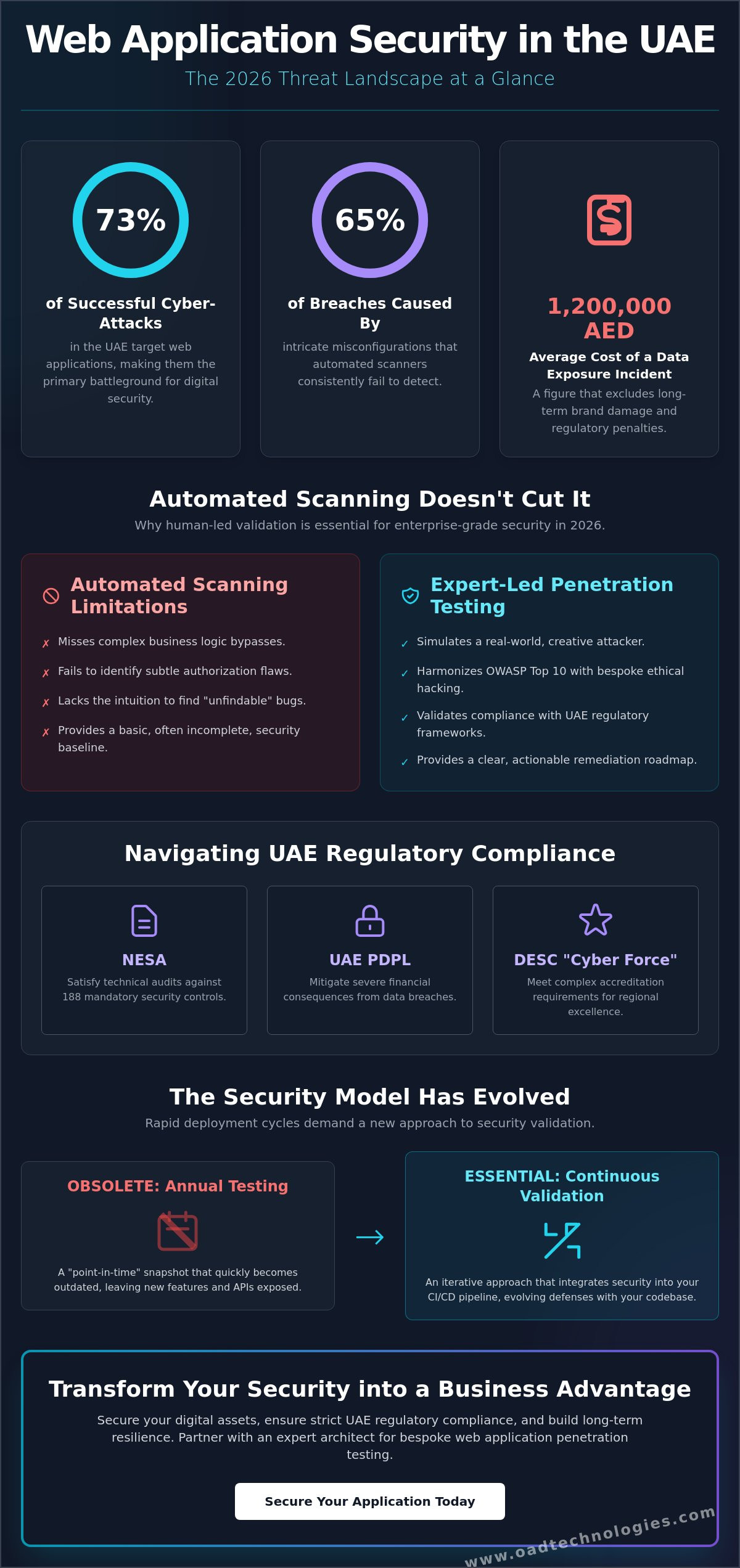
Did you know that 73% of successful cyber-attacks against businesses in the Emirates target web applications? With misconfigurations causing 65% of breaches and data exposure incidents costing an average of 1,200,000 AED, the stakes for your digital infrastructure have never been higher. For forward-thinking enterprises, web application penetration testing uae is no longer just a checkbox; it's a strategic architectural necessity. You likely feel the pressure of navigating the DESC "Cyber Force" accreditation requirements or NESA’s 188 mandatory security controls. It's a complex environment where the risk of business disruption during testing is a legitimate concern for any C-suite executive or technical lead.
We believe security should empower your growth rather than hinder your momentum. This guide reveals how bespoke web application penetration testing secures your digital assets and ensures strict compliance with UAE regulatory frameworks like the PDPL. We'll provide a clear roadmap for vulnerability remediation and demonstrate how independent, high-precision testing builds the long-term digital resilience your organization needs to thrive in 2026. Discover how to transform your security posture from a reactive defense into a proactive business advantage.
Key Takeaways
- Understand why automated scanning doesn't cut it in the 2026 UAE threat landscape and why enterprise-grade security requires human-led, manual validation.
- Discover how bespoke web application penetration testing uae ensures your digital infrastructure satisfies NESA technical audits and PDPL requirements.
- Learn the "Expert Architect" methodology that integrates the OWASP Top 10 with tailored ethical hacking to protect your specific application architecture.
- Identify critical criteria for choosing a security partner, focusing on the balance between industry certifications and real-world manual testing depth.
- Explore a remediation roadmap designed to prioritize vulnerability patching based on tangible business impact and strategic growth.
The State of Web Application Security in the UAE: 2026 Outlook
The UAE's digital economy has reached a level of maturity where innovation and security are inseparable. In this environment, web application penetration testing in the UAE is no longer a simple diagnostic exercise. It's a sophisticated architectural audit designed to identify deep-seated flaws before they're exploited by regional threat actors. While automated vulnerability scans provide a basic baseline, they consistently fail to detect complex business logic bypasses or subtle authorization flaws. These automated tools lack the nuance of human intelligence, often missing the 65% of breaches caused by intricate misconfigurations. For an enterprise to remain resilient in 2026, it must adopt rigorous penetration testing methodologies that simulate the persistence and creativity of a real-world attacker.
The regional threat landscape has shifted toward high-impact attacks like credential stuffing and sophisticated supply chain compromises. Statistics from the UAE Cybersecurity Council indicate that 73% of successful attacks against local businesses now target the application layer. These aren't random events; they're targeted efforts to bypass authentication and expose sensitive data. Proactive testing is the only way to safeguard your brand's reputation and maintain the trust of a digitally savvy consumer base that expects flawless data privacy.
Beyond the Checkbox: Why Frequency Matters
The traditional model of annual "point-in-time" testing is obsolete in an era of rapid deployment and CI/CD pipelines. As of May 2026, the UAE threat landscape is defined by the convergence of AI-driven automated hacking tools and highly targeted supply chain exploits aimed at the region’s critical financial and energy sectors. Every new feature or API integration expands your attack surface. Moving toward continuous security validation ensures that your defenses evolve as quickly as your codebase. This iterative approach allows your technical teams to address vulnerabilities in real-time, preventing the accumulation of technical debt that often leads to catastrophic failure.
The Cost of Inaction
Ignoring these risks carries a heavy price. Under the UAE Personal Data Protection Law (PDPL), the financial consequences of a breach are severe, but the operational fallout is often worse. Data exposure incidents in the Emirates now carry an average cost of 1,200,000 AED, a figure that doesn't account for the long-term erosion of brand equity. A single authentication bypass, which accounts for 19% of regional attacks, can halt operations and trigger intense regulatory scrutiny. Integrating robust Data Loss Prevention (DLP) strategies alongside regular testing is essential for maintaining the continuity and integrity of your enterprise operations.
The OAD Methodology: A Bespoke Approach to Web Application Penetration Testing UAE
At OAD Technologies, we approach security through the lens of an "Expert Architect." We don't believe in the generic, one-size-fits-all scanning routines that dominate the lower tiers of the market. Instead, our web application penetration testing uae service begins with a deep dive into your specific application architecture. We recognize that a financial services portal in Dubai has vastly different risk profiles and logic flows than a logistics platform in Abu Dhabi. By tailoring every engagement, we ensure that our testing mirrors the actual paths an adversary would take to compromise your unique digital ecosystem.
Our methodology harmonizes the globally recognized OWASP Top 10 framework with bespoke ethical hacking techniques designed for the 2026 threat landscape. While standards provide a necessary foundation, they often miss the nuanced business logic flaws that lead to authentication bypasses, which currently account for 19% of regional attacks. Human intelligence remains our most potent tool. Our senior engineers use intuition and experience to find "unfindable" bugs that automated tools overlook, ensuring your defense strategy aligns perfectly with the UAE's National Cyber Security Strategy. We prioritize rigors over speed, focusing on the quality of findings rather than the volume of automated alerts.
Technical Precision vs. Automated Volume
Commercial scanners are excellent for identifying known vulnerabilities, but they're notoriously blind to zero-day exploits and complex authorization issues. Our team simulates real-world adversary behavior, moving beyond simple script execution to test how your application handles unexpected, multi-step manipulation. We place a particular emphasis on API security and microservices architecture. As enterprises shift toward modular software, the inter-service communication layers often become the weakest link. We dissect these integrations to ensure that data remains encrypted and authenticated at every transition point. If you're looking to elevate your security posture, you can consult with our security architects to discuss a tailored evaluation.
The Scoping and Reconnaissance Phase
Rigorous scoping is the safeguard that prevents business disruption. We establish clear Rules of Engagement (RoE) before a single packet is sent, ensuring zero impact on your live production environments. This phase goes beyond a simple Vulnerability Assessment and Penetration Testing (VAPT) by mapping the entire application ecosystem. We account for third-party integrations, cloud dependencies, and hidden endpoints that often escape traditional audits. This comprehensive visibility allows us to identify lateral movement opportunities that could turn a minor web flaw into a full-scale enterprise breach.
Navigating UAE Regulatory Compliance through Technical Validation
Meeting the stringent demands of the National Electronic Security Authority (NESA) requires more than just policy documentation. For federal entities and operators of Critical Information Infrastructure (CII), validating the 188 mandatory security controls through rigorous technical testing is a non-negotiable requirement. Web application penetration testing uae provides the empirical evidence regulators demand, proving that security measures aren't just present on paper but are effective against active exploitation. This technical validation serves as a cornerstone for demonstrating maturity to the Signals Intelligence Agency (SIA) and other federal oversight bodies.
Financial institutions governed by the Central Bank of the UAE and entities adhering to Dubai's Information Security Regulation (ISR) face similar pressures. These frameworks mandate regular Vulnerability Assessment and Penetration Testing (VAPT) to protect the integrity of the regional financial ecosystem. When organizations move beyond "checkbox compliance" and align their testing outcomes with these specific mandates, they transform a regulatory burden into a competitive business advantage. A certified, secure application becomes a powerful signal of market reliability and operational maturity in the GCC region.
The Intersection of GRC and Technical Security
OAD Technologies bridges the gap between high-level consulting and technical execution. We don't just deliver a list of vulnerabilities; we provide a strategic interpretation that maps technical findings to your broader risk posture. By integrating our findings with your Governance Risk and Compliance (GRC) framework, we help the C-suite understand how a specific authentication bypass translates into a quantifiable business risk. This alignment ensures that remediation budgets are allocated to the areas of highest impact, fostering a culture of accountability and precision.
Data Sovereignty and Localized Testing
Choosing a UAE-based partner is vital for maintaining data sovereignty and navigating regional legal nuances. During the testing process, our team manages sensitive data with extreme precision to prevent unintended leakage, ensuring all activities remain within the jurisdictional boundaries of the Emirates. This localized expertise is particularly critical for adhering to the UAE Personal Data Protection Law (PDPL). Regular penetration testing supports the PDPL principle of "Security of Processing" by providing documented proof that personal data is shielded from unauthorized access through robust technical safeguards. Our approach ensures that your compliance strategy is as future-proof as the applications we help you protect.
Evaluation Criteria: Choosing Your Penetration Testing Partner in the UAE
Selecting the right partner for web application penetration testing uae is a decision that impacts your organization's long-term digital resilience. You aren't just hiring a vendor; you're choosing an architect to stress-test your digital foundations. The first step involves assessing technical certifications such as OSCP, CREST, or GIAC. While these are essential baselines, they don't replace real-world experience. You must ask for evidence of how a provider handles complex application architectures that go beyond standard web frameworks. In 2026, the ability to exploit unique business logic is more valuable than the ability to run a commercial scanner.
The second step is evaluating the depth of manual testing versus a reliance on automated tools. Automated volume might provide speed, but it lacks the creative intuition required to find zero-day vulnerabilities. A high-quality engagement spends 80% of its time on manual exploitation of the most critical pathways. Regional expertise is the third pillar. Your partner must possess a deep understanding of UAE-specific regulatory knowledge, including DESC "Cyber Force" mandates and NESA standards. This ensures that the final report isn't just a list of bugs, but a document that satisfies local auditors. Finally, verify post-test support and re-testing policies. A partner should remain engaged until every critical vulnerability is effectively remediated and verified.
The Anatomy of a High-Value Pentest Report
A report that simply ranks findings as "Critical" or "High" without context is insufficient for modern enterprise needs. High-value reporting translates these technical risks into business language, allowing leadership to track security ROI and prioritize remediation based on actual business impact. Your development teams require clear, step-by-step guidance to fix flaws efficiently. Without this granularity, the gap between discovery and remediation remains dangerously wide. Executive summaries should provide a clear snapshot of your security posture, enabling board-level decisions that support strategic growth.
Strategic Partnership vs. Transactional Vendor
Move away from transactional vendors who vanish after delivering a PDF. The most effective security outcomes stem from strategic partnerships that understand your long-term digital transformation roadmap. This includes looking for providers that offer integrated solutions like Identity and Access Management (IAM) and Cloud Security Posture Management (CSPM). By aligning your penetration testing results with these broader security pillars, you create a cohesive defense strategy that evolves as your business scales. If you're ready to move beyond basic compliance, book a consultation with our senior security architects to design your bespoke testing roadmap.
From Vulnerability to Resilience: The OAD Post-Test Lifecycle
A high-quality security engagement shouldn't end with a PDF delivery. At OAD Technologies, we view the conclusion of the testing phase as the beginning of a more resilient operational chapter. Our web application penetration testing uae services include a dynamic remediation roadmap that categorizes vulnerabilities by technical severity and their potential impact on your specific business goals. We prioritize fixes that protect your most critical data assets first, ensuring your engineering resources are deployed where they'll generate the highest security ROI. This structured approach prevents your team from becoming overwhelmed by a long list of findings, allowing for a steady and deliberate improvement of your security posture.
We don't leave your developers to interpret complex findings in isolation. Our architects act as a collaborative extension of your team, providing technical clarity and hands-on guidance during the vulnerability patching phase. This partnership helps build a culture of "Security by Design" within your organization, where security becomes a core component of the development lifecycle rather than an afterthought. By addressing the root causes of vulnerabilities, we help you build applications that are inherently resistant to the sophisticated threat vectors targeting the Emirates in 2026.
Integrating with Managed Security Operations
The intelligence gathered during a penetration test is a strategic asset for your defensive teams. We provide the technical data necessary to feed VAPT findings directly into your detection logic, significantly improving the efficacy of your SIEM Strategic Guide. This integration allows your Security Operations Center (SOC) to create more precise alerts and reduce false positives. Beyond this, leveraging Managed Detection and Response (MDR) ensures that if a vulnerability can't be patched immediately due to legacy constraints, you have the specialized monitoring in place to detect and block any active exploitation attempts in real-time.
Final Steps to Securing Your Application
Validation is the final pillar of the OAD post-test lifecycle. We schedule a rigorous re-test to verify that every implemented fix is robust and hasn't introduced new regressions into your application architecture. This step is vital for maintaining compliance with UAE regulators who require documented proof of remediation. To complement your technical defenses, we also offer continuous brand protection services to monitor for leaked credentials or spoofed domains that could undermine your digital integrity. To secure your enterprise with a partner that values long-term resilience over quick fixes, Partner with OAD Technologies for bespoke web application penetration testing.
Securing Your Digital Future in the Emirates
The complexity of the 2026 threat landscape demands more than just a defensive posture; it requires a strategic architectural overhaul. We've explored how transitioning from automated scans to high-precision, manual validation identifies the logic flaws that lead to 19% of regional authentication bypasses. By choosing a partner that understands the specific technical mandates of NESA and the privacy requirements of the PDPL, you turn compliance into a competitive asset. High-quality web application penetration testing uae is the foundation of this journey, bridging the gap between identifying a vulnerability and achieving true enterprise resilience.
Our UAE-based team brings a bespoke methodology that blends deep ethical hacking with strategic GRC alignment. We don't just find bugs; we integrate findings into your SIEM and MDR frameworks to ensure your defenses remain sharp long after the initial test. It's time to move beyond the checkbox and build a culture of security that scales with your ambition. Secure your enterprise applications with a bespoke penetration test from OAD Technologies and ensure your organization stays ahead of the curve. Your path to a more secure, compliant, and resilient future starts today.
Frequently Asked Questions
What is the typical duration of a web application penetration test in the UAE?
A standard engagement typically spans 10 to 20 business days depending on the application's complexity and number of user roles. Smaller applications might finish in 5 to 7 days, while large-scale enterprise platforms with extensive API integrations can take longer. We define a precise timeline during the scoping phase to ensure your development roadmap remains on track and your business operations continue without delay.
How much does web application penetration testing cost for a UAE enterprise?
Pricing for web application penetration testing uae varies based on the specific scope and technical depth of the engagement. Industry data from May 2026 indicates that a standard web application test typically costs between 15,000 and 80,000 AED. Factors influencing this range include the number of dynamic pages, the complexity of user roles, and the depth of API integrations required for a thorough architectural audit.
Will a penetration test cause downtime for my live web application?
We design our testing methodologies to ensure zero disruption to your live production environments. By establishing clear Rules of Engagement (RoE) and utilizing non-destructive exploitation techniques, we safeguard your operational continuity throughout the process. In specific cases, we may recommend testing in a staging environment that mirrors your production setup to allow for more aggressive vulnerability validation without any risk to your users.
What is the difference between a vulnerability assessment and a penetration test?
A vulnerability assessment is an automated scan that identifies potential weaknesses, whereas a penetration test involves active, manual exploitation of those flaws by an expert. While assessments provide a high-level overview, a penetration test simulates a real-world adversary to determine the actual business impact of a vulnerability. This distinction is critical for satisfying NESA's 188 mandatory security controls and understanding your organization's true risk profile.
Does OAD Technologies provide re-testing after we patch our vulnerabilities?
We include a rigorous re-testing phase as a standard component of our post-test lifecycle to ensure all flaws are properly addressed. Once your team implements the recommended patches, our architects verify that the fixes are effective and haven't introduced new regressions into the system. This validation is essential for providing regulators with documented proof of remediation and ensuring your application's long-term digital resilience in a shifting threat landscape.
How does web application pentesting help with UAE PDPL compliance?
Pentesting directly supports the UAE Personal Data Protection Law (PDPL) principle of "Security of Processing" by validating your technical safeguards. By identifying and remediating vulnerabilities that could lead to data exposure, you demonstrate proactive compliance with regional privacy mandates. This technical validation helps avoid the severe financial consequences associated with breaches, which currently average 1,200,000 AED per incident for businesses across the Emirates.
Can you test applications hosted on cloud environments like Azure or AWS?
We specialize in testing applications hosted on major cloud providers like AWS, Azure, and Google Cloud Platform. Our team understands the shared responsibility model and tailors testing to identify cloud-specific misconfigurations that lead to 65% of web application breaches. We ensure all testing activities comply with the specific terms of service and notification requirements of your cloud service provider to maintain total legal and technical alignment.
What certifications do OAD Technologies penetration testers hold?
Our senior security architects hold globally recognized certifications including OSCP, CREST, and GIAC. These credentials provide a baseline of technical authority, but we prioritize real-world experience in exploiting complex application architectures. This blend of certified expertise and human intuition allows us to find sophisticated logic flaws that automated commercial scanners consistently miss during web application penetration testing uae engagements, providing you with a superior level of security assurance.
Disclaimer
Content by OAD Technologies is for general informational purposes only and does not constitute professional or cybersecurity advice. No warranties are made regarding accuracy or completeness; reliance is at your own risk. OAD Technologies shall not be liable for any direct or indirect losses arising from use of this content.


