

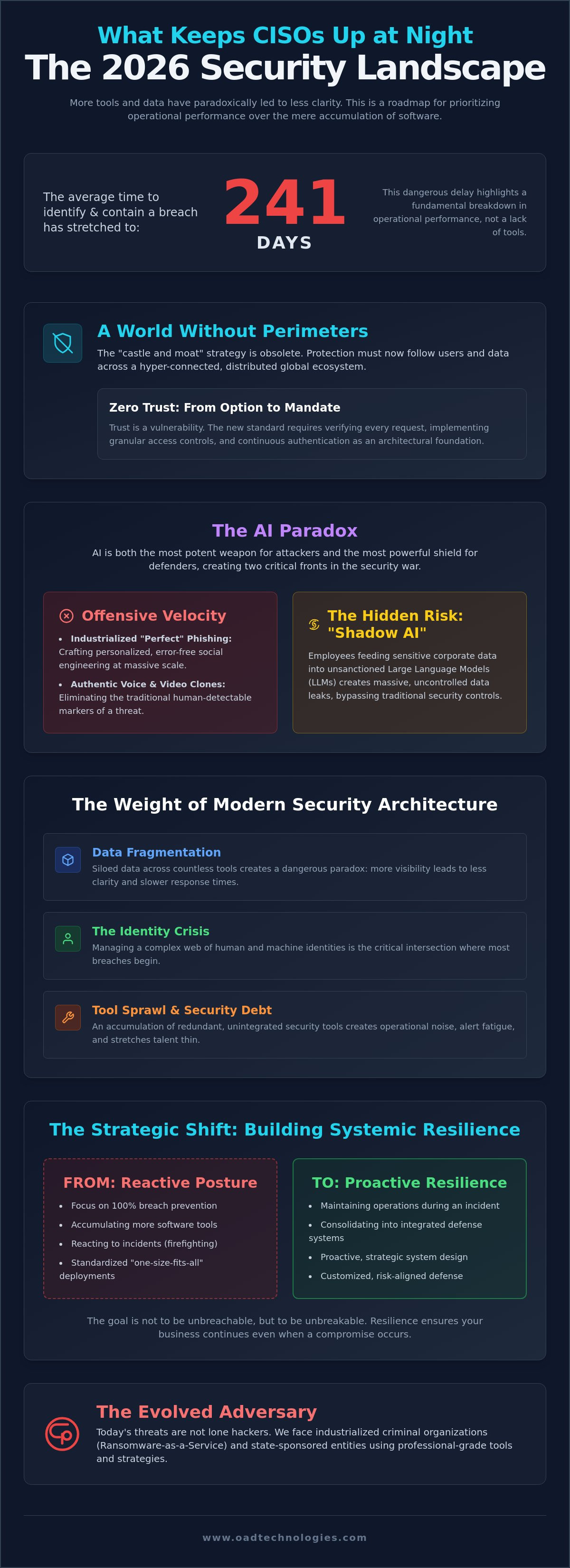
The greatest threat to your organization in 2026 isn't a shadowy external hacker, but the sheer weight of your own security architecture. While we've spent years layering defense upon defense, the resulting tool sprawl and data fragmentation have created a dangerous paradox where more visibility actually leads to less clarity. Understanding what keeps CISOs up at night 2026 requires looking past the headlines and into the operational friction that currently stretches the average time to identify and contain a breach to 241 days.
You likely feel the mounting pressure of managing an explosion of 'Shadow AI' while racing to meet strict 72-hour reporting mandates under regulations like the UAE PDPL. It's a relentless balancing act between driving innovation and maintaining a defensible posture. This strategic deep-dive promises to cut through the noise, offering a clear roadmap for 2026 security investments that prioritize operational performance over the mere accumulation of software.
We'll examine the evolving frameworks necessary to close the gap between perceived security and actual risk. By focusing on the synergy between human insight and technological capacity, you can move your team from reactive firefighting toward proactive, long-term resilience in an increasingly fragmented digital environment.
Key Takeaways
- Learn why the erosion of traditional perimeters has transformed Zero Trust from a strategic option into a mandatory architectural requirement for the hyper-connected enterprise.
- Identify the dual risks of AI-powered social engineering and the rise of "Shadow AI," where unsanctioned tools expose sensitive corporate data to external models.
- Gain a deeper understanding of what keeps cisos up at night 2026, specifically the critical intersection of identity management and data fragmentation.
- Discover how to reduce operational noise by auditing "security debt" and consolidating tool sprawl into integrated, high-performance defense systems.
- Establish a roadmap for long-term digital resilience by shifting from reactive software deployments to a customized, strategic system-design approach.
The 2026 Cybersecurity Landscape: Beyond Traditional Perimeter Defense
The traditional network perimeter has finally dissolved. In 2026, organizations operate in a hyper-connected ecosystem where employees, IoT devices, and cloud workloads are scattered across the globe. This dissolution is a primary factor in what keeps cisos up at night 2026. Security can no longer rely on a "castle and moat" strategy. Instead, protection must follow the data and the user, regardless of location. With the average time to identify and contain a breach currently sitting at 241 days according to 2026 data, the focus has shifted from keeping people out to minimizing the impact once they are in.
Zero Trust has transitioned from an aspirational buzzword to a mandatory architectural requirement. Organizations must verify every request as if it originates from an open network. By returning to foundational cybersecurity principles, we recognize that trust is a vulnerability. Implementing granular access controls and continuous authentication is the only way to manage the risks inherent in modern distributed environments. This shift requires a departure from standardized, "one-size-fits-all" security towards highly customized integrations that reflect specific business logic.
The UAE's pace of innovation creates unique national security challenges. As the nation pushes toward a fully digital economy, the attack surface expands exponentially. This rapid evolution is a core component of what keeps cisos up at night 2026, as they must secure cutting-edge infrastructure while legacy vulnerabilities still linger. Balancing this speed with rigorous engineering standards is the defining challenge of the current era. It's about building systems that aren't just fast, but inherently defensible from the ground up. This philosophy extends to the physical layer, where organizations increasingly rely on Ethernetics to decarbonise data centres and improve energy efficiency across the telecommunications industry.
The Rise of Systemic Resilience
2026 marks a shift in philosophy. We've moved beyond the illusion of 100% breach prevention toward systemic resilience. Resilience means your business doesn't stop when a compromise occurs. It's the ability to maintain operations during an active incident. Utilizing Managed Detection and Response (MDR) provides the visibility and rapid intervention needed to isolate threats before they become catastrophic. This "secure-by-design" mindset ensures that every new piece of infrastructure is built with rapid recovery as a core feature rather than an afterthought.
The Evolving Threat Actor Profile
The AI Paradox: Offensive Velocity vs. Defensive Capability
Artificial Intelligence has reached a point of strategic equilibrium where it serves as both the primary weapon of the adversary and the most potent shield for the defender. In 2026, generative AI has effectively industrialized "perfect" phishing. Attackers now craft highly personalized, error-free social engineering campaigns at a scale previously unimaginable. This rapid acceleration in offensive velocity is a central reason behind what keeps cisos up at night 2026. When every email looks legitimate and every voice clone sounds authentic, the traditional markers of a threat disappear.
The paradox deepens with the rise of "Shadow AI." Employees frequently feed sensitive corporate data into unsanctioned Large Language Models (LLMs) to boost productivity, inadvertently creating massive data leaks. This unauthorized use bypasses traditional controls, turning a tool for efficiency into a significant liability. Managing these complex CISO challenges in 2026 requires a sophisticated blend of policy and technical enforcement. To combat this, organizations are increasingly turning to automated defenses. Verified data shows that organizations utilizing extensive AI and automation saved an average of $1.9 million per data breach this year. By integrating SIEM and EDR solutions, security teams can filter through the noise to identify true anomalies in real-time.
Governing the AI Influx
AI governance is the strategic control of machine-learning data flows. It's not enough to simply permit or block AI; you must understand how data moves within these models. Establishing clear usage policies is the first step toward reclaiming control. We recommend utilizing Cloud Security Posture Management (CSPM) to monitor AI instances and ensure they remain within your security boundaries. If you're concerned about your current visibility, a professional vulnerability assessment can highlight where Shadow AI might be lurking in your network.
AI-Driven Threat Hunting
The shift from signature-based detection to behavioural AI analysis has fundamentally changed the Security Operations Center (SOC). AI doesn't just look for known malware; it identifies deviations from established user patterns. This capability significantly reduces the Mean Time to Detect (MTTD), which is vital when the average breach takes 181 days to identify. However, technology alone isn't a silver bullet. The true value lies in the synergy between human expertise and machine speed. Our approach focuses on empowering your team with tools that provide actionable intelligence, ensuring that automated incident response remains ethical and grounded in business reality.
Data Fragmentation and the Identity Crisis: The Real Visibility Gap
Data fragmentation has shifted from a technical hurdle to a massive security liability. In 2026, the volume of unstructured data residing outside managed silos has reached a critical tipping point. This "invisible data" is often the catalyst for what keeps cisos up at night 2026. When you lose track of where your sensitive information resides, you lose the ability to protect it. This visibility gap is particularly dangerous under the UAE Personal Data Protection Law (PDPL), where strict compliance and rapid incident reporting are now mandatory for every enterprise.
Modern CISOs view data as a potential liability as much as a strategic asset. The financial stakes are higher than ever. With the average cost of a US data breach hitting $10.22 million in 2026, a single mismanaged database can derail an entire fiscal year. We're seeing a critical intersection between Identity and Access Management (IAM) and data protection. If identity is compromised, your data protection is effectively nullified. It's no longer enough to guard the server; you must guard the human and machine identities accessing it.
The New Data Loss Prevention (DLP) Standard
Traditional, device-centric DLP is effectively dead. In a world of remote work and pervasive encryption, monitoring corporate laptops is insufficient. You need a Data Loss Prevention (DLP) framework that follows the data itself. This approach embeds security into the data layer, ensuring protection remains active whether the information sits in a private cloud or a SaaS application. Proper data classification is essential here. It allows you to meet UAE national compliance standards by applying the right level of encryption to the right assets based on their actual risk profile.
Identity as the New Perimeter
Identity has officially replaced the network wall. Organizations are moving toward passwordless authentication and biometric identity to eliminate the risk of stolen credentials, which still play a role in 68% of breaches. However, the challenge extends beyond human users. Securing machine identities and API keys in microservices architectures is now a top priority. IAM serves as your primary defense against lateral movement. If an attacker gains entry, a robust identity framework ensures they're trapped in a single, low-value segment. This prevents a minor credential compromise from turning into a systemic failure.
Operational Fatigue: Solving Tool Sprawl and Talent Shortages
Security leaders often focus on external adversaries, yet the most persistent friction comes from within the security stack itself. This operational complexity is a defining factor in what keeps cisos up at night 2026. Many organizations suffer from "Security Debt," where legacy tools are maintained out of habit rather than utility. This creates a fragmented environment where critical signals are lost in a sea of low-priority alerts. A CISO managing fifty disconnected tools is frequently less secure than a peer with ten deeply integrated solutions. Integration provides the clarity needed to act, while sprawl only provides noise.
The psychological toll on Security Operations Centre (SOC) teams is significant. Alert fatigue leads to burnout and, eventually, missed compromises. This pressure is compounded by a global cybersecurity workforce gap of 4.8 million unfilled positions as of July 2026. With only 5.5 million active professionals globally, the competition for talent is fierce. You can't simply hire your way out of this problem. Success in 2026 requires shifting from a resource-heavy model to a strategy-heavy one that prioritizes efficiency over raw headcount.
A Framework for Security Stack Consolidation
Reducing complexity requires a structured approach to your existing architecture. We recommend a three-step consolidation process to reclaim operational control:
- Step 1: Audit existing tools. Identify overlapping functionality and integration gaps that hinder data flow between systems.
- Step 2: Prioritize platforms. Move away from point solutions in favor of integrated platforms that reduce management overhead and training requirements.
- Step 3: Map to requirements. Ensure every tool in the stack directly supports a specific Governance, Risk, and Compliance (GRC) mandate.
The Managed Services Advantage
Managed services provide the specialized expertise required to navigate high-velocity threats without the overhead of internal recruitment. Managed Detection and Response (MDR) serves as the strategic bridge between technical detection and business-level response. By partnering with external experts, you gain access to sophisticated threat hunting and incident response capabilities that are difficult to build in-house. Regular VAPT engagements are essential to validate the effectiveness of this consolidated stack and ensure your defenses remain resilient against evolving tactics.
If your team is struggling with alert fatigue, it's time to evaluate how a customized security integration can streamline your operations and reduce your overall risk profile.
Building a Resilient Future with OAD Technologies
Addressing the layered complexities of the current threat landscape requires more than just another software license. As we've explored, the intersection of AI-driven threats, identity-based perimeters, and crushing operational noise is exactly what keeps cisos up at night 2026. Solving these challenges demands a master designer of systems, not a vendor of disconnected products. OAD Technologies acts as a strategic architect for UAE enterprises, building security frameworks that prioritize long-term viability over the temporary relief of a quick-fix deployment. We don't believe in standardized approaches because your risk profile is as unique as your business logic.
Our philosophy centers on the synergy between human insight and technological capacity. While automation handles the high-velocity data processing required to combat modern exploits, our experts provide the strategic context that machines lack. This partnership empowers C-suite leaders to make informed decisions grounded in practical business results rather than fear. We ensure your security investments translate directly into operational performance and strategic expansion, keeping you ahead of the digital evolution curve.
Strategic Partnership for the UAE Market
The UAE's digital transformation journey is unique, and so are its regulatory requirements. We bring deep expertise in local alignment, ensuring your organization remains compliant with national frameworks like the UAE PDPL. Our proactive, solution-oriented mindset is backed by rigorous engineering standards that treat security as a foundational component of business growth. We act as an extension of your team, guiding you through the complexities of modern governance and risk management. Ready to secure your 2026 roadmap? Consult with our strategic experts today.
Comprehensive Enterprise Safeguards
OAD Technologies provides a full spectrum of defenses designed to integrate seamlessly into your existing environment. We move your organization beyond the visibility gap by deploying customized solutions across the entire security lifecycle:
- Data and Identity Protection: Advanced Data Loss Prevention (DLP) and Identity and Access Management (IAM) to secure your most valuable assets.
- Real-Time Detection: Managed Detection and Response (MDR) and SIEM to identify anomalies before they escalate.
- Cloud and Infrastructure: Robust Cloud Security Posture Management (CSPM) and Network Security Solutions to protect distributed workloads.
- Continuous Validation: Regular VAPT and technical security assessments to identify vulnerabilities in your defensive stack.
By integrating these core services into your ongoing risk management lifecycle, we help you reduce tool sprawl and eliminate "Security Debt." Whether you're looking for a VMware replacement or comprehensive brand protection, our goal is to ensure your ongoing digital relevance. We don't just help you survive the current market; we position you to lead it with confidence.
Securing Your Legacy in a Hyper-Connected Future
The transition from defensive silos to systemic resilience isn't just a technical upgrade; it's a strategic necessity. We've seen how the erosion of the network perimeter and the rise of AI-driven exploits have fundamentally redefined what keeps cisos up at night 2026. Success now depends on your ability to consolidate fragmented tools and place identity at the heart of your data protection strategy. By prioritizing operational performance over the mere accumulation of software, you can transform security from a cost center into a resilient foundation for business growth.
OAD Technologies stands ready to act as your strategic architect in this evolving landscape. As a Dubai-based system integrator with national UAE coverage, we specialize in delivering high-performance DLP and MDR solutions tailored to your specific risk profile. Our comprehensive portfolio of GRC services and technical assessments ensures that your roadmap is grounded in both regulatory compliance and engineering excellence. Partner with OAD Technologies to secure your enterprise roadmap for 2026.
The future of your digital enterprise is built on the decisions you make today. Let's work together to ensure your organization remains resilient, relevant, and secure for years to come.
Frequently Asked Questions
What are the top 3 cybersecurity risks for CISOs in 2026?
The top three risks in 2026 are identity-based credential theft, AI-powered social engineering, and vulnerabilities within the third-party supply chain. These threats capitalize on human error and complex digital ecosystems, which are core reasons behind what keeps cisos up at night 2026. Third-party breaches have doubled year-over-year, now accounting for 30% of all data compromises globally.
How is AI changing the role of the CISO in the next year?
AI is transforming the CISO role from a technical gatekeeper to a strategic governor of machine-learning data flows. While AI-powered tools reduced breach costs by an average of $1.9 million in 2026, they also introduced "Shadow AI" risks. Leaders now spend more time managing algorithmic transparency and ensuring that unauthorized LLMs don't leak sensitive corporate data into the public domain.
Why is tool sprawl considered a major security risk?
Tool sprawl is a major risk because it creates a fragmented security posture where critical alerts are buried under operational noise. Managing dozens of disconnected point solutions leads to "Security Debt," where maintenance consumes resources that should be spent on proactive threat hunting. This complexity is why the average time to identify and contain a breach remains high at 241 days.
What is the impact of the UAE PDPL on corporate security strategies?
The UAE Personal Data Protection Law (PDPL) forces organizations to prioritize data sovereignty and implement rigorous incident reporting workflows. Under these regulations, major incidents must be reported within 72 hours, leaving little room for delayed identification or manual response. This legal pressure has shifted security strategies toward real-time visibility and highly customized data classification frameworks to ensure compliance.
How can organisations address the cybersecurity talent shortage in 2026?
Organizations address the global gap of 4.8 million unfilled cybersecurity positions by shifting toward managed services and automated defense layers. You can't out-hire a talent shortage of this magnitude. Instead, successful CISOs leverage Managed Detection and Response (MDR) to gain specialized expertise without the overhead of internal recruitment, allowing their internal teams to focus on core business objectives.
Is Managed Detection and Response (MDR) better than an in-house SOC?
MDR is often superior to a mid-sized in-house SOC because it provides specialized scale and 24 X 7 coverage that most internal teams can't replicate. While an in-house team understands internal business logic, MDR providers offer broader threat intelligence across multiple industries. This external partnership helps alleviate the alert fatigue that currently plagues internal security operations and leads to missed compromises.
What is the difference between a vulnerability assessment and a penetration test in a 2026 context?
In 2026, a vulnerability assessment acts as a broad diagnostic of known weaknesses, while a penetration test is a targeted attempt to exploit those gaps. Assessments provide the baseline for your security posture and compliance. Penetration testing validates your systemic resilience by simulating actual attack paths used by state-sponsored actors or professionalized ransomware groups to see if your defenses hold.
How does Zero Trust architecture help prevent data breaches?
Zero Trust architecture prevents breaches by removing implicit trust from the network and requiring continuous verification for every access request. It treats identity as the new perimeter, ensuring that a single compromised credential doesn't lead to lateral movement within the organization. This model is essential for managing what keeps cisos up at night 2026, especially in distributed, multi-cloud environments where data fragmentation is high.
Disclaimer
Content by OAD Technologies is for general informational purposes only and does not constitute professional or cybersecurity advice. No warranties are made regarding accuracy or completeness; reliance is at your own risk. OAD Technologies shall not be liable for any direct or indirect losses arising from use of this content.