

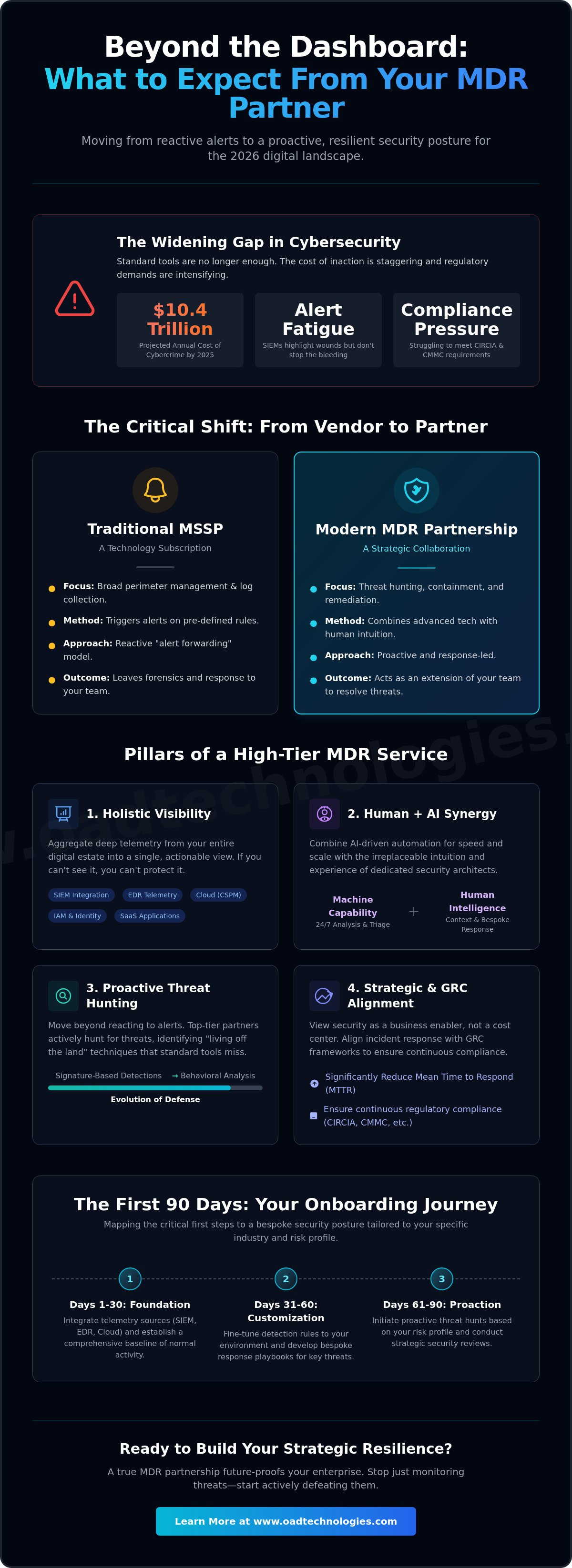
With cyberattacks projected to cost global businesses $10.4 trillion by 2025, the gap between simple monitoring and true resilience is widening. You've likely realized that a standard SIEM doesn't stop the bleeding; it just highlights the wounds. Understanding what to expect from your mdr partner is the first step in moving beyond alert fatigue and into a state of proactive defense. It's difficult to feel secure when your team is struggling to meet the 72-hour reporting requirements of CIRCIA or the rigorous Phase 1 standards of CMMC that became effective on December 16, 2024.
We agree that a partnership should provide more than just a dashboard. It should offer a sophisticated blend of human intelligence and machine capability that evolves with your specific threat landscape. This guide outlines the essential benchmarks and technical standards that define a high-tier MDR service. You'll learn how to achieve strategic alignment with GRC requirements and significantly reduce your Mean Time to Respond (MTTR). We'll explore the shift from reactive alerting to a bespoke security posture that future-proofs your enterprise against the complexities of the 2026 digital environment.
Key Takeaways
- Distinguish between standard security subscriptions and strategic collaborations by identifying the architectural differences between traditional MSSPs and modern MDR.
- Achieve holistic visibility across your digital estate by integrating deep telemetry from SIEM and EDR into a single, actionable pane of glass.
- Define exactly what to expect from your mdr partner regarding the intersection of AI-driven automation and the intuition of dedicated security architects.
- Map the critical first 90 days of onboarding to ensure detection rules and response playbooks are bespoke to your specific industry risk profile.
- Align your incident response capabilities with GRC frameworks to ensure continuous regulatory compliance and long-term strategic resilience.
Beyond Basic Alerting: Defining the Modern MDR Partnership
A true partnership isn't measured by the number of licenses you purchase. It's defined by the depth of the integration between your team and your security provider. When evaluating what to expect from your mdr partner, the first distinction you must make is between a vendor and a collaborator. Many organizations mistake a technology subscription for a security strategy, but a subscription only provides tools. A partnership provides the architectural expertise required to wield those tools effectively.
The difference between a Managed Security Service Provider (MSSP) and Managed Detection and Response (MDR) is fundamental. MSSPs typically focus on broad perimeter management and basic log collection. They alert you when a pre-defined rule is triggered. In contrast, MDR is response-led. It combines advanced technology with human intuition to not only identify threats but also to contain and remediate them. If a provider simply forwards raw alerts to your inbox and expects your team to handle the forensics, they've failed the partnership model. Alert forwarding is a symptom of a "one-size-fits-all" approach that ignores your specific risk profile. A bespoke MDR partner acts as a guardian of your long-term digital relevance in an increasingly volatile market.
The Shift from Reactive to Proactive Defense
In 2026, leading MDR services have moved beyond "stopping the breach" to anticipating the threat before it manifests. Proactive threat hunting, once considered a premium add-on, is now a standard requirement for top-tier providers. This shift requires a transition from simple log management to deep behavioral analysis. By analyzing patterns rather than just signatures, your partner can identify "living off the land" techniques that standard tools miss. This proactive stance ensures that your security posture evolves at the same rate as the global threat landscape.
Aligning Security Outcomes with Business ROI
With cyberattacks projected to cost businesses $10.4 trillion globally per year by 2025, security is no longer just a technical concern; it's a financial imperative. High-quality MDR drives operational efficiency by reducing your Mean Time to Respond (MTTR). When response times are measured in minutes rather than days, the financial impact of a potential breach is drastically minimized. We frame security maturity as a driver for strategic growth, ensuring that your technical rigour supports your broader business objectives. This alignment allows C-suite executives to view security as a sophisticated asset rather than a sunk cost.
Technical Rigour: Holistic Visibility Across the Enterprise
Visibility is the bedrock of any defensive strategy. If you can't see an asset, you can't protect it. When defining what to expect from your mdr partner, you should demand a "single pane of glass" view that aggregates telemetry from endpoints, network traffic, and cloud workloads. This level of technical rigour requires a seamless integration of SIEM and EDR tools. These aren't just standalone products; they're the sensors that feed a unified intelligence engine. A high-tier partner ensures these tools work in concert to provide deep telemetry, rather than operating in silos that create blind spots.
Your environment is likely a complex mix of legacy systems and modern cloud-native stacks. A partner must be platform-agnostic, meeting your business where it currently operates while providing a roadmap for future-proofing. This includes securing multi-cloud environments through robust Cloud Security Posture Management (CSPM). Without this, your expansion into AWS, Azure, or Google Cloud creates unmanaged risks. Effective MDR isn't just about monitoring; it's about the architectural precision required to secure every layer of your digital transformation.
Telemetry Beyond the Endpoint
As of February 15, 2026, industry standards have shifted. MDR services are now expected to provide coverage for identity monitoring and SaaS applications, not just traditional endpoints. Integrating Identity and Access Management (IAM) is critical for tracking lateral movement. When an attacker gains a foothold, they don't stay on one machine. They move through your network, often using compromised credentials. By monitoring IAM logs alongside network and email security traffic, your partner can detect these subtle shifts in behavior. This holistic approach extends to brand protection and dark web monitoring, ensuring that leaked credentials or targeted campaigns are identified before they lead to a breach. For organizations seeking this level of depth, exploring a tailored MDR framework is a logical next step.
Advanced Infrastructure Protection
Modern infrastructure requires more than just passive observation. Your partner should actively manage your cloud security posture to prevent misconfigurations that lead to data exposure. This is especially vital in virtualised environments where the perimeter is fluid. In 2026, leading solutions utilize AI-driven automation for tasks like root-cause analysis and remediation planning. Automated playbooks accelerate initial containment, stopping a threat in its tracks before an analyst even needs to intervene. This machine-scale speed, backed by human expertise, ensures your resilience remains high even during complex, multi-vector attacks.
The Human Element: Expert Architects vs. Automated Tools
While AI driven automation handles the heavy lifting of data correlation, human intuition remains the final arbiter of complex security decisions. The Gartner Market Guide for Managed Detection and Response, published on October 10, 2025, emphasizes that MDR is fundamentally a human led service. When evaluating what to expect from your mdr partner, you must look beyond the software stack. A high tier partner provides dedicated analysts who act as "Expert Architects," individuals who don't just monitor your environment but actively shape its defensive posture based on your specific industry risks.
The "human in the loop" model is particularly critical during incident remediation. Automated tools are excellent at isolating an infected endpoint, but they lack the business context to determine if shutting down a specific server will halt a mission critical production line. An expert partner understands these nuances. They utilize machine scale speed to identify threats while applying human judgment to ensure response actions are precise and proportionate. This intersection of machine capability and human intelligence ensures that your security doesn't come at the expense of operational continuity.
Collaborative Problem Solving
We believe a successful partnership functions as an extension of your internal team rather than a distant third party vendor. You should expect regular strategic reviews that go beyond automated PDF reports. These sessions focus on evolving your threat model and tuning detection rules to match your shifting digital footprint. During a high pressure incident, transparent communication is non negotiable. Your partner must provide real time updates and collaborative workspaces where your team and their analysts can work as a single unit to resolve the crisis.
Bridging the Cybersecurity Skills Gap
Hiring and retaining skilled security analysts is a primary pain point for 2026 enterprises. An MDR partnership solves this by providing immediate access to specialized expertise in areas like Vulnerability Assessment and Penetration Testing (VAPT) and Governance, Risk, and Compliance (GRC). This reduces the burden on your internal IT leads, allowing them to focus on core business transformation projects instead of chasing false positives. By empowering your people through sophisticated technology rather than replacing them, we help you build a sustainable security culture that scales with your growth.
What to Expect During the First 90 Days: The Onboarding Journey
Onboarding isn't a single event; it's a structured lifecycle that determines the long-term success of your defense strategy. When you evaluate what to expect from your mdr partner during the initial transition, look for a roadmap that prioritizes deep environment discovery. Phase 1 involves rigorous technical security assessments to map every digital asset and potential vulnerability. By Phase 2, your partner should be tailoring detection rules and response playbooks to your unique operational context. This ensures the system isn't just looking for generic threats but is specifically tuned to protect your most sensitive data architectures.
Phase 3 focuses on establishing a baseline and launching initial threat hunting missions. This period is critical for setting clear Service Level Agreements (SLAs) that go beyond simple uptime. You should expect confirmed benchmarks for detection and response times, ensuring that critical incidents are contained within minutes. This phase ensures the partnership moves from theoretical protection to active, measurable defense, providing the transparency required for modern board-level reporting.
Establishing the Security Baseline
A successful integration requires identifying "normal" behavior to filter out the noise of daily operations. This baseline reduction is essential for eliminating the alert fatigue that plagues 56% of security teams using unmanaged tools. We recommend conducting initial Vulnerability Assessments (VAPT) during this stage to identify and remediate low-hanging fruit. Hardening your infrastructure early prevents attackers from exploiting known gaps while the monitoring system matures. Seamless integration with your existing stack ensures that telemetry flows without creating operational friction.
Defining Roles and Responsibilities
Ambiguity is a threat actor's best friend during a crisis. During the first 90 days, you must establish clear authorization protocols, specifically defining who has the power to pull the "kill switch" during a confirmed breach. This decision-making framework prevents paralysis when every second counts. Your partner should set rigorous communication protocols for both emergency and non-emergency events, ensuring technical stakeholders and the C-suite receive relevant, timely updates. Establishing these reporting cadences early ensures that security outcomes remain aligned with your broader business objectives. If you're ready to architect a more resilient future, contact our team to begin your strategic onboarding journey.
Strategic Resilience: Integrating MDR with GRC and DLP
Strategic resilience is the ultimate goal of any modern security architecture. It requires a unified approach that bridges the gap between technical detection and high-level business risk. When determining what to expect from your mdr partner, you should look for a provider that treats Managed Detection and Response (MDR) as the cornerstone of your regulatory compliance strategy. It's no longer enough to simply detect threats. You must also prove that your response capabilities align with established Governance, Risk, and Compliance (GRC) frameworks. This alignment ensures that every technical action taken by an analyst is documented and mapped to a specific regulatory requirement.
The synergy between real-time response and Data Loss Prevention (DLP) is equally vital. While DLP tools flag sensitive data movement, an MDR partner provides the analytical context to distinguish between a legitimate business process and a malicious exfiltration attempt. This integrated view allows you to secure corporate digital assets in a borderless, cloud-first environment without sacrificing operational efficiency. By identifying exfiltration attempts in their earliest stages, your partner prevents the catastrophic financial and reputational damage associated with a major data breach.
Compliance as a Competitive Advantage
Regulatory pressure is intensifying across every sector. Proposed rules under the Cyber Incident Reporting for Critical Infrastructure Act (CIRCIA) require covered entities to report significant incidents within 72 hours and ransomware payments within 24 hours. Meeting these aggressive timelines is impossible without the high-fidelity telemetry and rapid response provided by a mature MDR partnership. Additionally, the California Privacy Protection Agency (CPPA) issued final regulations in July 2025 governing automated decision-making and cybersecurity risk assessments. We help you use MDR telemetry to automate compliance reporting, turning a mandatory burden into a strategic advantage that builds brand trust and protects your market position.
Closing the Loop on Data Protection
Future-proofing your enterprise means ensuring that security evolves alongside the threat landscape. A unified strategy ensures that your engineering standards remain high while your business remains agile. By integrating MDR with your DLP and GRC pillars, you create a feedback loop where every detected incident informs your broader risk profile. This holistic approach empowers your leadership to make data-driven decisions about digital transformation, ensuring that security is a facilitator of growth rather than a bottleneck. When you understand what to expect from your mdr partner, you aren't just buying a service; you're securing your organization's long-term digital relevance in an ever-changing market.
Architecting Your Enterprise Resilience
The transition from basic monitoring to a sophisticated security posture requires more than just new tools. It demands a partnership built on technical rigour and architectural precision. By integrating deep telemetry across cloud and endpoint environments, you move beyond the noise of false positives and into a state of proactive defense. This approach ensures your response capabilities aren't only fast but also strategically aligned with your broader business objectives and regulatory mandates.
Understanding exactly what to expect from your mdr partner allows you to shift from a reactive "break-fix" mentality to a future-proofed strategy. OAD Technologies brings specialized UAE market expertise and elite 24 X 7 technical security assessments to every engagement. We don't believe in generic subscriptions; we deliver bespoke integrations with your DLP and GRC frameworks to ensure your long-term digital relevance. Our team acts as an extension of your own, providing the human intelligence required to solve the most complex digital challenges.
Secure your future with a bespoke MDR strategy from OAD Technologies. Your journey toward a more resilient and scalable digital infrastructure starts with a single, strategic step. We're ready to help you shape the future of your enterprise security.
Frequently Asked Questions
What is the primary difference between a SOC and an MDR partner?
A Security Operations Center (SOC) is a facility or function that monitors logs and generates alerts; an MDR partner is a service-led collaborator that focuses on active response. While a SOC might notify you of a potential threat, an MDR partner contains and remediates that threat on your behalf. This distinction is fundamental when determining what to expect from your mdr partner, as the value lies in the human-led mitigation of risk rather than passive observation.
Can an MDR partner help with regulatory compliance like ISR or PDPL?
Yes, a high-tier MDR partner is essential for meeting the stringent requirements of ISR, PDPL, and global mandates like the 72-hour CIRCIA reporting window. By providing continuous telemetry and automated compliance reporting, they ensure your organization can demonstrate "reasonable security" to auditors. This strategic alignment helps you avoid the severe financial penalties associated with non-compliance while building long-term brand trust with your stakeholders.
How does an MDR partner handle false positives?
False positives are handled through a rigorous baseline establishment process conducted during the initial onboarding journey. By identifying "normal" network behavior, analysts tune detection rules to filter out the noise that causes alert fatigue for 56% of internal security teams. This ensures that when an alert is escalated, it represents a genuine threat requiring immediate human intervention, allowing your IT leads to focus on strategic growth projects.
Will I need to replace my existing security tools to work with an MDR partner?
You don't need to replace your current infrastructure to integrate with a sophisticated MDR provider. Most modern services are platform-agnostic and achieve seamless integration with your existing SIEM, EDR, and IAM tools. This approach maximizes your current ROI while layering on the expert architectural oversight needed to secure complex, multi-cloud environments without requiring a massive hardware overhaul.
What happens if a breach occurs? What is the partner’s specific role?
If a breach occurs, the partner takes the lead in containment, forensics, and remediation guidance. They execute pre-approved response playbooks to isolate infected endpoints and block malicious traffic instantly. Their role is to minimize the blast radius while providing your team with the technical intelligence needed for full recovery. This ensures that even during a high-pressure incident, your operational continuity remains the priority.
How does an MDR partner measure success and ROI?
Success is measured by the reduction of Mean Time to Respond (MTTR) and the overall decrease in your organization’s risk exposure. A clear ROI is demonstrated when the service cost is compared to the projected $10.4 trillion global annual cost of cyberattacks by 2025. Effective partnerships also reduce the financial burden of hiring and retaining a 24 X 7 internal security team, which is a significant saving in today's talent market.
Is MDR suitable for mid-sized enterprises or only large corporations?
MDR is highly suitable for mid-sized enterprises that lack the resources to build a full internal SOC. It provides these organizations with enterprise-grade security expertise and 24 X 7 coverage at a predictable cost. This scalability allows mid-sized firms to compete securely in the global digital economy while meeting the same rigorous regulatory standards as large corporations, ensuring their long-term digital relevance.
How often should I expect strategic updates from my MDR provider?
You should expect strategic updates on a monthly or quarterly basis, depending on your specific risk profile and industry requirements. These aren't just automated reports; they're collaborative reviews where your partner analyzes threat trends and adjusts your bespoke defensive posture. This ongoing dialogue ensures that your security architecture evolves at the same pace as your digital transformation, keeping you ahead of emerging threats.
Disclaimer
Content by OAD Technologies is for general informational purposes only and does not constitute professional or cybersecurity advice. No warranties are made regarding accuracy or completeness; reliance is at your own risk. OAD Technologies shall not be liable for any direct or indirect losses arising from use of this content.


