

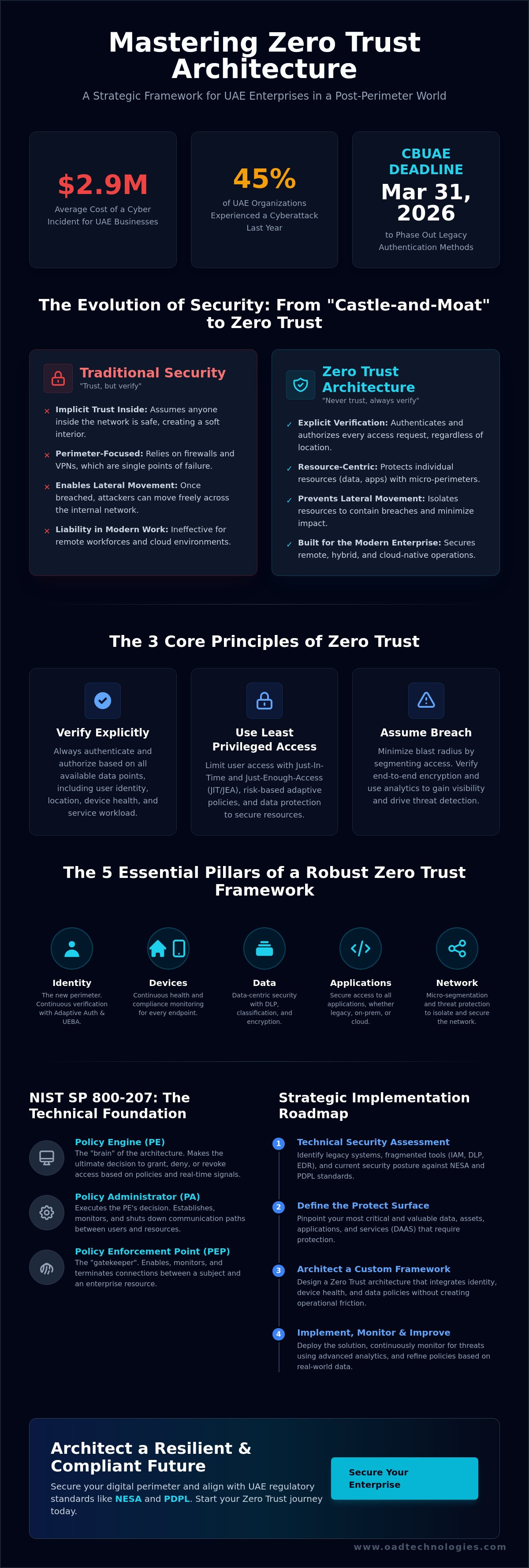
With the average cyber incident now costing UAE businesses $2.9 million, the traditional security perimeter isn't just failing; it's become a liability. You're likely facing the immense pressure of integrating fragmented IAM, DLP, and EDR tools while racing toward the March 31, 2026, CBUAE deadline to phase out legacy authentication methods. Building a resilient zero trust architecture framework is no longer a visionary goal but a technical necessity for any enterprise looking to reconcile modern remote work with rigorous NESA and PDPL compliance standards.
We recognize that the transition from legacy infrastructure to a "never trust, always verify" model requires more than just new software; it demands a strategic shift in how identity and data are governed. This guide promises to help you master the principles, components, and implementation strategies of Zero Trust to secure your digital perimeter in an evolving threat landscape. We'll provide a clear, structured roadmap for adoption that improves your security posture without creating operational friction, ensuring your organization remains both compliant and competitive in the years ahead.
Key Takeaways
- Understand the transition from traditional "castle-and-moat" security to a granular, resource-level protection model that assumes no inherent trust.
- Identify the core components of a zero trust architecture framework, specifically focusing on MFA-backed identity management and continuous device health monitoring.
- Bridge the gap between technical innovation and regional regulatory requirements, ensuring alignment with UAE PDPL and NESA standards.
- Follow a structured implementation roadmap that begins with a technical security assessment and the precise definition of your organization's protect surface.
- Learn how customized architectural designs can build long-term resilience and secure your digital perimeter without introducing operational friction.
Beyond the Perimeter: Defining the Zero Trust Architecture Framework
For decades, enterprise security relied on a "castle-and-moat" strategy. If you were inside the network, you were trusted; outside, you were a threat. This binary approach failed as workforces decentralized and cloud adoption surged. The modern zero trust architecture framework dismantles this outdated premise, replacing implicit trust with a rigorous, data-centric security posture. It operates on the fundamental assumption that no user, device, or application is inherently trustworthy, regardless of their location on the network.
Zero Trust Architecture is a resource-centric security model that requires continuous verification of every access request.
This shift in philosophy is built upon three core pillars that guide every technical decision within the architecture:
- Verify explicitly: Authenticate and authorize based on all available data points, including user identity, location, device health, and service or workload.
- Use least privileged access: Limit user access with Just-In-Time and Just-Enough-Access (JIT/JEA), risk-based adaptive policies, and data protection to secure both data and productivity.
- Assume breach: Minimize impact by segmenting access and verifying end-to-end encryption. Use analytics to gain visibility, drive threat detection, and improve defenses.
The Failure of Implicit Trust
Traditional tools like VPNs and firewalls were designed for a world where the perimeter was physical. Once a threat actor bypasses these entry points, they can move laterally across the network with ease. In the UAE, where over 45% of organizations experienced a cyberattack last year, this lateral movement is a primary driver of the $2.9 million average breach cost. Zero Trust Architecture (ZTA) solves this by isolating resources. It prevents an attacker who compromises a single endpoint from accessing the entire data center, effectively neutralizing the broad network access that legacy systems accidentally provide.
NIST SP 800-207: The Global Benchmark
The NIST SP 800-207 standard serves as the vendor-neutral foundation for any robust zero trust architecture framework. It defines a logical structure centered on three critical components. The Policy Engine (PE) makes the ultimate decision to grant access. The Policy Administrator (PA) executes that decision by establishing or shutting down communication paths. Finally, the Policy Enforcement Point (PEP) monitors and terminates connections between users and resources. At OAD Technologies, we adapt these rigorous standards to the specific needs of UAE enterprises, ensuring that your security design isn't just a theoretical model but a functional shield against localized threats.
The 5 Essential Pillars of a Robust Zero Trust Framework
A zero trust architecture framework is only as resilient as its weakest pillar. While many organizations treat security controls as isolated silos, a mature strategy requires these components to function as a unified ecosystem. This integrated approach ensures that security posture isn't just a collection of tools, but a synchronized defense mechanism that scales with your enterprise's digital evolution.
Identity as the New Perimeter
Integrating a robust Identity and Access Management (IAM) strategy serves as your primary defensive layer. We've moved beyond static passwords to a model where identity is verified continuously. This involves Adaptive Authentication and User Entity Behavior Analytics (UEBA) to detect anomalies in real time. If a user typically accesses files from Dubai at 9:00 AM but suddenly attempts a bulk download from an unrecognized IP at midnight, the system must automatically challenge the request or terminate the session. This alignment follows the core tenets of NIST SP 800-207, which emphasizes that protection must follow the identity, not just the network location.
Data-Centric Security and DLP
If identity is the gatekeeper, then data is the prize. Implementing Data Loss Prevention (DLP) is critical for classifying and labeling sensitive information automatically. In a zero trust environment, data protection isn't a perimeter activity; it's embedded within the data itself through encryption and granular access policies. This ensures that even if a file leaves your managed network, it remains unreadable to unauthorized parties. By automating these access decisions based on data sensitivity, you reduce the risk of human error and ensure long-term viability for your compliance efforts.
Beyond identity and data, a complete zero trust architecture framework requires the orchestration of three additional pillars:
- Devices: Every endpoint, from corporate laptops to mobile devices, must be interrogated for health and compliance before granting access. A compromised device is a direct tunnel into your resources.
- Network: We implement micro-segmentation and software-defined perimeters to isolate workloads. This limits the "blast radius" of any potential breach, preventing lateral movement across the network.
- Applications: Security must be applied at the application layer, ensuring that users only interact with the specific interfaces required for their roles, rather than the underlying infrastructure.
The true strength of this model lies in the synergy between human insight and technological capacity. Technology provides the data, but strategic governance determines the rules. If you're looking to refine these pillars within your own infrastructure, a specialized system integrator can help bridge the gap between high-level design and practical execution.
Aligning Zero Trust with UAE Regulatory Standards
For UAE enterprises, security architecture is inseparable from legal compliance. The zero trust architecture framework provides a technical blueprint that aligns perfectly with the nation's stringent data protection mandates. By moving away from perimeter-based trust, organizations can demonstrate the granular control required by the UAE Personal Data Protection Law (PDPL) and the National Electronic Security Authority (NESA) standards. This alignment ensures that your security investment serves a dual purpose: protecting digital assets and safeguarding the organization against regulatory penalties.
Zero Trust and the UAE PDPL
The principle of "Least Privilege" is a direct answer to the PDPL's requirements for data sovereignty and protection. Under this law, organizations must ensure that personal data is only accessed by authorized personnel for specific, documented purposes. A Zero Trust model enforces this by verifying the identity and context of every access request before granting entry to sensitive data stores. Continuous monitoring provides a comprehensive audit trail, which is essential for meeting the PDPL's reporting standards. These logs prove that the organization maintains active control over data, even during complex cross-border transfers.
Integrating GRC for Long-Term Resilience
A successful deployment requires oversight from a robust Governance, Risk, and Compliance (GRC) framework. GRC acts as the strategic glue, ensuring that technical controls map directly to legal obligations. While NIST's Zero Trust Architecture provides the technical foundation, your GRC strategy adapts these global standards to the UAE’s evolving legislative changes. This proactive approach allows enterprises to map Zero Trust controls to international certifications like ISO 27001, creating a unified posture that satisfies both local regulators and global partners.
OAD Technologies acts as a strategic partner in this journey. We don't just implement software; we design architectures that bridge the gap between technical complexity and regulatory mandates. By grounding our engineering standards in local law, we ensure that your zero trust architecture framework remains a source of long-term viability rather than a temporary fix for compliance audits. We help you build a system where security and compliance empower your people rather than restricting your processes.
A Strategic Roadmap for Zero Trust Implementation
Implementing a zero trust architecture framework requires a steady, deliberate approach that moves beyond simple software installation. It's a lifecycle of continuous improvement. We recommend a five-step roadmap to ensure your transition is both technically sound and strategically aligned with business goals. This structured journey allows you to replace legacy friction with modern resilience, securing your digital perimeter without compromising operational speed.
- Step 1: Conduct a technical security assessment. You can't protect what you don't understand. Start by identifying every critical asset and the data flows that sustain them across your hybrid environment.
- Step 2: Define the protect surface. Focus your resources. Identify the specific data, applications, and services that require the highest level of security rather than trying to boil the ocean.
- Step 3: Map transaction flows. Document how users and devices interact with these assets. Understanding these pathways is essential for creating accurate, automated access policies.
- Step 4: Architect the Zero Trust environment. Build your defenses using micro-segmentation to isolate workloads. Integrate robust IAM solutions that phase out SMS OTPs in favor of biometrics, meeting the March 2026 CBUAE mandate.
- Step 5: Monitor and maintain. Use Managed Detection and Response (MDR) to provide the ongoing oversight necessary to catch sophisticated threats that bypass initial authentication.
The Importance of VAPT in the Planning Phase
Success begins with a clear understanding of your existing vulnerabilities. Utilizing Vulnerability Assessment and Penetration Testing (VAPT) identifies the gaps in your current perimeter before you begin architecting new controls. These results allow you to prioritize policy enforcement where the risk is highest. VAPT provides the empirical data required to define a ZTA "protect surface". By grounding your strategy in real-world testing, you ensure the zero trust architecture framework addresses your most pressing technical weaknesses first.
Continuous Monitoring and Response
Architecture isn't static. It evolves with your business. Achieving a mature posture requires ongoing visibility through SIEM systems that aggregate logs from every corner of the network. Integrating Endpoint Detection and Response (EDR) and Network Detection and Response (NDR) allows you to detect anomalies that might bypass initial authentication. Automation plays a critical role here, enabling rapid incident containment before a breach can escalate. This synergy between human insight and technological capacity ensures long-term viability for your security program.
If you're ready to move beyond fragmented security tools and build a unified defense, consult with our systems architects to design a roadmap tailored to your enterprise needs.
Architecting Resilience: Why OAD Technologies for Zero Trust?
Customized Integration vs. Standardized Products
Many vendors offer standardized products that force you to abandon existing technology investments. We take a different route by designing systems that respect your current stack while moving you toward a mature zero trust architecture framework. Our engineering team focuses on the seamless interoperability between Identity and Access Management (IAM), Data Loss Prevention (DLP), and Cloud Security. This customized approach ensures that your security posture doesn't come at the cost of operational performance. We prioritize solutions that offer a clear return on investment, focusing on long-term stability rather than quick, expensive fixes that fail to scale with your enterprise growth.
The OAD Advantage: Local Expertise, Global Standards
We combine global engineering standards with a deep, intuitive understanding of the UAE's specific regulatory environment. Our team doesn't just read the PDPL and NESA guidelines; we live them. This local expertise allows us to anticipate the challenges unique to regional enterprises, from specific localized threat actors to the nuances of national data sovereignty. We bring a proactive, solution-oriented mindset to every project, acting as an extension of your own team rather than a distant vendor. It's about the synergy between human insight and technological capacity, ensuring that your tools empower your people to work securely from anywhere.
Architecting Your Digital Future
The transition to a zero trust architecture framework represents more than a technical upgrade; it's a strategic commitment to long-term resilience. By moving toward continuous verification, you effectively neutralize the risk of lateral movement. This shift ensures your organization remains ahead of the March 2026 CBUAE authentication mandates. Success requires a precise balance between sophisticated technology and the human insight needed to navigate the UAE's specific regulatory landscape.
As a UAE-based strategic cybersecurity partner, we bring deep expertise in NESA and PDPL compliance to every architectural design. Our team provides comprehensive MDR and DLP integration capabilities. We ensure your data remains protected without creating operational friction. We act as an extension of your team, providing the roadmap required for a secure digital future. It's time to move beyond fragmented tools and adopt a cohesive strategy built for the modern threat landscape.
Secure your enterprise with a customized Zero Trust framework from OAD Technologies. We're ready to help you architect a future where your security posture is a true competitive advantage.
Frequently Asked Questions
What is the primary goal of a Zero Trust architecture framework?
The primary goal is to secure individual resources rather than the network perimeter by assuming that every access request is a potential threat. By requiring explicit verification for every user, device, and application, it ensures that sensitive data remains protected regardless of where the request originates. This approach shifts the focus from broad network access to granular, asset-level security.
How does Zero Trust differ from traditional network security?
Traditional security relies on a "castle-and-moat" model that trusts anyone already inside the network. Zero Trust operates on the "never trust, always verify" principle, removing the inherent trust that allows attackers to move laterally once they bypass the perimeter. It treats the internal network as just as hostile as the external internet, requiring continuous authentication for every session.
Is Zero Trust mandatory for businesses in the UAE?
While no single law mandates Zero Trust by name, regional regulations like the CBUAE Federal Decree-Law of 2025 require secure authentication methods by March 31, 2026. Adopting a zero trust architecture framework is the most effective way to meet these technical requirements and align with NESA standards. It provides the structured governance needed to satisfy local regulatory audits.
Can Zero Trust be implemented in a hybrid cloud environment?
Zero Trust is ideal for hybrid cloud setups because it decouples security from physical locations or specific network segments. It uses identity-centric controls to manage access across on-premises infrastructure and multiple cloud providers, creating a unified security posture. This ensures that your security policies remain consistent even as workloads move between different environments.
How does Zero Trust impact the employee user experience?
It often simplifies the user experience by replacing cumbersome VPNs with seamless, identity-based access. Modern tools like biometrics and passkeys allow employees to access the resources they need quickly, reducing the password fatigue associated with traditional systems. This approach empowers people by providing secure access without the operational friction of legacy security protocols.
What are the first steps to take when adopting a Zero Trust model?
Start with a technical assessment to identify your most critical assets and map their transaction flows. Understanding who needs access to specific data allows you to define a "protect surface" and build granular policies that don't disrupt business operations. This phased approach ensures that you prioritize the most vulnerable areas of your infrastructure first.
Does Zero Trust require replacing all existing security hardware?
You don't have to rip and replace your entire infrastructure to achieve a mature posture. A well-designed zero trust architecture framework leverages your existing investments in IAM, DLP, and SIEM, integrating them into a synchronized ecosystem. We focus on customized architectural design that fills security gaps through strategic integration rather than unnecessary hardware cycles.
How does Zero Trust assist with UAE PDPL compliance?
It assists with PDPL by enforcing data sovereignty and the principle of least privilege. The framework ensures that personal data is only accessed by authorized personnel for specific, documented purposes. Continuous monitoring provides the detailed audit trails and visibility required for regulatory reporting, ensuring your organization meets all legal obligations for data protection.
Disclaimer
Content by OAD Technologies is for general informational purposes only and does not constitute professional or cybersecurity advice. No warranties are made regarding accuracy or completeness; reliance is at your own risk. OAD Technologies shall not be liable for any direct or indirect losses arising from use of this content.


