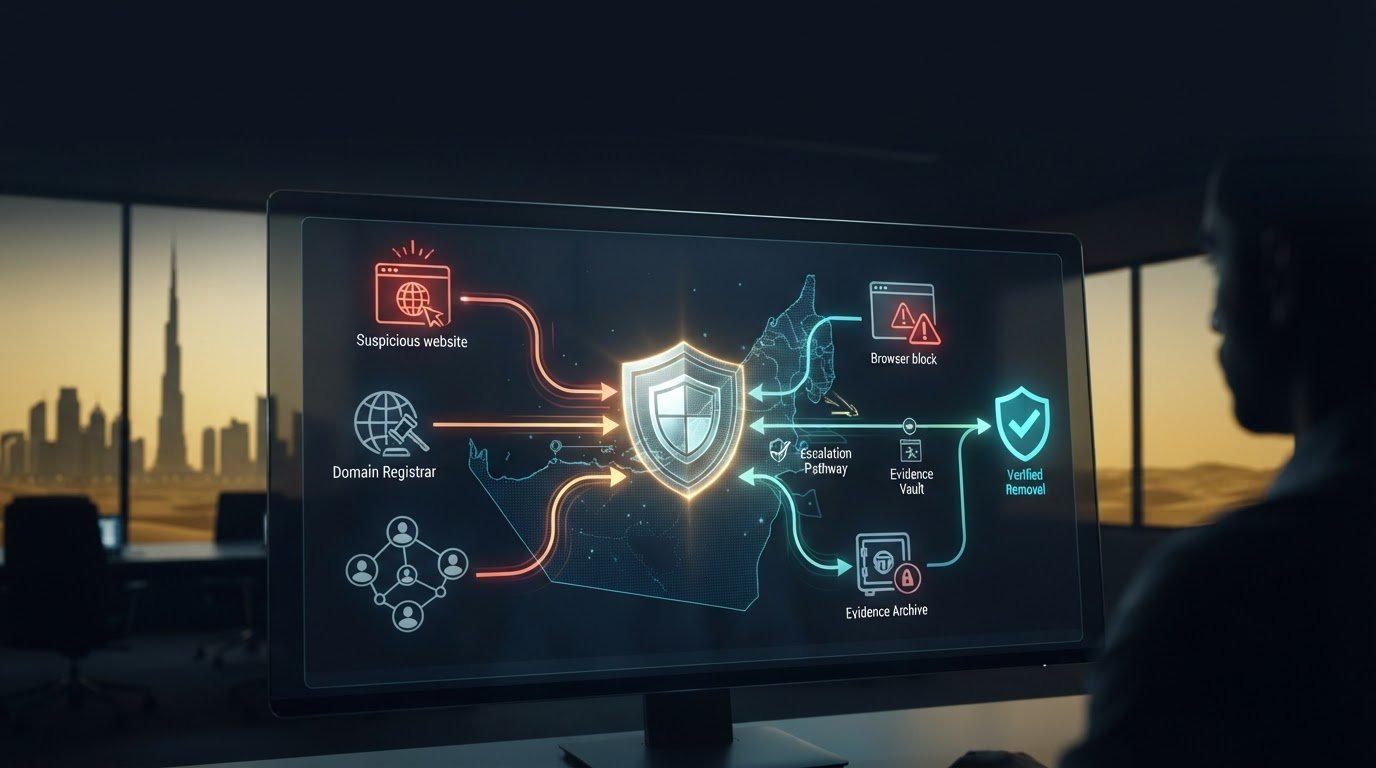
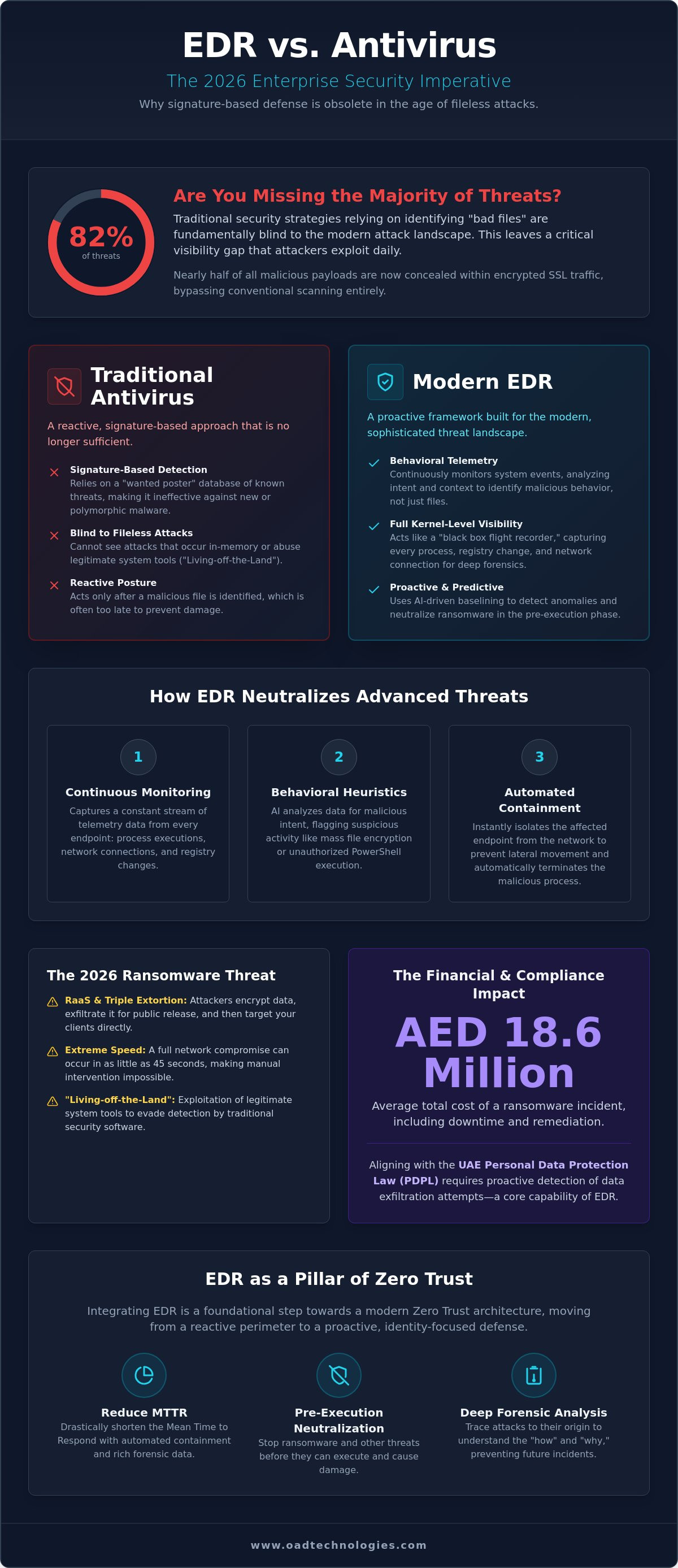
If your security strategy still relies on identifying "bad files," you're likely missing 82% of the threats currently targeting your network. In 2026, the debate of edr vs antivirus isn't just about software features; it's about whether your enterprise can survive an era where the most dangerous attacks don't use malware at all. With nearly half of all malicious payloads now concealed within encrypted SSL traffic, the traditional signature-based approach has reached its logical limit.
You've likely noticed that legacy antivirus feels increasingly inadequate against polymorphic threats, especially as you work to align your operations with the UAE Personal Data Protection Law (PDPL). The high cost of breach remediation, which now averages over AED 18.6 million globally for ransomware incidents, makes "good enough" security a massive financial liability. We'll show you how to transition from reactive shielding to a proactive framework that neutralizes ransomware in the pre-execution phase. This article provides a strategic roadmap to leverage behavioral telemetry, helping you reduce your Mean Time to Respond (MTTR) and maintain resilience in the face of sophisticated identity-focused attacks.
Key Takeaways
- Discover why traditional signature-based security fails against 2026-era threats and how behavioral telemetry bridges the critical visibility gap.
- Analyze the core differences in edr vs antivirus to transition your defense from static file scanning to dynamic, kernel-level monitoring.
- Learn to neutralize sophisticated ransomware in the pre-execution phase by identifying malicious intent through continuous process telemetry.
- Align your endpoint security framework with the UAE Personal Data Protection Law (PDPL) to minimize operational risk and data breach recovery costs.
- Follow a strategic roadmap for asset discovery and policy mapping to integrate EDR as a foundational pillar of your Zero Trust architecture.
The Evolution of Ransomware and the Necessity of EDR
The security perimeter has dissolved. While traditional antivirus once provided a reliable shield, it's now fundamentally ill-equipped to handle the industrialization of cybercrime. Endpoint detection and response (EDR) is not merely a replacement for your existing tools; it's a continuous monitoring ecosystem designed to provide visibility where legacy agents are blind. In the current edr vs antivirus debate, the distinction lies in the difference between a static lock and a 24 X 7 surveillance team. EDR serves as the primary telemetry source for modern threat hunting, recording every system interaction to identify anomalies before they escalate into catastrophes.
The 2026 Ransomware Threat Landscape
The Ransomware-as-a-Service (RaaS) model has matured into a sophisticated corporate structure, allowing even low-skilled actors to launch devastating attacks against UAE enterprises. We see a shift toward triple extortion tactics, where attackers don't just encrypt data, but also exfiltrate it for public disclosure and target your clients directly. The speed of these incidents is staggering. In 2026, a network can be fully compromised in as little as 45 seconds, a timeframe that renders manual human intervention impossible. Modern threats increasingly utilize "living-off-the-land" (LotL) techniques, abusing legitimate system tools to bypass detection. This makes proactive monitoring a requirement for any organization aiming to comply with the UAE Personal Data Protection Law (PDPL).
The Structural Failure of Traditional Antivirus
Traditional antivirus operates on a "wanted poster" methodology. It looks for known file signatures that match a database of previously identified threats. This approach is obsolete against polymorphic ransomware, which changes its code with every iteration to stay unique. When an attack is "fileless" or occurs entirely within system memory, a standard antivirus agent sees nothing. This lack of memory-level visibility is a critical vulnerability that attackers exploit daily.
Relying on static scanning creates a false sense of security that can lead to massive financial losses. The average total cost of a ransomware incident now reaches approximately AED 18.6 million, including downtime and remediation. When evaluating edr vs antivirus, the decision ultimately impacts your ability to detect lateral movement within the network. To survive this landscape, businesses must move toward behavioral heuristics. Unlike the reactive nature of antivirus, EDR analyzes the intent of a process. If a legitimate application suddenly begins encrypting files at high speed, EDR identifies the behavior as malicious and intervenes, regardless of whether a signature exists. This transition is a core component of modern GRC strategies, ensuring long-term operational resilience.
The Mechanics of EDR: How Behavioral Telemetry Stops Ransomware
To understand why modern security has shifted, we must look at the technical architecture of edr vs antivirus. While traditional agents focus on the file, EDR focuses on the event. It acts as a continuous telemetry bridge, capturing every process execution, registry change, and network connection across your infrastructure. This data stream provides a 360-degree view of your environment, functioning much like a "black box" flight recorder. If a breach occurs, this historical data allows your team to perform deep forensic analysis, tracing the attack back to its point of origin to ensure it can't happen again.
Detection through Behavioral Heuristics
EDR doesn't need to recognize a specific file to know it's dangerous. Instead, it monitors for "malicious intent" by analyzing behavioral heuristics. For example, it flags unusual parent-child relationships, such as a Microsoft Word document suddenly launching a hidden PowerShell script. It also tracks system-wide activities like mass file renaming or unauthorized calls to cryptographic APIs, which are classic hallmarks of ransomware. AI-driven baselining creates a unique behavioral profile for every user, instantly flagging deviations that suggest compromised credentials or insider threats. This level of scrutiny is essential for maintaining compliance with the UAE Personal Data Protection Law (PDPL), as it identifies data exfiltration attempts that static tools would miss.
Automated Containment and Remediation
The true power of EDR lies in its ability to close the gap between detection and response. When the system identifies an encryption attempt, it triggers an automated "Detect, Contain, Remediate" cycle. This begins with network isolation, effectively "quarantining" the infected endpoint to prevent lateral movement across the national corporate network. Unlike the binary "allow or block" logic found in the edr vs antivirus comparison, EDR can surgically terminate a single malicious thread while allowing the rest of the system to remain operational.
If the ransomware manages to encrypt a small number of files before the process is killed, advanced EDR solutions offer automated rollback capabilities. This technology uses shadow copies and protected backups to restore encrypted files to their pre-attack state instantly. This automation significantly reduces your Mean Time to Respond (MTTR), ensuring that a potential catastrophe becomes a minor, logged incident. To see how these architectural standards can be integrated into your specific environment, you might consider how bespoke EDR engineering can harden your defense against 2026-era threats.
EDR vs. Legacy Antivirus: Moving Beyond Signature-Based Defense
The core of the edr vs antivirus comparison lies in the depth of the defensive layer. Legacy antivirus operates primarily at the file level, scanning objects as they arrive on a disk to find a match in a signature database. This approach is inherently reactive; it requires a pre-existing "wanted poster" to recognize a threat. In contrast, EDR provides kernel-level visibility, monitoring the very heart of the operating system. It observes system calls, memory allocations, and network socket creation in real-time. By moving from a static to a dynamic model, your security posture shifts from waiting for a known match to actively investigating suspicious patterns before they can execute.
A professional Security Operations Centre (SOC) is essential for maximizing the value of these insights. While antivirus is a "set and forget" tool, EDR is a continuous source of high-fidelity data that requires expert interpretation. To explore how managed IT support can provide this level of oversight, you can discover Proactive Networking Ltd. For UAE enterprises, the edr vs antivirus investment pays for itself by preventing the catastrophic downtime associated with 2026-era ransomware. Avoiding a single major breach saves millions in AED, protects brand reputation, and ensures your organization remains a reliable partner in the national digital economy.
Visibility Gaps and Detection Efficacy
Legacy agents suffer from a significant visibility gap because they can only block what they have seen before. This leaves a massive window of opportunity for zero-day exploits and custom-coded threats. EDR closes this gap by focusing on the "how" and "why" of system changes through:
- Process Lineage: Tracking which application launched a specific thread.
- Network Telemetry: Identifying unauthorized data exfiltration attempts.
- Registry Monitoring: Detecting changes to boot sequences or system configurations.
Strategic Integration with SIEM and MDR
Architecture resilience relies on synergy rather than isolated tools. EDR acts as the "eyes" of your infrastructure, providing the raw telemetry that a SIEM uses as its "brain" to correlate events across the network. This combination is most effective when managed through Managed Detection and Response (MDR), where human experts hunt for threats 24 X 7. Integrating these capabilities with Identity and Access Management (IAM) ensures that even if a user's credentials are compromised, the resulting anomalous endpoint behavior is flagged and neutralized instantly.
Implementing EDR Ransomware Protection: A Strategic Roadmap
Deploying a resilient endpoint strategy requires moving beyond the simple installation of a security agent. When organizations evaluate edr vs antivirus, they often overlook the fact that EDR is a lifecycle, not a product. Success begins with comprehensive asset discovery. You must identify every endpoint across your national infrastructure, from remote workstations to legacy servers, to ensure no blind spots remain. Once visibility is established, the next phase involves policy mapping. This process aligns your EDR rules with specific business workflows and GRC requirements, ensuring that security measures don't impede operational performance.
Tuning and optimization are the final technical hurdles. A poorly configured system creates alert fatigue through excessive noise. By refining sensitivity levels for critical assets, you ensure your team focuses only on high-fidelity threats. This shift from periodic scans to 24 X 7 endpoint vigilance transforms your security from a gatekeeper into a continuous monitoring engine. To ensure your implementation meets these rigorous engineering standards, consider consulting with a team specialized in bespoke EDR integration.
Aligning with UAE Regulatory Standards
For UAE businesses, EDR is a vital tool for meeting the strict logging and monitoring requirements of the UAE Personal Data Protection Law (PDPL). Regulators now demand granular visibility into how data is accessed and moved. EDR provides the "evidence of due diligence" required by modern regulators by maintaining an immutable record of all process interactions. These logs are indispensable during national cybersecurity audits and VAPT assessments, where they prove the efficacy of your active defenses.
The Human Element: Managing the EDR Stack
Technology alone is insufficient. You must decide between training an internal team or partnering with a specialized MSSP for Managed Detection and Response (MDR) services. Proactive threat hunting is a core discipline of EDR that requires high-level expertise to identify the subtle signs of a breach that automated tools might miss. In modern hybrid environments, integrating your endpoint data with Cloud Security Posture Management (CSPM) creates a unified defense that spans from the local device to the cloud. This synergy ensures that your edr vs antivirus transition isn't just a software upgrade, but a complete evolution of your organizational resilience.
Elevating Endpoint Security with OAD Technologies
Choosing between edr vs antivirus is a foundational decision, but the efficacy of that choice depends entirely on the architectural framework supporting it. At OAD Technologies, we reject the "quick fix" mentality of standardized software deployments. We believe that national resilience is built through rigorous engineering and bespoke system design. For high-stakes UAE enterprise environments, a generic off-the-shelf solution is rarely sufficient to counter the precision of 2026-era threats. Our approach prioritizes a long-term partnership, acting as a guardian of your digital relevance in a market where the cost of a single breach can exceed AED 18.6 million.
We bridge the gap between automated speed and human insight. While AI-driven telemetry identifies anomalies in milliseconds, our Managed Detection and Response (MDR) stack leverages seasoned security analysts to provide the necessary context. This synergy ensures that we don't just detect events; we understand their intent. By combining high-fidelity automation with deep human expertise, we transform the edr vs antivirus transition into a proactive defense strategy that anticipates adversary tactics before they manifest.
Customized Integration and Managed Services
Our integration services are highly individualized. We recognize that the operational requirements of a financial institution differ significantly from those of an industrial facility. OAD tailors EDR policies to these specific vertical needs, ensuring that security protocols enhance rather than hinder productivity. A critical component of this strategy is ensuring seamless interoperability between your endpoint defenses and Data Loss Prevention (DLP) tools. This holistic visibility prevents data exfiltration while maintaining strict compliance with the UAE Personal Data Protection Law (PDPL).
A Commitment to National Cybersecurity Excellence
As a specialized system integrator, OAD Technologies is committed to advancing the UAE's national cybersecurity standards. We don't just monitor for today's risks; we design systems capable of withstanding the evolved threat landscape of 2026. Our proactive mitigation strategies are built on a foundation of technical authority and a deep understanding of local regulatory pressures. We invite you to move beyond reactive shielding and embrace a future of architectural resilience. Schedule a strategic security assessment with OAD Technologies to begin hardening your enterprise against the next generation of digital challenges.
Securing Your Enterprise in the Post-Signature Era
The transition from legacy security to a modern framework is no longer optional for UAE organizations aiming for long-term viability. We've explored how the edr vs antivirus debate has evolved into a clear choice between reactive shielding and proactive behavioral telemetry. By prioritizing kernel-level visibility and automated containment, you don't just stop ransomware; you build an environment capable of neutralizing threats in the pre-execution phase.
True resilience requires more than software. It demands a strategic alignment with national regulations like the PDPL and the integration of expert human threat hunting. OAD Technologies stands as a UAE-based strategic partner, offering bespoke engineering and expert integration across EDR, MDR, and SIEM stacks. We ensure your security architecture is tailored to the specific demands of your industry and the unique risks of the 2026 landscape.
Now is the time to move beyond the limitations of static defense. Architect your endpoint resilience with OAD Technologies to ensure your infrastructure remains secure, compliant, and ready for the future. We look forward to helping you master the complexities of modern digital defense.
Frequently Asked Questions
How does EDR ransomware protection differ from standard antivirus?
The primary difference in edr vs antivirus is the detection methodology. Standard antivirus relies on a database of known file signatures to identify threats, making it reactive. EDR uses behavioral telemetry to monitor system intent in real-time. This allows it to identify and block suspicious activities, such as unauthorized encryption, even if the specific ransomware variant hasn't been seen before by security researchers.
Can EDR stop fileless ransomware attacks that do not use traditional files?
Yes, EDR is specifically designed to neutralize fileless attacks that bypass traditional security layers. These threats often reside in system memory or abuse legitimate tools like PowerShell to execute malicious commands. Because EDR monitors process behavior and kernel-level interactions, it can identify the anomalous execution patterns of a fileless attack and terminate the thread before it compromises your data.
Does EDR ransomware protection satisfy UAE PDPL compliance requirements?
EDR provides the granular logging and continuous monitoring capabilities necessary to meet the UAE Personal Data Protection Law (PDPL) standards. The law requires organizations to implement "appropriate technical and organizational measures" to protect personal data. EDR agents serve as a critical source of truth, providing the immutable audit trails and evidence of due diligence required during national regulatory assessments.
Will EDR slow down my employees’ computers or endpoints?
Modern EDR agents are engineered to be significantly more efficient than legacy antivirus software. While older tools often perform intensive, scheduled disk scans that consume CPU resources, EDR utilizes lightweight kernel-level drivers to monitor events as they happen. This event-driven approach ensures high-performance security without the noticeable system lag that often frustrates users in a high-speed corporate environment.
What is the role of a SOC in managing EDR ransomware protection?
A Security Operations Centre (SOC) acts as the analytical brain behind the EDR telemetry. While the software can automate containment, a SOC team provides the expert human insight needed to investigate complex alerts and perform proactive threat hunting. This partnership is essential for distinguishing between legitimate administrative tasks and sophisticated adversary tactics that might otherwise blend into normal network traffic.
Is EDR enough to protect against ransomware on its own?
While EDR is a foundational pillar of endpoint resilience, it's most effective as part of a multi-layered Zero Trust architecture. Comprehensive protection requires integrating EDR with Identity and Access Management (IAM) and robust backup strategies. This ensures that even if one layer is challenged, the rest of your security stack provides the necessary redundancy to prevent a total network collapse.
What happens if EDR detects ransomware while my team is offline?
Advanced EDR solutions utilize automated response playbooks to contain threats instantly, regardless of the time of day. If a ransomware process is detected at 3:00 AM, the system can automatically isolate the infected endpoint from the network and terminate the malicious process. This immediate containment prevents lateral movement, buying your security team valuable time to perform a full remediation once they're back online.
How much does it cost to implement EDR ransomware protection for a UAE enterprise?
The investment for EDR varies based on the total number of endpoints and the level of management required. Some organizations opt for self-managed licenses, while others prefer the comprehensive oversight of a Managed Detection and Response (MDR) service. You'll need to evaluate your specific infrastructure needs and compliance objectives to determine the most cost-effective deployment model for your national operations.
Disclaimer
Content by OAD Technologies is for general informational purposes only and does not constitute professional or cybersecurity advice. No warranties are made regarding accuracy or completeness; reliance is at your own risk. OAD Technologies shall not be liable for any direct or indirect losses arising from use of this content.