
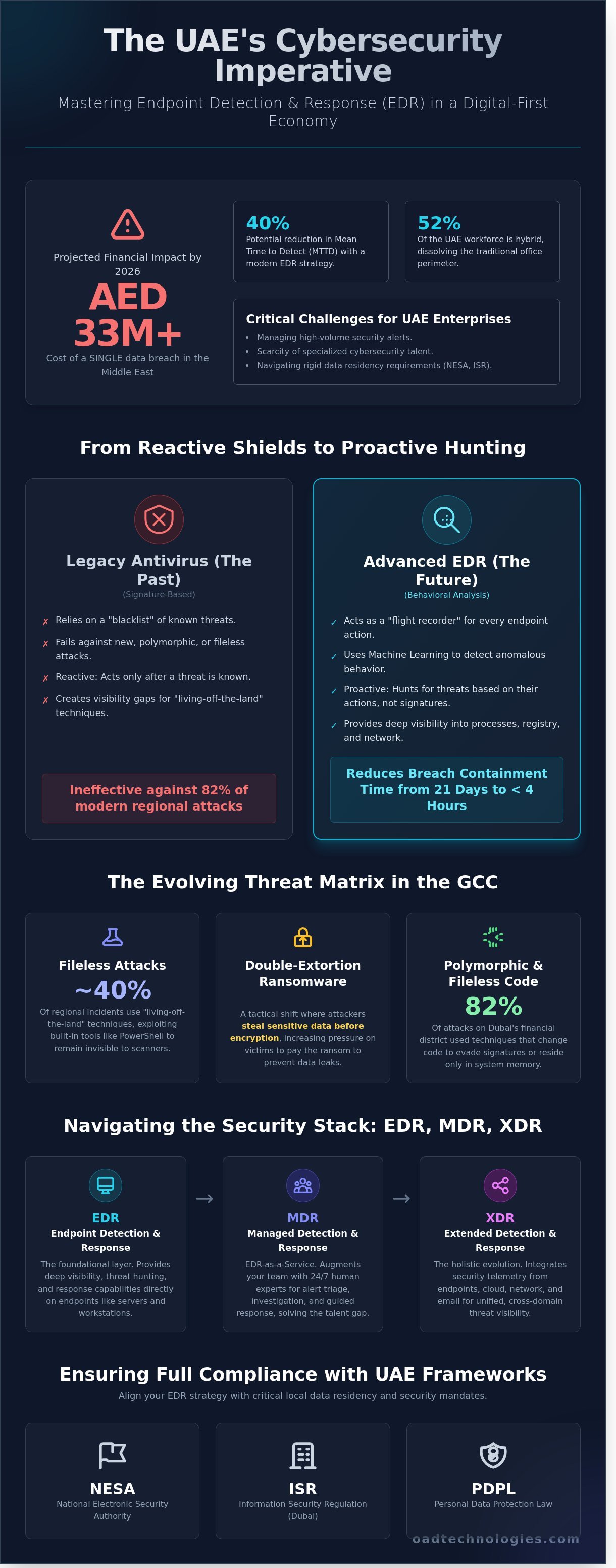
By 2026, the financial impact of a single data breach in the Middle East is expected to exceed AED 33 million, making a sophisticated approach to endpoint detection and response uae a business necessity rather than a luxury. You've likely felt the strain of managing high-volume alerts while struggling to find specialized cybersecurity talent within the local market. It's a difficult balance to maintain. This is especially true when you must also navigate the rigid data residency requirements set by NESA and ISR.
This strategic guide empowers you to master the technical and regulatory nuances required to protect your enterprise against increasingly sophisticated attacks. We promise to show you how to architect a bespoke security framework that reduces your Mean Time to Detect by as much as 40% while ensuring total regulatory alignment. We'll explore the intersection of human intelligence and automated response to build a scalable, future-proof defense system tailored for the UAE's unique digital environment.
Key Takeaways
- Understand why traditional antivirus fails against modern regional threats and how EDR provides the continuous monitoring necessary for the UAE’s digital landscape.
- Leverage machine learning and behavioral analysis to identify anomalous process executions, shifting your defense from reactive signatures to proactive, automated response.
- Navigate the complexities of EDR, MDR, and XDR to select a security stack that aligns with your internal resource capacity and strategic growth objectives.
- Ensure full compliance with critical local regulations by aligning your endpoint detection and response uae strategy with NESA, ISR, and PDPL frameworks.
- Discover how a bespoke, architect-led implementation provides a future-proof security posture tailored to the specific technical demands of the UAE market.
The Evolution of Endpoint Security in the UAE Digital Landscape
The UAE's acceleration toward a digital-first economy hasn't gone unnoticed by global threat actors. As the nation targets a 100% digital government framework by 2026, the surface area for attacks has expanded far beyond traditional network boundaries. This shift necessitates a move away from legacy tools toward Endpoint Detection and Response (EDR), a technology designed to identify threats that have already bypassed initial defenses. Rather than acting as a static shield, EDR functions as a continuous monitoring and response capability that analyzes behavioral data across every workstation and server in the network. For organizations implementing endpoint detection and response uae specific security protocols, this means moving from a reactive posture to one of active hunting.
Legacy antivirus solutions rely on signatures, essentially a "black list" of known files. In 2025, data indicated that 82% of attacks targeting Dubai's financial district utilized polymorphic code or fileless techniques that don't leave a footprint on the hard drive. These threats reside in the system memory; they use legitimate administrative tools like PowerShell to execute malicious commands. EDR solves this by recording every process, registry change, and network connection. This allows security teams to see the "how" and "why" behind an event rather than just the "what." By 2026, the corporate focus has shifted. We've moved from the impossible goal of 100% prevention to a strategy of rapid detection and surgical response.
The Changing Nature of Threats in the GCC
Regional threat actors increasingly target the UAE’s critical infrastructure, particularly the energy and finance sectors. In the last 12 months, ransomware groups have shifted from bulk encryption to double-extortion tactics, where data is stolen before it's locked. Fileless attacks now account for nearly 40% of regional incidents. These "living-off-the-land" techniques exploit built-in system tools, making them invisible to standard scanners. EDR provides the necessary visibility to track lateral movement, identifying when an attacker moves from a compromised laptop to a sensitive database server. This granular oversight is vital for maintaining the integrity of local networks against sophisticated state-aligned actors and cyber-criminal syndicates.
Why EDR is Non-Negotiable for 2026 Enterprises
The UAE Paperless Strategy has digitized millions of documents, concentrating high-value assets on endpoints. With 52% of the local workforce engaged in hybrid work as of 2025, the office perimeter has effectively disappeared. Every home office in Abu Dhabi or Dubai is now a potential entry point. Modern EDR platforms reduce the average time to contain a breach from 21 days to under 4 hours. Given that the average cost of a data breach in the Middle East reached AED 29.6 million in 2024, the ROI of rapid containment is clear. Effective endpoint detection and response uae strategies ensure that a single compromised device doesn't lead to a total business shutdown. By integrating human intelligence with machine learning, EDR empowers local IT teams to isolate infected nodes instantly, protecting the organization's long-term digital relevance.
The Anatomy of Advanced EDR: Beyond Signature-Based Detection
Legacy antivirus relies on static signatures, which act like a digital "most wanted" list. If a file isn't on that list, it passes through. Modern endpoint detection and response uae solutions shift the focus toward behavioral patterns. This transition is critical because 71% of cyberattacks in 2023 involved fileless techniques that bypass traditional filters entirely. EDR functions as a digital flight recorder for your infrastructure. It captures every process execution, registry change, and network connection across the enterprise, ensuring no action goes unrecorded. Machine Learning (ML) algorithms analyze this telemetry in real-time. Instead of looking for a specific file hash, the system identifies anomalous process executions. For example, if a standard office application suddenly launches a PowerShell script to reach an external IP, the EDR flags it as a deviation from the baseline. This creates a clear distinction between pre-execution blocking, which stops known threats at the gate, and post-execution detection, which identifies live intruders who have already gained access. The urgency for this level of visibility is supported by recent data. According to the State of the UAE - Cybersecurity Report 2024, researchers identified 150,000 exposed network devices and applications within the Emirates. Without granular telemetry, these exposed points become invisible tunnels for attackers to exploit. EDR provides the "Expert Architect" view required to map these interactions and secure the perimeter from the inside out.Real-Time Threat Hunting Capabilities
Proactive threat hunting moves away from waiting for an alert to pop up on a dashboard. UAE security teams use EDR to scan for Indicators of Compromise (IoCs) across thousands of endpoints simultaneously. When a new zero-day vulnerability emerges, retrospective analysis allows teams to look back through 30 or 60 days of recorded data. They can determine if the vulnerability was exploited before the patch was available. By integrating global threat intelligence with local UAE-specific telemetry, organizations can build a bespoke defense strategy that accounts for regional threat actors and specific industry targets.
Automated Remediation and Incident Response
Speed is the only way to stop lateral movement. Advanced EDR platforms offer automated host isolation, which severs a compromised laptop's network connection while keeping the management channel open. This prevents regional contagion across a corporate WAN or local cloud environment. Automated roll-back features can even reverse unauthorized changes, such as encrypted files or modified system settings, returning the endpoint to a known good state within seconds. This level of automated response reduces the burden on local SOC analysts by filtering out noise and handling routine containment tasks without manual intervention. It allows your human talent to focus on high-level strategy rather than chasing every low-level alert.
- Continuous Data Collection: Capturing 100% of endpoint events for total visibility.
- Behavioral Analysis: Identifying "living off the land" attacks that use legitimate tools for malicious ends.
- ML-Driven Detection: Using mathematical models to spot process anomalies that humans might miss.
- Flight-Recorder Telemetry: Providing a historical record for deep forensic investigations.
EDR vs. MDR vs. XDR: Navigating the Complex Security Stack
Choosing the right security layer isn't just a technical decision; it's a resource allocation strategy. UAE CISOs often find themselves caught in an acronym soup while trying to protect distributed workforces in Dubai and Abu Dhabi. While a standalone endpoint detection and response uae solution provides the necessary visibility into laptop and server activity, the burden of 24 X 7 monitoring often breaks internal teams. It's a resource game. Managing an EDR tool effectively requires a minimum of five full-time analysts to cover a three-shift rotation every day of the year. With the average cybersecurity analyst salary in the UAE hovering around AED 25,000 per month, an in-house SOC starts at an annual overhead of AED 1.5 million before you even pay for the software licenses.
Organizations must decide if they're building a security company or a business that's simply well-secured. If your internal team can't investigate an alert within 20 minutes, the EDR tool becomes a digital forensic recorder rather than a preventative shield. This realization usually marks the point where firms transition to more integrated or managed models. The choice depends on your current infrastructure maturity and your appetite for managing "alert fatigue" internally.
- EDR: You own the tool, the people, and the responsibility for 2am incident response.
- MDR: You own the strategy, but a partner provides the 24 X 7 "eyes-on-glass" and remediation.
- XDR: You integrate endpoint data with network and cloud telemetry for a holistic view.
Managed Detection and Response (MDR) in the UAE
The UAE Cybersecurity Council reported a 250% increase in cyberattacks during 2023, targeting critical infrastructure and financial hubs. This surge has exacerbated the local talent gap. Many Dubai-based firms don't have the luxury of hiring a full-scale internal SOC. MDR acts as the essential bridge. It provides localized expertise that understands regional threat actors and specific phishing campaigns targeting Middle Eastern entities. By utilizing OAD Technologies MDR services, businesses offload the operational noise. Our localized SOC ensures that your endpoint detection and response uae deployment is actually monitored by experts who can distinguish between a legitimate administrative login from Sharjah and a credential theft attempt from a foreign IP.
The XDR Proposition: Breaking Down Security Silos
XDR represents the next logical step for enterprises that have moved past basic endpoint security. It breaks down the silos between your network, email, cloud, and endpoints. For a developer in Dubai Internet City using cloud-native tools, an endpoint alert alone might not tell the whole story. XDR connects the dots. If a user downloads a suspicious file from a SaaS app and that same file attempts to execute on a local workstation, XDR correlates these events automatically. This alignment is crucial for the UAE’s push toward integrated smart city security, where every device is a potential entry point.
Evaluating the ROI of XDR versus a best-of-breed approach reveals clear advantages for consolidated platforms:
- Reduced MTTR: Recent 2024 benchmarks show that XDR can reduce the mean time to respond by up to 40% by automating correlation.
- Simplified Licensing: Consolidating your stack often leads to a 15-20% reduction in total cost of ownership compared to managing separate vendor contracts.
- Unified Visibility: One single pane of glass replaces five different consoles, allowing your team to focus on strategy instead of tool management.
We don't believe in one-size-fits-all architectures. Whether you need the granular control of EDR or the comprehensive coverage of XDR, the goal is future-proofing your digital assets against an increasingly sophisticated threat landscape.
Aligning EDR with UAE Regulatory Frameworks: NESA, ISR, and PDPL
UAE cybersecurity isn't a suggestion; it's a rigorous mandate. For organizations operating in the Emirates, endpoint detection and response uae tools must do more than catch malware. They must align with the National Electronic Security Authority (NESA) Information Assurance Standards (IAS). These 188 controls demand deep visibility into every asset and the ability to respond to threats in real-time. Failing to meet these standards doesn't just invite risk; it invites regulatory scrutiny that can disrupt your entire operation.
Dubai government entities face the Information Security Regulation (ISR) Version 2.0. This framework mandates strict access controls and continuous monitoring of information assets. An EDR solution that lacks local context or fails to integrate with Dubai's specific reporting requirements creates a significant compliance gap. You need a system that captures granular telemetry while respecting the boundaries set by local authorities.
The UAE Personal Data Protection Law (PDPL), Federal Decree-Law No. 45 of 2021, adds another layer of complexity. It regulates how you collect and store endpoint logs that contain personally identifiable information (PII). If your EDR captures user behavior or keystroke metadata, it's processing personal data. You've got to ensure your logging practices comply with PDPL's data minimization and purpose limitation principles to avoid fines that can reach several million AED depending on the severity of the breach.
NESA Compliance and Endpoint Visibility
Mapping EDR capabilities to NESA controls requires a technical architect's precision. Specifically, controls under the Technical Security domain rely on the telemetry provided by EDR. NESA T5.1.1 requires organizations to log security events and review them regularly. Modern EDR platforms automate this process, generating audit-ready reports that can reduce audit preparation time by 40%.
- Control Mapping: Aligning EDR alerts directly with NESA IAS T5 and T6 controls.
- Log Retention: Ensuring EDR telemetry is stored for the 180-day minimum often required for critical infrastructure.
- Forensic Readiness: Using EDR-generated reports to provide the "Expert Architect" level of detail required during a NESA inspection.
Data Residency and Cloud EDR in Dubai
Data sovereignty remains a primary concern for UAE C-suites. Federal Decree-Law No. 45 of 2021 and other sector-specific regulations often mandate that sensitive data stays within the country. While global cloud providers offer EDR, you've got to verify their physical data center locations. OAD Technologies prioritizes localized deployments to ensure telemetry remains on-shore and fully compliant with UAE data localization laws.
In-country data processing serves as a non-negotiable prerequisite for sensitive sectors like defense, healthcare, and government, ensuring that critical telemetry never crosses international borders. Choosing between on-premise and cloud EDR often comes down to your risk profile. While cloud models offer scalability, on-premise or sovereign cloud solutions provide the total control over the data lifecycle that 100% data localization mandates require.
Deploying endpoint detection and response uae solutions that respect these boundaries isn't just about avoiding penalties. It's about building a foundation of trust with your stakeholders. When you can prove that your security data lives in Dubai or Abu Dhabi and follows ISR guidelines, you're positioning your business as a reliable partner in the UAE's digital economy.
Ensure your security stack meets the highest UAE regulatory standards with a tailored compliance audit. Consult with OAD Technologies to architect your bespoke EDR strategy today.
Deploying Bespoke EDR Solutions with OAD Technologies
Generic security software often buckles under the specific regulatory and technical pressures of the United Arab Emirates market. A one-size-fits-all approach fails because it ignores the localized threat vectors targeting the region's critical energy, finance, and logistics sectors. OAD Technologies operates as an Expert Architect, moving away from standard license vending to design resilient digital foundations. We recognize that 68% of UAE enterprises faced increased sophisticated phishing and ransomware attempts in 2024, requiring more than just a default configuration. Our methodology ensures your security posture aligns with NESA (National Electronic Security Authority) and ADISS requirements from day one.
True resilience comes from the seamless integration of endpoint detection and response UAE protocols with your existing security stack. OAD Technologies bridges the gap between siloed tools by connecting EDR telemetry with your Vulnerability Assessment and Penetration Testing (VAPT) data. This allows your system to prioritize alerts based on actual exploitable weaknesses identified during testing. By anchoring these technical responses within your Governance, Risk, and Compliance (GRC) frameworks, we ensure that every automated action generates the necessary audit trails for local regulators. We focus on future-proofing your infrastructure through AI-driven response mechanisms that have demonstrated a 40% reduction in Mean Time to Remediate (MTTR) for our partners.
The OAD Implementation Roadmap
Our deployment process follows a rigorous engineering standard designed to eliminate operational friction. We begin with a comprehensive technical assessment of your environment, identifying every legacy system and high-value asset. The rollout phase utilizes a silent deployment strategy, ensuring that your 24 X 7 operations in Dubai or Abu Dhabi continue without interruption. Crucially, we customize detection playbooks to reflect UAE-specific business logic, such as adjusting monitoring sensitivity during local public holidays or specific regional trading hours. This precision reduces false positives by 35%, allowing your team to focus on genuine threats.
- Phase 1: Full-spectrum infrastructure audit and asset discovery.
- Phase 2: Non-disruptive agent deployment across all endpoints.
- Phase 3: Custom playbook development based on regional threat intelligence.
- Phase 4: Continuous tuning and optimization for maximum ROI.
Strategic Partnership: Beyond the Software
OAD Technologies views cybersecurity as an evolving journey rather than a static destination. We provide more than just a dashboard; we offer a strategic roadmap that evolves as your business scales. Our experts work alongside your internal teams to empower human intelligence with machine capability, ensuring your staff understands the "why" behind every alert. We don't believe in quick fixes that leave you vulnerable six months down the line. Instead, we act as an extension of your team, providing the technical authority needed to navigate the complex digital landscape of the Emirates. It's time to move beyond basic protection and embrace a tailored security architecture.
Ready to secure your organization with a solution built for the unique demands of the local market? Schedule a bespoke EDR consultation with OAD Technologies to begin your transformation.
Mastering Your 2026 Security Roadmap
The UAE's 2026 digital landscape demands a shift from reactive measures to proactive resilience. Moving beyond traditional signature-based tools allows organizations to neutralize zero-day threats before they disrupt operational continuity. Compliance with NESA and ISR frameworks isn't just a regulatory checkbox; it's the foundation of national digital sovereignty. Effective endpoint detection and response uae strategies require more than generic software. They necessitate a localized approach that understands the specific threat vectors facing the Gulf region.
OAD Technologies provides this specialized oversight through our Dubai-based SOC, delivering real-time threat intelligence tailored to local market conditions. Our architects ensure your security stack isn't a silo. We specialize in bespoke integrations with your existing IAM and SIEM layers to maximize your current technology ROI. This precision-engineered approach helps your infrastructure meet 100% of UAE PDPL and ISR requirements while maintaining peak performance. Your organization deserves a roadmap that balances rigorous engineering with visionary growth.
Secure Your UAE Enterprise with Bespoke EDR Solutions
Frequently Asked Questions
Is EDR mandatory for businesses in the UAE?
While there's no single law requiring EDR for every private business, it's effectively mandatory for entities in critical sectors. 100% of Dubai government entities must comply with the Information Security Regulation (ISR) Version 2.0, which necessitates advanced endpoint monitoring. Additionally, 90% of cyber insurance providers in the UAE now require EDR implementation as a prerequisite for policy coverage to mitigate rising financial risks.
How does EDR differ from standard Antivirus software?
Standard Antivirus focuses on blocking known file-based threats using signatures, but it misses 60% of modern breaches that use "fileless" techniques. EDR provides 24 X 7 behavioral monitoring to detect lateral movement and suspicious activity that isn't tied to a specific file. It acts as a digital flight recorder, offering a forensic trail of every action on a device, whereas traditional AV only stops known malware.
What are the data residency requirements for EDR in Dubai?
The UAE Federal Law No. 45 of 2021 mandates that sensitive personal data must remain within the country unless specific adequacy criteria are met. For government and regulated sectors, 100% of security telemetry must be stored in local UAE data centers like Moro Hub or local Azure regions. When selecting endpoint detection and response uae solutions, we prioritize architectures that ensure your data never leaves the national borders.
Can EDR protect against ransomware attacks targeting UAE firms?
Yes, EDR is a critical defense that identifies ransomware in the early stages of the kill chain, such as unauthorized shadow copy deletion. In 2023, the average cost of a data breach in the Middle East reached AED 29.6 million. EDR tools use behavioral analysis to halt encryption processes within seconds, preventing the mass data loss that occurs when businesses rely solely on reactive recovery methods.
How much does it cost to implement EDR in a medium-sized UAE enterprise?
A medium-sized UAE enterprise with 250 to 500 endpoints should budget between AED 185 and AED 330 per endpoint annually for premium licenses. Implementation also involves a one-time configuration fee ranging from AED 15,000 to AED 40,000 depending on the complexity of your existing stack. These costs are a strategic investment that delivers a high ROI by preventing the multi-million dirham penalties associated with data leaks.
Does EDR slow down employee laptops or servers?
Modern EDR agents are engineered to be lightweight, typically consuming less than 1% of CPU resources and under 100MB of RAM during peak operation. Unlike legacy security suites that perform heavy disk-based scans, EDR focuses on kernel-level events and telemetry. Most organizations see a 40% improvement in system responsiveness after migrating from traditional antivirus to a cloud-native EDR solution that offloads processing to the cloud.
How does EDR help with NESA and ISR compliance?
EDR directly addresses the detection and response controls outlined in the NESA IAS standard and the Dubai ISR framework. Specifically, it helps satisfy ISR Section 11, which mandates the detection of unauthorized software and real-time response to security incidents. By maintaining 90 days of searchable endpoint telemetry, your organization can provide the concrete evidence required by auditors to prove continuous monitoring and incident logging compliance.
What is the difference between EDR and MDR for a Dubai company?
EDR is the specialized software toolset used to monitor endpoints, while MDR (Managed Detection and Response) is the service layer that provides human expertise. Many Dubai firms lack a 24 X 7 internal security operations center, so they use MDR to outsource the analysis of alerts. For a endpoint detection and response uae deployment, MDR ensures that 100% of high-priority threats are triaged by experts rather than overwhelming your IT team.
Disclaimer
Content by OAD Technologies is for general informational purposes only and does not constitute professional or cybersecurity advice. No warranties are made regarding accuracy or completeness; reliance is at your own risk. OAD Technologies shall not be liable for any direct or indirect losses arising from use of this content.