

Why are so many enterprise SIEM platforms acting as expensive log graveyards rather than proactive guardians of the digital estate? You've likely felt the frustration of managing fragmented data silos across multi-cloud environments while drowning in false positives that leave your analysts exhausted. In the UAE, the pressure is even higher as you balance these operational hurdles with the need to meet strict national regulatory standards. Adopting the right siem implementation best practices is no longer just a technical task; it's a strategic necessity to ensure your investment delivers actual security value instead of just more noise.
This guide moves beyond basic setup to master the architectural and operational shifts required to transform your security stack into a high-performance threat-hunting engine. We'll show you how to achieve unified visibility across your entire digital footprint and significantly reduce your Mean Time to Respond (MTTR). By following this strategic roadmap for 2026, you'll learn to automate compliance reporting for UAE national standards and build a resilient architecture that empowers your people. We'll explore the critical shift toward cloud-native architectures and the integration of AI-driven analytics to ensure your security operations remain viable for the long term.
Key Takeaways
- Understand the shift from passive log storage to strategic telemetry orchestration needed to secure complex multi-cloud environments in 2026.
- Master technical siem implementation best practices by prioritizing data normalization to turn raw logs into standardized, high-fidelity intelligence.
- Enhance visibility by correlating endpoint telemetry with identity and access data to identify sophisticated threats hiding in your system perimeters.
- Execute a phased deployment strategy that focuses on high-value assets first, ensuring faster response times and alignment with UAE national compliance standards.
- Transition from off-the-shelf tools to a customized security architecture that empowers your internal team through human-centric technology and expert partnership.
The Strategic Necessity of SIEM Implementation in 2026
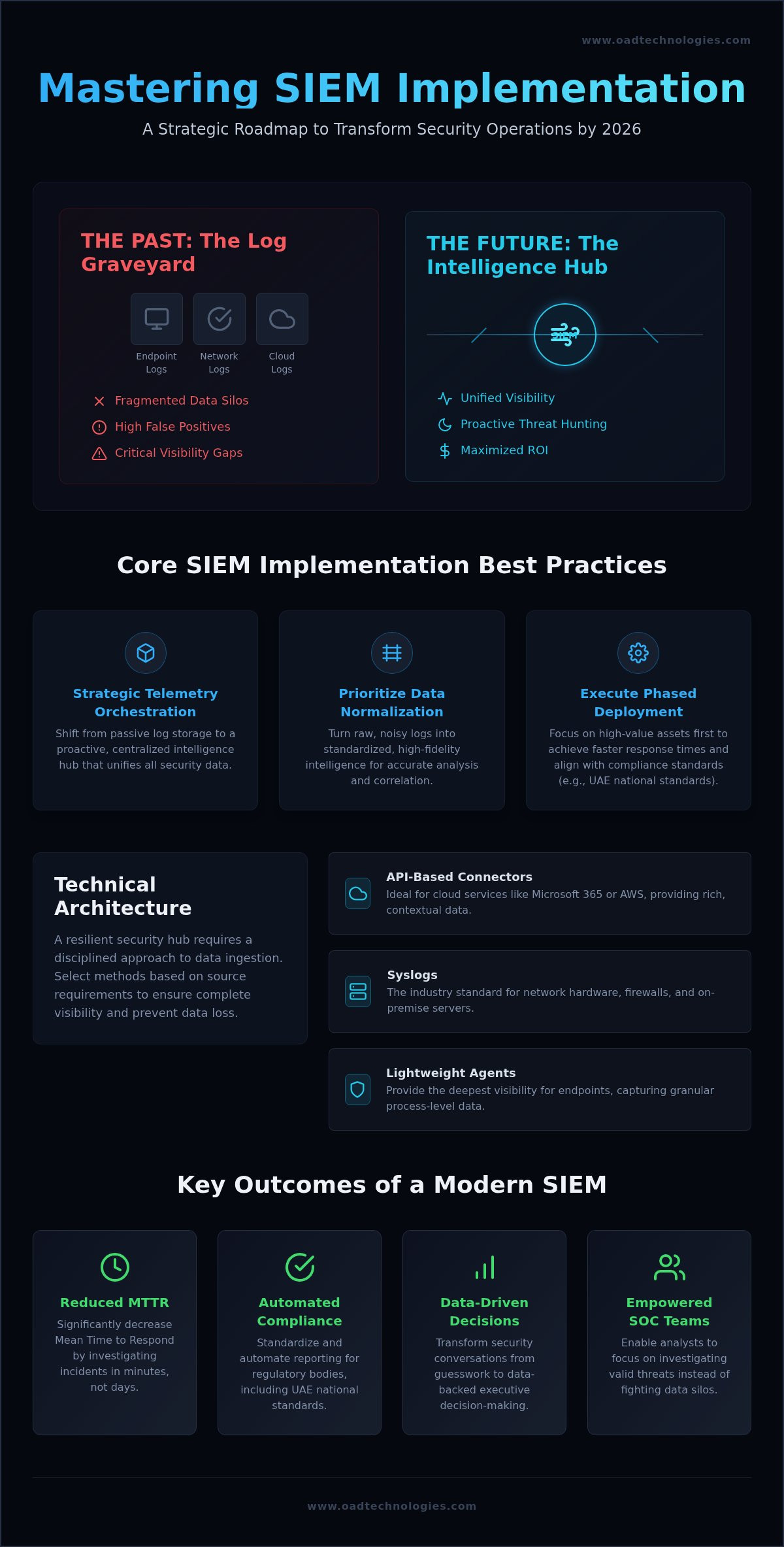
At its core, Security Information and Event Management (SIEM) implementation is the architectural process of unifying disparate telemetry into a centralized intelligence hub. It serves as the single source of truth for your security posture. By 2026, the complexity of multi-cloud environments and fragmented identity perimeters has made strategic orchestration a survival requirement rather than a luxury. Modern siem implementation best practices focus on eliminating the "Visibility Gap" where advanced persistent threats (APTs) often hide. In the UAE's rapidly evolving digital market, businesses face unique pressures from both sophisticated actors and strict national standards, making a centralized view of data essential.
Isolated security tools often create blind spots that attackers exploit. When your network logs don't talk to your cloud access logs, you lose the ability to see the full narrative of a breach. Moving away from reactive log management toward proactive threat hunting requires a system that doesn't just store data but interprets it. This transition ensures that your security team isn't just archiving history but actively shaping the organization's defense in real-time.
Breaking Down Enterprise Security Silos
Fragmented data carries a heavy price. Relying solely on Endpoint Detection and Response (EDR) or firewall logs is insufficient for modern defense because these tools only see their own slice of the environment. SIEM enables cross-layered correlation to detect "low and slow" lateral movement that would otherwise bypass individual security layers. Unified visibility impacts the organization by:
- Reducing the time required to identify compromised accounts across hybrid environments.
- Standardizing reporting for UAE national regulatory compliance.
- Improving the return on investment for existing security tools through integrated data streams.
This holistic approach transforms how leadership perceives risk. It moves the conversation from technical guesswork to data-driven executive decision-making, ensuring that every security investment is documented and justified.
SIEM as the Brain of the Modern SOC
A high-performing Security Operations Center (SOC) depends on a centralized engine to function effectively. We position SIEM as the core engine for managed detection and response (MDR), where telemetry from across the digital estate is analyzed and acted upon. This centralization supports rapid incident investigation and deep forensic analysis, allowing teams to reconstruct an attacker's steps within minutes rather than days. SIEM stands as the foundational layer of enterprise resilience by providing the clarity needed to act under pressure. Adhering to technical siem implementation best practices ensures your analysts spend their time investigating valid threats instead of fighting a losing battle against unorganized data silos.
Technical Architecture and Data Ingestion Best Practices
Building a resilient security hub requires more than just connecting data sources; it demands a disciplined approach to how telemetry enters the environment. Adhering to technical siem implementation best practices requires a focus on how data enters the system. You must select ingestion methods based on the specific requirements of the source. API-based connectors are ideal for cloud services like Microsoft 365 or AWS, while syslogs remain the standard for network hardware. Lightweight agents provide the deepest visibility for endpoints, capturing granular process-level data that network logs often miss. Large-scale implementations, such as those documented in IRS SIEM Systems, illustrate how robust collection architectures prevent data loss during peak traffic periods.
Once data is ingested, real-time event correlation begins. This process allows the system to identify patterns across diverse data sources, such as linking a VPN login from an unusual IP address to a sudden surge in database queries. By leveraging behavioral analytics, your system establishes "normal" baselines for every user and entity. When a deviation occurs, the SIEM doesn't just flag an event; it provides the context needed to understand if that anomaly represents a legitimate threat. If you are looking to refine your current architecture, consulting with a specialized security partner can help align your telemetry with specific business risks.
Normalization and Common Information Models
Raw logs are noisy and inconsistent. Without a common schema like the Elastic Common Schema (ECS) or the Splunk Common Information Model (CIM), your analysts will waste hours manually translating fields across different vendor formats. Normalization transforms this raw telemetry into standardized, searchable formats. This process includes enriching logs with contextual data, such as geolocation and user identity, to make investigations faster. Maintaining data integrity and timestamp accuracy during this lifecycle is vital. If your timestamps are out of sync, reconstructing a cross-cloud attack becomes nearly impossible.
Advanced Correlation and Alert Tuning
The true power of a modern SIEM lies in its ability to connect the dots between seemingly unrelated events. Integrated systems use sophisticated logic to connect a failed login on an Identity and Access Management (IAM) platform with a sensitive file download on a data loss prevention (DLP) tool. This cross-tool correlation is what turns a series of minor alerts into a high-fidelity incident report. AI and machine learning play a critical role here by filtering out the background noise of daily operations. Properly tuned correlation rules significantly reduce the cognitive load on your security team by ensuring only actionable threats reach their dashboard.
Essential Security Layers for SIEM Orchestration
Orchestrating a sophisticated security ecosystem requires more than just collecting logs; it involves layering specialized telemetry to build a comprehensive narrative of your digital estate. Modern siem implementation best practices emphasize that the SIEM shouldn't work in isolation. It acts as the central intelligence hub for tools like Endpoint Detection and Response (EDR), which provides deep, device-level visibility into process executions and registry changes. By feeding EDR telemetry into the SIEM, analysts see exactly what happened on a local machine before a network-wide alert was ever triggered.
Understanding the "who" behind the "what" is equally critical for a resilient defense. Integrating identity and access management (IAM) allows the SIEM to correlate user behavior with specific system access requests. This integration helps identify stolen credentials by flagging when a user logs in from an unusual location while simultaneously accessing sensitive cloud buckets. Adhering to CISA SIEM Implementation Guidance ensures these layers are integrated with a focus on threat model impact rather than just ingestion volume. This strategic alignment turns your SIEM from a passive observer into an active orchestrator of enterprise security.
The Synergy of SIEM and DLP
SIEM integration significantly enhances Data Loss Prevention (DLP) by providing much-needed context to sensitive data movement. A standalone DLP alert might show a file transfer, but when correlated with unusually timed IAM logins or a spike in EDR activity, it reveals a potential insider threat. Integrated playbooks then automate the response, such as revoking access or isolating the device, the moment exfiltration is detected. This cross-tool orchestration ensures that siem implementation best practices translate into tangible protection for your organization’s intellectual property. Key benefits of this synergy include:
- Detection of sophisticated data staging activities across multi-cloud environments.
- Real-time correlation between privilege escalation and sensitive data access.
- Streamlined incident reporting for UAE national regulatory compliance audits.
Cloud and Infrastructure Integration
Bridging the gap between on-premise legacy systems and modern SaaS or IaaS platforms is a primary challenge for Dubai enterprises. Centralizing logs from firewalls, VPNs, and virtualized environments provides a unified monitoring plane that eliminates blind spots. Incorporating cloud security posture management (CSPM) telemetry is vital for identifying misconfigurations in real-time before they become entry points for attackers. This unified approach ensures that your security posture remains resilient across your entire digital estate, regardless of where the data resides or how it's accessed.
Overcoming Implementation Barriers and Latency
Many organizations treat security deployment as a one-off project, only to find their systems overwhelmed by noise and rising costs within months. Overcoming these barriers requires a shift in mindset. You shouldn't view your platform as a passive tool but as a living ecosystem that evolves alongside your business. The cybersecurity talent gap remains a significant hurdle in the UAE, making it difficult to find analysts who can effectively tune complex correlation rules. By adopting a phased approach and focusing on siem implementation best practices, you can prioritize high-value data sources that offer the most immediate protection and return on investment.
Aligning your technical operations with governance risk and compliance (GRC) ensures that your security efforts directly support your legal and regulatory obligations. This alignment is particularly critical for meeting UAE national standards, where automated reporting can save hundreds of hours during audits. If you're looking to bridge the gap between technical complexity and business results, securing a strategic partnership for your SIEM deployment can provide the specialized expertise needed to manage these challenges effectively.
A 5-Step SIEM Implementation Roadmap
A structured rollout prevents the "all-at-once" failure common in enterprise deployments. Follow this roadmap to ensure a resilient integration:
- Step 1: Audit Assets: Catalog your existing security infrastructure and identify critical "blind spots" in your cloud and on-premise environments.
- Step 2: Define Use Cases: Prioritize high-impact scenarios such as ransomware detection, insider threat monitoring, or specific compliance reporting.
- Step 3: Establish Ingestion: Set up ingestion methods and normalization schemas to ensure all data is searchable and consistent from day one.
- Step 4: Sandbox Testing: Build and test correlation rules in a controlled environment to minimize false positives before they reach your analysts.
- Step 5: Continuous Tuning: Update the SIEM regularly based on the evolving threat landscape and new business risks.
Managing Data Volume and ROI
The urge to "log everything" is a common trap that leads to high licensing costs and analyst burnout. Effective siem implementation best practices dictate that you should focus on data filtering and aggregation at the source. This ensures that only relevant, high-fidelity telemetry enters your hub. You can calculate the business value of an integrated SIEM by tracking the reduction in Mean Time to Respond (MTTR) and the prevention of potential breach costs. Reducing your Total Cost of Ownership (TCO) is possible through strategic automation and managed services, which allow your internal team to focus on high-level strategy rather than basic log maintenance.
Elevating Security Operations with OAD’s Integrated Ecosystem
OAD Technologies operates as a master designer of security systems, moving far beyond the limitations of standard, "off-the-shelf" deployments. We recognize that every enterprise in the UAE has a unique risk profile that requires a tailored approach to telemetry and orchestration. By applying advanced siem implementation best practices, we ensure your security hub isn't just a collection of logs, but a proactive engine for defense. Our process involves deep collaboration with your stakeholders to align technical capabilities with specific business outcomes. We don't just deploy software; we architect a resilient ecosystem that protects your most critical digital assets while maximizing your existing technology investments.
Our methodology focuses on the synergy between human insight and technological capacity. We believe that tools should empower your people rather than just replacing manual processes. This human-centric approach is vital for maintaining high-fidelity alerts and reducing the cognitive load on your staff. By integrating your SIEM with our broader security portfolio, we provide a unified visibility layer that allows your team to focus on high-level strategic growth instead of chasing ghosts in the machine.
Strategic Partnership vs. Transactional Vendor
We act as an extension of your internal security team to bridge the critical talent gap that persists in the modern tech landscape. Unlike transactional vendors who deliver a product and disappear, we focus on the long-term viability of your digital estate. This collaborative mindset allows us to build a roadmap for digital evolution that grows with your organization. We maintain a rigorous commitment to UAE national security standards, ensuring your architecture remains compliant with local regulatory requirements. Our goal is to act as a guardian of your digital relevance, providing a steady and deliberate path toward strategic expansion and operational performance.
The OAD Managed Integration Advantage
Leveraging national expertise is essential for navigating the complex local regulatory landscapes in Dubai and the wider UAE. Our managed integration services provide the 24 X 7 peace of mind required in today's high-stakes market. By combining proactive vulnerability assessment and penetration testing (VAPT) with your SIEM operations, we create a feedback loop that identifies weaknesses before they are exploited. This proactive mindset ensures your siem implementation best practices are grounded in real-world testing and rigorous engineering standards. Partner with OAD Technologies for a resilient future and transform your security operations into a strategic business asset that drives long-term success.
Building a Resilient Security Foundation for 2026
Transforming your security posture requires moving beyond basic log collection to embrace a model of continuous, proactive orchestration. By mastering siem implementation best practices, your organization can eliminate the visibility gaps that modern threats exploit. You've seen how technical normalization, cross-layered integration with IAM and DLP, and a phased roadmap are essential for achieving a high-fidelity defense. This journey isn't just about software; it's about aligning your technological capacity with the long-term strategic goals of your business.
OAD Technologies serves as a UAE-based technical authority, acting as an extension of your team to bridge the talent gap. Our specialists provide deep expertise in Managed Detection and Response (MDR) while ensuring a strategic focus on the synergy between GRC and DLP. We're committed to helping you navigate the complex local regulatory landscape with precision and confidence. Secure your enterprise with OAD’s strategic SIEM solutions and ensure your digital estate remains resilient in an ever-changing threat landscape. You have the tools and the roadmap; now it's time to build a future defined by clarity and strength.
Frequently Asked Questions
What is the primary difference between SIEM and SIEM implementation?
SIEM is the technology platform itself, while SIEM implementation is the strategic architectural process of configuring that technology to your business risk profile. Successful implementation involves data normalization, correlation rule tuning, and integrating disparate telemetry into a centralized intelligence hub. Without a rigorous implementation process, the platform remains a passive log repository rather than an active threat-hunting engine.
Can SIEM integrate with cloud-native security tools from AWS or Azure?
Yes, modern SIEM platforms integrate seamlessly with cloud-native security tools from AWS, Azure, and Google Cloud through API-based connectors. This integration is a core part of siem implementation best practices, as it provides unified visibility across hybrid and multi-cloud environments. By centralizing cloud logs with on-premise data, your team can track lateral movement that crosses from your local network into your cloud infrastructure.
How much data should an enterprise integrate into their SIEM for optimal performance?
Optimal performance is achieved by prioritizing high-fidelity data sources rather than attempting to log every single event. You should focus on critical telemetry from identity providers, endpoints, and network perimeters to ensure your analysts aren't overwhelmed by noise. Strategic data filtering and aggregation allow you to maintain visibility while managing licensing costs and reducing the storage burden on your infrastructure.
Do I need a specialized in-house team to manage SIEM implementation?
You don't necessarily need a large in-house team if you partner with a specialized Managed Security Service Provider (MSSP). Many UAE enterprises find that the cybersecurity talent gap makes it difficult to maintain 24 X 7 monitoring internally. A strategic partnership allows you to leverage external expertise for the initial siem implementation best practices and ongoing tuning, acting as a direct extension of your existing team.
What happens to SIEM integration if we change our EDR or Firewall provider?
Changing a provider requires updating your ingestion parsers and re-mapping the new telemetry to your common information model (CIM). While the underlying SIEM architecture remains stable, you must ensure the new logs are normalized correctly to maintain the integrity of your correlation rules. This flexibility is a key advantage of a vendor-agnostic SIEM design, allowing you to evolve your security stack without losing historical context.
How does SIEM implementation help with UAE regulatory compliance like PDPL?
SIEM implementation directly supports UAE Personal Data Protection Law (PDPL) by providing automated audit trails and real-time monitoring of sensitive data access. By correlating identity data with file access logs, you can prove compliance with data sovereignty and protection requirements. This centralized reporting capability significantly reduces the time and effort required to prepare for national regulatory audits and forensic investigations.
Is SIEM implementation possible for legacy on-premise systems?
Yes, SIEM platforms are designed to ingest data from legacy on-premise systems using syslogs, lightweight agents, or database connectors. This capability is essential for Dubai enterprises that maintain hybrid environments with both modern cloud apps and older local infrastructure. Centralizing these logs ensures that your security operations center (SOC) has a complete view of the digital estate, regardless of the age or location of the system.
What is the typical timeframe for a full enterprise SIEM implementation project?
A full enterprise SIEM implementation typically takes between three to six months, depending on the complexity of your environment and the number of data sources. We recommend a phased approach, where you prioritize high-value assets for immediate ROI in the first 90 days. This steady and deliberate timeline ensures that each integration is properly tuned and tested in a sandbox environment before moving into full production.
Disclaimer
Content by OAD Technologies is for general informational purposes only and does not constitute professional or cybersecurity advice. No warranties are made regarding accuracy or completeness; reliance is at your own risk. OAD Technologies shall not be liable for any direct or indirect losses arising from use of this content.