
A routine supplier invoice can become a route to fraud when an attacker impersonates a trusted contact or takes over their email account. This is business email compromise (BEC): deception designed to prompt a company, employee, customer or partner to send money or disclose information. Effective BEC protection in the UAE needs to address both convincing impersonation and suspicious activity inside genuine accounts.
It is easy to assume email security tools will catch a fraudulent request, but BEC scams often rely on persuasive messages and familiar business processes rather than obvious malicious links or attachments. A sudden request to change a supplier’s bank details, especially when paired with pressure to pay quickly, deserves careful scrutiny.
This article explains how BEC attacks work, the scams they commonly use and the warning signs that can help teams identify them. It also covers practical ways to reduce payment and account risks, including a UAE business example involving an invoice and a bank-detail change. You will find a practical basis for deciding which safeguards suit your organisation’s people, email environment and payment workflows.
Key takeaways
- Recognise how impersonation and compromised accounts can turn familiar business correspondence into fraudulent payment or information requests.
- Look beyond malware: unusual urgency, approval bypasses, unexpected login activity and email forwarding rules can all signal risk.
- Reduce exposure by verifying sensitive requests through a separate, trusted channel and strengthening email and account protections.
- Understand how UAE privacy and sector-specific requirements shape the safeguards organisations need to protect personal and financial data.
- See where email security, brand protection, DLP, VAPT and MDR can help strengthen detection and reduce exposure to impersonation and related threats.
BEC threat detection signals
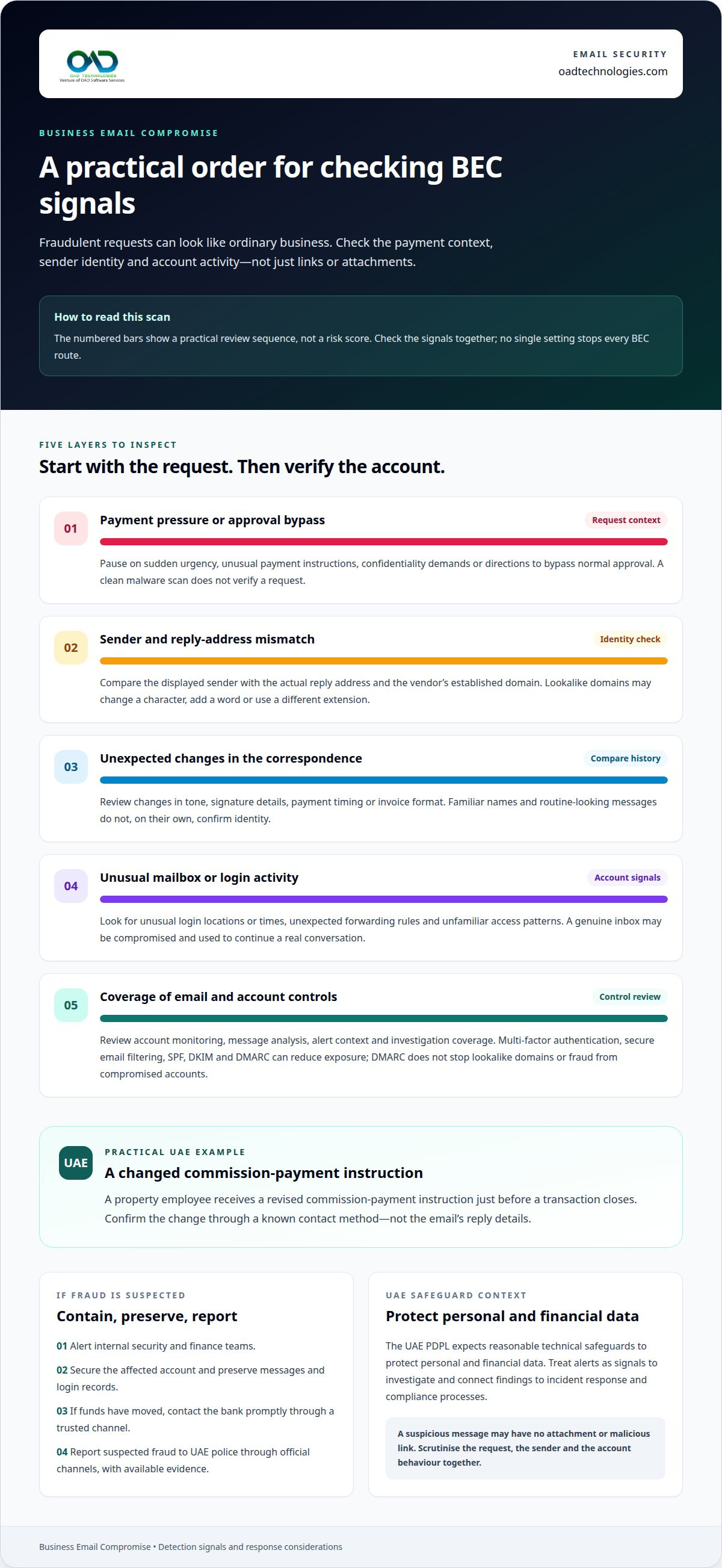
Business email compromise often blends into ordinary work, so a clean malware scan does not prove that a message is safe. Look for sudden urgency, requests to bypass approval, unusual payment instructions or a sender asking an employee to keep a transfer confidential. These social engineering signals warrant scrutiny even when the email has no attachment or suspicious link.
Compare the displayed sender with the actual reply address and the vendor’s established domain. A lookalike domain might change one character, add a word or use a different extension. Flag unexpected changes in tone, signature details, payment timing or invoice format, too. A familiar display name alone does not verify the sender’s identity.
Account behaviour provides another detection layer. Unusual login locations or times, unexpected mailbox forwarding rules and unfamiliar access patterns can signal a compromised account. Review these indicators alongside message content and communication history. Advanced analysis can help identify changes in a sender’s usual behaviour, relationships, wording and business activity.
Microsoft 365 and Google Workspace both provide native security controls, but their value depends on configuration and the protections enabled for each account. Specialist security tools can add behavioural analysis and connect email signals with wider threat activity. Compare coverage by examining account monitoring, message analysis, alert context, and how teams investigate suspicious activity.
Technical controls reduce exposure, but no single setting stops every BEC route. Use multi-factor authentication for email and critical applications, secure email filtering with impersonation and BEC detection, such as Mimecast, and SPF, DKIM and DMARC authentication. DMARC can help prevent spoofing of your domain, but it does not stop lookalike domains or fraud from compromised accounts. Monitor forwarding rules and unusual logins as well.
For UAE businesses, the UAE PDPL expects reasonable technical safeguards to protect personal and financial data. BEC can also lead to police investigations and financial or contractual disputes; legal consequences depend on the evidence and circumstances. A suspected fraud should trigger a documented incident response, not an assumption that an email filter has resolved the risk.
After a suspected incident, alert your internal security and finance teams, secure the affected account and preserve relevant messages and login records. If funds have been transferred, contact the bank promptly through a trusted channel. Report suspected fraud to UAE police through official channels and provide the available transaction and communication evidence.
Sector-specific payment patterns shape risks in the UAE: a bank may face executive impersonation, a property business may receive false payment instructions, and an international firm may be targeted through cross-border invoices. For example, a property employee receives a revised commission-payment instruction just before a transaction closes. Confirm it through a known contact method, not the email’s reply details.
Brand impersonation can begin before a fraudulent message reaches an employee, so monitoring lookalike domains can add an early warning layer. For organisations concerned about misuse of their identity, brand protection measures can complement email and account controls. Treat each alert as a signal to investigate, then connect the findings to your incident and compliance processes.
BEC attack methods
BEC attacks manipulate trust in business communication to trigger payments or expose sensitive information. Some rely on impersonation, with an attacker posing as an executive, supplier, employee or attorney. Others involve account compromise, where someone takes control of a legitimate email account and uses its identity. The methods can overlap, but the distinction matters: one imitates a trusted person, while the other may use that person’s real inbox.
Social engineering is often central to the attack. An attacker studies business relationships, then sends a message that fits an expected transaction or deadline. For example, a supplier impersonator may claim its bank details changed before an invoice is due. The message can look routine and contain no malicious link or attachment, making the deception harder for automated security tools to recognise.
A compromised account offers a different advantage. Access to an employee’s mailbox can reveal legitimate correspondence, invoice formats, contacts and payment schedules. Attackers may use that context to continue an existing conversation or make a convincing new request. Malware can also provide access to internal data and financial correspondence, helping criminals make later messages more credible.
Finance teams are frequent targets because their work can move funds. An attacker may impersonate a chief executive and pressure an employee to make a confidential transfer, bypassing normal approval. Alternatively, a criminal may pose as a vendor and redirect payment to an account they control. Urgency, secrecy and instructions to avoid established checks are pressure tactics, not proof of authority.
Other methods target sensitive information or recurring payments. A fraudulent payroll message may ask an employee to change direct-deposit details, diverting salary payments. An attorney impersonator may demand an urgent, confidential payment linked to a fictitious lawsuit or acquisition. HR and bookkeeping staff may also be targeted for information that supports later fraud. Awareness should cover these scenarios, not just suspicious attachments.
Once money moves, recovery can become difficult, so payment verification and prompt escalation are important parts of the response. Authentication helps establish whether a message came from an authorised domain, but cannot confirm that a request from a compromised account reflects the real sender’s intent.
Controls work best when they address both messages and account activity. A company can combine employee awareness, multi-factor authentication, payment approval procedures and email security controls. For bank-detail changes or unusual transfers, staff should confirm the request through a known, separate contact channel. That check interrupts an attacker’s attempt to turn a convincing message into an authorised payment.
Common BEC scam types and warning signs
BEC scams often imitate routine financial communication, so assess the request and its context together. A supplier impersonation may arrive in an existing email thread, while a lookalike address differs slightly from the vendor’s usual domain. Check the full sender and reply addresses, not just the display name. Independently confirm unexpected changes to payment instructions.
Invoice fraud can exploit familiar documents rather than introduce a suspicious attachment. Compare the invoice reference, payment destination, account name and stated reason for any change with the supplier’s established records. A mismatch between the beneficiary and the known vendor, or a request to replace normal approvals, calls for a pause. Confirm using a number already held in the company directory.
Executive impersonation uses authority to pressure employees into unusual actions. A message may describe a transaction as confidential or urgent, or claim it is exempt from the usual approval route. Treat those instructions as warning signs, even when the sender’s name and writing style seem familiar. Before processing a payment, confirm through a separate channel with the executive or relevant finance approver.
Payroll scams target employees with messages that appear to come from HR or payroll. A request to update salary account details should follow the organisation’s established process, not an email-only exchange. Employees can check whether the request matches an expected payroll event and report discrepancies through the internal reporting route. A genuine-looking signature does not prove that the email account is genuine.
Some attacks involve an actual compromised email account, not simple impersonation. A message may come from a legitimate address and accurately refer to earlier correspondence. Watch for a sudden change in payment destination, an unfamiliar reply address or an unexpected request to move the conversation. Phishing can also precede account compromise, so treat unexpected sign-in prompts with care.
- Supplier emails: Treat altered bank details, changed invoice instructions, and unfamiliar domains as reasons to verify independently.
- Executive messages: Escalate requests that bypass approval or demand secrecy, even if the sender appears senior.
- Payroll requests: Use the organisation’s established employee-change process for salary account updates.
- Ongoing conversations: Confirm unusual requests through a known phone number, not a number supplied in the email.
If a UAE company receives an altered invoice from a regular supplier, finance staff can call the supplier using its number in the company directory before changing payment details. Keep the original email and verification record together. This gives finance and security teams useful evidence if the request proves fraudulent and preserves a clear audit trail for internal review.
Which UAE laws and regulations address business email compromise (BEC)?
No single control prevents every BEC scenario, so UAE organisations should map email fraud risks to the rules relevant to their sector and data. The UAE Personal Data Protection Law (PDPL) addresses safeguards for personal data. BEC may expose employee, customer or supplier information, making account security and incident handling relevant to privacy compliance.
Under Article 9 of the UAE PDPL, a controller must notify the UAE Data Office after becoming aware of a qualifying personal data breach. The law sets no fixed number of hours for this notification. A suspected fraudulent email alone does not establish that a qualifying breach occurred; the organisation must assess whether personal data was accessed, disclosed, altered, or lost.
Article 26 of the UAE PDPL leaves penalties to a Cabinet decision, so avoid relying on unsupported fine amounts. For a BEC incident, retain relevant emails and access records, document the assessment, and record decisions about escalation. Those records help explain how the organisation evaluated possible data exposure and its response.
Financial institutions should also map email risks to their applicable Central Bank of the UAE (CBUAE) requirements. Email security gateways, DMARC and regular phishing simulations are common supporting measures with different purposes: gateways inspect email, DMARC helps address domain spoofing, and simulations test how staff respond to deceptive messages.
Government entities and critical infrastructure operators should check whether national or emirate-level frameworks, such as the UAE Information Assurance Standards or Dubai’s DESC ISR, bring additional email controls into scope. Anti-phishing measures and SPF, DKIM and DMARC authentication support these frameworks, but requirements depend on the organisation’s role, so treat them as scope-specific rather than universal.
The DIFC Data Protection Law requires technical measures to prevent unauthorised access to personal data. A DIFC organisation facing suspected mailbox compromise should assess whether the incident could expose personal data and review the relevant technical safeguards. The applicable privacy regime depends on the organisation’s jurisdiction and circumstances.
- Identify scope: Determine whether the organisation falls under the UAE PDPL, DIFC Data Protection Law, or sector-specific controls.
- Assess exposure: Establish whether an account or message exposed personal data, financial records, or other protected information.
- Record response: Preserve evidence and document decisions, including any required notification assessment.
For example, a UAE company whose finance mailbox is compromised should examine the messages, account activity and data involved before deciding whether PDPL notification applies. A bank or critical infrastructure operator must also consider its relevant sector controls. This joined-up assessment connects BEC response with privacy, security and compliance obligations.
How common are BEC scams in the UAE, and what are the latest reported figures?
Available figures show the scale of BEC globally, but they don’t establish its frequency in the UAE. The FBI Internet Crime Complaint Center (IC3) consistently lists business email compromise among the highest-loss cybercrime categories worldwide. That ranking signals substantial financial impact, not a UAE incident count or a prediction for an individual company.
IC3’s category also covers varied schemes, including supplier impersonation and fraud involving compromised email accounts. Reports may capture losses differently, depending on what victims submit and how incidents are classified. A business comparing figures should distinguish reported complaints, financial losses, and confirmed incidents. Each measure answers a different question about threat exposure.
For UAE decision-makers, the practical issue is exposure within their own payment and communication workflows. A company that regularly receives supplier invoices, changes beneficiaries or processes cross-border payments has specific verification points to assess. Review where a request can change payment details, who approves that change and whether staff can confirm it independently.
Internal incident records can provide a more useful local view than a global headline. Track suspected impersonation, compromised accounts, attempted payment changes, confirmed losses and near misses separately. Record the business unit, transaction stage and control that detected each event. This helps leadership see whether incidents cluster around a process, supplier relationship or approval gap.
For example, a UAE finance team could record an attempted invoice diversion even when a callback stops payment. Counting only completed losses would hide that warning. Separating blocked attempts from successful transfers gives management a clearer view of which controls are working and where further attention is needed.
Use external reports to understand the wider threat, then assess exposure using internal evidence. Compare incident patterns with payment controls, staff reporting and email security alerts. A rise in reported suspicious messages may reflect stronger detection rather than an increase in successful fraud. Interpret trends alongside how consistently employees report incidents and teams investigate them.
OAD Technologies: Brand protection
OAD Technologies supports BEC risk reduction through enterprise-grade Managed Technology Services delivered on a Fully Managed, Defined Scope basis. The agreed design may include email security, domain protection, identity controls, monitoring and incident coordination; vendor authorisation, coverage, response targets and client approval responsibilities are verified and documented for the specific engagement.
OAD Technologies also helps UAE businesses address impersonation risks through brand protection, which supports visibility into misuse of business identity. This can complement internal email and payment controls when fraudulent domains or executive impersonation are a concern. Managed Detection and Response (MDR) can help address suspicious activity, while Vulnerability Assessment and Penetration Testing (VAPT) assesses security weaknesses. Data Loss Prevention (DLP) can help protect sensitive information from unauthorised disclosure.
The right combination depends on your exposure, systems, and existing controls. Contact OAD Technologies to discuss your organisation’s BEC protection needs.
Build resilience into everyday decisions
Make BEC protection in the UAE part of how your organisation manages digital risk, not an isolated email setting. Align account security, payment approvals and incident handling with the way your teams and suppliers work. Clear ownership helps people respond decisively when a message challenges established processes.
OAD Technologies can support this work with email-security, Managed Detection and Response, VAPT and DLP capabilities selected for the organisation’s environment. These address different risks and do not replace payment verification, identity governance or staff procedures.
Practical safeguards shaped around your operations help teams make informed decisions and protect the confidence at the heart of every business relationship.
Frequently asked questions
What is Business Email Compromise (BEC)?
Business Email Compromise is fraud that uses a trusted business identity to influence payments, information sharing or other company actions. An attacker may impersonate a director or supplier, or misuse a genuine email account. For example, an accounts employee may receive a message that appears to come from a regular contractor but directs payment to a different beneficiary. The defining risk is deception through business communication.
Can employee training alone stop BEC?
No. Training helps employees recognise pressure tactics and report unusual requests, but it cannot secure an account that has already been compromised or detect every convincing impersonation. Pair awareness with controls such as multi-factor authentication, email filtering, monitored account activity and payment verification procedures. For example, a trained finance employee still needs a clear way to confirm a supplier’s account change independently.
How do BEC attackers manipulate employees during a scam?
Attackers exploit trust, authority, urgency and confidentiality to make an employee act before following normal checks. A message may appear to come from a senior manager and request an urgent, private payment during a busy reporting period. Other emails imitate a supplier’s tone or refer to a familiar project. The pressure is deliberate: it makes the request feel routine while discouraging consultation.
Is BEC the same as phishing?
No. Phishing commonly uses deceptive messages to steal credentials or prompt harmful actions; BEC focuses on abusing business trust, often to divert payments or obtain sensitive information. Phishing can be one route into a BEC incident, such as when an employee gives away account access. But a BEC message may also rely on conversation and impersonation without a malicious link or attachment.
What is BEC protection in the UAE?
BEC protection in the UAE combines technical controls and business procedures to reduce email impersonation, account misuse and fraudulent transactions. Measures can include multi-factor authentication, domain email authentication, suspicious-message detection, employee awareness and independent checks for payment changes. Organisations should align these measures with their systems, transaction processes and applicable compliance obligations, rather than relying on a single email setting.
What are the most common BEC tactics targeting UAE businesses?
Common tactics include impersonating a company executive, posing as a supplier with revised bank details, and using a compromised employee account to continue genuine correspondence. Attackers may also pressure payroll staff to change salary-payment details or target finance teams with confidential transfer requests. UAE businesses handling property transactions, supplier invoices and international payments should pay particular attention to unexpected beneficiary changes and requests to bypass established approval steps.
Disclaimer
Content by OAD Technologies is for general informational purposes only and does not constitute professional or cybersecurity advice. No warranties are made regarding accuracy or completeness; reliance is at your own risk. OAD Technologies shall not be liable for any direct or indirect losses arising from use of this content.