
The strongest email defence for a UAE bank isn’t a single security product. Email security for UAE banks works best as a layered approach: authentication helps prevent domain spoofing, while encryption and data loss prevention (DLP) address the risk of sensitive information leaving the organisation. Protection for Microsoft 365 or Google Workspace can add controls within the platforms staff already use.
That distinction matters because phishing and business email compromise (BEC) exploit trust and routine business processes. Data leaks can also result from messages sent to the wrong recipient or containing sensitive information. A gateway alone cannot address every risk, and controls that are not designed to work together can leave gaps or create unnecessary friction for staff.
This guide compares six email security options for UAE banks, including SPF, DKIM and DMARC authentication, encryption, DLP, email filtering, and Microsoft 365 or Google Workspace protection. It explains what each control is designed to address, where they complement one another, and how to assess a practical combination for your environment.
Key takeaways
- Use SPF, DKIM and DMARC together to reduce domain spoofing, and plan policy enforcement around legitimate sending sources.
- Assess phishing and business email compromise controls alongside staff processes, including independent verification of payment changes.
- Match encryption and data loss prevention controls to the sensitive information your teams send and the risks of misdirected email.
- Compare Microsoft 365 and Google Workspace protections with email security controls that operate across your wider environment.
- Build a UAE-focused control set around regulatory context, threat detection and evidence that supports ongoing security reviews.
Email spoofing and authentication with DMARC, DKIM and SPF
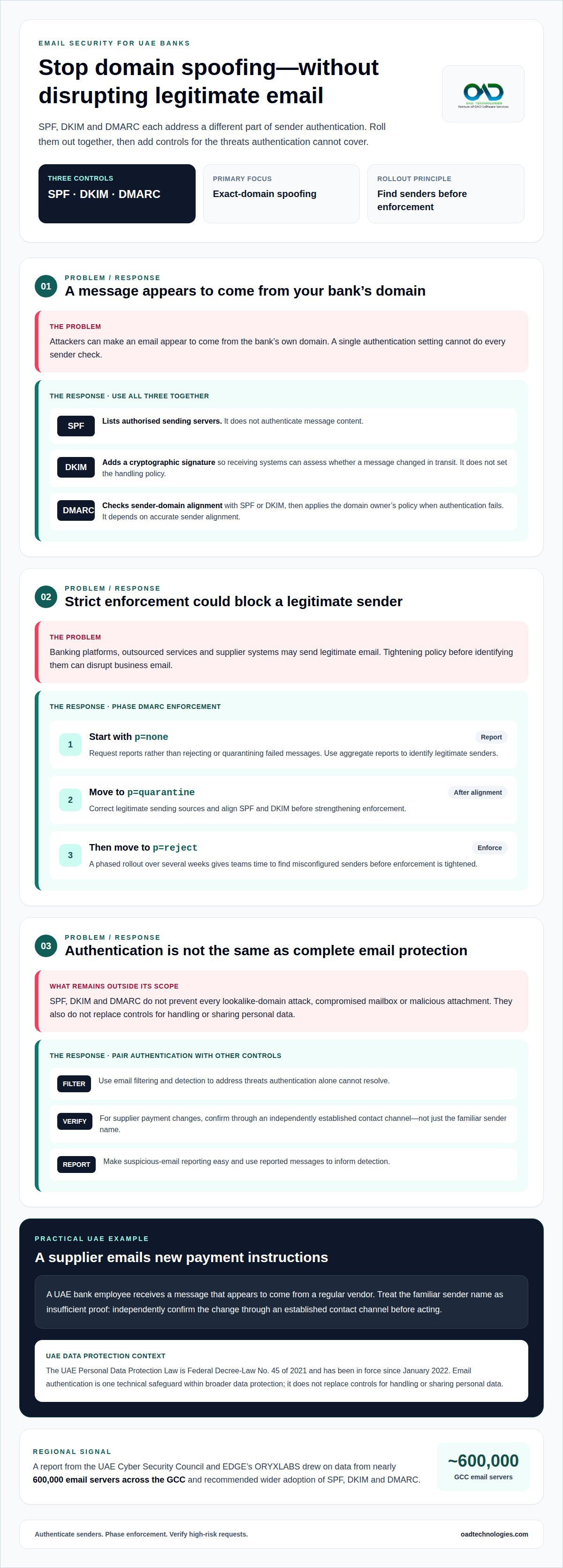
SPF, DKIM and DMARC each address a different part of sender authentication. SPF identifies mail servers authorised to send for a domain. DKIM adds a cryptographic signature so receiving systems can assess whether a message changed in transit. DMARC checks whether SPF or DKIM aligns with the visible sender domain, then applies the domain owner’s policy when authentication fails.
For a UAE bank, these controls help reduce exact-domain spoofing, where attackers make messages appear to come from the bank’s own domain. They do not prevent every lookalike-domain attack, compromised mailbox or malicious attachment. Email filtering, detection and clear procedures for verifying supplier payment changes address risks that authentication alone cannot resolve.
A report published by the UAE Cyber Security Council and EDGE’s ORYXLABS in October 2025 drew on data from nearly 600,000 email servers across the GCC and recommended wider adoption of SPF, DKIM and DMARC. A practical rollout starts with DMARC p=none, which requests reports rather than rejecting or quarantining failed messages. Teams can use aggregate reports to identify legitimate senders, including banking platforms, outsourced services and supplier systems.
After aligning SPF and DKIM with legitimate sending sources, banks can move to p=quarantine, then p=reject. A phased rollout over several weeks gives teams time to identify misconfigured senders before enforcement is tightened. The sequence matters: applying a strict policy before identifying legitimate services can disrupt business email.
According to the UAE Government, the UAE Personal Data Protection Law is Federal Decree-Law No. 45 of 2021, in force since January 2022. Email authentication is one technical safeguard within broader data protection; it does not replace controls for handling or sharing personal data.
Card transaction authentication is separate from email authentication. Banks should distinguish cardholder verification from SPF, DKIM and DMARC, which authenticate email-sending domains. Mobile banking apps and tokenised authentication can reduce reliance on one-time codes sent by email or SMS. The right combination depends on transaction workflows and how customers securely access banking services.
| Option | Primary purpose | Key limitation |
|---|---|---|
| SPF | Lists authorised sending servers | Doesn’t authenticate message content |
| DKIM | Signs messages for integrity checks | Doesn’t set the handling policy |
| DMARC | Checks alignment and sets failure policy | Needs accurate sender alignment |
| App or token authentication | Supports secure banking access or transaction approval | Doesn’t authenticate email domains |
Base the rollout on known sending sources: collect reports, correct legitimate senders, then strengthen DMARC enforcement.
What is the best email security solution for UAE banks?
An effective approach combines technical controls, clear payment procedures and a response process suited to the bank’s email environment. After a suspected breach, contain affected accounts, revoke active sessions, preserve relevant logs, assess potential data exposure and follow applicable escalation and reporting procedures.
Phishing and business email compromise
Phishing uses deceptive messages to prompt actions such as opening an attachment, sharing passwords or following a harmful link. Business Email Compromise (BEC) often relies on impersonation and social pressure rather than malware. An attacker might imitate a senior manager requesting an urgent transfer or pose as a supplier asking to change payment details.
Supplier fraud can exploit an existing relationship, so a familiar sender name is not proof of legitimacy. For example, a UAE bank employee might receive a message that appears to come from a regular vendor, requesting new payment instructions. Confirming the change through an independently established contact channel can interrupt the fraud before funds move.
Phishing simulations and employee reporting
Phishing simulations test how employees respond to realistic messages. Unlike filtering, which aims to detect threats before delivery, simulations assess behaviours such as reporting suspicious email or entering passwords on a false sign-in page. Scenarios can reflect the bank’s workflows, including supplier invoices, document-sharing requests and unexpected account alerts.
Make the reporting route easy to use, then analyse reported messages for patterns that can inform detection. Present results as learning opportunities rather than punishing individual mistakes. Repeated exercises can help employees recognise unusual sending addresses, urgent payment requests and unexpected attachments. Reporting speed and message details also help security teams determine whether a wider internal investigation is needed.
Email security controls for UAE banks
Effective protection combines controls rather than relying on a single filter. Use gateway filtering, click-time URL checks, browser isolation, enforced SPF, DKIM and DMARC, endpoint detection and phishing simulations. These address different stages of an attack, from message delivery to activity on a user’s device. A platform such as Mimecast brings gateway filtering, click-time URL protection and impersonation defence together in one managed service, reducing the number of separate tools a bank’s team must operate.
Choose controls to suit the bank’s email platform, payment processes, supplier relationships and escalation procedures. Assessors may expect evidence such as DMARC reporting history and phishing simulation results. A response plan should assign responsibility for account containment, log preservation, internal escalation and impact assessment.
For suspected personal-data breaches, assess whether notification duties apply. Article 9 of the UAE Personal Data Protection Law requires notification to the UAE Data Office once the controller becomes aware of a qualifying breach; it sets no fixed number of hours. Applicable duties depend on the bank’s legal and regulatory context.
To align controls with your bank’s workflows, discuss your email security requirements.
Email encryption and data loss prevention
UAE banks can protect email data across cloud services and international transfers by combining encryption, access controls and data loss prevention (DLP). Map where messages and attachments are stored, accessed and routed, then apply the bank’s approved transfer and retention rules consistently.
Encryption protects message content from unauthorised access while it is stored or transmitted. Transport encryption protects the connection between mail systems, while message-level encryption can protect content beyond that connection. Banks should distinguish these controls: a secure connection does not necessarily prevent an authorised recipient from forwarding a message. Choose protection according to the data, recipient and business purpose.
DLP focuses on what employees send. Policies can identify sensitive information, such as account details or customer identifiers, and take a defined action before a message leaves the organisation. Depending on the bank’s configuration, that action may block delivery, alert a reviewer or require approval. DLP can also help identify messages to external recipients when their contents match a bank-defined rule.
Consider a UAE relationship manager preparing a payment instruction for a corporate customer overseas. A recipient error could expose account information, while an unauthorised change could create payment risk. DLP can inspect the message and attachment against configured policies; encryption can protect approved sensitive content. A separate confirmation process should govern payment changes, because encryption cannot establish whether a sender’s request is genuine.
Cloud email creates additional points to manage. Apply consistent policies to messages accessed through webmail, mobile devices and connected applications. Limit access by role, and review who can open shared mailboxes or retrieve stored messages. For international transfers, document the systems and destinations involved, the business reason for sharing, and the controls applied to each route. This gives teams a clearer operational view than treating the email gateway as the only control point.
Useful design decisions include:
- Classify: Set clear categories for customer, payment and operational information.
- Inspect: Apply DLP rules to message bodies, attachments and recipient domains.
- Protect: Enable encryption for sensitive content, including approved external exchanges.
- Review: Record policy actions and investigate repeated alerts or blocked messages.
Controls should work together without treating every external message as a threat. Tune policies to legitimate banking workflows, such as customer statements and supplier correspondence, and review exceptions when processes change. This helps protect sensitive data while keeping authorised communication practical.
Email protection for Microsoft 365 and Google Workspace
Microsoft 365 and Google Workspace provide the email platform, but banks must configure protection around their own workflows. Compare each environment by how it handles suspicious messages, account access, sensitive information, investigation and recovery. A feature list alone won’t show whether controls work together during a real incident.
Start with the bank’s actual mail paths. Identify employee mailboxes, shared accounts, mobile access, external forwarding and applications that send messages on the bank’s behalf. Then map controls to each path. For example, a customer service mailbox may need different access controls and monitoring from an internal finance account handling payment instructions.
Microsoft 365 and Google Workspace differ in administration, policy settings and integration with the rest of each organisation’s systems. Compare them against consistent criteria rather than assuming one platform is automatically safer. Check how administrators configure suspicious-message handling, review alerts, control mailbox access and investigate an incident. Also assess whether security teams can correlate email activity with relevant identity and device signals.
- Message protection: Assess how the platform identifies suspicious messages and handles reported email.
- Account security: Review access controls for staff, shared mailboxes and authorised applications.
- Data handling: Map how policies protect personal data in messages and attachments.
- Investigation: Confirm that relevant email events can be reviewed during an incident.
- Operational fit: Test controls against real workflows, including customer communication and internal transactions.
Consider a UAE bank employee receiving an unexpected request to change a corporate customer’s payment details. Email controls can help identify a suspicious message, but the bank also needs a defined verification process before staff act. Test the complete workflow, including how an employee reports the message and how security teams review related mailbox activity.
Cloud protection extends beyond the inbox. Review connected applications, forwarding rules and administrative access, as these can affect how messages are handled after delivery. For cross-border communication, map where email data travels and apply the bank’s approved privacy and security controls. The UAE Central Bank context may shape governance priorities, but the platform itself does not determine regulatory compliance.
Run a controlled evaluation using representative email traffic and agreed success criteria. Include messages with attachments, external recipients and routine business requests. Record false positives, missed threats, alert quality and the effort needed to investigate them. This helps decision-makers compare operational fit without relying on a single headline feature.
Choose Microsoft 365 or Google Workspace protection according to the bank’s existing platform, control requirements and investigation workflow, then add complementary controls where gaps remain. A well-configured email security capability should support the platform rather than create a disconnected layer.
What email security controls are required or recommended for UAE banks?
For UAE banks, the central question is how to demonstrate that email risks are governed, assigned and reviewed. UAE IA standards provide a baseline for technical controls, while the CBUAE Cyber Risk Management Regulation and accompanying Standards set out cyber risk management requirements without prescribing a named email-security product. Translate applicable obligations into documented control objectives, then show who owns each objective and how exceptions are approved.
Separate regulatory obligations from internal standards and recommended improvements. A control register can record each control’s purpose, accountable role, evidence source and review trigger. This helps risk and technology teams explain why a control exists, who maintains it and what happens when a business process changes. It also gives procurement a clearer basis for assessing a proposed solution than a feature checklist alone.
- Set ownership: Assign accountable roles across information security, email administration, risk and business operations.
- Record exceptions: Document the business reason, approval route and review conditions for each exception.
- Define evidence: Specify which records demonstrate that a control operates as intended.
- Manage changes: Reassess control impact when mail services, suppliers or business processes change.
- Review outcomes: Use audit findings and incident lessons to prioritise improvements.
For example, a UAE bank introducing a new customer communication service can assess its data flows, accountable owner and approval requirements before launch. The decision record can explain how the service fits existing policies and identify residual risks for authorised acceptance. This governance step helps prevent a technical change from bypassing established oversight.
Security leaders should assess how email-related events connect with wider risk and incident records. SIEM can support this view when relevant events are integrated, helping teams examine email risks alongside other security activity. Its value comes from useful context and clear ownership, not simply collecting more alerts.
Use the assessment to set priorities, owners and review points for the bank’s operating model. Keep decisions traceable, particularly when a control change affects customer communication or supplier processes. This provides a practical basis for oversight and continuous improvement without treating any single product as proof of compliance.
OAD Technologies: Email Security Solutions
OAD Technologies helps UAE banks assess email-security gaps across message protection, sensitive-data handling and incident response. Delivery is provided as enterprise-grade Managed Technology Services on a Fully Managed, Defined Scope basis, with product licensing, current vendor authorisation, covered use cases and operational responsibilities documented before deployment.
A defined design may connect email controls with Zero Trust, SIEM, SOC, endpoint security, DLP and incident processes. Monitoring coverage, response targets and containment authority depend on the bank’s risk requirements and written service agreement; no universal sub-15-minute response or default endpoint platform is asserted.
For banks assessing risks beyond email controls, Vulnerability Assessment and Penetration Testing (VAPT) can identify security weaknesses, while Managed Detection and Response (MDR) supports threat detection and response. The right starting point depends on the bank’s environment, risk priorities and existing processes. These capabilities can be considered individually or aligned with the wider security operation.
If you’re reviewing email risks or planning improvements, contact OAD Technologies to discuss your requirements.
Build resilience into the next email security decision
Effective email security for UAE banks is an operating capability, not a one-off deployment. Assign ownership for policy changes, exception reviews and incident learning so controls remain aligned with banking workflows as systems and teams evolve.
Set review points around meaningful signals: recurring policy exceptions, employee reports, investigation findings and changes to email services. Use these insights to refine controls without adding friction to legitimate customer and supplier communication. Clear accountability also connects technical decisions with risk oversight and the bank’s wider security priorities.
OAD Technologies can help assess email risks and shape an approach around your environment and operational requirements. Discussing current control gaps and intended outcomes gives the next conversation a practical starting point.
With clear ownership and measured improvements, your teams can strengthen protection while keeping essential banking communication moving.
Frequently asked questions
What is the difference between a secure email gateway and API-based email security?
A gateway examines mail as it passes through a designated route; API-based security connects directly to a cloud mail service. This distinction matters when a bank has mailboxes, applications or forwarding paths that bypass its gateway. Map the actual message routes before comparing architectures. For example, a cloud mailbox connected to a third-party application may need visibility beyond the bank’s perimeter mail flow.
Which UAE regulations apply to email security?
Applicable requirements depend on the bank’s licensing, legal entity and operating jurisdiction. Build a scope map identifying the regulator and data-protection regime for each relevant entity, including any DIFC or ADGM presence. Then map email-related risks to the bank’s existing obligations and internal policies. This avoids assuming that one national standard or email control applies identically across every entity.
What UAE Central Bank regulations apply to email security at banks?
For a CBUAE-licensed institution, assess email security against the CBUAE’s Standards for the Regulations Regarding Risk Management, including its requirements for identifying, assessing and managing operational risks. Identify which business services depend on email, who owns the related risks and how an email incident could affect those services. The bank can then connect control decisions to existing operational-risk processes, escalation routes and evidence requirements, rather than treating email as an isolated technology issue.
What UAE data protection and cybersecurity laws affect bank email security?
The UAE Government identifies Federal Decree-Law No. 45 of 2021 as the UAE Personal Data Protection Law. A bank should also assess whether its legal entity falls under a separate regime, such as DIFC Law No. 5 of 2020 or the ADGM Data Protection Regulations. For each relevant regime, map where personal data is handled, who can access it, and which approved processes govern sharing and retention.
How should UAE banks implement SPF, DKIM, and DMARC?
Manage changes to these records through a controlled process, with an owner, approval trail and rollback plan. Keep an inventory of domains used for customer communications, internal notices and delegated sending services, and update it when suppliers or systems change. This governance view complements technical configuration and helps prevent a business service from sending messages under a bank-controlled domain without appropriate oversight.
What are the best email security platforms for banks operating in the UAE?
No platform suits every bank. Compare products against architecture, regulatory scope, data flows, executive-mailbox risk, shared accounts, integrations and the bank’s operating capability. OAD can help structure that assessment, but product selection and any vendor relationship should be verified for the specific proposal.
How do leading email security solutions compare on features, compliance, and cost?
Compare solutions against the same documented requirements and record where each meets, partly meets or misses them. Separate product capability from the bank’s work to configure, operate and evidence that capability. Compare costs using the same scope, accounting for required integrations, administration and ongoing support. This gives procurement and security teams a more useful basis for comparison than feature counts or a headline subscription figure.
How can UAE banks prevent phishing, business email compromise, and account takeover?
Reduce account takeover risk by limiting privileged access, reviewing unusual sign-in activity and protecting recovery processes from social engineering. For sensitive internal actions, define approval rules that cannot be satisfied solely by an email request. For example, a staff member handling a supplier record should follow the bank’s established authorisation workflow before changing account details. Clear reporting routes and escalation ownership help teams respond to suspicious activity.
Disclaimer
Content by OAD Technologies is for general informational purposes only and does not constitute professional or cybersecurity advice. No warranties are made regarding accuracy or completeness; reliance is at your own risk. OAD Technologies shall not be liable for any direct or indirect losses arising from use of this content.