
If 85% of organizations using Microsoft 365 have already suffered an email data breach, is your current configuration actually protecting your assets or just providing a false sense of comfort? You likely recognize that while Microsoft Purview offers a robust foundation, the sheer complexity of E5 and the new E7 licensing tiers can feel like a moving target. It's frustrating when automated policies trigger constant false positives that disrupt your team's workflow instead of securing your perimeter. Managing data loss prevention for office 365 requires more than just toggling switches; it demands a strategic alignment between technical capability and business risk.
We understand the pressure of maintaining compliance as the UAE activates its PDPL executive regulations and the new Federal Authority for Artificial Intelligence and Data begins enforcement. This guide will show you how to master these complexities and bridge the gap between native tools and enterprise-grade protection. You'll gain a clear roadmap for M365 DLP implementation that reduces accidental leaks while ensuring your organization stays ahead of the July 2026 licensing shifts. We'll examine how to refine your policy logic to eliminate noise and build a resilient framework for the modern digital landscape.
Key Takeaways
- Understand how the 2026 threat landscape, including AI-driven data scraping and advanced insider risks, has redefined security requirements across the entire Microsoft 365 ecosystem.
- Explore the technical mechanics of Microsoft Purview, moving beyond basic keyword matching to leverage machine learning classifiers and deep content analysis for more precise detection.
- Identify why native data loss prevention for office 365 often leads to alert fatigue and how a managed strategy bridges the gap between tool deployment and operational resilience.
- Learn to align your security policies with the specific mandates of the UAE Personal Data Protection Law (PDPL) to automate the identification and protection of sensitive national data.
- Discover how a "Strategy First" integration approach transforms complex security architectures into a sustainable asset for enterprise governance and long-term risk management.
What is Data Loss Prevention for Office 365 in 2026?
In 2026, the definition of Data Loss Prevention (DLP) has shifted from simple perimeter defense to a deep, integrated strategy within the cloud ecosystem. Modern data loss prevention for office 365 isn't just about blocking emails with credit card numbers. It's a comprehensive framework that monitors and protects sensitive information across Exchange, SharePoint, OneDrive, and Microsoft Teams. The core objective remains the same: preventing the unauthorized disclosure of proprietary data. However, achieving this in a high-velocity enterprise environment requires a delicate balance. You must secure the data without strangling the productivity of your workforce.
The risk profile has evolved significantly. We've moved beyond simple accidental attachments. In 2026, organizations face AI-driven data scraping where malicious actors use automated tools to harvest information from unstructured datasets. We also see more sophisticated insider threats, where employees might inadvertently or intentionally leak data using generative AI prompts or collaborative shortcuts. It's vital to distinguish between Data Loss, which is typically accidental, and Data Theft, which involves a deliberate attempt to exfiltrate value. Effective data loss prevention for office 365 must address both scenarios with equal precision.
The Scope of Modern M365 Data Protection
Protection now extends far beyond traditional documents. Collaborative tools like Microsoft Teams and Microsoft Loop create fluid data streams that are harder to track. Security must cover data in transit as it moves between users and data at rest within the cloud tenant. This is where unified labeling becomes critical. By applying sensitivity classifications at the point of creation, the security policy follows the data regardless of where it resides or how it's shared. This ensures that a sensitive file remains protected even if it moves from a secure SharePoint site to a private Teams chat.
Why Native Protection is the Starting Point, Not the Finish Line
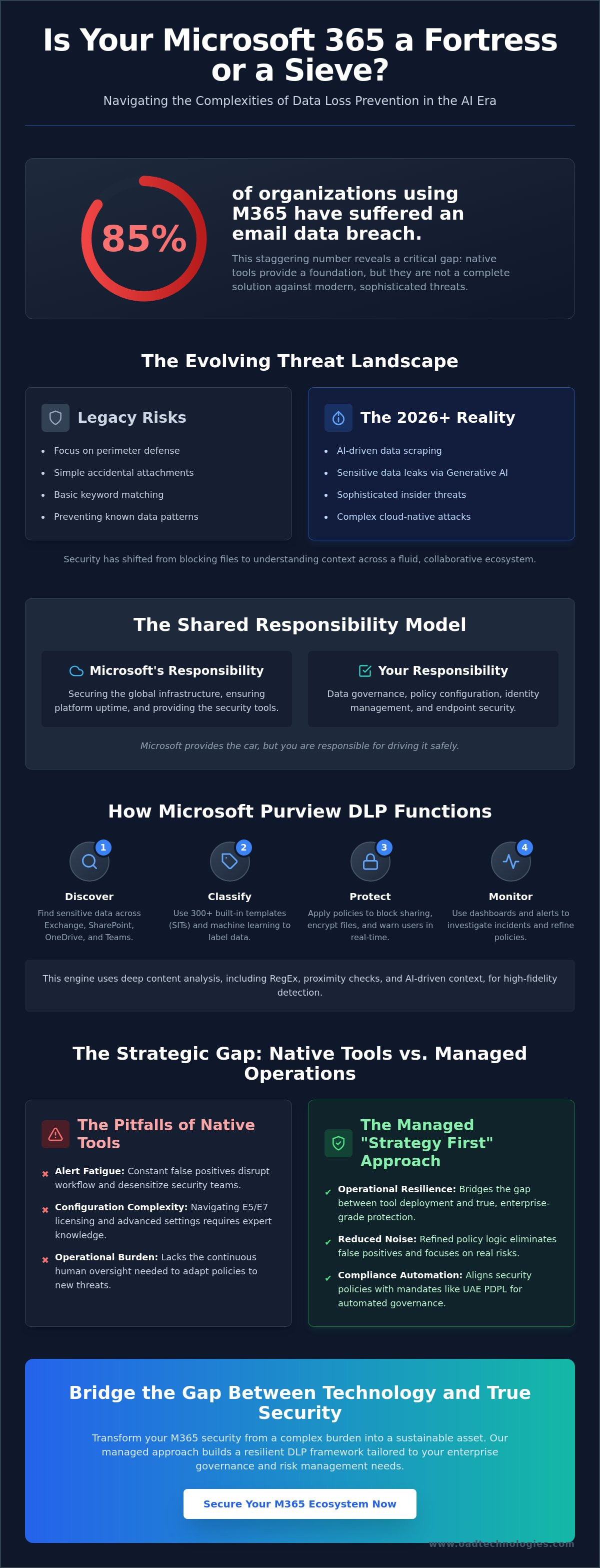
Microsoft operates on a Shared Responsibility Model. While they secure the underlying infrastructure, the burden of data governance and policy configuration rests entirely on your shoulders. Choosing between Standard Purview and Premium capabilities, like those found in the M365 E5 or the new E7 license released in May 2026, determines the depth of your automated response. Despite these native tools, a 2021 report from Business Wire claimed that 85% of organizations using Microsoft 365 had suffered email data breaches. This high rate suggests that tools alone aren't a silver bullet. Without a customized strategy and human oversight, even the most advanced licenses can fail to stop a breach.
How Microsoft Purview DLP Functions: A Technical Deep Dive
To understand the efficacy of data loss prevention for office 365, we must look under the hood of the Microsoft Purview engine. This technical deep dive reveals a system built on deep content analysis. It doesn't just scan for strings; it validates data using Regular Expressions (RegEx), internal functions, and proximity checks. For instance, the engine doesn't just flag a 16-digit number. It looks for "secondary data matches" like an expiration date or a CVV nearby. This multi-layered validation significantly reduces the false-positive rates that often plague unoptimized systems.
The DLP lifecycle follows a logical progression: discovery of existing data, classification based on sensitivity, application of restrictive policies, and continuous monitoring. In 2026, this process is increasingly augmented by AI. Machine learning classifiers now analyze the context of a document rather than just its individual words. This allows the system to identify "Shadow AI" risks where sensitive data might be fed into unauthorized large language models. This proactive stance is essential for maintaining a modern data loss prevention for office 365 strategy.
Sensitive Information Types (SITs) and Custom Classifiers
While Microsoft provides over 300 standard SITs for global regulations, enterprise-grade protection requires customization. You can use Exact Data Match (EDM) to create fingerprints of your actual database records. This ensures that only your specific customer IDs or employee records trigger an alert. For unique corporate documents like patent applications or legal briefs, we utilize AI-based trainable classifiers. These models learn from your specific data patterns. They move security beyond generic templates into a bespoke defense architecture designed for your unique business needs.
Policy Actions and User Experience
Effective DLP isn't just about blocking data. It's about guiding human behavior. The spectrum of actions ranges from silent auditing to "Block with Override," which allows a user to proceed if they provide a business justification. Policy Tips are vital here. They provide real-time education within Outlook or Teams, stopping a leak before it happens. By integrating these policies with Identity and Access Management (IAM), we create context-aware protection. If a user login appears suspicious, the DLP rules can automatically tighten. This prevents data egress until the identity is fully verified.
If you're looking to refine these technical configurations into a cohesive strategy, our team can help you optimize your Purview deployment for maximum resilience.
The Strategic Gap: Native Tools vs. Managed DLP Operations
While Microsoft Purview Data Loss Prevention provides a powerful engine for security, many enterprises struggle with its operational weight. It's a common objection: "Purview is just too complex to manage at scale." This complexity isn't a flaw in the tool itself but a reflection of the intricate data relationships within a modern enterprise. When you deploy data loss prevention for office 365, you aren't just installing software; you're attempting to codify business logic. Without a dedicated strategy, the result is often a deluge of alerts that overwhelm your security team and obscure real threats.
This "Alert Fatigue" is where most native implementations fail. Automated policies are excellent at catching obvious leaks, but they lack the context to distinguish a legitimate business process from a sophisticated data exfiltration attempt. Human oversight is the only way to validate these high-stakes events. This is why a managed approach is becoming the standard for resilient organizations. By integrating your DLP with Managed Detection and Response (MDR), you transform a passive monitoring tool into a proactive defense mechanism that responds to incidents in real time.
Building an in-house team to manage this 24 X 7 is a significant capital investment. You need data scientists to tune classifiers and analysts to triage incidents around the clock. Partnering with a specialized MSSP allows you to access this high-level expertise without the overhead of internal recruitment and training. It shifts the focus from managing a technical tool to achieving a business-aligned security outcome.
Refining the Noise: The Importance of Policy Tuning
"Set and forget" is a dangerous mindset for 2026. Threat actors pivot quickly, and your data footprint grows daily. Continuous policy iteration is necessary to keep pace with new threat intelligence. We use behavioral analytics to establish a baseline of "normal" work patterns. When a user's activity deviates from this baseline, the system can escalate the response automatically. This ensures that data loss prevention for office 365 remains effective without blocking legitimate workflows or causing business disruption.
Closing the Gaps in Native M365 Security
Native tools often have blind spots, particularly with unmanaged devices or non-Microsoft SaaS applications. Bridging the gap between SIEM alerts and actionable DLP events provides a unified view of your risk. There's also a powerful synergy between DLP and Cloud Security Posture Management (CSPM). While CSPM ensures your cloud environment is configured correctly, DLP protects the actual data residing within that environment. Together, they create a multi-layered defense that guards against both configuration errors and active data theft.
Implementing DLP for UAE Regulatory Compliance
The activation of the UAE Personal Data Protection Law (PDPL) executive regulations in 2026 has fundamentally changed the compliance requirements for local enterprises. Organizations can't treat data privacy as a secondary concern anymore. The new Federal Authority for Artificial Intelligence and Data now mandates strict oversight of how personal data is processed and stored. For many, data loss prevention for office 365 serves as the primary technical control to meet these legal obligations. By automating the identification of sensitive information, you ensure your organization remains compliant without manual, error-prone audits.
Data sovereignty is another critical pillar of the UAE regulatory landscape. You must ensure your M365 data residency aligns with national standards, often requiring data to remain within the UAE's borders. Microsoft's local data centers in Dubai and Abu Dhabi facilitate this, but the configuration of Multi-Geo capabilities requires precise management. This technical alignment is a core component of a modern Governance, Risk, and Compliance (GRC) framework. It transforms regulatory pressure into a structured, defensible security posture.
Mapping PDPL Requirements to Purview Policies
Standard global templates often miss the nuances of regional data. We configure custom Sensitive Information Types (SITs) to detect UAE-specific identifiers like Emirates ID numbers and local bank account formats. Beyond detection, your policies must reflect legal mandates for data retention and deletion. Purview allows you to automate these lifecycles, ensuring that personal data isn't held longer than necessary. This automation also streamlines the generation of compliance reports, providing a clear audit trail for regulatory bodies during mandatory reviews.
Incident Response and Breach Notification
The PDPL mandates specific timelines for breach notification. When a potential leak occurs, your DLP logs become your most valuable forensic tool. They provide the "who, what, and when" necessary to satisfy the regulator's requirements. To strengthen your defense, we correlate these DLP events with findings from your Vulnerability Assessments (VAPT). This correlation helps you identify if a data leak was the result of a misconfigured policy or a deeper systemic vulnerability. By maintaining documented policy enforcement, you build a resilient strategy that protects both your data and your brand's reputation in the UAE market.
If you're ready to align your cloud environment with national regulations, consult with our UAE compliance experts to secure your M365 tenant today.
Partnering with OAD Technologies for Managed O365 DLP
Owning a powerful tool is not the same as achieving operational resilience. While Microsoft provides the infrastructure, OAD Technologies acts as the strategic integrator that transforms these native capabilities into a tailored defense system. We move beyond simple tool deployment to focus on operational excellence. Our "Strategy First" approach ensures that your data loss prevention for office 365 is aligned with your specific business risks and the unique regulatory environment of the UAE. We don't just configure settings; we design a sustainable governance model that protects your most valuable digital assets.
One of the most significant advantages of our partnership is the deep integration of DLP data into our 24 X 7 Managed Security Operations. By funneling DLP events through our SIEM and MDR workflows, we eliminate the silos that often lead to missed threats. This synergy allows us to correlate a sensitive data movement with other suspicious activities across your network. It turns a standalone compliance tool into a vital component of your active threat detection ecosystem. This holistic view is essential for identifying sophisticated exfiltration attempts that might otherwise bypass standard automated filters.
The OAD Advantage: Human-Centric Security
Technology alone cannot navigate the nuance of human intent. Our experts specialize in policy tuning to dramatically reduce the noise of false positives that often paralyze internal IT teams. We focus on creating synergetic security workflows where the technology empowers your staff rather than creating friction. By combining advanced AI classifiers with human insight, we ensure that your security measures remain precise and effective. This approach doesn't just stop leaks; it ensures the long-term viability of your data protection investment by adapting to your organization's evolving needs.
Next Steps for Your Enterprise
Securing your environment requires a clear understanding of where your data lives and how it moves. We recommend starting with a comprehensive Data Discovery Assessment to identify hidden risks and unstructured data sets that may be currently unprotected. We'll also review your current Microsoft 365 licensing to ensure you're achieving the optimal security ROI, especially with the upcoming July 2026 price adjustments. It's time to move from a reactive posture to a proactive, managed strategy. Consult with our DLP specialists for a strategic roadmap and discover how we can secure your enterprise's digital future.
Future-Proofing Your Enterprise Data Strategy
Effective data loss prevention for office 365 requires moving beyond basic configurations to embrace a managed, strategic framework. We've explored how the technical depth of Microsoft Purview must be balanced with human oversight to eliminate alert fatigue and ensure operational velocity. As the UAE's PDPL regulations reach full enforcement in 2026, the cost of inaction far outweighs the investment in professional governance. You need a partner who understands the local regulatory landscape and the technical nuances of the Microsoft ecosystem.
At OAD Technologies, we provide the synergy between technical capacity and strategic insight. Our UAE-based SOC and specialized GRC expertise ensure your policies are optimized for both security and compliance. We don't just deploy tools; we design resilient systems that empower your people and protect your brand's reputation. Our team focuses on Microsoft Purview optimization to ensure your investment delivers tangible business results without disrupting your workflow.
Secure your enterprise data with a strategic M365 DLP framework from OAD Technologies. Let's build a secure, compliant, and visionary future for your organization together.
Frequently Asked Questions
Is Microsoft Purview DLP included in all Office 365 plans?
Microsoft Purview DLP is not included in every plan. While basic features exist in Microsoft 365 E3, the advanced automation and AI-driven classifiers require an E5 or the new E7 license released in May 2026. It's important to plan for the July 1, 2026, price increases, where E5 will move to $60 per user. Selecting the right tier ensures you have the necessary tools for complex data loss prevention for office 365 without overspending.
How does DLP for Office 365 handle encrypted emails and files?
Microsoft Purview can inspect content encrypted by its native Information Protection service. The system temporarily decrypts the file or email in a secure memory space to perform content analysis against your active policies. Once the scan is complete, it re-applies the encryption. This ensures that sensitive data remains protected even when it's being audited for compliance or security risks across your tenant.
Can O365 DLP prevent data leaks to third-party AI tools like ChatGPT?
You can prevent leaks to unauthorized AI platforms by combining cloud policies with the Microsoft Purview Extension for browsers. This setup allows you to block users from pasting sensitive data or uploading documents to sites like ChatGPT. By identifying "Shadow AI" risks through behavioral analytics, you can enforce strict egress controls that prevent proprietary corporate data from training external large language models.
What is the impact of DLP policies on end-user productivity?
The impact on productivity depends entirely on how policies are tuned. Unoptimized "Hard Block" settings cause friction, but using "Policy Tips" and "Block with Override" allows users to self-correct in real time. This approach turns data loss prevention for office 365 into an educational tool. It empowers employees to understand security risks without halting their daily operations or legitimate business communications.
How does Office 365 DLP differ from an Endpoint DLP solution?
Office 365 DLP focuses on data within cloud services like Teams and SharePoint, while Endpoint DLP monitors the physical device. Endpoint solutions track data movement to USB drives, local printers, and non-Microsoft applications. For a comprehensive strategy, you should integrate both layers. This ensures that data is protected whether it's sitting in a cloud tenant or being accessed on a remote laptop by a mobile worker.
Can I use third-party DLP solutions alongside Microsoft Purview?
You can use third-party solutions, though native integration offers the most seamless experience for M365 environments. Many organizations choose to augment Purview with a specialized MSSP to manage the operational burden. This hybrid approach allows you to leverage Microsoft's deep infrastructure while benefiting from the customized response and incident triage capabilities provided by a dedicated security partner who understands your specific industry risks.
How often should we review and update our DLP policies?
You should review your policies at least once per quarter to ensure they align with evolving threats. Major shifts, such as the activation of the UAE PDPL executive regulations in 2026, require more immediate updates. Continuous iteration prevents "Set and Forget" decay. Regular audits help you refine your classifiers, reduce false positives, and ensure your protection remains relevant as your business data footprint grows and changes.
Does O365 DLP support compliance with the UAE PDPL?
Yes, it supports PDPL compliance when configured with regional specificities. You must create custom Sensitive Information Types to identify UAE-specific data like Emirates IDs or local banking details. Additionally, you should configure data residency settings to ensure information remains within national borders. This technical alignment is essential for meeting the strict notification and processing requirements mandated by the new Federal Authority for Artificial Intelligence and Data.
Disclaimer
Content by OAD Technologies is for general informational purposes only and does not constitute professional or cybersecurity advice. No warranties are made regarding accuracy or completeness; reliance is at your own risk. OAD Technologies shall not be liable for any direct or indirect losses arising from use of this content.