
With ransomware incidents in the UAE surging by 267%, the average cost of a single breach has now reached a staggering $2.9 million. You're likely already feeling the pressure of the 700,000 daily attack attempts targeting the region, where legacy tools often struggle to distinguish between legitimate processes and sophisticated, fileless threats. It's a frustrating cycle of alert fatigue that leaves your team stretched thin while the requirement for compliance with NCAP and CBUAE regulations grows more urgent every day.
We understand that modern security isn't just about blocking threats; it's about maintaining operational continuity and protecting your digital evolution. This guide reveals how edr for ransomware protection serves as the vital sensory layer of a unified defense ecosystem, bridging the gap between technical innovation and practical business results. You'll discover a strategic roadmap for ransomware readiness, learn how to maximize your ROI, and see how to align your architecture with the UAE's stringent national security standards for 2026.
Key Takeaways
- Understand why legacy antivirus fails against AI-orchestrated, fileless attacks and how to shift your focus toward behavioral detection.
- Explore the core mechanics of edr for ransomware protection, including continuous process monitoring and real-time response to suspicious registry changes.
- Learn how to integrate EDR with Data Loss Prevention (DLP) to create a dual-layered defense that stops malicious processes while shielding critical data assets.
- Follow a structured deployment roadmap that begins with a comprehensive VAPT to eliminate existing vulnerabilities before establishing a behavioral baseline.
- Discover how Managed Detection and Response (MDR) bridges the internal talent gap by providing the 24 X 7 expert oversight required to manage complex endpoint signals.
The Ransomware Landscape in 2026: Why Traditional Defenses Fail
The 2026 threat landscape is no longer defined by lone actors or simple scripts. It's an era of AI-orchestrated, multi-stage campaigns that treat cybercrime like a high-performance business. Traditional Endpoint Protection Platforms (EPP) designed to block known malware signatures are failing because modern attackers don't always use malware in the traditional sense. Instead, they favor fileless attacks and living-off-the-land techniques, utilizing legitimate system tools like PowerShell to move laterally across your network. This tactical shift makes edr for ransomware protection an essential component of a modern security posture rather than an optional upgrade.
Attackers have also evolved their monetization strategies. We've moved far beyond simple encryption. Today, UAE enterprises face triple extortion. In this scenario, criminals encrypt your systems, exfiltrate sensitive data to leak online, and launch Distributed Denial of Service (DDoS) attacks to cripple your operations until the ransom is paid. Endpoint Detection and Response (EDR) provides the granular, real-time visibility needed to spot these subtle behavioral deviations before they escalate into full-scale crises.
The Rise of Ransomware-as-a-Service (RaaS)
The barrier to entry for cybercriminals has vanished. Sophisticated ransomware kits are now available for rent, allowing even low-skill actors to launch devastating attacks against UAE infrastructure. This ecosystem is supported by initial access brokers who specialize in breaching enterprise endpoints and selling that access to the highest bidder. These brokers often exploit unpatched vulnerabilities or use stolen credentials to gain a foothold. RaaS represents the complete industrialization of cybercrime in 2026.
The Failure of Signature-Based Detection
Legacy security tools rely on known bad lists, but these are obsolete against polymorphic ransomware that changes its code with every execution. Static file scanning cannot keep up with threats that exist only in memory or those that hijack compromised endpoint identities to bypass firewalls. Success in 2026 requires a transition to behavioral analysis. By monitoring what a process does rather than what it is, edr for ransomware protection identifies malicious intent in real-time, even when the threat has never been seen before. This proactive stance is the only way to safeguard corporate data against modern, identity-centric attacks.
The Mechanics of EDR: How It Neutralizes Modern Ransomware
EDR acts as a digital flight recorder for your endpoints. It doesn't wait for a known virus signature to trigger an alert. Instead, it maintains a continuous log of every process execution, registry modification, and network connection across your entire infrastructure. This granular level of visibility is what makes edr for ransomware protection so effective. When an attacker attempts to use a legitimate administrative tool for a malicious purpose, EDR sees the context of the action rather than just the tool itself. It provides the technical authority needed to govern your digital environment with precision.
The behavioral engine is the core intelligence center. It looks for patterns that deviate from your established baseline. For example, if a standard user account suddenly begins renaming dozens of files in rapid succession, the system identifies this as ransomware-like behavior. It doesn't matter if the specific malware is new or has been modified by AI to avoid detection; the action itself is the trigger. Aligning these technical triggers with documented best practices, such as those found in CISA's #StopRansomware Guide, ensures your response is both rapid and strategically sound.
Forensic playback allows your team to look back in time. You can trace an infection back to its origin, identifying exactly how the breach occurred and which user was Patient Zero. This visibility is crucial for preventing repeat incidents and ensuring long-term viability. If you're unsure where your current endpoint visibility stands, our comprehensive security assessments can help identify gaps in your existing architecture before they are exploited.
Detection vs. Response: The Two Pillars of EDR
Detection is about using machine learning to sift through millions of events to find the needle in the haystack. It's about spotting the anomaly before it becomes an outage. Response is the active half of the equation. Once a threat is verified, the EDR system can instantly kill malicious processes, isolate the infected host from the network, and even roll back unauthorized changes to the registry or file system. This automation reduces dwell time, the period an attacker spends in your system, from weeks to mere minutes.
Threat Hunting and Intelligence Integration
Modern EDR doesn't operate in a vacuum. It integrates global threat intelligence feeds to stay updated on the latest ransomware strains and attacker tactics. This external data is combined with your internal telemetry to facilitate proactive threat hunting. Instead of waiting for an alert, your security team can search for dormant threats or indicators of compromise that haven't yet been activated. EDR converts raw endpoint data into actionable intelligence, allowing you to anticipate attacks rather than just reacting to them.
Beyond Detection: Integrating EDR with Data Loss Prevention (DLP)
While EDR provides unparalleled visibility into the execution of malicious code, it often lacks context regarding the specific value of the information being accessed. In the context of 2026's "double extortion" tactics, simply stopping an encryption process is no longer a complete victory. If an adversary successfully exfiltrates your intellectual property or regulated customer data before the EDR triggers, the damage is already done. This is why edr for ransomware protection must be integrated with a robust data-centric strategy to be truly effective. EDR serves as the defensive shield that kills the malicious process, while DLP acts as the vault that governs the asset itself.
To build a truly resilient posture, UAE enterprises should look at Data Loss Prevention (DLP): A Strategic Framework for Enterprise Resilience in 2026. By integrating these two layers, you ensure that even if a threat actor gains a foothold through a compromised credential, they cannot move sensitive data beyond your perimeter. This dual-layered approach is the only way to prevent the reputational and regulatory fallout associated with modern data-focused ransomware campaigns.
Integrated visibility allows your security operations center to see the "why" behind an alert. When an EDR tool flags a suspicious PowerShell script, the presence of an integrated DLP layer can immediately confirm if that script is attempting to touch a database containing personal data. This context allows for faster, more accurate prioritization of incidents, ensuring your team focuses on the threats that pose the greatest risk to your business continuity.
Mapping Endpoint Activity to Data Sensitivity
Content-aware endpoint security is a game changer for resource-constrained teams. By using DLP tags, you can prioritize EDR alerts on high-value servers or executive workstations. If a process attempts to move a file tagged as "Confidential" to an unauthorized cloud storage provider, the system can automatically trigger a high-severity EDR response. This prevents the silent exfiltration of data that often precedes the encryption phase of a ransomware attack, effectively neutralizing the attacker's leverage.
Unified Visibility Across the Enterprise
Eliminating the silos between endpoint monitoring and data flow tracking is essential for modern compliance. OAD Technologies bridges these gaps through customized integration, ensuring that your security telemetry isn't just a collection of logs, but a unified narrative of your risk posture. Unifying these streams reduces the total cost of ownership (TCO) by simplifying the management of your security stack. It allows your human analysts to spend less time correlating data and more time performing high-value threat hunting, maximizing the impact of your technological investments.
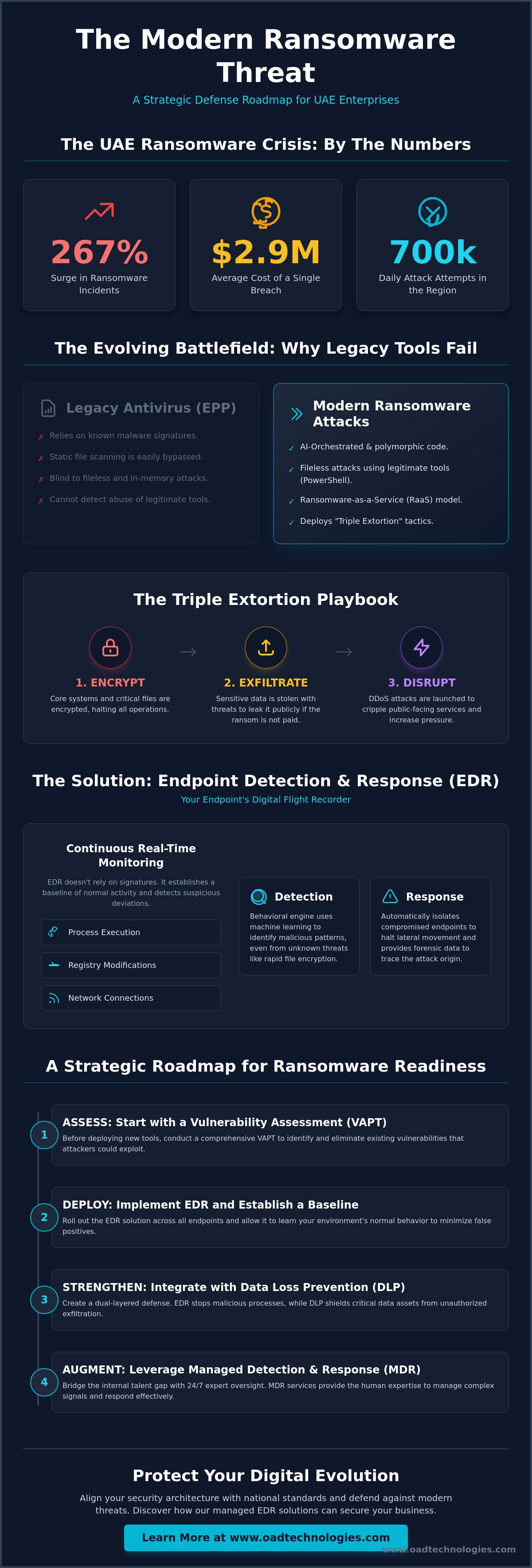
A Strategic Roadmap for EDR Deployment and Ransomware Readiness
Deploying a sophisticated security tool without a clear roadmap often leads to operational friction and visibility gaps. Successful implementation requires a structured approach that moves from initial assessment to full-scale integration. By following a deliberate lifecycle, UAE enterprises can ensure that edr for ransomware protection becomes a catalyst for resilience rather than a source of alert fatigue. This process begins by understanding your current vulnerabilities and ends with a unified, correlated security stack.
- Step 1: Conduct a VAPT. You can't protect what you haven't assessed. Identifying existing endpoint vulnerabilities ensures your EDR isn't trying to defend a fundamentally compromised foundation.
- Step 2: Define "Normal" behavior. Utilize a baseline monitoring period to understand standard user activities and process flows. This reduces false positives during the active enforcement phase.
- Step 3: Map to GRC standards. Align your technical controls with your broader Governance Risk and Compliance (GRC) framework to ensure every alert serves a regulatory or business objective.
- Step 4: Implement a phased rollout. Start with non-critical departments to test policy impact. A gradual expansion prevents widespread operational disruption.
- Step 5: Integrate with SIEM. Ensure your endpoint data flows into a centralized SIEM for cross-stack correlation, allowing you to see the full narrative of an attack across networks and identities.
If you're ready to move from reactive patching to a proactive security posture, our team can help you design a customized deployment roadmap tailored to your specific infrastructure.
Aligning with UAE Regulations (PDPL and ISR)
In 2026, compliance isn't just about checkboxes; it's about data sovereignty. UAE enterprises must ensure that EDR data logging practices meet the localization requirements of Federal Decree-Law No. 45 of 2021 (PDPL). Modern EDR supports the "Right to be Informed" by providing the forensic detail necessary for timely breach reporting. For those managing Critical Information Infrastructure (CII), these tools are essential for meeting the continuous monitoring mandates of the Information Assurance (ISR) standards and maintaining NCAP accreditation.
The Role of VAPT in EDR Strategy
EDR is a powerful layer of defense, but it's only truly effective if the underlying operating systems are hardened. We recommend starting with a comprehensive Vulnerability Assessment and Penetration Testing (VAPT) to identify the paths of least resistance that attackers might take. By using VAPT results to tune your EDR detection rules, you can create specific triggers for the high-risk areas unique to your business. This synergy ensures your technological capacity is always empowered by human insight and rigorous engineering standards.
OAD Technologies: Elevating EDR through Managed Detection and Response (MDR)
The most significant barrier to effective endpoint security isn't usually the budget or the hardware; it's the human element. Many UAE enterprises find that while they can procure the best edr for ransomware protection, they lack the dedicated staff to monitor the resulting telemetry 24 X 7. An EDR tool that generates hundreds of alerts is only as useful as the analyst who can validate and respond to them in real-time. Without constant oversight, even the most sophisticated behavioral engines can't prevent a breach that occurs at 3:00 AM on a weekend.
OAD Technologies solves this challenge by providing Managed Detection and Response (MDR) as a strategic extension of your internal team. We take a master designer approach to your endpoint architecture, ensuring that your tools are properly tuned to your specific operational environment. By maintaining a human-in-the-loop, our expert UAE-based analysts validate every anomaly, separating legitimate administrative tasks from actual malicious intent. This proactive mindset ensures that your technological capacity is always backed by rigorous engineering standards.
Why Managed EDR Outperforms In-House Solutions
The cybersecurity talent gap in the regional market makes it difficult for individual firms to maintain a full-scale Security Operations Center (SOC). OAD provides an immediate solution to this scarcity, offering 24 X 7/365 monitoring and incident response. One of the most powerful benefits we offer is community immunity. When our analysts identify a new ransomware tactic or a zero-day exploit targeting one client, we immediately apply those lessons and detection rules across our entire client base. This collective intelligence ensures that your defense is always evolving faster than the threats themselves.
Building Long-Term Digital Resilience
We view edr for ransomware protection as a strategic investment in your ongoing digital relevance rather than a simple line-item expense. Real resilience comes from the synergy between OAD’s GRC, DLP, and EDR services, creating a unified posture that protects your assets from every angle. By aligning your security strategy with national standards and business goals, we help you transition from a state of constant firefighting to one of stable, scalable growth. If you're ready to secure your future, consult with OAD Technologies for a tailored ransomware protection strategy that fits your unique enterprise needs.
Securing Your Digital Future in the UAE
The transition from reactive security to proactive resilience is no longer a luxury for UAE enterprises; it's a fundamental requirement for operational survival. You've seen how legacy tools fail against AI-driven threats and why a unified approach that integrates endpoint visibility with data protection is the only way to neutralize double extortion tactics. By implementing edr for ransomware protection as part of a broader Managed Detection and Response strategy, you transform your security posture from a cost center into a strategic asset.
Success in 2026 requires more than just advanced software; it demands the synergy of human expertise and localized intelligence. As Dubai-based technical security experts, OAD Technologies specializes in bridging the gap between high-level GRC requirements and practical engineering. Our team ensures your architecture remains fully compliant with UAE PDPL and national security standards while providing the comprehensive MDR and DLP integration needed to stay ahead of evolving threats. It's time to move beyond the fear of the next alert and embrace a roadmap built for long-term viability.
Secure your enterprise with OAD Technologies managed ransomware protection and take the first step toward a more resilient digital evolution. We're ready to act as an extension of your team to safeguard your ongoing success.
Frequently Asked Questions
Is EDR enough to protect against ransomware on its own?
No, EDR is not a standalone solution for total security. While it provides the behavioral visibility needed for edr for ransomware protection, it works most effectively as part of a layered ecosystem. You need Data Loss Prevention (DLP) to stop data exfiltration and human expertise to manage the alerts. Without these additional layers, you might stop the encryption process but still lose your sensitive data to double extortion tactics.
How does EDR differ from traditional antivirus software?
EDR focuses on behavior rather than file signatures. Traditional antivirus looks for "known bad" files, which fails against the polymorphic and fileless attacks common in 2026. EDR records every process and registry change, allowing it to spot suspicious patterns in real-time. It provides a flight recorder for your endpoints, offering forensic data that legacy tools simply can't capture during a sophisticated breach.
Can EDR prevent data exfiltration during a ransomware attack?
EDR can stop the malicious processes used to move data, but it isn't specifically designed for data flow tracking. Integration with DLP is essential to identify and block the unauthorized movement of sensitive assets. While EDR kills the attacker's script, DLP ensures the actual files remain within your secure perimeter. This dual-layered approach is the only way to neutralize the threat of exfiltration during a ransomware event.
What is the role of EDR in UAE PDPL compliance?
EDR provides the detailed forensic logging required by the UAE Personal Data Protection Law (PDPL). If a breach occurs, the law requires timely reporting and clear documentation of the incident. EDR serves as your evidence-based compliance tool, offering a granular timeline of events. This proves your organization took reasonable steps to secure personal data and maintain the national security standards mandated for Critical Information Infrastructure.
Does EDR slow down employee workstations or system performance?
Modern EDR agents are designed to be extremely lightweight and typically use less than 1% of CPU resources. Unlike legacy security software that performs heavy disk scans, EDR monitors events in real-time through the operating system's kernel. This architectural approach ensures that your security posture remains robust. It protects your environment without impacting the productivity of your workforce or causing frustrating system latency during peak hours.
How much does it cost to implement EDR for a UAE enterprise?
Implementation costs vary based on the number of endpoints and whether you choose a managed or self-hosted model. Pricing is usually structured on a per-endpoint, per-month basis. When evaluating the investment for edr for ransomware protection, businesses should consider the total cost of ownership, including the specialized staff required to monitor the tool. Proactive investment is a strategic move to avoid the high costs associated with recovery and regulatory penalties.
What happens if ransomware is detected on an endpoint?
The system immediately triggers an automated response to contain the threat. This typically includes killing the malicious process and isolating the infected endpoint from the rest of the network to prevent lateral movement. Once the threat is neutralized, security teams use forensic playback to investigate the root cause. This allows them to roll back any unauthorized changes made to the file system or registry and harden the environment against future attempts.
Why should we choose a managed EDR service instead of an in-house tool?
Managed services provide 24 X 7 expert oversight that most in-house teams struggle to sustain. Ransomware doesn't follow business hours, so you need analysts who can validate and respond to alerts at any time of the day or night. A managed provider also brings "community immunity" to your defense. They apply lessons learned from attacks on other organizations to your specific environment, ensuring your posture is always evolving faster than the threats themselves.
Disclaimer
Content by OAD Technologies is for general informational purposes only and does not constitute professional or cybersecurity advice. No warranties are made regarding accuracy or completeness; reliance is at your own risk. OAD Technologies shall not be liable for any direct or indirect losses arising from use of this content.