
What if your security tools are looking for a signature that doesn't exist while an attacker is already using your own system tools against you? You've likely felt the frustration of legacy antivirus failing to catch fileless attacks or drowning your team in false positives. It's a common struggle for organizations trying to maintain visibility into lateral movement while facing the pressure of the UAE's tightening cybersecurity regulations. Understanding how edr stops advanced threats is no longer just a technical requirement; it's a strategic necessity for business continuity in 2026.
This article explores the architectural mechanisms EDR uses to neutralize zero-day exploits and sophisticated adversary techniques that traditional security misses. We'll show you how modern platforms move beyond identifying "bad files" to deciphering malicious intent within legitimate processes. This guide provides the technical logic needed to justify security investments to leadership and ensures your strategy aligns with national standards like the UAE Information Assurance (IA) requirements. We're looking at the future of endpoint resilience, where human insight and technological capacity merge to create a proactive defense.
The EDR market is projected to reach a valuation of over $7 billion in 2026, yet many organizations still struggle to see past the noise of legacy alerts. You likely recognize that traditional signature-based tools are no longer enough to defend against today's fileless malware and sophisticated lateral movement. It's a common concern for security teams facing stricter enforcement of UAE Information Assurance standards and the mandatory shift toward NCAP accreditation. This strategic guide details exactly how edr stops advanced threats by moving beyond simple file identification to analyze real-time behavioral intent.
We'll explore the technical mechanisms of continuous telemetry and the role of the "Data Lake" in providing the historical context required for deep forensic investigation. You'll also learn how to map these capabilities to the MITRE ATT&CK framework to stop "Living off the Land" techniques that abuse legitimate system tools. Finally, we examine how OAD Technologies’ human-centric approach aligns with the UAE Personal Data Protection Law to ensure long-term viability. By the end of this article, you'll have a clear roadmap for integrating human expertise with advanced automation to secure your digital evolution.
The Evolution of Endpoint Security: Why Legacy Antivirus Fails Against Advanced Threats
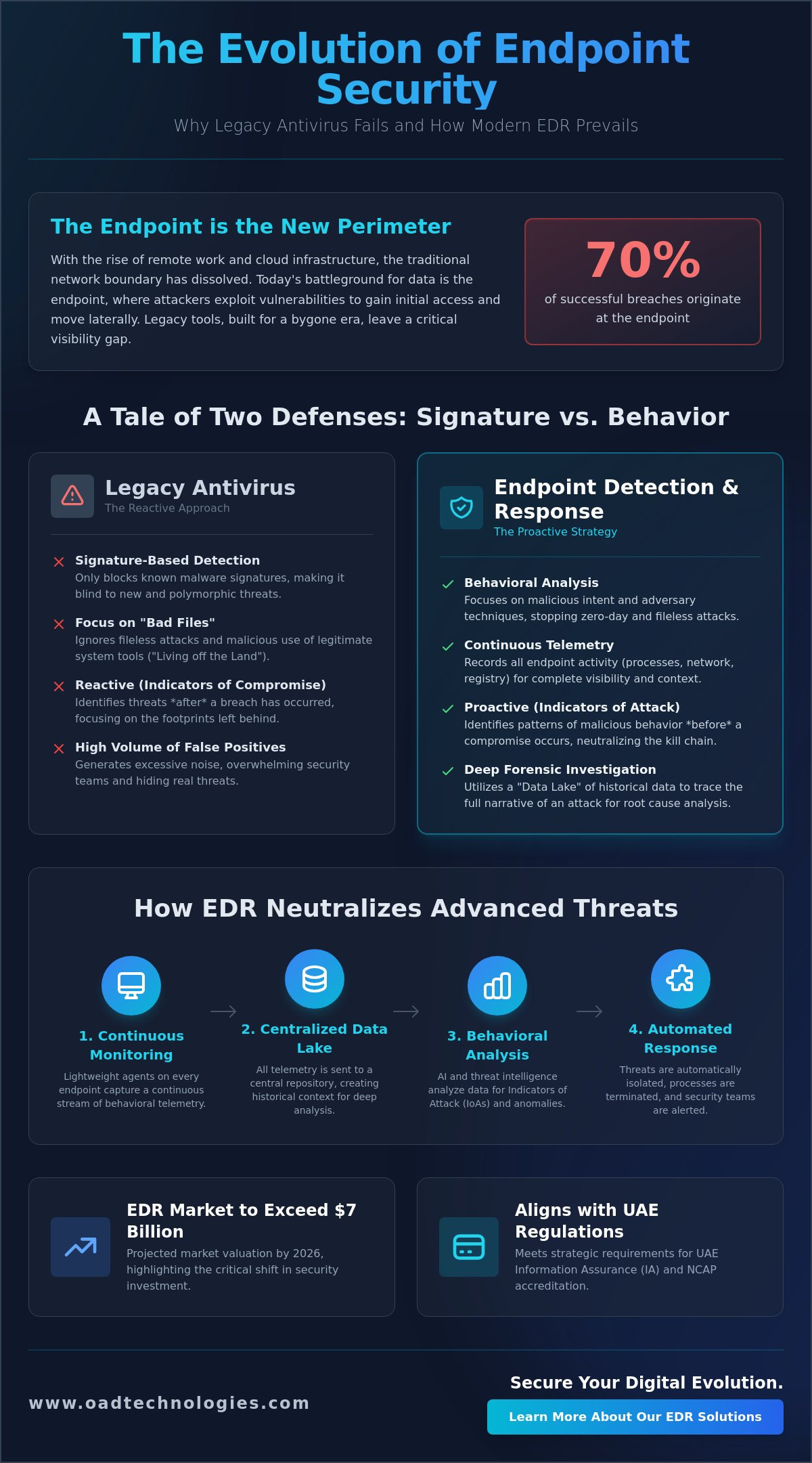
Legacy antivirus was built for a world that no longer exists. In that era, security relied on a static library of known signatures. If a file's hash matched an entry in the database, it was blocked. If it didn't, it was allowed to run. Today, that approach is fundamentally broken. By 2026, polymorphic malware and AI-driven code generation allow threats to change their digital fingerprint in milliseconds, rendering signature-based detection obsolete. This creates a dangerous visibility gap where traditional tools report a "clean" environment while an adversary is actually moving laterally through the network. Modern attackers don't just drop a malicious payload; they hijack legitimate system processes to hide their tracks.
To bridge this gap, organizations have shifted toward Endpoint detection and response (EDR). Unlike its predecessors, EDR doesn't wait for a known threat to appear. It focuses on continuous monitoring, telemetry collection, and automated behavioral response. By analyzing the "how" and "why" behind every action on a device, EDR provides the historical context required to identify sophisticated adversary techniques. This shift is critical because 2026 threats prioritize identity theft and process manipulation over simple file-based attacks. When an attacker uses a legitimate admin tool to exfiltrate data, there is no "bad file" for antivirus to catch. Only behavioral logic can reveal the malicious intent.
The Death of the Perimeter and the Rise of the Endpoint
The transition to remote work and distributed cloud infrastructures has effectively dissolved the traditional network perimeter. In a Zero Trust architecture, the endpoint is the primary battleground and the last line of defense for your data. Industry research suggests that approximately 70% of successful breaches originate at the endpoint. This high success rate is due to the inherent complexity of securing diverse, off-network devices. Without granular visibility into these assets, your security posture remains reactive. EDR provides the necessary oversight to treat every device as a controlled environment, regardless of its physical location.
Signatures vs. Behaviors: A Critical Distinction
Understanding how edr stops advanced threats requires a shift from looking at what a file is to what a process does. Traditional antivirus looks for Indicators of Compromise (IoC), which are the footprints left behind after a breach occurs. Modern defense focuses on Indicators of Attack (IoA). These are behavioral patterns that signal malicious intent before a payload is even delivered. By monitoring for intent-based anomalies, such as unusual registry changes or unexpected network connections, EDR identifies the subtle signs of an adversary "living off the land." This proactive approach ensures that even if a threat has never been seen before, its behavior will trigger a response, effectively neutralizing the attack before it can escalate.
The Mechanics of Detection: How EDR Processes Behavioral Telemetry
EDR functions as a high-fidelity digital flight recorder for your endpoints. It doesn't just block known files; it captures a continuous stream of behavioral telemetry across your entire infrastructure. This granular data ingestion is fundamental to understanding how edr stops advanced threats. By recording every process execution, registry modification, and network connection, EDR creates a living map of system activity. This map allows security teams to see the context behind an action, transforming isolated events into a coherent narrative of an attack.
At the heart of this process lies the "Data Lake." This centralized repository stores massive volumes of enriched metadata, providing the historical context required for deep forensic investigation. If a breach is suspected, investigators can "rewind" the tape to see exactly when an adversary first gained access and what steps they took next. This capability is vital for meeting the strict auditing requirements of the UAE Information Assurance (IA) standards, which mandate real-time inventory and historical visibility of cryptographic and system assets.
Telemetry Collection and Enrichment
Modern EDR agents are designed for high efficiency, collecting essential metadata without compromising device performance. This data isn't just stored; it's enriched with global threat intelligence feeds in real-time. By correlating local events with known adversary tactics seen worldwide, the system can identify a threat much faster than a human analyst could alone. Retaining this raw data is crucial for "look-back" investigations, allowing you to search for new indicators of compromise across your historical records.
AI and Behavioral Heuristics in 2026
In 2026, the distinction between a legitimate administrative task and a malicious intrusion is often razor-thin. This is where AI and machine learning models become indispensable. These systems identify unusual parent-child relationships, such as a productivity app like Word suddenly launching a PowerShell script. By analyzing millions of events, AI reduces alert fatigue by automatically correlating related incidents and prioritizing those that pose the highest risk.
This synergy between automated detection and human-led threat hunting ensures your team focuses on strategic defense rather than chasing false positives. To see how these mechanisms integrate into a broader resilience strategy, exploring the specialized security frameworks at OAD Technologies can help bridge the gap between technical capacity and business outcomes. The end result is a decision engine that doesn't just alert you to a problem but can automatically contain a compromised host before the threat spreads.
Neutralizing the Kill Chain: 5 Ways EDR Stops Sophisticated Attack Vectors
The cyber-attack lifecycle, or kill chain, has become increasingly non-linear. To maintain resilience, security teams must map their defenses to the MITRE ATT&CK framework; this ensures every tactical stage, from initial access to data exfiltration, is covered. This mapping is central to understanding how edr stops advanced threats by identifying specific adversary behaviors rather than just static files. By categorizing events into known tactical groups, EDR provides a structured way to visualize and disrupt an ongoing intrusion before it reaches its objective.
One of the most difficult vectors to detect is the "Living off the Land" (LotL) attack. In these scenarios, adversaries use legitimate administrative tools like PowerShell, WMI, or BITS to execute their mission. Because these tools are native to the operating system, they often bypass standard filters. EDR stops these by establishing a baseline of "normal" administrative behavior and flagging deviations, such as a PowerShell script executing an encoded command from a non-standard parent process. This logic moves beyond simple blocking to provide a sophisticated, context-aware defense.
Stopping Fileless and Memory-Resident Attacks
Fileless attacks are particularly insidious because they leave no trace on the physical hard drive, existing only in volatile memory. Traditional antivirus is blind here because there's no file to scan. EDR monitors API calls and memory space to identify unauthorized code injections. For instance, in a 2026-style fileless ransomware incident, an attacker might inject malicious code directly into a trusted system process. EDR detects this memory-resident anomaly in real-time, terminating the process before the encryption phase begins.
Deceiving the Attacker: Credential Guard and Deception
Credential theft is the fuel for lateral movement. EDR agents actively guard sensitive memory areas, such as the Local Security Authority Subsystem Service (LSASS), against unauthorized access. Modern platforms also deploy "honeypot" credentials; these are decoy accounts that exist solely to trap adversaries during their discovery phase. Once an attacker interacts with a decoy, the system triggers a high-fidelity alert. EDR identifies lateral movement by flagging non-standard SMB or RDP connections between endpoints that have no historical reason to communicate.
This level of visibility allows for one-click remediation and "rollback" features. If an endpoint is compromised, administrators can isolate the host from the network and restore it to a pre-infection state without a full re-image. This speed is essential for maintaining operational performance while meeting the rigorous uptime requirements of UAE national security standards. By combining automated containment with deep forensic evidence, your team can respond to threats in minutes rather than days.
Strategic Implementation: Aligning EDR with UAE Regulatory Standards
For enterprises operating within the UAE, the technical ability to detect threats is inseparable from the legal obligation to protect personal information. The UAE Personal Data Protection Law (PDPL), specifically Federal Decree-Law No. 45 of 2021, mandates that organizations implement rigorous "Technical and Organizational Measures" (TOMs) to safeguard data. EDR isn't just a security tool in this context; it's a compliance engine. By providing granular visibility into who accessed what data and when, EDR allows your team to meet mandatory breach notification timelines that require rapid, accurate reporting to the UAE Data Office.
Understanding how edr stops advanced threats provides the necessary foundation for demonstrating alignment with National Information Assurance (IA) standards. As of 2026, organizations handling Critical Information Infrastructure (CII) face stricter enforcement and must often achieve National Cyber Accreditation Programme (NCAP) accreditation. EDR supports these goals by facilitating continuous endpoint auditing. It ensures that every device on your network adheres to the UAE Cybersecurity Council’s latest policies, such as the 2026 mandate for transitioning to post-quantum cryptography standards and maintaining a real-time inventory of cryptographic assets.
Data Sovereignty and Endpoint Telemetry
A critical consideration for UAE-based firms is the residency of security telemetry. Under updated PDPL executive rules, businesses must often ensure that personal data remains within UAE-compliant centers. Modern EDR solutions address this by offering localized data storage options that satisfy sovereignty requirements without sacrificing the power of global threat intelligence. This level of control is a core component of a broader Governance Risk and Compliance (GRC): The 2026 Enterprise Strategy Guide, where technical visibility directly fuels regulatory reporting. By choosing a platform that respects local residency laws, you secure your infrastructure while avoiding the heavy penalties associated with non-compliance.
Audit Readiness and Incident Documentation
When an auditor requests proof of your security posture, the historical logs provided by an EDR platform serve as immutable evidence. These forensic records document every blocked attempt and successful containment, turning abstract security claims into verifiable data points. This transparency streamlines the evidence collection phase of any audit, allowing your team to focus on strategic growth rather than manual log aggregation. Integrating these insights with regular Vulnerability Assessment and Penetration Testing (VAPT): A Strategic Enterprise Guide for 2026 ensures that your defenses stay ahead of both adversaries and regulatory changes. To ensure your current architecture meets these evolving national standards, consult with the compliance specialists at OAD Technologies for a comprehensive gap analysis.
Beyond the Tool: OAD Technologies’ Human-Centric Approach to EDR
While the previous sections detailed the technical mechanics of telemetry and behavioral logic, a tool is only as effective as the intelligence driving it. Technology alone isn't a silver bullet. In the complex threat landscape of 2026, even the most advanced behavioral analytics require expert interpretation to distinguish between a legitimate administrative anomaly and a high-stakes intrusion. At OAD Technologies, we view EDR not as a standalone product but as a core component of a broader, human-centric resilience strategy. This approach ensures that technical capacity is always grounded in practical business results.
A primary challenge for many organizations is the sheer volume of data generated by modern endpoints. Without a strategic partner to filter the noise, security teams often fall victim to alert fatigue, potentially missing the subtle indicators of a sophisticated breach. We focus on customizing EDR policies to fit the unique operational requirements of UAE businesses. This means tuning the detection engine to recognize the specific software stacks and administrative patterns common in your industry, ensuring that how edr stops advanced threats is optimized for your specific digital environment.
The Synergy of SIEM and EDR
To achieve true endpoint resilience, organizations must bridge the gap between individual device visibility and total network oversight. EDR provides the necessary depth by monitoring the kernel and memory space of specific hosts, while SIEM provides the breadth required to see the entire digital estate. By integrating these two layers, security teams can correlate an unusual endpoint process with a suspicious login attempt on a cloud application. This cross-layer visibility is explored further in our guide on SIEM: The Strategic Guide to Security Information and Event Management in 2026. The seamless integration of SIEM and EDR serves as the foundational architecture of a modern, data-driven Security Operations Center (SOC).
Empowering People through Technology
Our goal is to empower your people rather than just replacing your processes. By utilizing EDR to handle the heavy lifting of continuous monitoring and automated containment, your internal security team can move away from manual triage and toward proactive threat hunting. This shift significantly reduces the time required to identify and neutralize an adversary. The OAD promise is one of long-term digital relevance, positioning your organization as a proactive guardian of its own data. For enterprises that require a higher level of oversight, our Managed Detection and Response (MDR): The 2026 Strategic Guide to Enterprise Resilience details how 24 X 7 vigilance can be seamlessly integrated into your existing workflow. Ultimately, understanding how edr stops advanced threats is the first step toward building a sustainable culture of cybersecurity excellence.
Securing Your Digital Evolution Through Adaptive Resilience
Endpoint resilience in 2026 requires more than reactive blocking. It demands a sophisticated understanding of behavioral telemetry to disrupt the kill chain at its earliest stages. We've explored how edr stops advanced threats by analyzing intent rather than static files; this ensures your defense remains effective against fileless malware and the abuse of legitimate system tools. This visibility is the bedrock of maintaining compliance with the UAE's evolving PDPL and IA standards. It's no longer enough to simply monitor; you must be prepared to respond with precision.
OAD Technologies serves as your specialized system integrator for the UAE market, bridging the gap between high-level innovation and regional regulatory requirements. Our expertise in PDPL and ISR compliance, combined with proactive 24 X 7 Managed Detection and Response, ensures your organization stays ahead of sophisticated adversaries. You don't have to navigate these complexities alone. Request a Strategic EDR Assessment from OAD Technologies to fortify your infrastructure and ensure long-term digital viability. Your journey toward a more secure and compliant future starts with a single, strategic decision.
Frequently Asked Questions
Is EDR better than traditional Antivirus?
EDR is superior because it provides continuous visibility and behavioral analysis that traditional antivirus lacks. While antivirus relies on a database of known signatures, EDR monitors system activities in real-time to identify anomalies. This transition is essential for modern defense because signatures can't keep pace with the rapid evolution of polymorphic code. It's the difference between checking an ID and monitoring ongoing behavior.
Can EDR stop ransomware before it encrypts files?
Yes, EDR identifies ransomware by its behavior rather than its file signature. It monitors for precursors like the mass deletion of backup files or unauthorized encryption attempts. By recognizing these malicious patterns early, the system can automatically isolate the affected endpoint and terminate the process before your data is compromised. This proactive containment is vital for minimizing downtime and ensuring business continuity.
How does EDR impact the performance of user laptops and servers?
Modern EDR agents are designed to be extremely lightweight, utilizing a "thin-agent" architecture that minimizes CPU and memory usage. Most of the heavy analytical processing occurs in the cloud or a centralized data lake. This ensures that user laptops and high-performance servers remain responsive while maintaining a high level of security oversight. Users generally won't notice the agent running in the background.
Is EDR mandatory for compliance with UAE cybersecurity laws?
While the term "EDR" might not appear in every statute, it's a practical requirement for meeting UAE Information Assurance (IA) standards and PDPL mandates. The UAE Cybersecurity Council requires organizations handling Critical Information Infrastructure to maintain real-time monitoring and historical auditing. EDR provides the technical evidence needed to achieve National Cyber Accreditation Programme (NCAP) accreditation and prove that organizational data is adequately protected.
What is the difference between EDR and MDR?
EDR is the technological platform installed on your devices, while Managed Detection and Response (MDR) is the service that provides human experts to manage that platform. MDR providers like OAD Technologies use EDR tools to hunt for threats 24 X 7. This combination ensures that the technical alerts are interpreted and acted upon by experienced security analysts, rather than just sitting in a dashboard.
How does EDR detect threats that don't use files or malware?
This is a core part of how edr stops advanced threats that bypass traditional filters. Instead of scanning files, the system monitors memory injections and unauthorized API calls. By analyzing the relationship between parent and child processes, EDR can detect when a legitimate tool like PowerShell is being hijacked for malicious purposes. This behavioral logic allows it to catch "living off the land" attacks.
Does EDR require a dedicated Security Operations Center (SOC) team?
EDR doesn't strictly require an in-house SOC, but it does demand constant expert oversight to be effective. Without experienced analysts to investigate high-fidelity alerts, organizations often face alert fatigue and missed detections. Many UAE businesses bridge this gap by partnering with a managed service provider to handle the specialized triage and response duties. This allows your internal team to focus on strategic initiatives.
Can EDR help with post-breach forensic investigations?
Yes, the "Data Lake" in an EDR platform acts as a digital flight recorder for your infrastructure. It retains a detailed history of process executions, registry changes, and network connections even after a device is taken offline. This data is invaluable for forensic investigators who need to determine the root cause of a breach and map an attacker's lateral movement. It provides the immutable evidence required for regulatory reporting.
Disclaimer
Content by OAD Technologies is for general informational purposes only and does not constitute professional or cybersecurity advice. No warranties are made regarding accuracy or completeness; reliance is at your own risk. OAD Technologies shall not be liable for any direct or indirect losses arising from use of this content.