
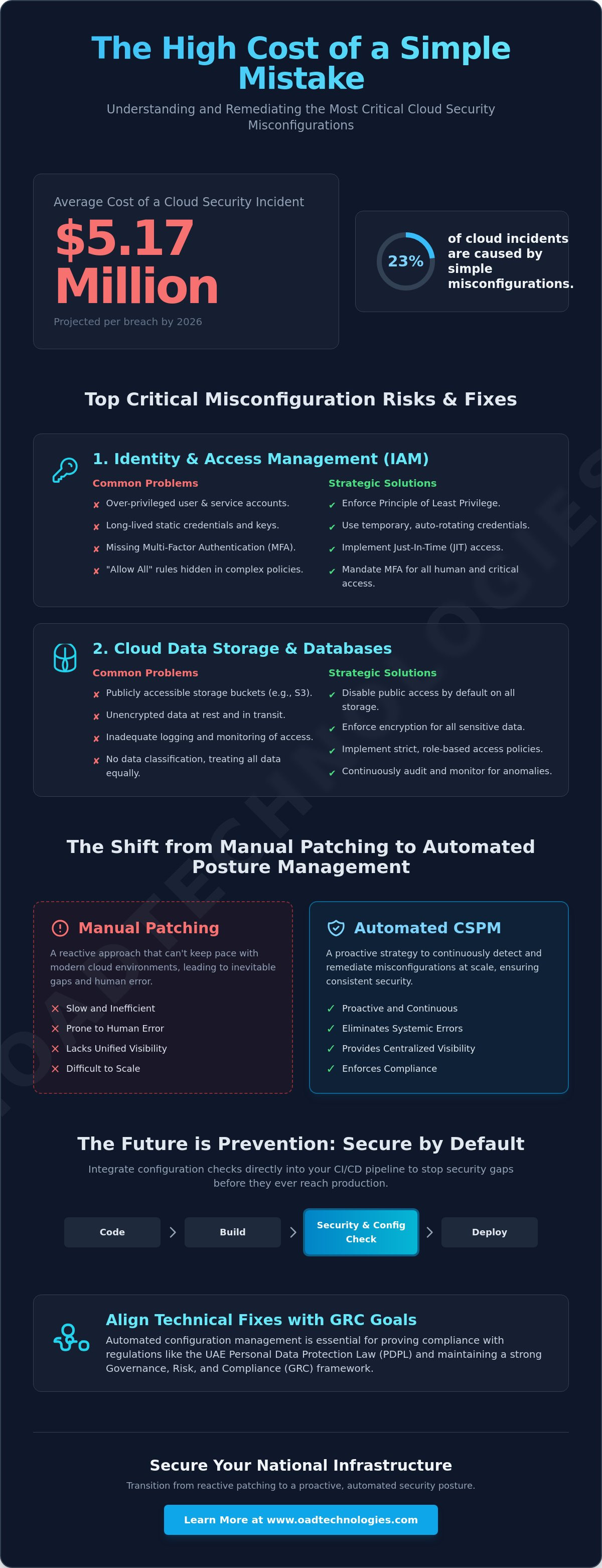
With the average cost of a public cloud security incident reaching $5.17 million per breach in 2026, your greatest threat isn't a sophisticated hacker. It's a simple toggle left in the wrong position. Misconfigurations now account for 23% of all cloud security incidents, often leaving sensitive data exposed through publicly accessible storage buckets or overly permissive IAM policies. Learning how to fix common cloud misconfigurations has evolved from a routine IT task into a high-stakes requirement for enterprise survival and regulatory standing.
We understand that the sheer volume of security alerts can be paralyzing, especially when you're balancing hybrid cloud visibility with the strict requirements of the UAE Personal Data Protection Law (PDPL). It's exhausting to chase vulnerabilities across fragmented systems without a clear sense of what truly impacts your risk profile. You need a way to bridge the gap between technical innovation and practical, compliant results.
This guide provides a strategic roadmap to help you regain control. You'll learn to master the systematic identification and remediation of security gaps to protect your enterprise assets and ensure total compliance. We'll detail a framework for automated posture management and a priority list that aligns your technical fixes with long-term business GRC goals.
Key Takeaways
- Identify the critical vulnerabilities within Identity and Access Management and data storage that create the most significant risks for your enterprise infrastructure.
- Transition from manual, reactive patching to automated Cloud Security Posture Management to eliminate systemic configuration errors at scale.
- Master how to fix common cloud misconfigurations by establishing secure by default guardrails that protect your assets without slowing down development.
- Learn to integrate configuration checks directly into your CI/CD pipeline to stop security gaps from ever reaching your production environment.
- Align technical remediation with your broader GRC goals to ensure continuous compliance with the UAE Personal Data Protection Law and other regulatory mandates.
The State of Cloud Misconfigurations in 2026
A cloud misconfiguration isn't just a minor technical oversight. It's any setting, policy, or architectural flaw that leaves your cloud assets vulnerable to unauthorized access or data exfiltration. In the context of cloud computing security, these gaps represent the path of least resistance for modern attackers. By 2026, the complexity of hybrid environments has made these errors nearly inevitable for teams relying on manual oversight. SentinelOne reports that 45% of data breaches now occur in the cloud, with an average incident cost reaching $5.17 million. While many organizations focus on external threats, misconfigurations actually cause 23% of cloud security incidents. Understanding how to fix common cloud misconfigurations is no longer a luxury; it's a prerequisite for operational continuity and data integrity.
Native cloud tools often provide a baseline of protection, but they frequently create a false sense of security for large scale enterprises. These tools often operate in silos, failing to provide the unified visibility needed to manage permissions across different providers. When your security team manages thousands of identities and storage objects, a single "allow all" rule can stay hidden for months, silently exposing your most critical assets to the public web.
The Evolution of the Cloud Threat Landscape
The risks have shifted significantly over the last few years. We've moved beyond the era of simple public S3 buckets. Today's threats involve sophisticated API exploitations and identity based attacks that leverage over-privileged service accounts. Shadow IT continues to complicate this landscape as departments deploy unmanaged cloud pockets without central oversight. In a multi-cloud architecture, the sheer volume of settings makes manual configuration impossible to maintain. If your team is still clicking through consoles to verify permissions, you're already behind the curve. Automation is the only way to keep pace with the speed of modern deployment cycles.
Regulatory Implications for National Enterprises
Top 3 Critical Misconfigurations and How to Fix Them
Addressing cloud security requires moving beyond a reactive mindset. When organizations evaluate how to fix common cloud misconfigurations, they must focus on the three vectors that provide the highest return on security investment. These aren't just technical checkboxes; they're the pillars of a resilient digital architecture. The Principle of Least Privilege serves as the cornerstone of this effort, ensuring that every user and service account possesses only the minimum permissions necessary to perform its intended function.
Fixing Identity and Access Management (IAM)
Identity is the new perimeter. Organizations often struggle with over-privileged service accounts that attackers can leverage for lateral movement. To remediate this, you must eliminate long-lived credentials in favor of temporary, rotating keys and enforce Multi-Factor Authentication (MFA) across all entry points. By applying identity and access management best practices, you can implement Just-In-Time (JIT) access. This reduces your attack surface by granting elevated permissions only when they're required for a specific task, effectively closing the window of opportunity for credential abuse.
Securing Cloud Data Storage and Databases
Unsecured data storage remains a high-impact risk. While public S3 buckets are a well known issue, modern blob security requires a more nuanced approach. You should enforce default encryption for all data at rest and in transit. Automated policies are essential here to block public access to sensitive volumes before they're even deployed. Integrating data loss prevention tools allows your team to identify sensitive datasets automatically, ensuring they're never subject to a misconfiguration. This alignment with CISA's Cloud Security Technical Reference Architecture ensures your storage layer meets global standards for operational resilience.
Remediating Network and API Vulnerabilities
Network and API exposure often stems from unrestricted inbound traffic. Closing non-essential ports like SSH (22) and RDP (3389) to specific, trusted IP ranges is a fundamental step in how to fix common cloud misconfigurations. APIs require even tighter controls, including robust authentication and aggressive rate limiting to prevent automated scraping or injection attacks. Micro-segmentation adds another layer of defense, isolating workloads so that a single compromised node doesn't lead to a total environment breach. If you're unsure where your network vulnerabilities lie, a strategic security review can provide the clarity needed to prioritize your remediation roadmap.
Manual Patching vs. Automated Posture Management
Many enterprises treat security like a game of whack-a-mole. Every time a port is closed or a storage bucket is secured, three more vulnerabilities appear in a different region or a newly deployed environment. This manual approach fails because it treats symptoms rather than the underlying architectural disease. When you're looking at how to fix common cloud misconfigurations, relying on human intervention is no longer a viable strategy for scale. The speed of modern DevOps cycles means that a single manual error can be replicated across hundreds of instances in seconds, far outpacing the capacity of any security team to respond.
Cloud Security Posture Management (CSPM) has emerged as the strategic solution to this resource drain. Instead of waiting for a quarterly audit to find a mistake made months ago, CSPM provides a persistent layer of oversight. It reduces the Mean Time to Remediate (MTTR) from days of investigation and manual ticketing to mere seconds of automated correction. By shifting from a reactive patching model to a proactive posture management model, you ensure that your security standards are enforced globally and instantaneously. The goal isn't just to find errors, but to build an environment where misconfigurations are technically impossible to maintain.
The ROI of Automated Remediation
The financial argument for automation is clear. A manual security audit is a static snapshot in time that requires hundreds of man-hours to execute. In contrast, continuous monitoring provides a living record of your security state. This automation directly enhances your vulnerability assessment and penetration testing (VAPT) efforts. By clearing the "noise" of basic misconfigurations, your security specialists can focus on complex, logic-based threats that actually require human insight. Infrastructure as Code (IaC) templates further solidify this by ensuring that every environment is built from a secure-by-default blueprint, drastically reducing the margin for human error during the deployment phase.
Implementing Continuous Monitoring and Compliance
Deploying real-time alerts ensures that any unauthorized configuration change is flagged the moment it occurs. Modern CSPM tools go beyond simple alerts by mapping technical settings to complex GRC requirements automatically. This creates a functional bridge between your engineering team and your compliance officers, allowing for "compliance-as-code" that satisfies both parties. There's also a powerful synergy between siem and CSPM. While your SIEM analyzes log data for signs of an active attack, CSPM ensures the underlying environment is structurally sound. Together, they provide a holistic view of your threat landscape that manual processes simply cannot replicate.
Establishing Preventative Guardrails: A 2026 Strategy
Fixing a vulnerability in a live production environment is a high-stakes race against time. By 2026, the most resilient enterprises have shifted their focus from reactive patching to the implementation of rigid preventative guardrails. This transition addresses the phenomenon of "security drift," where configurations slowly degrade over time due to manual tweaks, emergency overrides, or undocumented changes. Implementing these guardrails is the ultimate answer to how to fix common cloud misconfigurations before they ever exist in your runtime environment. By mandating secure-by-default settings, you ensure that every new resource complies with your security policy from the moment of its creation.
Shifting security left involves integrating configuration checks directly into your CI/CD pipeline. This means security isn't a final hurdle at the end of the development cycle; it's a continuous part of the build process. Developers need to understand the security implications of their infrastructure choices, such as why a specific load balancer configuration might expose internal traffic. Infrastructure as Code (IaC) scanning stands as the most effective preventative measure because it identifies and neutralizes misconfigurations during the design phase, long before any resources are actually provisioned.
Building a Culture of Security Accountability
Security is a shared responsibility that requires clear ownership boundaries between IT and security teams. Without defined accountability, cloud resources often fall into a "management gray zone" where neither team feels responsible for their configuration. Implementing strict tagging policies allows you to track asset ownership and data sensitivity automatically. These tags act as a digital fingerprint, ensuring every resource is linked to a specific department and compliance requirement. When these guardrails are bypassed, managed detection and response provides the necessary oversight to identify and remediate the anomaly before it escalates into a breach.
Leveraging IaC for Consistent Configurations
Standardization is the enemy of misconfiguration. By using Terraform or CloudFormation templates, you can create a library of "Golden Images" and approved architectures that have been pre-vetted by your security specialists. This approach automates the rejection of non-compliant code. If a developer attempts to deploy a database with public access or unencrypted storage, the pipeline simply fails the build. This systematic enforcement ensures that your global infrastructure remains uniform, predictable, and secure. If you're ready to build a more resilient cloud architecture, contact our team of systems designers to begin your strategic transformation.
Secure Your National Infrastructure with OAD Technologies
OAD Technologies understands that the technical complexity of 2026 requires more than just a list of patches. We bridge the critical gap between technical cloud security posture management (CSPM) and your broader enterprise GRC objectives. While generic platforms might highlight a vulnerability, we provide the strategic context needed to understand its impact on your national infrastructure. Our mission is to transform your security from a series of reactive fixes into a resilient, managed posture that supports long term business growth.
Our unique approach integrates CSPM directly with Data Loss Prevention (DLP) to solve the "context gap" that plagues many security teams. Most automated tools treat every misconfigured storage volume with the same level of urgency. We prioritize remediation by identifying the sensitivity of the data within those volumes. If a storage object contains personal data regulated under the UAE Personal Data Protection Law (PDPL), our framework ensures it moves to the top of your priority list. This synergy ensures you're not just learning how to fix common cloud misconfigurations, but you're fixing the ones that represent the highest risk to your regulatory standing and brand reputation.
Beyond Tools: The OAD Strategic Partnership
Automated tools are essential, but they require human expertise to navigate complex remediation scenarios in hybrid environments. We act as a master designer of your security systems, acting as an extension of your own team rather than a distant vendor. Our expert led VAPT and technical assessments are specifically tailored for the UAE market, ensuring your configurations meet both global standards like ISO 27001:2022 and local sovereignty requirements. We don't believe in standardized approaches. Instead, we build customized security roadmaps that evolve alongside your digital transformation, acting as a guardian of your ongoing relevance in an unpredictable market.
Taking the Next Step in Cloud Resilience
Moving toward a secure by default architecture starts with a clear, objective analysis of your current environment. A comprehensive cloud security audit is the first step in identifying where your existing guardrails are failing and where "security drift" has taken hold. We invite you to initiate a pilot program for automated posture management, allowing your team to experience the benefits of real time remediation and reduced MTTR firsthand. Contact our specialists today to schedule a tailored cybersecurity assessment. Let's work together to align your cloud security with your most ambitious business goals.
Future-Proofing Your Cloud Infrastructure
Transitioning from reactive patching to a resilient cloud posture is a strategic necessity for the modern enterprise. You've seen how automated posture management and preventative guardrails replace the inefficient cycle of manual fixes. By prioritizing identity security and integrating configuration checks into your development pipeline, you eliminate the security drift that leads to costly breaches. Mastering how to fix common cloud misconfigurations isn't just about technical compliance. It's the foundation of your organization's digital longevity.
OAD Technologies provides the specialized UAE GRC expertise needed to navigate national data regulations while securing complex hybrid environments. Our integrated CSPM and DLP solutions offer a level of visibility that native tools can't match on their own. When combined with our national-scale Managed Detection and Response (MDR), we act as a dedicated partner in your security journey. Strengthen your cloud posture with OAD Technologies today. Your infrastructure is the engine of your innovation, and we're here to ensure it remains protected against the threats of tomorrow.
Frequently Asked Questions
What is the most common cloud misconfiguration found in UAE enterprises?
Overly permissive Identity and Access Management (IAM) roles and publicly accessible storage buckets remain the most frequent issues across the region. These gaps often emerge when engineering teams prioritize rapid deployment over strict access controls during digital transformation projects. In a 2026 enterprise environment, these settings represent the primary entry point for unauthorized data access and lateral movement within a network.
How does the UAE Personal Data Protection Law (PDPL) affect cloud configuration?
The UAE PDPL mandates rigorous technical and organizational measures to protect personal data, including specific requirements for data residency and encryption. Misconfigurations that allow data to leak outside of approved jurisdictions or travel over unencrypted channels lead to direct regulatory violations. Organizations must align their cloud settings with these legal frameworks to maintain their license to operate and avoid significant penalties.
Can CSPM tools automatically fix misconfigurations without human intervention?
Yes, modern Cloud Security Posture Management (CSPM) tools can automatically remediate high-risk settings the moment they deviate from your established baseline. For example, a tool can immediately revoke public access to a newly created database or reset an open security group to a secure state. This automation is essential for reducing the mean time to remediate (MTTR) across large scale, dynamic infrastructures.
Is native cloud security enough for an enterprise?
Native tools like AWS Config or Azure Policy provide a solid technical baseline but often lack the unified visibility required for hybrid or multi-cloud environments. They struggle to provide a single pane of glass for complex GRC reporting across different cloud providers. Enterprises usually need third-party solutions to bridge the gap between basic settings and strategic business risk management.
How often should we perform a cloud security configuration audit?
You should move toward a model of continuous monitoring rather than relying on quarterly or annual audits. Since cloud environments change by the minute, a point-in-time audit is often obsolete by the time the report is generated. Continuous oversight ensures you understand how to fix common cloud misconfigurations as they occur, rather than discovering them months after a potential exposure.
What is the difference between CSPM and Vulnerability Management?
CSPM focuses on the security of the cloud control plane and infrastructure settings, such as IAM policies and network rules. Vulnerability management typically scans for flaws within the operating system, libraries, or application software itself. Both are necessary components of a modern security strategy, but they address different layers of the technology stack.
How does misconfiguration lead to Data Loss Prevention (DLP) failures?
A misconfigured cloud environment can create blind spots that allow sensitive information to bypass your Data Loss Prevention (DLP) controls entirely. If a storage bucket is set to public or an API is exposed without proper authentication, data can exit the organization without passing through a monitored checkpoint. Integrating your posture management with DLP ensures your security policies follow the data regardless of where it lives.
Can OAD Technologies help with VMware replacement and associated cloud migrations?
Yes, OAD Technologies specializes in VMware replacement and the strategic migration of workloads to more resilient, modern cloud architectures. We ensure that your transition is not just a technical move, but an opportunity to build a secure-by-default environment. Our team manages the migration lifecycle to ensure your new posture is fully compliant with national standards and optimized for long-term performance.
Disclaimer
Content by OAD Technologies is for general informational purposes only and does not constitute professional or cybersecurity advice. No warranties are made regarding accuracy or completeness; reliance is at your own risk. OAD Technologies shall not be liable for any direct or indirect losses arising from use of this content.