
What if the 50-page document sitting on your desk isn't a list of technical failures, but actually the most valuable strategic roadmap your organization will receive this year? Learning how to read a vapt report effectively is the difference between reactive firefighting and proactive resilience. Most security leaders in the UAE feel a familiar sense of dread when a fresh assessment lands in their inbox. You're likely staring at a sea of "Critical" and "High" findings, wondering which ones actually threaten your business continuity and which are merely technical noise. It's exhausting to bridge the gap between raw data and the executive pressure to meet local standards like the ISR or PDPL.
We'll show you how to interpret these complex findings to prioritize the fixes that truly matter to your bottom line. You'll gain a clear framework for aligning security vulnerabilities with business risk, ensuring your remediation efforts strengthen your posture and pass every compliance validation with confidence. We'll explore exactly how to translate technical jargon into a structured plan for long-term digital stability.
Key Takeaways
- Understand the critical distinction between automated scanning and manual exploitation to grasp the full scope of your security posture.
- Learn how to read a vapt report by separating high-level executive summaries from granular technical data to drive faster decision-making.
- Prioritize remediation efforts by layering business context over standard CVSS scores, focusing resources on vulnerabilities that impact your most vital assets.
- Transform static findings into an actionable roadmap by assigning clear ownership and integrating security tasks into your standard operational sprints.
- Bridge the gap between diagnostic audits and continuous protection by aligning your VAPT results with a comprehensive Managed Detection and Response framework.
Decoding the Strategic Value of a VAPT Report
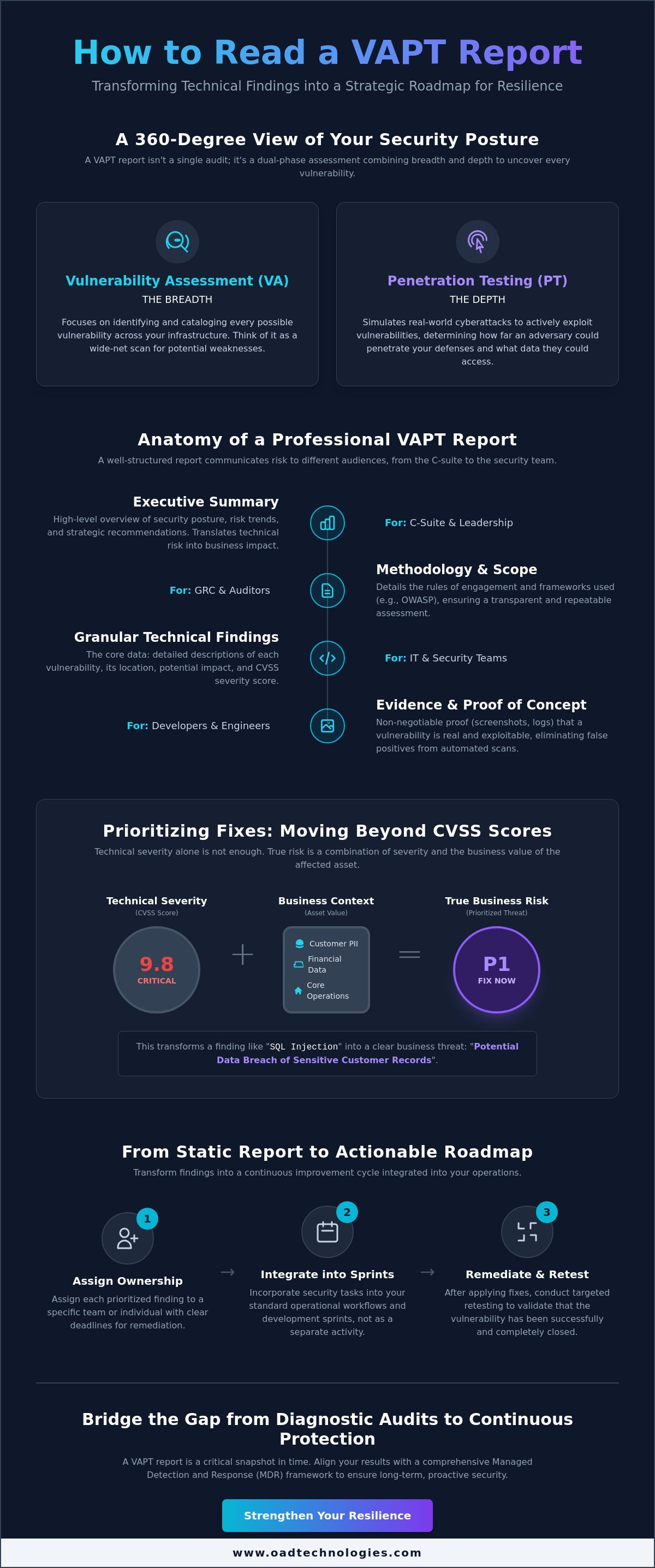
A VAPT report isn't just a technical summary; it's a dual-phase security audit designed to provide a 360-degree view of your digital vulnerabilities. Vulnerability Assessment (VA) focuses on breadth, identifying every possible entry point across your infrastructure. Penetration Testing (PT) provides the depth, simulating real-world attacks to see how far an adversary could actually penetrate your defenses. For UAE enterprises, understanding the penetration testing process is essential because the final report serves as the primary deliverable for board-level stakeholders and regulatory auditors alike.
As you learn how to read a vapt report, you'll see it acts as a critical bridge between technical discovery and strategic defense. This document is the cornerstone of achieving national cybersecurity compliance, specifically meeting the rigorous standards set by the Information Assurance Regulation (ISR) and the Personal Data Protection Law (PDPL). It transforms abstract threats into a concrete action plan that supports long-term business resilience.
Why Technical Findings are Business Risks
Security vulnerabilities often hide behind complex terminology that masks their true impact. A finding labeled as "SQL Injection" might seem like a minor coding error to a non-technical manager. However, a professional guide on how to read a vapt report translates this into "Potential Data Breach of Sensitive Customer Records," which immediately signals a threat to business continuity. These reports provide the empirical evidence required for Governance, Risk, and Compliance (GRC) audits. They prove that your organization isn't just guessing at security but is actively managing its digital trust and protecting its brand reputation in a competitive market.
The Difference Between a Scan and a Professional Report
Raw outputs from automated scanners don't qualify as professional reports. While tools are efficient at spotting known signatures, they lack the human-in-the-loop expertise required to identify complex logic flaws that a sophisticated attacker would exploit. A professional report includes manual analysis that filters out false positives and adds the context necessary for effective remediation. For a deeper look at these methodologies, check out our Vulnerability Assessment and Penetration Testing (VAPT): A Strategic Enterprise Guide for 2026. This distinction ensures your team isn't chasing ghosts, but rather focusing on high-impact vulnerabilities that actually threaten your operations.
The Anatomy of a Professional VAPT Report
A professional VAPT report serves as the definitive architecture of your security assessment. It isn't a monolithic block of text but a carefully layered document designed to communicate risk across different organizational levels. Understanding the internal structure is the first step in mastering how to read a vapt report effectively. By examining the key components of a report, you can ensure that the testing results translate into meaningful action rather than gathering digital dust. Beyond the high-level summaries, the document must include granular Technical Findings for your IT and security teams. This section should provide Evidence and Proof of Concept (PoC), including screenshots and logs that prove a vulnerability is exploitable. These proofs are non-negotiable because they eliminate the guesswork and false positives often found in automated scans.
Understanding the Executive Summary
The Executive Summary isn't just a simplified version for non-technical leadership. It's a strategic tool that provides a 10,000-foot view of your organizational security posture. When reviewing this section, look for risk score trends that show how your defenses have evolved since the last audit. A high-quality summary moves beyond simple vulnerability counts to provide a 'Security Maturity' assessment. It offers strategic recommendations that address root causes, such as systemic configuration issues or architectural weaknesses, rather than just suggesting immediate technical patches. This perspective allows the C-suite to align security investments with actual business risk.
Evaluating the Methodology Section
Many reports fail to transparently document the methodology used, which is a significant gap in many standard assessments. A professional report must prove it followed international standards like OWASP for web applications or OSSTMM for operational security. This section should clearly identify whether the team used 'Black Box' testing, where the tester has no prior knowledge of the system, or 'White Box' testing, which involves full disclosure of the environment. One of the most critical parts of how to read a vapt report involves verifying the scope. You must know exactly which assets were tested and which were excluded to understand your remaining blind spots. This transparency is critical for maintaining robust Governance Risk and Compliance (GRC) frameworks. If your current reporting feels incomplete, you may need to evaluate a more structured security partnership to ensure your data remains protected.
Prioritizing Findings: Moving Beyond CVSS Scores
The Common Vulnerability Scoring System (CVSS) provides a vital baseline for assessing risk, utilizing a 1-10 scale to rank technical severity. However, a high score doesn't always equate to a high priority for your specific enterprise. Mastering how to read a vapt report involves understanding that these scores measure the intrinsic qualities of a vulnerability, not the specific risk to your business operations. To gain a complete perspective, it helps to consult external benchmarks on how to read a vulnerability assessment report to see how standard metrics translate into actionable intelligence.
This creates a 'Context Gap' that savvy security leaders must bridge. A 'High' finding on a public-facing gateway demands immediate attention over a 'Critical' finding found on an isolated, non-routable development server. You should categorize findings by the ease of exploitation alongside the potential impact on business continuity. This approach allows you to identify 'Quick Wins.' These are low-effort remediations that significantly reduce your attack surface without requiring massive infrastructure changes or prolonged downtime.
The Role of Compensating Controls
Compensating controls are your primary defense when a direct technical patch isn't feasible or could disrupt critical services. For instance, robust Identity and Access Management (IAM) can neutralize the risk of a credential-related vulnerability even if the underlying software remains unpatched. In some cases, you may choose 'Risk Acceptance' for findings where the cost of remediation outweighs the potential business impact. It's vital that you document these decisions clearly to satisfy Governance, Risk, and Compliance (GRC) requirements during your next audit.
Risk-Based Prioritization Framework
A risk-based framework uses a 2x2 matrix to plot the probability of an attack against its business impact. Don't dismiss 'Informational' findings too quickly. Attackers often use a technique called 'chaining' to link several low-level issues into a single, high-impact exploit. Your internal roadmap for how to read a vapt report should conclude with realistic remediation timelines. We recommend structuring these in 30, 60, and 90-day windows based on the refined risk profile of each asset, ensuring your team isn't overwhelmed by technical debt.
Operationalizing the Report: From Remediation to Retesting
Transforming a static document into a dynamic security improvement plan requires more than just technical skill; it demands a structured operational workflow. Once you've mastered how to read a vapt report and prioritized your findings, the next phase involves assigning clear ownership. Every vulnerability needs a designated stakeholder, whether it's a database administrator for SQL issues or a cloud architect for misconfigured buckets. This accountability ensures that findings don't linger in a backlog but are integrated directly into your dev/ops sprint cycles through a formal Remediation Roadmap.
Retesting is the only way to formally close the loop and update your organizational risk register. It provides the empirical proof that your remediation efforts were successful and didn't introduce new instabilities. Beyond the immediate fixes, you should use these discovered attack vectors to refine your Incident Response plan. If a penetration test successfully bypassed a specific control, your response team now has a blueprint to harden that area against real-world adversaries. This proactive approach turns every audit into a catalyst for long-term digital evolution.
Collaborating Across Technical and Management Teams
Effective remediation relies on bridging the gap between the security auditor and the system administrator. These teams often have competing priorities, but a well-structured VAPT report serves as a neutral ground for collaboration. You can use these findings to build a business case for more advanced tools, such as SIEM and EDR solutions, by demonstrating where manual controls are failing. When you encounter potential 'False Positives,' approach the auditor with technical evidence. A professional dialogue here ensures the final risk profile is accurate and grounded in your specific architectural reality.
Verification and Compliance Reporting
For UAE enterprises, the final deliverable isn't the initial list of bugs, but the 'Clean' report generated after successful retesting. This document is what you present to external auditors to prove compliance with the UAE Personal Data Protection Law (PDPL). Every finding should map directly to specific regulatory requirements, showing that your data protection measures are both active and verified. Ensuring these VAPT results are reflected in your enterprise GRC dashboard provides leadership with a real-time view of compliance status. If you need a partner to help you navigate these complex regulatory waters, book a strategic VAPT consultation to secure your organizational future.
Closing the Resilience Gap with OAD Technologies
VAPT isn't an isolated event; it's the diagnostic baseline for a sophisticated defense strategy. While knowing how to read a vapt report allows you to fix current vulnerabilities, it doesn't protect you from the threats that emerge the day after the audit concludes. This is why we position VAPT as the critical first step in a broader Managed Detection and Response (MDR) framework. By understanding your weaknesses through a diagnostic lens, you can calibrate your MDR sensors to monitor the specific entry points attackers are most likely to exploit in the future.
OAD Technologies moves beyond standardized checklists. We provide tailored security assessments that reflect the unique UAE threat landscape. Instead of relying on periodic, point-in-time audits, we help enterprises transition toward Continuous Security Posture Management. This ensures your defenses evolve alongside changing software architectures and emerging attack vectors. Our deep Governance, Risk, and Compliance (GRC) expertise ensures that every finding in your report is mapped to national regulatory standards like the ISR, providing a clear path to certification and legal compliance.
Integrating VAPT with Data Loss Prevention (DLP)
A professional VAPT assessment does more than find bugs; it identifies the potential exfiltration paths for your most sensitive corporate data. By understanding how to read a vapt report through the lens of data privacy, you can align your remediation efforts with your Data Loss Prevention (DLP) policy. If a penetration test reveals a weak network segment or a misconfigured cloud bucket, your DLP strategy must prioritize monitoring that path to prevent brand-damaging leaks. This synergy between vulnerability discovery and data protection creates a hardened infrastructure that safeguards both technical assets and intellectual property.
Your Partner in National Cybersecurity Excellence
OAD Technologies acts as a strategic integrator, not just another third-party vendor. We leverage our UAE-based expertise to provide localized threat intelligence that global providers often overlook. We understand the specific pressures of the local market, from the nuances of PDPL compliance to the high-stakes digital evolution occurring across the Emirates. Our team acts as an extension of your own, ensuring that technical findings lead to practical business results and investment returns. Contact OAD Technologies today for a comprehensive VAPT assessment that speaks your business language and secures your long-term digital relevance in an ever-changing market.
Transforming Vulnerability into Strategic Resilience
Mastering how to read a vapt report shifts your perspective from seeing a document as a list of technical failures to viewing it as a strategic roadmap for business continuity. You've learned that true security depends on prioritizing findings within your specific operational context and closing the loop through rigorous retesting. By aligning technical remediation with broader business goals, you don't just patch systems. You build a foundation for long-term digital trust and regulatory compliance across the UAE.
OAD Technologies stands as your strategic partner in this evolution. As Dubai-based cybersecurity experts, we specialize in GRC and UAE regulatory alignment. This ensures your security posture meets every national standard. We provide more than just a report; we offer end-to-end remediation support through our integrated MDR and SIEM solutions. Secure your infrastructure with OAD Technologies' comprehensive VAPT services today. Your journey toward a more resilient future starts with a single, data-driven decision.
Frequently Asked Questions
What is the difference between a vulnerability scan and a VAPT report?
A vulnerability scan is an automated process that identifies known security flaws, while a VAPT report includes manual exploitation to prove how those flaws could be weaponized. Scans provide breadth across your network, but they often lack the depth and context provided by human testers. A professional report filters out noise to focus on validated risks that actually impact your business.
How often should my organization conduct a VAPT in 2026?
Organizations should conduct a VAPT at least once a year or whenever significant changes occur in their digital infrastructure. In 2026, the rapid pace of software updates and shifting threat landscapes makes annual testing a baseline. High-risk sectors often choose quarterly assessments to maintain continuous visibility into their security posture and meet evolving regulatory expectations in the UAE.
What should I do if my VAPT report shows 100+ critical vulnerabilities?
You should prioritize these findings by mapping them against your most critical business assets rather than attempting to fix everything at once. Focus on vulnerabilities that reside on public-facing servers or contain sensitive data. This strategic approach ensures your team addresses the highest risks first, preventing operational paralysis and focusing resources where they offer the most protection for your bottom line.
Is a VAPT report mandatory for UAE PDPL compliance?
The UAE PDPL requires organizations to implement appropriate technical and organizational measures to protect personal data. While the law doesn't explicitly use the term VAPT, regular security assessments are the industry standard for demonstrating compliance with these data protection mandates. A professional report serves as essential evidence that you are actively managing risks to personal information and maintaining digital trust.
Can I share my full VAPT report with third-party vendors and partners?
You should generally share only the Executive Summary or a redacted attestation report with third-party partners. Providing the full technical breakdown exposes your internal architecture and specific weaknesses to external entities. If a vendor requires proof of security, a high-level summary that confirms the assessment took place and that critical issues were remediated is usually sufficient for most compliance needs.
What is a 'False Positive' in a VAPT report and how should it be handled?
A false positive occurs when an automated tool incorrectly identifies a vulnerability that isn't actually present or isn't exploitable in your specific environment. When learning how to read a vapt report, you'll find that expert manual analysis is what removes these errors. Challenging these findings with your auditor ensures your remediation team doesn't waste time on non-existent threats or irrelevant data.
How long does it typically take to complete a full VAPT engagement?
A standard VAPT engagement typically spans two to four weeks depending on the complexity and size of the target environment. This timeline includes the initial reconnaissance, the active testing phase, and the final reporting period. Larger enterprises with diverse cloud and on-premise assets may require longer durations to ensure every segment is thoroughly assessed and validated against international standards.
Does a VAPT report cover cloud environments like AWS or Azure?
A modern VAPT report definitely covers cloud environments like AWS and Azure, focusing on configuration errors and identity vulnerabilities. Traditional network testing doesn't capture the unique risks associated with cloud service providers, such as misconfigured buckets or overly permissive IAM roles. Understanding how to read a vapt report for cloud assets is vital for maintaining a secure and compliant hybrid infrastructure.
Disclaimer
Content by OAD Technologies is for general informational purposes only and does not constitute professional or cybersecurity advice. No warranties are made regarding accuracy or completeness; reliance is at your own risk. OAD Technologies shall not be liable for any direct or indirect losses arising from use of this content.